
New York ICE Detention Law, What Changes at County Jails on November 25, 2026?
New York county jails have until November 25, 2026 to end agreements that let them house people detained solely for federal civil immigration violations. Attorney General Letitia James and Governor Kathy Hochul confirmed the deadline in guidance issued November 6.
Under the state’s Local Cops, Local Crimes Act (New York Executive Law § 170-k), counties, sheriffs, and covered detention facilities cannot keep contracts that provide jail space for certain U.S. Immigration and Customs Enforcement (ICE) detainees. After the deadline, prohibited agreements are void and unenforceable under New York law.
The law does not automatically release ICE detainees, stop federal immigration enforcement in New York, or close federally operated facilities such as the Buffalo Federal Detention Facility. Qualifying agreements to hold people facing federal criminal charges can also continue.
The deadline comes amid litigation. On November 4, a federal judge denied a request by 15 county sheriffs to temporarily block the law. The underlying constitutional dispute has not been resolved.
New York ICE Detention Law: Quick Facts
| Detail | Verified Information |
| Law | Local Cops, Local Crimes Act |
| Enacted | May 27, 2026 (signed by Governor Kathy Hochul) |
| Primary statute | New York Executive Law § 170-k |
| New AG guidance | November 6, 2026 |
| Detention-contract deadline | November 25, 2026 |
| Earlier 287(g) deadline | August 25, 2026 |
| Prohibited activity | Agreements to house people solely for federal civil immigration violations |
| Still permitted | Qualifying federal criminal detention, and compliance with judicial warrants and court orders |
| Automatic release of detainees? | No |
| State enforcement office | New York Attorney General’s Office of Immigrant Trust |
| Related lawsuit | Bourgault v. Hochul, No. 1:26-cv-01637 (N.D.N.Y.) |
| Latest court ruling | Preliminary injunction denied November 4, 2026 |
| Current status | Law remains enforceable; litigation continues |
What Changes at New York County Jails on November 25?
The deadline concerns contracts used to house people detained for civil immigration violations. Under Executive Law § 170-k(2)(a)(ii), covered agencies cannot enter into, renew, extend, modify, or remain in agreements that provide detention space for this purpose. These can include intergovernmental service agreements (IGSAs) under which federal immigration authorities pay county jails to hold people in ICE custody.
Section 170-k(7)(b) requires agencies with existing prohibited contracts to use their termination provisions within three months of the law’s effective date. After November 25, those agreements are void and unenforceable under state law.
What If a Contract Covers Both Civil and Criminal Detention?
The state does not necessarily require ending the whole agreement. The Attorney General’s November 6 guidance explains that a contract covering both federal criminal custody and civil immigration detention must have its prohibited civil-detention provisions terminated. A county can keep a qualifying arrangement to house people facing pending federal criminal charges if the agreement does not authorize detention solely for federal civil immigration violations.
Why Did New York Pass the Local Cops, Local Crimes Act?
The law reflects a dispute over whether state and local resources should support federal civil immigration enforcement. For years, ICE has used agreements with county governments to get detention space in local jails. These arrangements can bring revenue to counties and add to the federal government’s detention capacity.
Supporters argue that local police and jail resources should focus on state and local public safety instead of federal immigration detention. Governor Hochul and Attorney General James have also argued that limiting local involvement strengthens trust between immigrant communities and law enforcement.
Opponents, including several county sheriffs, argue that the restrictions interfere with established federal cooperation and local officials’ ability to make public-safety decisions.
These are competing policy and legal positions, and no court has issued a final ruling on every constitutional challenge.
Which County Jails Are Affected?
The law applies statewide, but its immediate impact depends on whether a county or covered facility has an agreement for federal civil immigration detention. In a May 21, 2026 announcement, State Senator Julia Salazar identified seven local jails with active ICE detention contracts at that time.
Jails Previously Identified as Having ICE Detention Contracts
| County | Facility Identified in May 2026 |
| Orange | Orange County Jail |
| Broome | Broome County Jail |
| Allegany | Allegany County Jail |
| Montgomery | Montgomery County Jail |
| Clinton | Clinton County Jail |
| Niagara | Niagara County Jail |
| Nassau | Nassau County Jail |
This is a historical list from May 2026, not a verified list of facilities still holding ICE detainees on November 16. Some counties may already have ended agreements or stopped housing detainees. An earlier contract does not prove an agreement is still active. The Attorney General’s advisory does not give a current facility-by-facility compliance list, and county officials have been asked to report their compliance steps or confirm they have no prohibited agreements.
Related article: New York Shield Law 2026, Can Another State Obtain Your Abortion or Medical Records?
Facilities the State Law Does Not Close
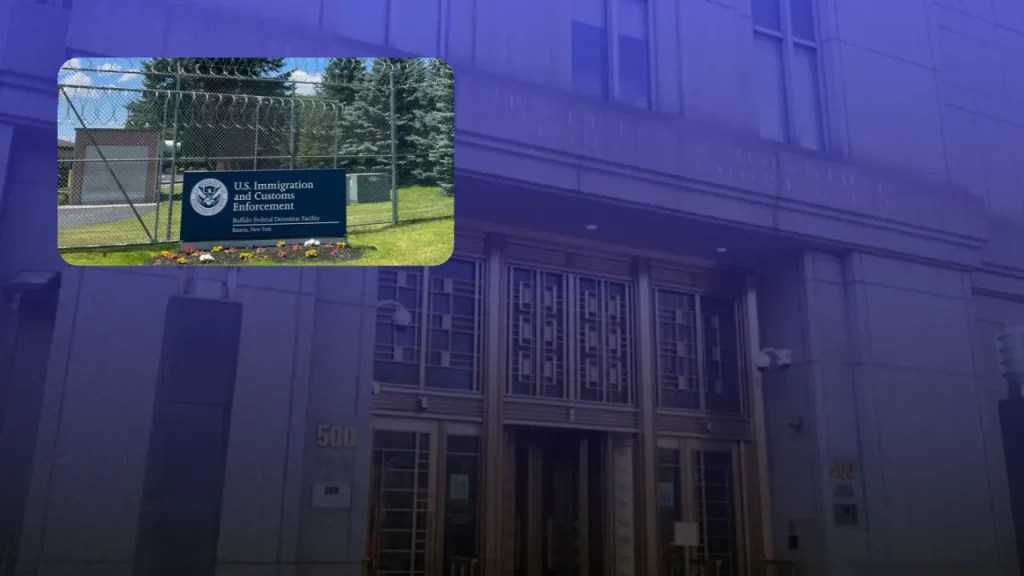
The Buffalo Federal Detention Facility in Batavia is a federally run facility, not a county jail. State law governs state and local entities, so the November 25 deadline does not close it or stop federal officials from operating federal detention centers.
Does the Law Apply to New York City?
Yes, the statewide restrictions apply to covered city agencies and detention arrangements. That does not mean every city jail has an active ICE civil detention contract. A facility’s obligations depend on its actual agreements and custody authority.
Related Reading on AllAboutLawyer.com
- New York Sheriffs Sue to Overturn ICE Cooperation Ban, Here’s What the Law Actually Does
- Trump Administration ICE Agreements With Local Police, What the 287(g) Surge Means for Americans
- ICE Detainee Locator Lawsuit, Four Legal Aid Groups Sue DHS Over Policy Hiding Detainees With Final Removal Orders
Will ICE Detainees Be Released on November 25?
Not automatically. This is the most important point for families. The law regulates state and local participation in federal civil immigration detention. It does not cancel federal removal proceedings or order ICE to release everyone held under an affected agreement.
When an agreement ends, ICE may arrange other lawful custody, including transferring people to a federally operated facility or another detention center. Whether a particular person is transferred, released, or held elsewhere depends on federal immigration law, custody authority, court orders, and individual circumstances. Federal detention authority includes:
- 8 U.S.C. § 1226: Arrest and detention while removal proceedings are pending
- 8 U.S.C. § 1231: Detention and removal after a removal order
- 8 U.S.C. § 1231(g): Federal authority over detention arrangements
Families should not assume November 25 is a release date.
Civil Immigration Detention vs. Criminal Custody
Immigration detention often involves administrative proceedings about whether a noncitizen may remain in the United States, and a person can be detained without a criminal conviction. Criminal custody involves a criminal charge, prosecution, or sentence. An immigration violation is not necessarily a crime. For example, civil removability and the federal crime of unlawful reentry under 8 U.S.C. § 1326 raise different legal questions.
| Situation | Effect of New York Law |
| Held solely under a prohibited ICE civil detention contract | Agreement must end |
| Awaiting trial on federal criminal charges | Qualifying detention agreement may continue |
| Held under a valid judicial warrant or court order | Compliance is not prohibited by § 170-k |
| Serving a state criminal sentence | Sentence not automatically canceled |
| Subject to an ICE administrative detainer | A detainer is not a judicial warrant; state-law restrictions remain relevant |
| Held directly by federal authorities | State contract ban does not remove federal custody authority |
Does New York’s Law Ban All Cooperation With Federal Authorities?
No. Executive Law § 170-k(6) preserves compliance with state or federal court orders, judicial warrants, and other actions required by law. The statute also has exceptions for certain healthcare services, care for children in federal refugee-related custody, and qualifying federal criminal detention agreements. Those exceptions do not make every voluntary immigration enforcement arrangement permitted. Other federal and state laws can independently limit what officials may do.
Judicial Warrant vs. ICE Administrative Warrant
A judicial warrant is issued by a court. An administrative immigration warrant (such as ICE Form I-200 or I-205) is issued within the federal immigration system, not by a judge. An ICE detainer generally asks another agency to notify ICE or hold a person under specified circumstances, and it is not a judicial warrant. New York courts have addressed this: in People ex rel. Wells v. DeMarco, 168 A.D.3d 31 (N.Y. App. Div. 2d Dep’t 2018), the court held that state law did not authorize local officers to detain someone solely on an ICE civil immigration detainer. The judicial-warrant exception in § 170-k should not be read as treating every ICE administrative document as a court order.
Why Are There Two Different ICE Deadlines in 2026?
The Local Cops, Local Crimes Act covers two related practices.
August 25, 2026: Section 287(g) agreements. Section 287(g), codified at 8 U.S.C. § 1357(g), lets designated local officers perform certain federal immigration functions through qualifying agreements. New York’s law restricted those arrangements and required existing ones to end by the earlier deadline.
November 25, 2026: Civil immigration detention contracts. This later deadline applies to agreements for housing people detained solely for federal civil immigration violations.
A county’s 287(g) agreement is not necessarily the same contract as its agreement to provide ICE detention beds.
What Happened in the New York Sheriffs’ Lawsuit?
Fifteen county sheriffs sued in federal court to challenge New York’s restrictions on immigration enforcement agreements. The case is Bourgault et al. v. Hochul et al., No. 1:26-cv-01637, in the U.S. District Court for the Northern District of New York. Rensselaer County Sheriff Kyle Bourgault is the lead plaintiff.
The sheriffs argue that the law violates the Supremacy Clause, Contracts Clause, Tenth Amendment, and New York Constitution. The state’s defenders point to anti-commandeering principles, the constitutional doctrine that the federal government cannot force states and localities to carry out federal regulatory programs.
November 4, 2026: Preliminary Injunction Denied
U.S. District Judge Mae A. D’Agostino denied the sheriffs’ request for a preliminary injunction on November 4. She found the plaintiffs had not shown a sufficient likelihood that they had the legal capacity to bring their constitutional claims against the state and its officials. The judge did not issue a final ruling that every challenged provision is constitutional. The lawsuit continues, but the denial means that request did not stop enforcement.
What Happens If a County Refuses to End Its Agreement?
The Attorney General’s Office of Immigrant Trust is responsible for investigating and enforcing the state requirements. Under Executive Law § 63-e, it can receive complaints, investigate, issue subpoenas, and bring civil enforcement actions. County officials may face legal scrutiny if they keep prohibited agreements after November 25.
The statute should not be described as automatically imposing a criminal conviction, a set fine, or a predetermined damages award on every noncompliant sheriff. Consequences depend on the conduct, the statutory authority used, and any resulting court proceedings.
How Can Families Locate Someone Transferred From a New York Jail?
Verify custody information instead of assuming someone has been released.
- Use the ICE Online Detainee Locator System (locator.ice.gov/odls).
- Search by A-Number and country of birth, or by exact name and other required details.
- Contact the relevant ICE Enforcement and Removal Operations field office if the search doesn’t give a reliable answer.
- Call the ICE Detention Reporting and Information Line at 1-888-351-4024.
- Tell the person’s immigration attorney about any known transfer.
- Keep documents showing the person’s prior detention location, A-Number, and pending proceedings.
The locator may not immediately reflect every custody change, and an unsuccessful search does not mean someone was deported, transferred, or released. Separate litigation challenges restrictions on detainee-location information.
How to Report a County Jail Violating the Law
Residents who believe a state or local agency is unlawfully taking part in federal civil immigration detention can submit information to the Attorney General’s Office of Immigrant Trust through its online complaint form (pcf.ag.ny.gov/form/OIT) or the Attorney General’s hotline at 1-800-771-7755. The complaint process does not start an individual lawsuit or provide a lawyer. People facing immediate detention, removal, or habeas deadlines should get individualized immigration-law help.
Key Dates
| Date | Milestone |
| May 21, 2026 | State Senator Salazar identifies seven county jails with ICE detention contracts |
| May 27, 2026 | Local Cops, Local Crimes Act enacted |
| August 25, 2026 | Deadline for ending Section 287(g) agreements |
| November 4, 2026 | Federal judge denies sheriffs’ preliminary injunction request |
| November 6, 2026 | AG James and Governor Hochul issue guidance on detention contracts |
| November 25, 2026 | Deadline for ending prohibited civil immigration detention contracts |
Frequently Asked Questions
Does the New York ICE detention ban take effect November 25?
The broader law is already in effect. November 25, 2026 is the deadline to end existing civil immigration detention agreements.
Will all ICE detainees be freed from New York county jails?
No. The law does not order blanket release, and ICE may make other lawful custody arrangements, including transfers.
Can ICE still arrest people in New York?
Yes. The state law does not remove ICE’s independent federal enforcement authority.
Can county jails still hold people charged with federal crimes?
Yes, if a qualifying detention agreement meets the statute’s requirements.
Does the deadline close the Buffalo Federal Detention Facility?
No. That facility is federally run, and state law governs state and local entities.
Are all New York county jails affected?
The law applies statewide, but the contract-termination duty matters for covered agencies that have prohibited agreements.
Did a federal judge block the law?
No. On November 4, Judge Mae A. D’Agostino denied a preliminary injunction sought by 15 sheriffs. The case remains pending.
Are 287(g) agreements and detention contracts the same thing?
No. Section 287(g) concerns delegated immigration enforcement functions. Detention contracts concern providing custody space. The law restricts both, with different deadlines.
Is there a class action settlement or compensation program?
No. The sheriffs’ lawsuit challenges the law and does not offer payments to detainees.
What Happens Next Before November 25?
Counties with prohibited agreements must finish the termination process. The Attorney General’s Office has asked sheriffs and county executives to explain their compliance steps or confirm they have no prohibited agreements. The state may investigate unresolved arrangements while the federal litigation continues. For families, the practical question is whether a detained relative will stay at the same facility, be moved, or become eligible for release under federal law, and that needs individual custody information.
Bottom line: New York is ending local jail agreements for federal civil immigration detention by November 25, 2026. The deadline does not end ICE enforcement, cancel federal criminal detention arrangements, close federal facilities, or guarantee the release of current detainees. Counties must comply with the statute unless a court order changes their obligations.
Disclaimer: AllAboutLawyer.com publishes independent legal news and general information, not individualized legal advice. Immigration detention, release, transfer, and removal decisions depend on federal law, court orders, and individual circumstances.
Researched by AllAboutLawyer.com, Legal Content Research. Last updated: November 16, 2026.
Sources
- New York Attorney General, November 6, 2026 announcement on immigration detention contracts: https://ag.ny.gov/press-release/2026/attorney-general-james-and-governor-hochul-notify-local-officials-obligation-end
- Attorney General’s guidance letter to sheriffs and county leaders (PDF): https://ag.ny.gov/sites/default/files/letters/guidance-on-immigration-detention-contracts-letter-2026.pdf
- New York Executive Law § 170-k: https://www.nysenate.gov/legislation/laws/EXC/170-K
- New York Executive Law § 63-e: https://www.nysenate.gov/legislation/laws/EXC/63-E
- New York State Senate, Dignity Not Detention announcement (May 21, 2026): https://www.nysenate.gov/newsroom/press-releases/2026/julia-salazar/dignity-not-detention-included-budget-bans-new-york
- Bourgault v. Hochul, order of November 4, 2026 (PDF): https://cases.justia.com/federal/district-courts/new-york/nyndce/1%3A2026cv01637/155616/23/0.pdf
- ICE Online Detainee Locator System: https://locator.ice.gov/odls/
- New York Attorney General, Office of Immigrant Trust complaint form: https://pcf.ag.ny.gov/form/OIT
- People ex rel. Wells v. DeMarco, 168 A.D.3d 31 (N.Y. App. Div. 2d Dep’t 2018); 8 U.S.C. §§ 1226, 1231, 1326, 1357(g)
About the Author
Israr Ahmad is a legal content researcher with 4+ years of experience covering class action settlements and consumer rights cases. He has researched and published coverage of 2,500+ settlements using verified court records, settlement administrator filings, and government sources. Learn more about Israr.