
Is Kratom Legal in Wisconsin? 2026 Schedule I Ban, Criminal Penalties, 7-OH Rules and Legalization Updates
No. Kratom is illegal in Wisconsin as of November 16, 2026. State law lists two kratom alkaloids, mitragynine and 7-hydroxymitragynine (7-OH), as Schedule I controlled substances. Possessing, selling, manufacturing, or distributing kratom products can lead to criminal charges anywhere in the state, including Milwaukee, Madison, Green Bay, Kenosha, Racine, and Eau Claire.
Simple possession is generally a misdemeanor, while selling or distributing kratom can be a Class H felony. Wisconsin’s ban has been in effect since April 25, 2014. Lawmakers have considered replacing it with a regulated market, but those bills failed, and no enacted measure lifting the ban was identified for 2026.
Ordinary kratom leaf is not generally scheduled under federal law. That does not make it legal in Wisconsin, where the state’s own controlled-substance law applies independently.
Wisconsin Kratom Law 2026: Quick Facts
| Question | Current Wisconsin law |
| Is kratom legal? | No |
| Controlled substance status | Schedule I (mitragynine and 7-OH) |
| Main statute | Wis. Stat. § 961.14(7)(mk)–(mL) |
| Is possession legal? | No, generally a crime |
| Are retail sales legal? | No |
| Can adults 21+ buy kratom? | No age-based exception |
| Is 7-OH legal? | No |
| Simple possession (first offense) | Generally a misdemeanor: up to $500 and/or 30 days in jail |
| Repeat drug offenses | Penalties can escalate. Consult an attorney |
| Selling, delivering, or possessing with intent | Generally a Class H felony: up to 6 years and/or $10,000 |
| Online orders shipped to Wisconsin | Do not make possession legal |
| Buying legally in a neighboring state | No defense once you bring it into Wisconsin |
| Ban effective since | April 25, 2014 (2013 Wisconsin Act 351) |
| Legalization enacted in 2026? | No |
| Federal status of ordinary kratom leaf | Not generally scheduled |
| Last reviewed | November 16, 2026 |
Why Is Kratom Illegal in Wisconsin?
Wisconsin regulates kratom through its Uniform Controlled Substances Act, Chapter 961 of the Wisconsin Statutes. Section 961.14(7)(mk)–(mL) lists both mitragynine and 7-hydroxymitragynine as Schedule I substances, which Wisconsin defines as having high abuse potential and no accepted medical use in treatment.
Mitragynine is the main alkaloid in the leaves of Mitragyna speciosa, the plant known as kratom. 7-OH occurs naturally in much smaller amounts but is sometimes concentrated in commercial products.
Does Wisconsin Ban the Plant or Only Its Chemicals?
The statute names the alkaloids rather than the botanical name. In practice, that distinction does not make ordinary kratom lawful. Because kratom leaf naturally contains mitragynine, leaf, powder, capsules, tea, extracts, and shots generally fall within the prohibition. The law has no exception for products described as natural, organic, or low-potency.
When Did Wisconsin Ban Kratom?
The alkaloids were added to Schedule I by 2013 Wisconsin Act 351, effective April 25, 2014. The ban long predates the recent national debate over concentrated 7-OH products. No new Wisconsin ban was needed in 2025 or 2026, and national headlines about kratom regulation should not be confused with a change to Wisconsin law.
What Is the Penalty for Possessing Kratom in Wisconsin?
Possession is governed by Wis. Stat. § 961.41(3g). Kratom’s alkaloids are not named among the specially treated drugs in that section, so ordinary possession generally falls under the “other drugs” provision and is a misdemeanor punishable under § 939.61.
| Offense | General penalty |
| Simple possession (first offense) | Misdemeanor |
| Maximum fine | $500 |
| Maximum jail time | 30 days |
| Fine and jail together | Possible |
| Possession with intent to deliver | Generally Class H felony |
| Manufacturing, distributing, or delivering | Generally Class H felony |
These are statutory maximums, not mandatory sentences. A prior drug conviction, additional charges, or location-based enhancements, such as an offense near a school, can change the outcome. Anyone charged should have a licensed Wisconsin criminal-defense attorney review the exact statute and facts.
Is Kratom Possession a Felony in Wisconsin?
Simple first-offense possession is generally a misdemeanor, not automatically a felony. Schedule I status does not mean every offense carries the same penalty. Wisconsin punishes possession and commercial activity separately, and prosecutors alleging distribution must prove the elements of that offense rather than treating possession as proof of a sale.
Can You Go to Prison for Selling Kratom in Wisconsin?
Yes. Manufacturing, distributing, or delivering a Schedule I nonnarcotic substance, or possessing it with intent to do so, is generally a Class H felony under Wis. Stat. § 961.41. Under § 939.50, a Class H felony carries up to six years of imprisonment, a fine of up to $10,000, or both. Quantity, packaging, sales records, and communications can all be used as evidence of intent to distribute. A smoke shop, gas station, or online seller faces far greater exposure than a person charged only with possession.
Is 7-OH Legal in Wisconsin?
No. Wisconsin lists 7-hydroxymitragynine in Schedule I independently of its listing for mitragynine. 7-OH products, sometimes sold as tablets, gummies, shots, or extracts, are prohibited whether the compound is natural or artificially concentrated. Wisconsin sets no percentage or milligram exemption, unlike proposals and laws in some other states that regulate products by potency.
Related article: Is Kratom Legal in Colorado? 2026 Age Limits, Daniel Bregger Act, 7-OH Ban and Local Laws
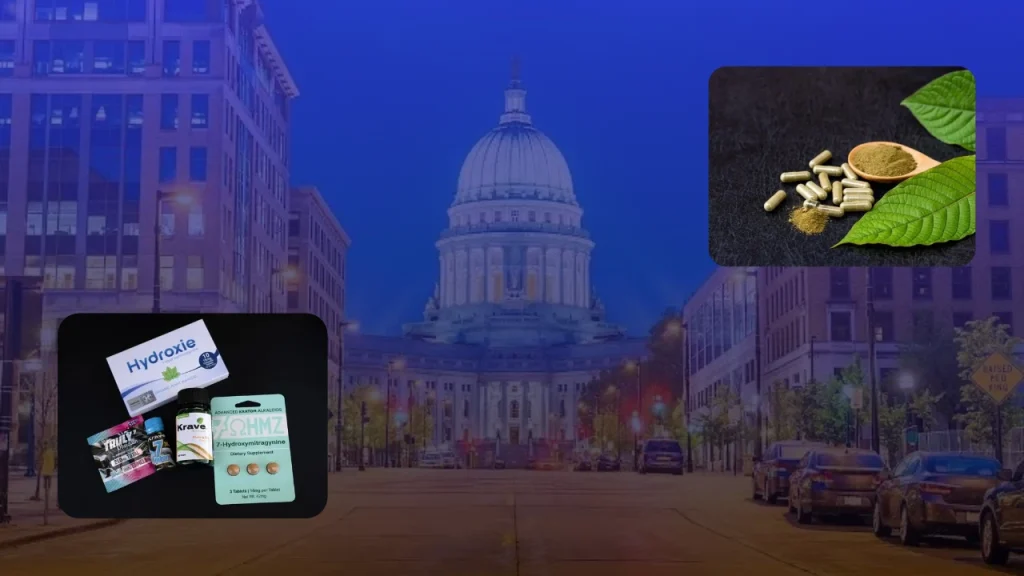
Is Kratom Legal in Milwaukee, Madison or Green Bay?
No. The statewide controlled-substance law applies in every Wisconsin city and county, and no local ordinance is needed for it to apply. Enforcement priorities may differ locally, but that does not remove the legal restriction.
| Location | Kratom legality |
| Milwaukee | Illegal |
| Madison | Illegal |
| Green Bay | Illegal |
| Kenosha | Illegal |
| Racine | Illegal |
| Eau Claire | Illegal |
| Waukesha | Illegal |
| Appleton | Illegal |
| La Crosse | Illegal |
| Janesville | Illegal |
Can You Order Kratom Online and Have It Shipped to Wisconsin?
A seller in another state accepting your order does not exempt you from Wisconsin law. A product marketed as a dietary supplement does not override a state controlled-substance classification either. Do not assume that buying kratom online makes possession legal in Wisconsin. Both the shipper and the recipient may face legal exposure.
Can You Bring Kratom Into Wisconsin From Another State?
No. Wisconsin is surrounded by states where ordinary kratom is generally legal under statewide frameworks, including Illinois, Iowa, Michigan, and Minnesota, though their age and product rules differ. Legal purchase there provides no defense in Wisconsin. Once kratom crosses the state line in your vehicle or luggage, you may be exposed to arrest and prosecution under Wisconsin law. Interstate highways and state routes near the border are routinely patrolled for drug offenses.
| State | General status of ordinary kratom |
| Wisconsin | Prohibited |
| Illinois | Generally permitted, with regulation and some local bans |
| Iowa | Generally permitted |
| Michigan | Generally permitted |
| Minnesota | Generally permitted, with regulation |
Is Kratom Legal Under Federal Law?
Ordinary kratom is not generally scheduled under the federal Controlled Substances Act. However:
- In August 2026, the DEA temporarily scheduled three named semisynthetic compounds: mitragynine pseudoindoxyl (MGPI), MGM-15, and MGM-16.
- On October 14, 2026, the DEA published a notice of intent concerning certain concentrations of 7-OH and mitragynine pseudoindoxyl. A notice of intent is not a final scheduling order.
Why Doesn’t Federal Legality Make Kratom Legal in Wisconsin?
States may impose controlled-substance restrictions that differ from federal law. Wisconsin independently lists mitragynine and 7-OH in Schedule I, so the lack of a broad federal ban does not stop state authorities from enforcing state law.
Has Wisconsin Tried to Legalize Kratom?
Yes. Lawmakers have proposed replacing the ban with a regulated market, most recently through 2023 Assembly Bill 393 and 2023 Senate Bill 445. The proposals would have removed mitragynine and 7-OH from Schedule I and instead required:
- Protection against contamination and adulteration
- Disclosure of mitragynine and 7-OH content
- Limits on synthetic alkaloids and 7-OH concentration
- A minimum purchase age of 21
Both bills failed when the 2023–2024 session ended on April 15, 2024. The Wisconsin Controlled Substances Board had recommended keeping kratom controlled, and medical and public-health groups raised concerns about dependence, toxicity, and limited evidence of safety. Advocates argued that regulated labeling and purity standards would be better than prohibition.
Is There a Wisconsin Kratom Legalization Bill in 2026?
No enacted measure was identified in the 2025–2026 session. Some websites still describe AB 393 or SB 445 as pending, but they were introduced in the prior session and failed. Wisconsin Statute § 961.14 remains the controlling law as of November 16, 2026. Watch for an actual Wisconsin bill removing kratom’s alkaloids from Schedule I, not national headlines about federal scheduling.
Can You Drive After Using Kratom in Wisconsin?
Wisconsin prohibits operating a vehicle while impaired by drugs (Wis. Stat. § 346.63) and has a restricted-controlled-substance provision based on detectable amounts of certain substances in a driver’s blood. Schedule I substances other than THC generally fall within that definition. Because mitragynine and 7-OH are listed in Schedule I, their presence may raise operating-while-intoxicated issues. Outcomes depend on testing, evidence, and circumstances.
Does Wisconsin’s Good Samaritan Law Protect Someone Calling for Help?
Wis. Stat. § 961.443 provides limited immunity from certain possession-related prosecutions for qualifying people who seek emergency help for someone experiencing an overdose or adverse drug reaction. It has specific requirements and does not provide blanket immunity for distribution or unrelated charges.
If someone is unresponsive, has trouble breathing, or shows signs of a serious reaction, call 911 immediately. Fear of legal consequences should never delay emergency care.
Is Kratom Safe Because It Comes From a Plant?
No. Kratom contains psychoactive alkaloids that act on receptors involved in pain and reward. The FDA has not approved kratom to treat pain, anxiety, opioid withdrawal, or any other condition. Federal health agencies have identified concerns including dependence, withdrawal, seizures, liver problems, and dangerous interactions with other substances. Risks can differ between ordinary leaf and concentrated extracts.
Wisconsin’s prohibition is a legal classification, not a substitute for individual medical advice. Anyone struggling with kratom dependence should speak with a healthcare provider.
Can Kratom Products Lead to Consumer Lawsuits?
Potentially. Separate lawsuits elsewhere have alleged misleading marketing and inadequate warnings for kratom-containing products. Those cases are unrelated to Wisconsin’s statutory ban and do not create a general settlement for Wisconsin residents.
Wisconsin Kratom Law Timeline
| Date | Development |
| 2013 | Legislature adopts 2013 Wisconsin Act 351 |
| April 25, 2014 | Kratom alkaloids added to Wisconsin Schedule I |
| 2021–2022 | Earlier legalization proposals fail |
| March 2023 | Controlled Substances Board recommends keeping kratom controlled |
| September 2023 | AB 393 and SB 445 introduced |
| April 15, 2024 | Both bills fail |
| August 2026 | DEA temporarily schedules three semisynthetic compounds federally |
| October 14, 2026 | DEA publishes proposed action on concentrated 7-OH and MGPI |
| November 16, 2026 | Wisconsin’s statewide kratom prohibition remains in effect |
Frequently Asked Questions
Is kratom legal in Wisconsin in 2026?
No. Wisconsin lists mitragynine and 7-hydroxymitragynine as Schedule I controlled substances, making kratom products generally illegal to possess or sell.
Can adults over 21 buy kratom in Wisconsin?
No. There is no regulated 21-and-older market. The ban applies regardless of age.
Is kratom a felony in Wisconsin?
Simple first-offense possession is generally a misdemeanor. Manufacturing, distributing, delivering, or possessing with intent to distribute can be a felony.
How much is the fine for possessing kratom?
The ordinary misdemeanor provision allows a fine of up to $500, up to 30 days in jail, or both.
Can you buy kratom at Wisconsin gas stations or smoke shops?
Kratom containing mitragynine or 7-OH is prohibited. Shelf availability does not make a sale lawful.
Is 7-OH legal in Wisconsin?
No. Wisconsin lists 7-hydroxymitragynine in Schedule I.
Can kratom be shipped to Wisconsin?
A shipment from another state does not override Wisconsin law. Possession may still violate state law.
Can I bring kratom from Illinois, Minnesota, Michigan or Iowa?
No. Out-of-state legality is not a defense in Wisconsin.
Did Wisconsin legalize kratom in 2026?
No. Earlier bills failed, and no enacted 2026 measure was identified.
Is kratom legal in Milwaukee or Madison?
No. The statewide prohibition applies to both.
Why is kratom federally unscheduled but illegal in Wisconsin?
Federal and state controlled-substance laws operate separately, and Wisconsin may enforce its own restrictions.
Is CBD legal in Wisconsin even though kratom is banned?
Hemp-derived CBD within the legal THC limit is treated differently under Wisconsin’s hemp laws. Kratom’s alkaloids remain scheduled with no exception.
Final Takeaway: Is Kratom Legal in Wisconsin?
Kratom is illegal throughout Wisconsin as of November 16, 2026. The state lists mitragynine and 7-hydroxymitragynine in Schedule I. First-offense possession is generally a misdemeanor, while manufacturing or distribution can be a Class H felony. The ban reaches ordinary kratom leaf, not just concentrated 7-OH products.
Legalization bills failed, and no enacted change was identified. Do not assume kratom is allowed because it is sold in neighboring states or is not broadly scheduled under federal law.
Disclaimer: This article provides general legal information, not individualized legal or medical advice. Criminal charges and penalties depend on the facts, applicable laws, and available defenses. Anyone facing a Wisconsin controlled-substance charge should consult a licensed criminal-defense attorney.
Last reviewed: November 16, 2026.
Sources
- Wisconsin Legislature, Chapter 961, Uniform Controlled Substances Act: https://docs.legis.wisconsin.gov/statutes/statutes/961
- Wisconsin Statute § 961.14, Schedule I: https://law.justia.com/codes/wisconsin/chapter-961/section-961-14/
- Wisconsin Statute § 961.41, Possession, Distribution and Penalties: https://law.justia.com/codes/wisconsin/chapter-961/section-961-41/
- Wisconsin Statute § 939.61, Misdemeanor Penalties: https://law.justia.com/codes/wisconsin/chapter-939/section-939-61/
- Wisconsin Statute § 939.50, Felony Classification and Penalties: https://law.justia.com/codes/wisconsin/chapter-939/section-939-50/
- Wisconsin Statute § 961.443, Emergency Assistance and Limited Immunity: https://law.justia.com/codes/wisconsin/chapter-961/section-961-443/
- Wisconsin Statute § 346.63, Operating Under the Influence: https://law.justia.com/codes/wisconsin/chapter-346/section-346-63/
- 2013 Wisconsin Act 351 (kratom alkaloids added to Schedule I)
- Wisconsin Assembly Bill 393 (2023): https://legiscan.com/WI/text/AB393/id/2839671/Wisconsin-2023-AB393-Introduced.pdf
- Wisconsin Senate Bill 445 (2023): https://legiscan.com/WI/bill/SB445/2023
- Wisconsin Department of Justice, Controlled Substances: https://www.wisdoj.gov/Pages/CriminalJusticeServices/controlled-substances.aspx
- DEA, Kratom Drug and Chemical Information: https://www.deadiversion.usdoj.gov/drug_chem_info/kratom.pdf
- Wisconsin Court System, Uniform Misdemeanor Bail and Penalty Schedule: https://www.wicourts.gov/publications/fees/docs/updatedbondsched26.pdf
About the Author
Israr Ahmad is a legal content researcher with 4+ years of experience covering class action settlements and consumer rights cases. He has researched and published coverage of 2,500+ settlements using verified court records, settlement administrator filings, and government sources. Learn more about Israr.