
Trump Administration ICE Agreements With Local Police, What the 287(g) Surge Means for Americans
Immigration enforcement in the United States increasingly runs through local police departments and county sheriff’s offices, not just federal agents. A report published by NPR on October 28, 2026, says the number of state and local officers working with U.S. Immigration and Customs Enforcement (ICE) has roughly doubled in eight months as the Trump administration expands a federal program known as 287(g).
Direct takeaway for readers: Signing a 287(g) agreement does not turn every local officer into an immigration agent. But in areas with a Task Force agreement, designated officers can carry out limited immigration functions during ordinary policing. Your rights during a stop still apply, and the details of each local agreement matter.
Quick Facts: 287(g) Agreements With Local Police
| Detail | Verified information |
| Federal agency | U.S. Immigration and Customs Enforcement (ICE) |
| Governing law | Section 287(g) of the Immigration and Nationality Act, 8 U.S.C. § 1357(g) |
| Created by Congress | 1996 |
| Latest ICE count | 2,698 signed agreements as of October 21, 2026 |
| Coverage | 38 states and two U.S. territories |
| Officers deputized | More than 29,000 between January 2025 and October 2026 (FWD.us analysis reported by NPR) |
| Immigration arrests through the program | More than 47,000 between January 2025 and August 2026 (same analysis) |
| Largest model | Task Force Model, 1,942 agreements |
| Policy driver | Executive Order 14159, signed January 20, 2025 |
| Federal reimbursement fund | Up to $3.5 billion under 34 U.S.C. § 61101 |
| Legal status | Program active; state restrictions and specific agreements are being litigated |
What Is a 287(g) Agreement?
Congress added Section 287(g) to the Immigration and Nationality Act in 1996. Under 8 U.S.C. § 1357(g), ICE can sign a written agreement authorizing qualified state or local officers to perform specified immigration officer functions, such as investigation, apprehension or detention.
The statute requires that these officers:
- Receive adequate training in federal immigration enforcement.
- Know and follow federal law.
- Act under federal direction and supervision.
- Use only the powers and duties named in the written agreement.
- Act consistently with state and local law.
In practice, a sheriff’s office might screen people already in jail, while a police department under a Task Force agreement might have designated officers perform limited immigration functions during routine work.
Why Agreements Have Surged Under Trump
On January 20, 2025, President Trump signed Executive Order 14159, Protecting the American People Against Invasion. Section 11 directs the Department of Homeland Security, to the extent permitted by law and with state or local consent, to authorize qualified local officers to perform immigration functions under federal supervision.
The authority is not new. What changed is how aggressively it is being used. Trackers put the number of agreements at only about 130 to 135 at the start of 2025, compared with 2,698 in ICE’s October 2026 figures.
How many agreements exist?
| 287(g) model | Agreements reported by ICE (Oct. 21, 2026) | Coverage |
| Task Force Model | 1,942 | 32 states and two territories |
| Warrant Service Officer | 574 | 34 states |
| Jail Enforcement Model | 182 | 29 states and one territory |
| Total | 2,698 | 38 states and two territories |
These are agreements, not necessarily 2,698 separate agencies. One agency can hold more than one agreement. Independent trackers report lower counts (some list roughly 2,200 to 2,300) and different state totals because they use different methods and dates. This article uses ICE’s own figures.
How many officers and arrests?
FWD.us found more than 29,000 officers deputized between January 2025 and October 2026, compared with about 11,600 ICE deportation officers. That is a cumulative figure, not the number on duty at any moment. The same analysis counted more than 47,000 immigration arrests through the program by August 2026, with Florida and Texas accounting for about half.
In some states, participating officers made up most or a large share of immigration arrests in particular months: 77% in Wyoming (April 2026), about 60% in New Hampshire (June 2026) and close to half in Oklahoma (June 2026). Oklahoma’s Highway Patrol has also enrolled its troopers, extending enforcement to state highways. These are month-specific figures, not national averages.
What Local Police Can Do Under the Three Models
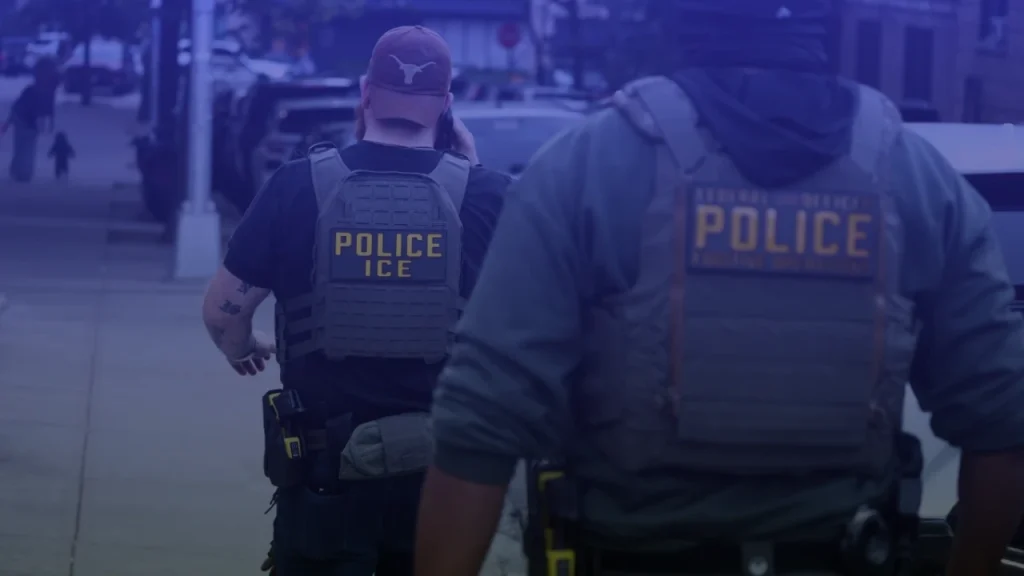
Task Force Model. Designated, trained officers can perform certain immigration functions during regular police work or alongside ICE. This is the model that most directly touches traffic stops and street-level encounters. It does not mean every stop becomes an immigration investigation.
Jail Enforcement Model. Officers identify and process people already in local or state custody who may be subject to immigration proceedings.
Warrant Service Officer Model. The narrowest model. Officers serve ICE administrative warrants on people already in the agency’s custody. An administrative immigration warrant is not a judge-issued criminal warrant.
Funding and Incentives
The One Big Beautiful Bill Act (July 2025) appropriated up to $3.5 billion for a Justice Department reimbursement fund under 34 U.S.C. § 61101. It can cover eligible state and local costs such as apprehension of certain people who are unlawfully present and have committed a crime, specified investigations and prosecutions, temporary detention and transportation. Funds are available through September 30, 2028.
That is a ceiling, not proof the money has been spent, and not an automatic payment to every participating agency. Some analysts estimate that $1.4 billion to $2 billion could reach local agencies through 287(g) in 2026 for compensation, equipment and performance-related payments. Treat that as an estimate. Reports also say training has been shortened in some cases, which is one reason oversight questions keep coming up.
Supporters say funding helps small departments take part. Critics say financial incentives can pull local resources toward federal priorities.
Legal Limits on 287(g) Agreements
Federal statute. Officers may act only within the written agreement, after training, under federal supervision.
Constitution. The Fourth Amendment and equal protection principles still apply. An agreement is not a substitute for the legal grounds needed for a specific stop, detention or arrest.
State and local law. Section 1357(g) says delegated functions must be consistent with state and local law, and this is now the main legal battleground. The Justice Department sued New York in June 2026 over state limits on ICE cooperation, and New York sheriffs separately challenged the state’s Local Cops, Local Crimes Act. Our explainer on the New York sheriffs’ lawsuit and what the law actually does covers that dispute in detail. A separate case over the Las Vegas Metropolitan Police Department’s agreement is on appeal to the Nevada Supreme Court, asking whether state law authorized the agreement and related detention practices. Related county-level fights over detainer requests are covered in DOJ Sues Washtenaw County Over ICE Policies.
None of these cases decides the legality of every agreement. Each depends on its own facts and state law.
A Small-Town Example: Spirit Lake, Idaho
The expansion is not limited to border states. On October 8, 2026, the Spirit Lake Police Department in northern Idaho signed a Task Force Model agreement, and training was underway by October 24. The chief said the department did not plan to go looking for undocumented immigrants and described the partnership as access to databases and cooperation. Reports did not show that officers had finished training or made arrests. Signing, training and using the authority are separate stages. The ACLU of Idaho’s roster, updated October 15, listed 16 Idaho agencies with agreements.
What It Means If You Live in a 287(g) Area
The effect depends on your local agency and the model it signed. Jail-based agreements mainly affect people booked into custody. Task Force agreements can link routine policing more directly to immigration enforcement. Participation is voluntary, and some localities continue to limit cooperation.
How to check your area: Look up your agency on ICE’s 287(g) participating-agency page, noting the model and the list date. Then check your city council, county commission or sheriff’s website for the actual memorandum of agreement, training details and local policies.
During a police encounter: Stay calm, do not physically resist, and do not give false information or documents. A traffic stop, a criminal arrest, an immigration detainer and a transfer to ICE custody are different legal events. If you are detained or facing an immigration issue, ask to speak with a qualified immigration attorney before signing anything. For background on how federal and local authority differ, see Do ICE Have the Same Rights as Police?
Supporters and Critics
The federal government and DHS describe 287(g) as a public-safety tool that helps identify people subject to immigration enforcement and multiplies enforcement capacity. Civil-rights groups, including the ACLU, raise concerns about racial profiling, blurred responsibility between agencies, strained local budgets and reduced trust between immigrant residents and police. These are policy arguments, not findings that any particular department acted unlawfully. The statistics show rapid growth but do not alone show whether the program improves public safety or increases constitutional violations.
What to Watch Next
- Whether ICE keeps adding agencies and officers.
- How reimbursement funds are distributed.
- Whether states restrict local participation, and how courts rule on those limits.
- Whether new data shows changes in arrests, detention and criminal case outcomes.
As of October 28, 2026, the program remains active and still expanding.
Frequently Asked Questions
What does a 287(g) agreement mean?
It is a written agreement under federal law that authorizes designated, trained state or local officers to perform specified immigration functions under federal supervision.
How many ICE agreements with local police exist?
ICE reported 2,698 as of October 21, 2026, covering 38 states and two territories. One agency may hold several agreements.
Can local police make immigration arrests?
Designated officers can exercise limited authority under their agreement and applicable law. The Task Force Model allows specified functions during routine duties. It does not let every officer make any immigration arrest at will.
Does every officer in a participating city have this authority?
No. Only specifically designated and trained personnel do, and only within the written agreement.
Did Trump create the 287(g) program?
No. Congress created it in 1996. The administration has directed broader use of it.
Can a state restrict local participation?
Because the statute requires consistency with state and local law, restrictions can matter. Courts are currently deciding how far they reach.
Are local police paid for working with ICE?
Some may qualify for reimbursement or other federal funding. Payment is not automatic.
Will everyone stopped by police face immigration screening?
No. It depends on the officer’s authority, the reason for the stop and applicable law.
Sources
- 8 U.S.C. § 1357(g), Immigration and Nationality Act § 287(g): https://uscode.house.gov/us/usc/119-118/t8/s1357/
- Executive Order 14159, Protecting the American People Against Invasion (Jan. 20, 2025): https://www.whitehouse.gov/presidential-actions/2025/01/protecting-the-american-people-against-invasion/
- ICE, 287(g) program and participating agencies: https://www.ice.gov/identify-and-arrest/287g
- Deportation Data Project, ICE 287(g) agreements dataset (Oct. 16, 2026): https://deportationdata.org/news/2026-10-16-287g-release.html
- NPR (Jaclyn Diaz), “Partnerships between ICE and local police surge, report finds” (Oct. 28, 2026), via KPBS: https://www.kpbs.org/news/national/2026/10/28/partnerships-between-ice-and-local-police-surge-report-finds
- 34 U.S.C. § 61101, immigration-related reimbursement fund: https://uscode.house.gov/view.xhtml?edition=prelim&f=treesort&fq=true&granuleId=USC-prelim-title34-section61101&hl=true&num=1018&req=alien
- ACLU of Idaho, 287(g) Agreements in Idaho: https://www.acluidaho.org/news/287g-agreements-in-idaho/
- ACLU of Nevada v. Las Vegas Metropolitan Police Department: https://www.aclu.org/cases/aclu-nv-v-lvmpd
- Coeur d’Alene Press, Spirit Lake police partnership with ICE (Oct. 24, 2026): https://cdapress.com/news/2026/oct/24/spirit-lake-police-enter-partnership-with-ice/
- Independent trackers (287g Watch, Marshall Project analyses), used only for context on growth and differing counts.
Researched and written by Israr Ahmad, Legal Content Researcher. AllAboutLawyer.com is an independent U.S. consumer legal information website, not a law firm. This article is for informational purposes only and is not legal advice. The legality of any stop, arrest, detention or local agreement depends on its facts and applicable law.
About the Author
Israr Ahmad is a legal content researcher with 4+ years of experience covering class action settlements and consumer rights cases. He has researched and published coverage of 2,500+ settlements using verified court records, settlement administrator filings, and government sources. Learn more about Israr.