
ICE Detainee Locator Lawsuit, Four Legal Aid Groups Sue DHS Over Policy Hiding Detainees With Final Removal Orders
On October 28, 2026, four immigrant-rights organizations sued the Department of Homeland Security (DHS) and U.S. Immigration and Customs Enforcement (ICE) in federal court in Massachusetts. They challenge a policy that, since about September 15, 2026, stopped showing the locations of detainees with administratively final removal orders in ICE’s Online Detainee Locator System. No court has blocked the policy yet. A missing search result does not mean a person has been deported or released, and families should contact a lawyer or legal aid group right away.
These are the plaintiffs’ allegations. No court has ruled on them, and the government is entitled to defend the policy.
ICE Detainee Locator Lawsuit: Quick Facts
| Detail | Information |
| Case | Greater Boston Legal Services, Inc. et al. v. Mullin et al., No. 1:26-cv-14869 |
| Court | U.S. District Court for the District of Massachusetts |
| Filed | October 28, 2026 |
| Plaintiffs | Greater Boston Legal Services, Rian Immigrant Center, Florence Immigrant and Refugee Rights Project, Amica Center for Immigrant Rights |
| Defendants | DHS Secretary Markwayne Mullin; DHS; David Venturella, in his official capacity as the senior official performing the duties of ICE director; ICE |
| Challenged policy | The “ODLS Final Order Policy,” allegedly effective on or about September 15, 2026 |
| Who is affected | Detainees with administratively final removal orders, subject to alleged exceptions for certain facilities |
| Estimated reach | About 21,700 people with final orders in ICE custody on an average day in July 2026, roughly 32% of the detained population (plaintiffs’ estimate) |
| Legal claims | Administrative Procedure Act (two claims), First Amendment, Freedom of Information Act |
| Relief sought | Declaration that the policy is unlawful, a stay, vacatur, publication of the policy, and attorneys’ fees |
| Money for detainees? | No. The complaint seeks no damages or individual compensation |
| Class action? | No class is identified in the complaint |
| Status | Newly filed; no order blocking the policy verified as of October 29, 2026 |
Primary source: Filed complaint, Greater Boston Legal Services et al. v. Mullin et al.. The complaint’s figures are estimates and allegations, not court findings.
What Did ICE Change About the Online Detainee Locator System?
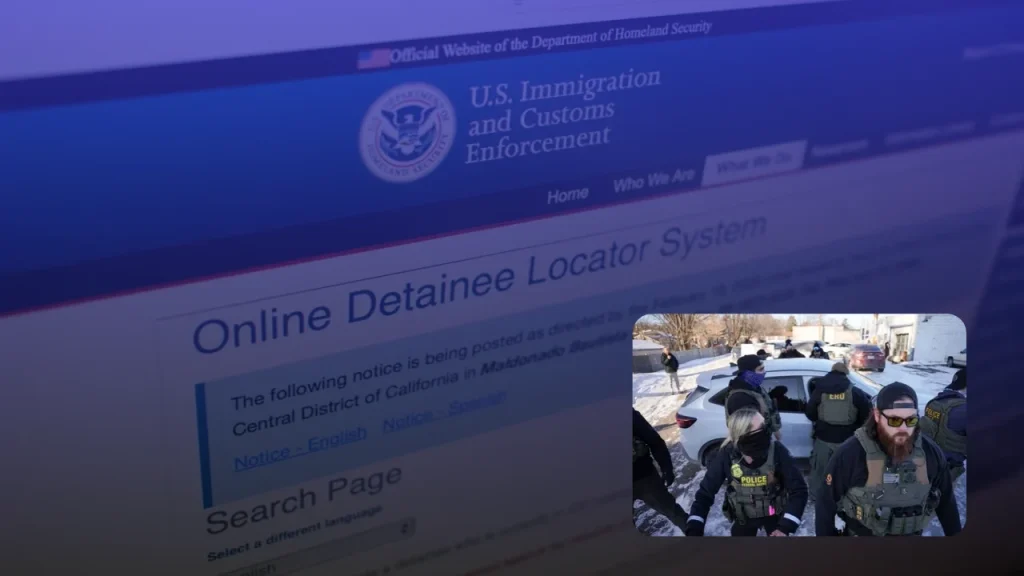
For more than 16 years, DHS has offered the Online Detainee Locator System (ODLS), where families and lawyers could search by A-Number, or by name and country of birth, to find where a person was held in immigration detention.
According to the complaint, around September 15, 2026, DHS stopped displaying locations for people with administratively final removal orders, except for people held at certain facilities in Adelanto, California, and temporary holding facilities in Minneapolis, New York City and suburban Chicago. The complaint also alleges that officers were told not to give these locations out over the phone, and that the policy was adopted without public notice, publication or an explanation.
It does not mean every ICE detainee vanished from the database. People without final orders generally still appear, though the tool has long been criticized for delays and gaps.
Timeline of the ICE Locator Policy and Lawsuit
| Date | Event |
| June 2010 | DHS launches the ODLS, according to the complaint |
| September 15, 2026 | Alleged start of the Final Order Policy |
| September 30, 2026 | 47 members of Congress write to ICE urging restoration of the information and asking for a copy of the policy |
| October 14, 2026 | Date by which the letter requested the policy; the complaint alleges no response |
| October 28, 2026 | Lawsuit filed in Boston federal court |
How Many ICE Detainees Are Affected by the Final Order Policy?
The complaint relies on July 2026 data: an average of 66,904 people in ICE detention per day, including an average of 21,700 with final removal orders. That is about 32% of the detained population. ICE also booked 13,788 new people with final orders into detention that month, so the number keeps growing.
These are plaintiffs’ estimates of potential reach, not a verified count of records removed on a given day. Earlier press coverage used lower figures, such as more than 16,000 people, so use the complaint’s numbers when citing the case.
Why Do the Legal Aid Groups Say the Locator Policy Is Unlawful?
The plaintiffs say lawyers need to know where a client is held to arrange calls, send documents, file in the right court and meet deadlines. They allege the policy forces them to spend hours calling facilities and relatives instead.
- Greater Boston Legal Services says staff spend significant time phoning detention centers and relatives to find clients with final orders.
- Rian Immigrant Center represents more than 10 people with final orders who mostly have pending or expected applications for relief, and says losing location data slows its response when clients are detained.
- Florence Immigrant and Refugee Rights Project says it could not schedule services for roughly 15% to 25% of referrals because it could not locate the people, and flags detainees with serious mental health conditions who cannot explain where they are.
- Amica Center for Immigrant Rights says it is harder to find existing clients and take new habeas and conditions cases.
The complaint also says courts in other proceedings have been affected, including instances where a person’s absence caused criminal-case problems and bench warrants. Whether the evidence supports legally recognized injury is for the court to decide.
Can ICE Detainees Still Fight Deportation After a Final Removal Order?
Sometimes. A final order does not mean the person is already deported, and it does not mean every option is gone. Depending on the facts, a person may be able to:
- Move to reopen under 8 C.F.R. § 1003.23, subject to strict grounds and deadlines.
- File a petition for review in a federal court of appeals under 8 U.S.C. § 1252, generally within 30 days of the final order.
- Challenge detention through habeas corpus under 28 U.S.C. § 2241. Habeas is not a way around the limits on reviewing removal orders themselves.
- Pursue other relief, such as certain crime-victim or trafficking-related protections, if eligible.
None of these is guaranteed, and each has its own requirements. That is why the plaintiffs say location access still matters after a final order. This lawsuit does not reopen any individual case or stop any removal.
Which Federal Laws Does the ICE Detainee Locator Lawsuit Invoke?
Administrative Procedure Act, 5 U.S.C. § 706(2)(A): Arbitrary and Capricious Policy Change
The Administrative Procedure Act (APA) lets courts set aside agency action that is arbitrary, capricious or not in accordance with law. The plaintiffs say DHS dropped a 16-year practice without a reasoned explanation and without weighing the effects on lawyers, families and courts. The complaint cites Motor Vehicle Manufacturers Ass’n v. State Farm, 463 U.S. 29 (1983), and DHS v. Regents of the University of California, 591 U.S. 1 (2020), which require agencies to consider relevant factors and reliance interests when changing course. Agencies can change policy. The question is whether this change met that standard.
Administrative Procedure Act, 5 U.S.C. §§ 704 and 706(2)(B): Action Contrary to Constitutional Right
The second APA claim says the policy is final agency action that is contrary to constitutional rights. The court must first decide whether the policy is reviewable final action, then whether it is unlawful.
First Amendment: Lawyers’ Ability to Reach and Represent Clients
The plaintiffs argue the policy blocks their protected speech and association, including contacting and representing clients. They cite NAACP v. Button, 371 U.S. 415 (1963), which recognized legal advocacy as protected activity, and discuss Turner v. Safley, 482 U.S. 78 (1987), a framework for restrictions in custodial settings. Whether Turner applies, and whether the claim succeeds, is open. The plaintiffs say they are not asking this court to review their clients’ removal orders or detention decisions.
For a related First Amendment dispute involving immigration enforcement, see DHS Sued For Threatening ICE Observers Are You In The Class?. It is a different case with different facts.
Freedom of Information Act, 5 U.S.C. § 552(a)(2): Failure to Publish the Policy
Greater Boston Legal Services and Rian Immigrant Center allege ICE violated FOIA, 5 U.S.C. § 552(a)(2), which requires agencies to make certain adopted policy statements and staff instructions that affect the public available for inspection. The plaintiffs say ICE never published the policy’s text. FOIA does not require disclosure of every internal document, so the exact category and any exemption will matter.
Other Laws That Shape the Case
| Law | Why it matters |
| 28 U.S.C. § 1331 | Federal-question jurisdiction |
| 28 U.S.C. §§ 2201–2202 | Declaratory relief |
| 28 U.S.C. § 1391(e) | Venue in suits against federal agencies and officers |
| 5 U.S.C. § 705 | Authority to stay agency action while the case proceeds |
| 8 U.S.C. § 1362 | Right to chosen counsel at no government expense in covered removal proceedings |
| 8 U.S.C. § 1231(a) | Governs detention during the removal period after a final order, which is why people with final orders are often held |
Section 1362 does not give detainees a government-paid lawyer. Detention after a final order is also limited by the Supreme Court’s decision in Zadvydas v. Davis, 533 U.S. 678 (2001), which is the type of habeas challenge that depends on a lawyer knowing where the client is held.
Will the Court Even Reach the Merits? The Standing Question
The plaintiffs are organizations, not detainees. They say the policy injures them directly by draining staff time and blocking client contact. The government may contest whether that is enough, since the Supreme Court has limited organizational standing based only on diverted resources in FDA v. Alliance for Hippocratic Medicine (2024). Expect this to be an early fight.
What Are the Plaintiffs Asking the Court to Order?
The complaint seeks no money for detainees. The groups ask the court to:
- Declare the policy unlawful under the First Amendment and the APA.
- Stay the policy under 5 U.S.C. § 705 while the case proceeds.
- Vacate the policy under 5 U.S.C. § 706.
- Order ICE to publish the policy.
- Award costs and attorneys’ fees.
Has a Judge Blocked the ICE Locator Policy Yet?
No order blocking the policy was verified as of October 29, 2026. The ACLU said the organizations planned to seek temporary relief, but a request is not a ruling. The government has not been reported to have filed a response. Until a court orders otherwise, assume the policy is in effect.
Is There a Separate FOIA Lawsuit Over ICE Detention Data?
Yes, according to reporting. The Marshall Project, represented by Loevy & Loevy, reportedly filed a FOIA suit in federal court in Washington, D.C., around October 20, 2026, seeking the names, ages and detention locations of people in ICE’s Enforcement Integrated Database. That case seeks broader disclosure and is separate from the Boston lawsuit, which targets the locator policy for people with final orders.
What Can Families Do If a Detainee Is Missing From the ICE Locator?
A missing result does not prove a person was deported, released or moved out of custody.
- Re-check the search. Use the nine-digit A-Number (add leading zeros if needed). Name searches usually need an exact name match and the correct country of birth.
- Know the tool’s limits. The official ICE locator cannot search for people under 18 and may lag behind new arrests or transfers.
- Contact the person’s lawyer, if there is one, so they can verify custody through official channels.
- Gather identifying details: full legal name, A-Number, country of birth, last known encounter, and any immigration court papers.
- Call a qualified immigration lawyer or legal aid group if the person still cannot be found, and mention any removal date or medical urgency.
This lawsuit does not automatically protect any individual from removal.
Why the ICE Detainee Locator Case Matters Beyond the Four Plaintiffs
The case asks whether the government can stop disclosing where certain people in its custody are held without explaining the change or addressing the effect on access to lawyers, families and courts. It sits alongside other disputes over transparency and oversight in immigration detention. See Immigrant Deaths In ICE Custody, Oversight And Family Rights and Minnesota Ice Lawsuit, Federal Agents Sued Over Racial Profiling and Constitutional Violations During Immigration Surge. Those are separate matters and do not decide this one.
Frequently Asked Questions About the ICE Detainee Locator Lawsuit
What is the case name and number in the ICE detainee locator lawsuit?
Greater Boston Legal Services, Inc. et al. v. Mullin et al., No. 1:26-cv-14869, in the U.S. District Court for the District of Massachusetts.
When did ICE change the Online Detainee Locator System policy?
The complaint alleges the policy took effect on or about September 15, 2026. The lawsuit was filed October 28, 2026.
Which ICE detainees are hidden from the locator?
People with administratively final removal orders, subject to alleged exceptions for certain facilities in Adelanto, Minneapolis, New York City and suburban Chicago.
How many people does the ICE locator policy affect?
The complaint estimates about 21,700 people with final orders on an average day in July 2026, roughly 32% of ICE’s detained population. It is an estimate, not a verified count of removed records.
Which laws does the ICE locator lawsuit rely on?
The Administrative Procedure Act (5 U.S.C. § 706), the First Amendment, and the Freedom of Information Act (5 U.S.C. § 552(a)(2)), plus jurisdiction and relief provisions such as 28 U.S.C. §§ 1331 and 2201–2202.
Does the lawsuit stop deportations of people with final removal orders?
No. It challenges how location information is disclosed. It does not cancel final orders or bar removals.
Has the court ordered ICE to restore detainee locations?
Not as of October 29, 2026. The plaintiffs have asked for a stay and vacatur, and no order granting them has been verified.
Can families join the lawsuit or file a claim?
No. There is no claim form or compensation program. The case is brought by four organizations seeking declaratory and injunctive relief.
Is the ICE locator lawsuit a class action?
No class is identified in the complaint.
Can someone with a final removal order still have a lawyer?
Yes. Under 8 U.S.C. § 1362 a person in covered proceedings may be represented by chosen counsel at no government expense. Which legal options remain depends on the individual case.
What happens next in the ICE locator case?
The court may rule on a request for temporary relief, and the government will respond. Expect arguments on standing, APA reviewability, the First Amendment and FOIA. No trial date has been verified.
Sources
- Filed complaint, Greater Boston Legal Services, Inc. et al. v. Mullin et al., No. 1:26-cv-14869 (PDF)
- National Immigration Law Center, case page
- National Immigration Project of the National Lawyers Guild, case page
- ACLU, Immigrants’ Rights Organizations File Lawsuit to Stop ICE from Hiding Locations of Detained People, October 28, 2026
- ICE Online Detainee Locator System
- Statutes and rules: 5 U.S.C. § 706, 5 U.S.C. § 552, 8 U.S.C. § 1252, 8 U.S.C. § 1362, 28 U.S.C. § 2241
This article is for informational purposes only and is not legal advice. AllAboutLawyer.com is a legal information website, not a law firm. The allegations described have not been proven in court.
Researched and written by Israr Ahmad, legal content researcher and founder of AllAboutLawyer.com. All facts verified against the filed complaint (No. 1:26-cv-14869), the NILC and NIPNLG case pages, the ACLU press release, ICE’s official locator, and the cited federal statutes, as of October 29, 2026. Last Updated: October 29, 2026.
About the Author
Israr Ahmad is a legal content researcher with 4+ years of experience covering class action settlements and consumer rights cases. He has researched and published coverage of 2,500+ settlements using verified court records, settlement administrator filings, and government sources. Learn more about Israr.