
Is Clipping Legal in 2026? YouTube, TikTok, Twitch and Copyright Rules
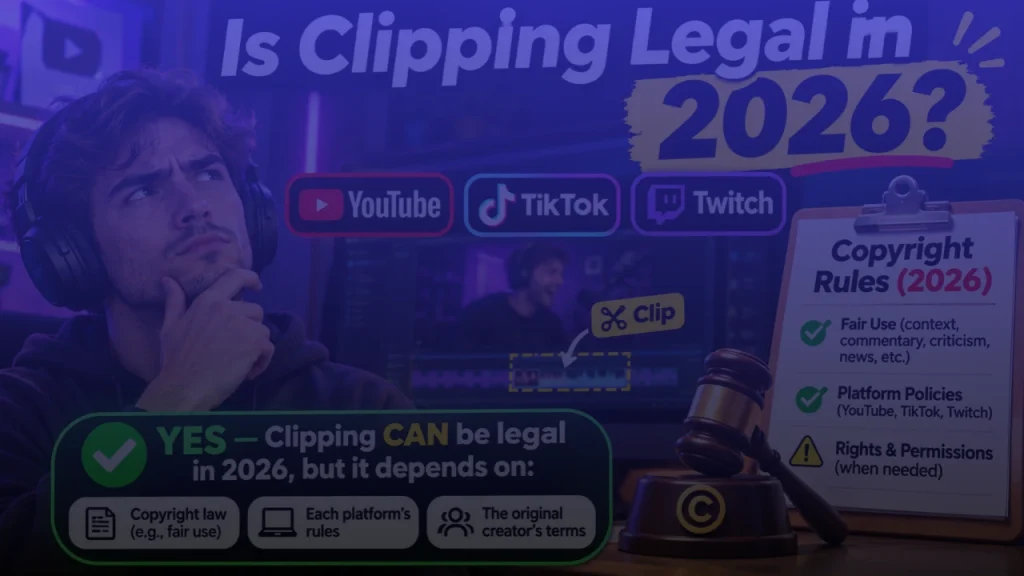
Yes, video clipping is legal in the United States when you own the footage, have permission to use it, or your use qualifies for a copyright exception such as fair use under 17 U.S.C. § 107. However, downloading someone else’s YouTube video, Twitch stream, podcast, or TikTok and reposting a shorter version can infringe copyright, even if you credit the creator and even if the clip is only a few seconds long.
Clipping has become a real business. Creators and brands pay editors to turn long videos into YouTube Shorts, Instagram Reels, and TikToks, and some accounts are built entirely on reposting viral moments. But earning money from clipping does not make it legal, and no federal rule exempts videos under 30 seconds.
The governing law is the Copyright Act, Title 17 of the United States Code. Whether a clip is lawful depends on who owns the footage, what permission exists, how the clip is used, and whether an exception applies.
Is Clipping Legal Under U.S. Copyright Law? Quick Facts
| Question | Legal answer |
| Is video clipping legal in the U.S.? | Yes, when authorized or covered by an exception |
| Can you clip your own videos? | Generally yes |
| Can you clip someone else’s videos? | Only with permission or a valid exception such as fair use |
| Is clipping streamers legal? | Depends on the streamer’s permission and third-party rights |
| Is clipping podcasts legal? | Permission or an exception is generally needed |
| Is clipping for money legal? | Yes, with proper rights and required disclosures |
| Is a 10-second clip automatically fair use? | No |
| Does giving credit prevent infringement? | No |
| Are reaction videos protected by fair use? | Sometimes (see Hosseinzadeh v. Klein) |
| Can YouTube deny monetization even with permission? | Yes, under its reused content policy |
| Statutory damages (17 U.S.C. § 504(c)) | $750 to $30,000 per work; up to $150,000 per work if willful |
| Time limit to sue (17 U.S.C. § 507(b)) | 3 years after the claim accrued |
| Main statutes | 17 U.S.C. §§ 106, 107, 412, 504, 505, 507 and 512 |
| Last reviewed | November 16, 2026 |
What Does “Clipping” Mean Under Copyright Law?
Clipping means taking a shorter segment from a longer recording and using it as separate content. Examples include:
- Turning a two-hour podcast into a 45-second TikTok.
- Posting highlights from a Twitch livestream.
- Reposting a funny moment from a YouTube video.
- Cutting a sports broadcast into short highlights.
- Editing a creator’s authorized footage for a paid marketing campaign.
Clipping itself is not prohibited. The legal problem arises when you copy, edit, and distribute someone else’s protected work without authorization or a legal justification. Under 17 U.S.C. § 106, the copyright owner holds the exclusive rights to reproduce, distribute, adapt, and publicly perform or display the work. Saving and reposting a clip uses several of those rights at once.
When Is Clipping Someone Else’s Video Legal?
| Situation | General legal position |
| You clip footage you created and own | Generally permitted |
| Creator gives written permission | Permitted within the license terms |
| A brand hires you to edit its authorized footage | Permitted within the agreement |
| Footage is in the public domain | Generally permitted, subject to other rights |
| A Creative Commons license allows reuse | Permitted if the license conditions are met |
| The clip qualifies as fair use | Permitted under 17 U.S.C. § 107 |
| You repost copyrighted footage without permission | Infringement risk |
| You only add captions to someone else’s video | Captions alone do not make it legal |
Does a Creator Saying “You Can Clip Me” Count as Permission?
It can, if it is a legally effective authorization such as a written agreement or public licensing terms. But permission has a scope. Letting fans share a clip inside Twitch does not necessarily authorize downloading it, uploading it to TikTok, and monetizing it. Confirm exactly what the permission covers, and keep a written record.
Is Clipping YouTube Videos Legal?
YouTube’s built-in Clips feature lets viewers share short segments (5 to 60 seconds) that link back to the original video. Using that feature as intended is very different from downloading copyrighted footage and re-uploading it.
A video being publicly viewable does not mean it is free to download, edit, and republish. YouTube’s own copyright guidance rejects the myth that copying only a few seconds avoids infringement, and a third-party editing app does not give you rights to the source footage.
Can You Monetize Clipped Videos Under YouTube’s Reused Content Policy?
Possibly, but YouTube’s Partner Program has a separate reused content policy. Channels that make minimal changes to other people’s content, such as clip compilations with little commentary or videos copied from other social accounts, can be denied monetization. Even permission from the original creator does not guarantee monetization approval. That is a platform-policy issue, separate from copyright law.
Is Clipping Twitch Streamers Legal?
The same copyright principles apply. Three situations should be kept apart:
- Sharing clips through Twitch’s own tools: generally fine when you use the feature as the platform and the streamer’s settings allow.
- Reposting streamer clips on your own social media account: may need additional permission, a license, or a valid exception.
- Monetizing someone else’s stream highlights: requires attention to commercial rights, music licensing, and the exact terms of any permission.
Livestreams often contain third-party songs, game footage, and guests. A streamer’s permission does not cover rights that belong to those third parties.
Is It Legal to Clip Video Game Footage?
Video games are copyrighted audiovisual works, so technically recording and uploading gameplay needs the publisher’s permission. In practice, many major publishers publish fan content or content creator policies that allow players to record, clip, and share gameplay. Those policies usually have limits: selling proprietary assets, leaking unreleased content, or re-uploading full cutscenes without commentary can violate the publisher’s terms. Read the specific publisher’s policy before you monetize.
Is Clipping Podcasts Legal?
Podcast recordings are protected by copyright, and the rights may belong to the podcaster, a production company, or an employer. If a podcaster hires you to cut shorts from their episodes, the agreement can authorize your clipping. Taking segments from someone else’s podcast and reposting them without authorization risks infringement.
A podcast going viral does not make it public domain, and a clip appearing on hundreds of accounts does not mean every account has permission. A clip that simply reproduces an entertaining answer is harder to defend as fair use than one used for genuine criticism, commentary, or news reporting.
Related article: Is THC Legal in Florida in 2026? Delta-8, Delta-9, Edibles and Penalties
Is Clipping TikTok Videos and Instagram Reels Legal?
TikTok and Instagram allow some sharing and remixing through their own features. Those features give platform-specific permissions, but not unlimited rights to distribute the original elsewhere. Permission to use a remix feature may not authorize selling that footage to an advertiser or uploading it to another platform. Keep three situations separate:
- Sharing through an approved platform feature.
- Reusing footage under an actual copyright license.
- Independently downloading and reposting a video, which carries the greatest copyright risk when the creator has not authorized it.
Does Fair Use (17 U.S.C. § 107) Make Clipping Legal?
Sometimes. Section 107 permits certain uses without permission, such as criticism, commentary, news reporting, teaching, scholarship, and research. But labeling a clip “reaction” or “educational” does not make it fair use. Courts weigh four factors:
| Factor | What courts examine |
| Purpose and character of the use | Whether the new use is transformative, such as genuine commentary or criticism, and whether it is commercial |
| Nature of the copyrighted work | Whether the original is factual or highly creative, published or unpublished |
| Amount and substantiality used | How much was taken and whether it includes the “heart” of the work |
| Effect on the potential market | Whether the clip substitutes for the original or harms its market |
No single factor decides the outcome. A 10-second clip in a 15-minute video essay analyzing cinematography is much easier to defend than a lightly edited 5-minute clip of a film’s climax.
Are Reaction Videos Fair Use? Hosseinzadeh v. Klein
They can be. In Hosseinzadeh v. Klein (S.D.N.Y., No. 16-cv-3081, decided August 23, 2017), a federal court held that Ethan and Hila Klein’s critical reaction video was fair use. The court found the video added substantial criticism and commentary and did not substitute for the original. The court did not hold that every reaction video qualifies. The ruling shows why the purpose of a clip matters more than a simple time limit.
Is Clipping Under 30 Seconds Legal Under U.S. Copyright Law?
No federal rule automatically allows clips shorter than 5, 10, 15, or 30 seconds. A five-second excerpt can infringe, and a longer excerpt can sometimes be fair use if the four factors support it. The U.S. Copyright Office states that no set number of seconds, words, or percentage guarantees fair use.
Does Giving Credit Make a Clip Legal?
No. Tagging the creator, naming the podcast, or adding “no copyright infringement intended” is not a substitute for permission and is not a legal defense. Credit can be a condition of a license, but authorization is a separate question. Adding subtitles, changing speed, cropping, or using AI editing software does not guarantee fair use either.
Is Clip Farming Legal?
“Clip farming” usually means producing large numbers of short videos to gain views or revenue. No federal statute specifically bans it, so legality depends on the underlying conduct. An authorized clipping business can operate lawfully. Mass-reposting copyrighted videos without permission creates repeated infringement exposure, and YouTube and other platforms may penalize repetitive or unoriginal content.
Can You Get Paid to Clip Videos Legally?
Yes. Businesses and creators can lawfully pay editors to clip properly licensed footage. Before joining a clipping campaign, confirm:
- Who owns or controls the source footage.
- Which videos you may use and where you may publish them.
- Whether monetization is authorized.
- Whether background music and third-party material are cleared.
- What happens to the clips when the campaign ends.
A company supplying footage does not automatically own every copyright inside it.
Do Paid Clippers Have to Disclose Sponsorships Under FTC Rules?
Sometimes. The Federal Trade Commission’s Endorsement Guides require clear disclosure of a material connection, such as payment, when it could affect how consumers view an endorsement. Someone paid to post promotional clips recommending a product may need to disclose that relationship. Not every paid editing job is an endorsement, so it depends on the content and the arrangement.
What Are the Penalties for Clipping Copyrighted Content Without Permission?
| Consequence | What it means |
| YouTube Content ID claim | The video may be tracked, blocked, muted, or monetized by the rights holder |
| DMCA takedown (17 U.S.C. § 512) | The platform removes the reported material |
| Copyright strike | The account receives a platform penalty |
| Loss of monetization | The channel may become ineligible for ad revenue |
| Account termination | Repeated violations can lead to removal |
| Federal copyright lawsuit | The owner may seek damages and an injunction |
On YouTube, three active copyright strikes within 90 days can lead to channel termination. A Content ID claim is not automatically a strike.
Can You Be Sued for Video Clipping? Damages Under 17 U.S.C. §§ 504, 505 and 412
Yes. Under 17 U.S.C. § 504, a copyright owner can seek actual damages plus the infringer’s profits or, where legal requirements are met, statutory damages:
- $750 to $30,000 per infringed work (ordinary statutory damages).
- Up to $150,000 per work if the infringement was willful.
- As low as $200 per work if the infringer proves they were not aware and had no reason to believe the act was infringement.
These are not automatic fines. Under 17 U.S.C. § 412, statutory damages and attorney’s fees are generally unavailable unless the work was registered before the infringement began (or within three months of first publication). Under 17 U.S.C. § 505, a court may award reasonable attorney’s fees to the prevailing party; it is discretionary, not automatic, and it can go either way. Under 17 U.S.C. § 507(b), a civil claim must be brought within three years after it accrued.
For a real-world example of a copyright dispute between streamers, see Kaceytron Lawsuit 2026, Streamer Settled With Ethan Klein In December 2025, Paid Settlement Plus GoFundMe Donations After Copyright Infringement Claims. For a broader example of a dispute over copying a protected creative work, see The Holdovers Copyright Infringement Lawsuit, Alexander Payne Sued Over Alleged Copying of Frisco.
What Should You Do After a YouTube Copyright Strike or DMCA Takedown?
First, read the notice and identify the specific work and the rights holder. Then check whether you had permission, held a license, or can rely on a valid exception such as fair use. YouTube offers several paths: ask the claimant for a retraction, complete Copyright School and wait for the strike to expire, or submit a counter-notification.
A DMCA counter-notification under 17 U.S.C. § 512(g) is a sworn statement, under penalty of perjury, that you believe the material was removed by mistake or misidentification. If the claimant does not file a lawsuit within the statutory window, the platform may restore the content. Filing a counter-notice can invite a federal suit, so consider talking to an intellectual property attorney first.
Do not file a false counter-notification just to restore a video. Under 17 U.S.C. § 512(f), a person who knowingly materially misrepresents that material was removed by mistake can be liable for damages. Disputes over allegedly improper takedowns have reached federal court, as in SXSBlog Lawsuit, Employees Accused of Stealing $230K in Federal Lawsuit – Settlement Details Revealed, which involves allegations over ownership of edited YouTube videos and disputed copyright notices. Those allegations are separate from the rights of ordinary video clippers.
How to Clip Videos Legally in 2026
- Identify the owner. Find out who controls the video, audio, and any other material you plan to use.
- Check the license. If the creator allows clipping, confirm which platforms, accounts, uses, and monetization methods are included.
- Get written permission. Save the agreement or messages.
- Review third-party content. Music, sports broadcasts, and movie excerpts may have separate owners.
- Add real original work. If you rely on fair use, make sure the clip genuinely comments on or critiques the original instead of replacing it.
- Check platform rules. A licensed video can still violate YouTube’s reused content policy.
- Keep records. Store licenses, source links, project files, and campaign agreements in case of a dispute.
These steps reduce legal risk, but they cannot guarantee that a platform will never issue a claim.
Frequently Asked Questions About Clipping and Copyright
Is clipping YouTube videos legal under U.S. copyright law?
Yes, when you own or have permission to use the footage, or a valid exception such as fair use applies. Simply downloading and reposting someone else’s video creates copyright risk.
Is clipping Twitch streamers without permission legal?
It may be fair use in limited circumstances, such as genuine criticism or commentary, but ordinary reposting without authorization risks infringement. Permission is the clearer path.
Can I clip podcasts and post them on TikTok?
Yes, if the rights are cleared or your use is otherwise legally permitted. A podcast being publicly available does not authorize reposting.
Is clipping copyrighted videos illegal even if I add captions?
Captions alone do not guarantee fair use. Courts look at the purpose of the use, the amount taken, and the effect on the market for the original.
Can I be sued under the Copyright Act for a 10-second clip?
Potentially. There is no automatic exemption for any number of seconds.
Can a creator sue me if I gave them credit?
Yes. Credit is not permission and is not fair use.
Is clipping for money illegal?
No. Paid clipping can be lawful when it is authorized and complies with copyright law, platform rules, and FTC disclosure requirements.
Can I make money from YouTube Shorts made from other people’s content?
Possibly, but YouTube can deny monetization for reused content even when you have permission. Copyright and monetization eligibility are separate issues.
Does a creator have to give written permission?
U.S. copyright law does not require every nonexclusive permission to be in writing, but a written license gives clearer proof of its scope.
Is AI video clipping legal?
AI tools do not change copyright rules. You still need a lawful basis to use the footage, and the finished clip remains subject to platform policies.
Bottom Line: Is Clipping Legal in the United States?
Video clipping is legal in the United States when the footage is yours, its use is authorized, or a copyright exception applies. Reposting another creator’s livestream, podcast, movie scene, or YouTube video without permission can violate the Copyright Act, even when the clip is short or credited. Fair use can protect genuine criticism and commentary, but it is not an automatic exception for every reaction video or viral highlight.
For anyone building a clipping business, the strongest protection is a clear license that covers the footage, the distribution platforms, monetization, and third-party rights.
Primary Legal Sources
- U.S. Copyright Office: Copyright Act, Chapter 1 (§§ 106, 107)
- U.S. Copyright Office: Fair Use and Its Four Factors
- U.S. Copyright Office: Fair Use FAQ
- U.S. Copyright Office: How to Obtain Permission
- U.S. Copyright Office: Copyright Act, Chapter 5 (§§ 504, 505, 507)
- Federal Court: Hosseinzadeh v. Klein, August 23, 2017 Decision
- YouTube: Copyright Myths
- YouTube: Channel Monetization and Reused Content Policy
- YouTube: Copyright Strikes
- YouTube: Creating and Sharing Clips
- FTC: Endorsement Guides, What People Are Asking
Disclaimer: This article is general U.S. legal information, not legal advice. Consult a qualified intellectual property attorney about your specific situation.
Researched and written by Israr Ahmad, legal content researcher and founder of AllAboutLawyer.com. All facts verified against the U.S. Copyright Office (Title 17 text), the Hosseinzadeh v. Klein court opinion, and the official YouTube and FTC guidance pages listed above, as of November 16, 2026. Last Updated: November 16, 2026.
About the Author
Israr Ahmad is a legal content researcher with 4+ years of experience covering class action settlements and consumer rights cases. He has researched and published coverage of 2,500+ settlements using verified court records, settlement administrator filings, and government sources. Learn more about Israr.