
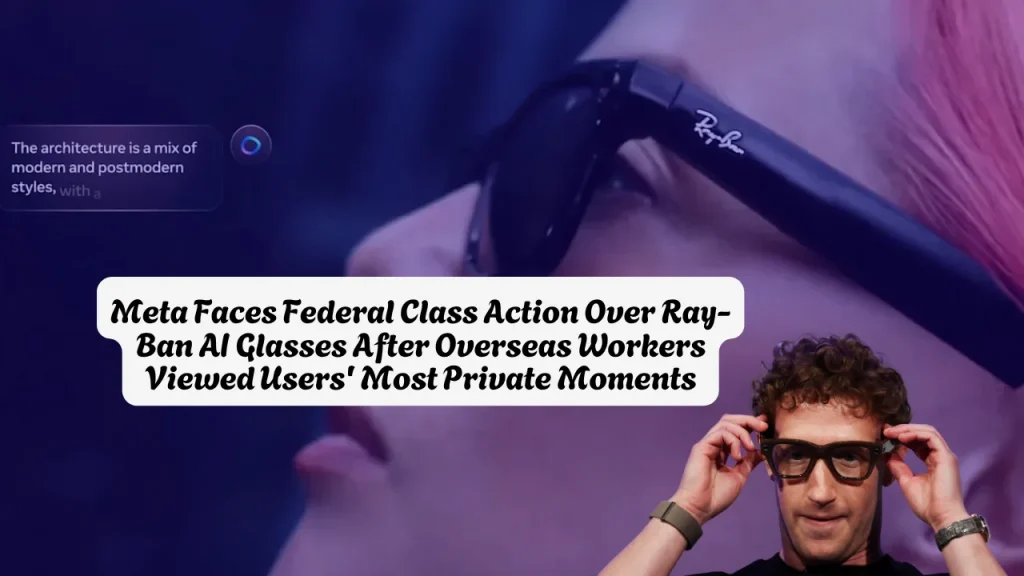
Meta Faces Federal Class Action Over Ray-Ban AI Glasses After Overseas Workers Viewed Users’ Most Private Moments
Millions of Ray-Ban Meta smart glasses buyers were promised their footage would stay private — a federal lawsuit says that promise was a lie.
Plaintiffs Gina Bartone and Mateo Canu filed a class action complaint against Meta Platforms Inc. and Luxottica of America Inc. in California federal court, alleging violations of federal and state laws for failing to disclose that the AI smart glasses transmit videos to third-party contractors for human review. The case, filed March 5, 2026, carries case number 3:26-cv-01897 in the U.S. District Court for the Northern District of California. The plaintiffs are represented by the Clarkson Law Firm and are seeking class certification to include all U.S. purchasers of Meta AI glasses in any outcome.
Quick Case Snapshot
| Field | Details |
| Plaintiffs | Gina Bartone (New Jersey), Mateo Canu (California) |
| Defendants | Meta Platforms Inc.; Luxottica of America Inc. |
| Court | U.S. District Court, Northern District of California, San Francisco Division |
| Case Number | 3:26-cv-01897 |
| Filing Date | March 4–5, 2026 |
| Judge | Not yet disclosed |
| Claims Alleged | False advertising, fraud by misrepresentation, fraud by concealment, negligent misrepresentation, breach of contract, breach of implied warranty, unjust enrichment, violations of California’s False Advertising Law, California Consumer Legal Remedies Act, and New Jersey Consumer Fraud Act |
| Damages Sought | Monetary damages, restitution, injunctive relief, declaratory relief, corrective advertising |
| Current Status | Newly filed; class certification pending |
What Happened: The Core Allegation Every Buyer Should Read
Meta may have sold seven million of its Ray-Ban smart glasses in 2025 alone — but likely didn’t anticipate the outpouring of criticism when a recent investigation by Swedish newspapers Svenska Dagbladet and Göteborgs-Posten revealed that Meta’s subcontracted data annotators in Nairobi, Kenya, could have been watching users through the glasses’ cameras as they went to the bathroom or had sex.
Workers called data annotators train AI systems by watching videos and drawing boxes around objects in the videos and inputting the name of the item — this is the process by which AI systems learn about the world. What neither the marketing materials nor Meta’s privacy policy made clear to buyers, the lawsuit argues, is that their footage — captured inside their own homes — was part of that pipeline.
The Meta class action claims the company misled consumers by failing to disclose that videos captured by the glasses are sent to Meta’s servers and then to a subcontractor in Kenya, where human workers manually view and label the footage to train Meta’s AI models.
The affected product lines cover more than just the Ray-Ban brand. The complaint focuses on two product lines — Ray-Ban Meta smart glasses and Oakley Meta smart glasses — with prices ranging from $299 to $799 depending on the model. These devices look like ordinary sunglasses from the outside.
Related article: Chrysler Pacifica Hybrid Owners Sue FCA Over Dangerous Battery Fires and Sudden Shutdowns Two Class Actions, One Defective Minivan
The Privacy Gap: What Meta Said vs. What Actually Happened
The lawsuit points to specific advertising claims Meta used to sell the glasses: “designed for privacy, controlled by you,” “built for your privacy,” and “you’re in control of your data and content.” The complaint argues these statements were materially false given that footage was routed to overseas contractors without meaningful user awareness.
Meta’s defense has been that recordings stay on the device unless a user chooses to share them. However, footage that is captured but not stored locally for users — like video when Live AI is in use — can be sent to contractors who help train the company’s AI models. Meta’s privacy policy doesn’t specifically mention the use of human contractors, though it states that such data can be used for training purposes.
In plain terms: turning on the glasses’ core AI features — the main selling point of the product — is what triggers the data transmission. Buyers who wanted the AI without the overseas review had no way to separate the two.
Making matters worse, in April 2025, the company quietly updated its privacy policy to make AI features — and the collection of voice recordings — the default, with no real way to opt out.
Meta claimed it was anonymizing footage by blurring faces. Meta claimed it was blurring faces in images, but sources disputed that this blurring consistently worked.
What the Lawsuit Is Asking the Court to Do
The plaintiffs are seeking class certification so that all U.S. purchasers of Meta AI glasses can participate in any outcome. They are also asking the court for declaratory relief — a formal court declaration that Meta’s conduct violates the law — and injunctive relief, meaning a court order requiring Meta to change how it handles user data and to run corrective advertising that accurately describes how the product works.
The lawsuit says the undisclosed human review pipeline “renders the Meta AI Glasses’ privacy features materially misleading, transforms the product from a personal device into a surveillance conduit, and exposes consumers to unreasonable risks of dignitary harm, emotional distress, stalking, extortion, identity theft, and reputational injury.”
Who Is Affected — Are You Eligible?
If you purchased Ray-Ban Meta smart glasses or Oakley Meta smart glasses anywhere in the United States and relied on Meta’s privacy representations when making that purchase, you may be a member of the proposed class. The plaintiffs claim they purchased the glasses after relying on Meta’s privacy assurances and would not have bought them had they known the truth.
If your glasses captured footage of your children, family members, or anyone in your home, that footage may have been reviewed by third parties. The Clarkson Law Firm is accepting inquiries from affected consumers on a contingency basis, meaning no upfront cost is required to join.
No deadline to join the class has been set yet. Class certification must be approved by the court before formal opt-in or opt-out procedures are established. Monitor the case docket (3:26-cv-01897) for updates.
Meta’s Response
A Meta spokesperson told Engadget that data from its glasses may end up in the hands of human contractors, but declined to respond to the lawsuit’s claims. The spokesperson maintained that media stays on the user’s device unless they choose to share it — a position the lawsuit directly contests.
Luxottica of America, the eyewear manufacturer and co-defendant, has not issued a public statement regarding the complaint.
Legal Context: Why This Case Could Set a Precedent
This lawsuit sits at the intersection of consumer protection law and AI data practices — a rapidly evolving legal frontier. The core legal theories are not exotic: false advertising and fraud by omission are well-established claims. What makes this case significant is the context — wearable AI devices entering the most intimate spaces of users’ lives.
The current controversy does not arise in isolation. Meta’s smart glasses have attracted privacy concerns since earlier iterations of the product. In October 2025, a man in San Francisco was reported to have used Meta smart glasses to covertly record women at the University of San Francisco, a case that drew significant media attention.
The case has also drawn international regulatory attention. The news prompted the U.K. regulator, the Information Commissioner’s Office, to investigate the matter.
Under California’s Consumer Legal Remedies Act and False Advertising Law — two of the statutes named in the complaint — courts have broad authority to award restitution to affected consumers and order businesses to stop deceptive practices. Because California is home to millions of tech product purchasers and hosts many of the nation’s largest tech companies, its consumer protection laws carry national weight.
What Happens Next
The case is in its earliest stage. The court must first determine whether it meets the legal requirements for class certification — meaning whether the plaintiffs’ claims are common enough across all buyers to be litigated together. That process typically takes several months to over a year.
After that, the parties would likely enter discovery (formal evidence exchange), followed by either settlement negotiations, summary judgment motions, or a trial. Given the scale of alleged harm and the number of glasses sold, if the lawsuit is successful, the financial damages would be substantial.
Settlement is common in large consumer class actions. If Meta chooses to settle, terms and any payout amounts would be announced publicly, and class members would be notified with instructions on how to file a claim. Watch this space — we will update this article as the case progresses.
Frequently Asked Questions
Who can join this class action lawsuit?
Any person in the United States who purchased Ray-Ban Meta smart glasses or Oakley Meta smart glasses — particularly those who relied on Meta’s privacy promises when buying — may be eligible. The class has not yet been formally certified by the court.
Has any settlement or payout been announced?
No. The case was filed in early March 2026 and remains in its opening phase. No settlement discussions have been publicly disclosed. Any payout to class members, if one occurs, would come later in the legal process.
What is the deadline to join?
No official claim deadline has been set. Class certification must be approved by the court first. Once that happens, class members will receive formal notice and a deadline to participate. Consumers interested in joining can contact the Clarkson Law Firm now to register their interest.
Did Meta really blur the footage to protect privacy?
Meta claimed its system anonymized footage by blurring faces. However, sources disputed that this blurring consistently worked. The lawsuit alleges the anonymization technology was unreliable and that the broader issue — human contractors seeing private footage at all — was never disclosed to buyers regardless of blurring.
What could Meta be ordered to do if it loses?
Beyond financial damages and restitution to buyers, the plaintiffs are asking the court to issue injunctive relief — a court order forcing Meta to change its data practices — and to require Meta to run corrective advertising that accurately tells consumers how their footage is actually used.
Is this the first time Meta has faced privacy lawsuits?
No. Last year, Meta was sued over allegations it illegally collected nonanonymized browsing data from Android users. The Ray-Ban lawsuit is, however, among the first to specifically target AI-enabled wearable hardware and the undisclosed use of human reviewers in an AI training pipeline.
Last Updated: April 19, 2026
This article is for informational purposes only and does not constitute legal advice. Allegations contained in a complaint are not findings of fact. All parties are presumed innocent unless and until proven otherwise in a court of law.
About the Author
Israr Ahmad is a legal content researcher with 4+ years of experience covering class action settlements and consumer rights cases. He has researched and published coverage of 2,500+ settlements using verified court records, settlement administrator filings, and government sources. Learn more about Israr.