
Sony Sued Over WH-1000XM5 Headphones, Defective Hinges, Denied Warranties, and a Class Action Explained
Sony’s flagship noise-cancelling headphones are at the center of a federal class action lawsuit, with consumers alleging that a fundamental structural flaw causes the $350+ WH-1000XM5 to snap apart — and that Sony has known about it all along.
Quick Case Snapshot
| Field | Detail |
| Plaintiff | Ian Kanter, individually and on behalf of all others similarly situated |
| Defendants | Sony Corporation of America; Sony Electronics Inc. |
| Court | U.S. District Court, Southern District of New York |
| Case Number | 1:25-cv-09691 |
| Filing Date | November 20, 2025 |
| Judge | Not yet assigned |
| Claims Alleged | Breach of express warranty; breach of implied warranty of merchantability; fraudulent concealment; unjust enrichment; violations of New York General Business Law; Nevada Deceptive Trade Practices Act; Magnuson-Moss Warranty Act |
| Damages Sought | Actual, statutory, punitive, and treble damages; injunctive relief |
| Current Status | Newly filed; class certification pending |
The Core Problem: What Is Actually Breaking
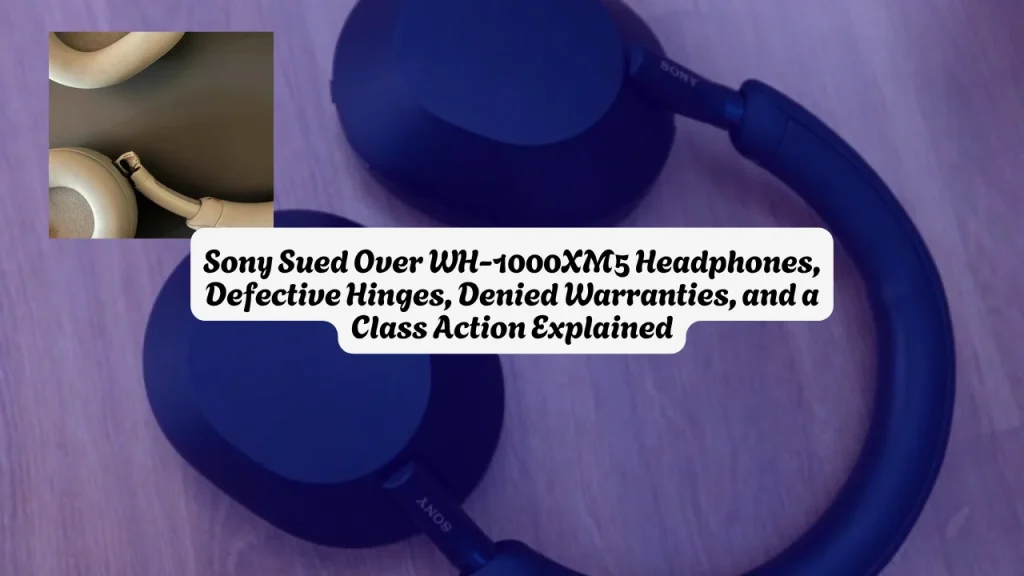
Plaintiff Ian Kanter claims the Sony WH-1000XM5 headphones contain a defect that over time causes their swiveling hinges to prematurely and unexpectedly break and fail at their “poorly secured” mounting point, eventually causing the earcups to detach from the frame.
In plain terms: the joint that connects the earcup to the headband snaps — often during ordinary daily use — leaving consumers with a $350+ pair of headphones that are entirely nonfunctional. Consumers allege that Sony refuses to offer repairs for this alleged defect, even if the headphones are still in warranty.
This is not a fringe complaint. Consumers across Reddit, Sony’s own forums, and the Better Business Bureau report cracked hinges and headbands within months of normal use, with many warranty claims denied as “cosmetic damage,” forcing consumers to pay steep repair fees.
What the Lawsuit Alleges
According to the complaint filed November 20, 2025, the WH-1000XM5 headphones were designed, manufactured, distributed, and sold by Sony Corporation of America and Sony Electronics Inc., and the lawsuit seeks to remedy violations of law in connection with Sony’s design, manufacture, marketing, advertising, selling, warranting, and servicing of the headphones.
The complaint alleges the defect is not random or the result of user error — it is structural. The result of these defects in materials and workmanship is that the swiveling of the earcups places undue stress on the hinge mechanism, causing the internal plastic to fracture, deform, separate, break, or otherwise fail and become inoperable.
Critically, plaintiffs argue Sony had prior knowledge of the problem. Kanter claims Sony has long been aware of the defect but has refused to remedy the issue or repair damaged headphones without charge, including when they are within or outside of the limited warranty period. Instead, Sony blames the defect on user-caused physical or accidental damage and refuses to repair or replace defective headphones under its warranty.
Related article: Abercrombie & Fitch Faces Class Action Over Fake Online Discounts, What Hollister Shoppers Need to Know
The complaint describes how consumers who contacted Sony directly were turned away: many consumers complaining to Sony about the defect were told that the issue was caused by user error and that Sony refused to provide complimentary repair under the limited warranty.
Industry reviews also confirm widespread complaints, and note Sony’s $370 out-of-warranty repair fee — a figure that, for many consumers, approaches or exceeds the original purchase price of a replacement pair.
What Sony Is Accused of Selling — vs. What It Actually Advertised
Sony advertises the WH-1000XM5 as “travel-ready and durable,” yet users face cracked hinges that compromise both function and aesthetics. The tension between that marketing language and the alleged real-world performance is central to the lawsuit’s consumer protection claims.
The sheer volume of similar complaints has become impossible to ignore. When scores of users report identical breaking points in the same hinge area, following the same pattern of failure, it stops looking like user error and starts looking like a design flaw. The consistency of these failures is too precise to be coincidental.
Engineering observers have pointed to a possible cause. One culprit could be Sony’s switch to recycled plastics, which, while environmentally conscious, may have compromised structural integrity — but it could also simply be the structural integrity of the hinge mechanism itself.
Related article: Charlotte MacInnes Sues Rebel Wilson for Defamation Trial Begins Today in Sydney
Sony’s Response
Sony has not publicly responded to the specific class action complaint filed by Kanter. The company’s pattern when consumers contacted support individually was to attribute hinge failures to user-caused accidental damage — a position plaintiffs in the lawsuit directly contest. No settlement offer or public statement has been made as of the date of this article.
Who Can Join — Eligibility for the Class Action
Kanter wants to represent a nationwide class and New York and Nevada subclasses of consumers who purchased Sony’s WH-1000XM5 headphones. The complaint specifically excludes purchasers in California, who may have separate state-level legal options.
To potentially qualify, you generally must have:
- Purchased Sony WH-1000XM5 headphones in the United States (outside California)
- Experienced hinge or earcup structural failure during normal use
- Had a warranty claim denied or been charged for out-of-warranty repairs
Class membership and eligibility will be formally determined by the court during the class certification process. Consumers interested in joining should contact a consumer protection attorney.
Legal Context: Why These Claims Are Legally Significant
Breach of Express Warranty means Sony allegedly failed to honor its own written warranty promise by denying valid structural defect claims and labeling them as accidental damage.
Breach of Implied Warranty of Merchantability is a more fundamental legal concept: any product sold commercially is implicitly guaranteed to work for its ordinary purpose. Headphones that break at the hinge within months of normal use allegedly fail that basic standard.
The Magnuson-Moss Warranty Act is a federal statute that governs consumer product warranties and provides consumers with legal remedies — including attorney’s fees — when a warrantor fails to honor its written warranty obligations. This is a frequently used tool in defective consumer electronics litigation.
Fraudulent Concealment goes further, alleging Sony not only had a defective product but actively hid that fact from buyers at the point of sale.
Kanter claims Sony is guilty of breach of express warranty, breach of the implied warranty of merchantability, fraudulent concealment and unjust enrichment, and of violating New York General Business Law, the Nevada Deceptive Trade Practices Act, and the Magnuson-Moss Warranty Act. The plaintiff demands a jury trial and requests injunctive relief and an award of actual, statutory, punitive, and treble damages for himself and all class members.
Treble damages — up to three times the actual harm suffered — can be awarded under certain state consumer protection statutes when deceptive trade practices are proven, significantly increasing Sony’s potential financial exposure.
The Broader Pattern: XM5 Is Not Alone
This lawsuit does not exist in a vacuum. The Sony WH-1000XM6 launched with what seemed like a solution to the XM5’s biggest flaw — a completely redesigned hinge mechanism — but Reddit is now filling with photos of broken XM6 headphones: cracked headbands, dangling earcups, separated sliders. The failures are happening sooner than the XM5s ever did, sometimes within weeks of purchase.
Consumer voices tell a consistent story. One user reported: “Hinge broke on mine just 4 months after buying them. Sony weren’t interested in replacing, so I got the hinge replaced by an independent company.” Another noted that Sony’s service center wanted more money for repairs than a new pair of headphones.
The pattern across multiple product generations — and Sony’s repeated warranty denials — forms the factual backbone of the class action’s argument that the defect is systemic and that Sony’s response has been deliberately inadequate.
Current Status & What Happens Next
The case was filed November 20, 2025 and is in its early stages. The court has not yet certified the class — a critical procedural step that determines whether this proceeds as a full class action on behalf of all affected consumers, or is narrowed in scope.
Typical next steps in a case like this include:
- Sony’s answer or motion to dismiss — Sony may challenge the legal sufficiency of the claims before the case advances to discovery
- Class certification motion — Plaintiffs will need to formally ask the court to certify a nationwide class and the state subclasses
- Discovery — Both sides exchange evidence, including internal Sony documents, consumer complaint records, engineering reports, and warranty denial data
- Possible settlement — Consumer product defect class actions frequently settle once the discovery phase reveals the full scope of internal knowledge; settlement terms typically include repair programs, refunds, or extended warranty coverage
No trial date has been set, and no settlement discussions have been publicly disclosed.
Frequently Asked Questions
What is the Sony WH-1000XM5 lawsuit about?
A consumer class action alleges that Sony’s flagship WH-1000XM5 noise-cancelling headphones contain a defective hinge that causes the earcups to crack and detach during normal use. The lawsuit further claims Sony knew about the defect and denied warranty claims by blaming consumers for damage the plaintiffs say is due to a manufacturing flaw.
How much could I receive if the case settles?
No settlement amount has been proposed or disclosed. Damages sought include actual losses (cost of repair or replacement), statutory damages, punitive damages, and treble damages under applicable state consumer protection laws. Individual recovery amounts in consumer product class actions typically vary depending on the nature of the defect and the number of class members.
Does the lawsuit cover all WH-1000XM5 buyers?
The lawsuit seeks to cover a nationwide class of purchasers, plus specific subclasses in New York and Nevada. California purchasers are explicitly excluded from this complaint, possibly due to separate California consumer protection litigation options. Class membership must ultimately be approved by the court.
Sony told me my broken hinge was my fault. What should I do?
The lawsuit directly addresses this: the complaint alleges Sony systematically attributed a manufacturing defect to user error to avoid warranty obligations. If you experienced hinge failure during normal use and were denied a warranty repair, you may be a potential class member. Document your experience and consider contacting a consumer protection attorney.
What does “treble damages” mean, and why does it matter?
Treble damages mean the court can award up to three times the actual financial harm proven. Under laws like the New York General Business Law and the Nevada Deceptive Trade Practices Act, this remedy is available when deceptive or fraudulent conduct is established. For Sony, this substantially multiplies potential liability beyond the repair or replacement cost of individual headphones.
Is there still time to join the class action?
The case is newly filed and no deadline for class members to opt in has been announced. However, statutes of limitations for consumer protection claims vary by state and can be as short as two to three years from the date of purchase or discovery of the defect. Anyone who believes they were harmed should not wait — consult an attorney to determine whether your claim is still timely.
Last Updated: April 20, 2026
This article is for informational purposes only and does not constitute legal advice. Allegations in a complaint are not findings of fact. All parties are presumed innocent unless and until proven otherwise in court.
About the Author
Israr Ahmad is a legal content researcher with 4+ years of experience covering class action settlements and consumer rights cases. He has researched and published coverage of 2,500+ settlements using verified court records, settlement administrator filings, and government sources. Learn more about Israr.
I have two pair of the headphones both broke in the same place… I have one pair of ww-XM1000 6 that broke the same way…