
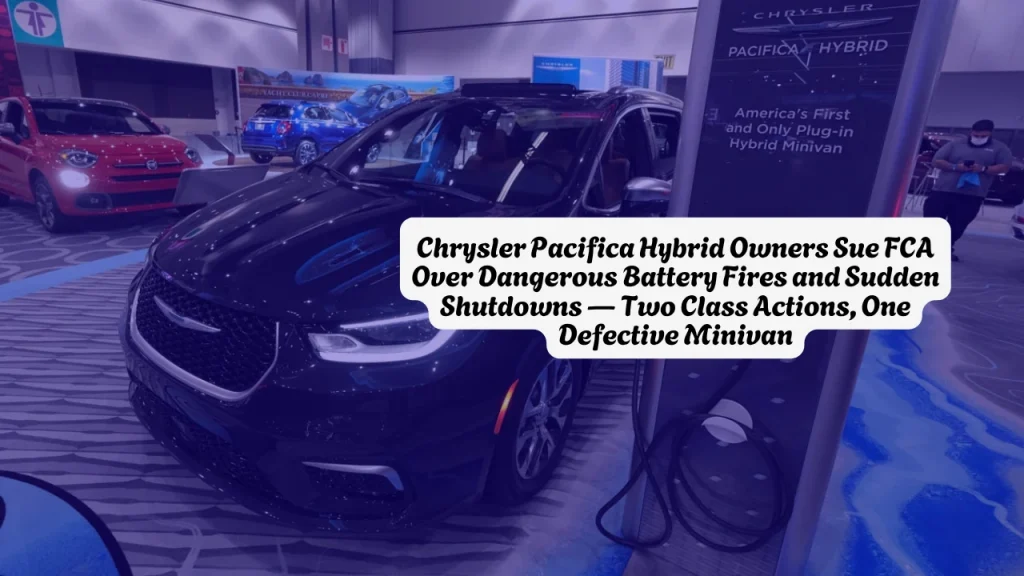
Chrysler Pacifica Hybrid Owners Sue FCA Over Dangerous Battery Fires and Sudden Shutdowns Two Class Actions, One Defective Minivan
If you own a Chrysler Pacifica Hybrid and your vehicle has unexpectedly shut down on the highway, caught fire in your driveway, or left you unable to park it safely near your home — you are not alone, and litigation is actively underway on your behalf.
A group of plaintiffs filed a class action complaint against FCA US LLC in Michigan federal court, alleging violations of state and federal consumer laws. According to the lawsuit, model year 2017–2023 Chrysler Pacifica Hybrid minivans contain a defect in the propulsion system that can cause the vehicle to experience an immediate shutdown of motive power while the vehicle is being driven. Separately, Chrysler Pacifica Hybrid battery fire lawsuits have been consolidated into one massive class action alleging a recall wasn’t good enough to prevent fires — a complaint Judge David M. Lawson described as a “massive pleading — 1,450-paragraphs spanning more than 430 pages.”
Together, these two parallel legal battles represent one of the most significant automotive safety disputes involving a plug-in hybrid vehicle in recent U.S. history.
Quick Case Snapshot: Two Active Lawsuits
Lawsuit #1 — Sudden Shutdown Defect
| Field | Details |
| Case Name | Kappes, et al. v. FCA US, LLC |
| Case Number | 23-cv-10259 |
| Court | U.S. District Court, Eastern District of Michigan, Southern Division |
| Judge | Hon. Jonathan J.C. Grey |
| Filing Date | February 1, 2023 |
| Plaintiffs | 36+ owners of 2017–2023 Pacifica Hybrid PHEVs |
| Defendant | FCA US LLC (Fiat Chrysler Automobiles) |
| Claims | Breach of warranty, fraudulent concealment, violations of state consumer protection laws, unjust enrichment |
| Damages Sought | Buyback at pre-recall Blue Book value; damages; fees |
| Current Status | Partially stayed; 12 plaintiffs sent to arbitration; lawsuit not dismissed |
Lawsuit #2 — Battery Fire Defect (MDL)
| Field | Details |
| Case Name | IN RE: Chrysler Pacifica Fire Recall Products Liability Litigation |
| Court | U.S. District Court, Eastern District of Michigan, Southern Division |
| Judge | Hon. David M. Lawson |
| Filing Date | Multiple complaints consolidated; master complaint filed November 4, 2022 |
| Plaintiffs | 69 plaintiffs across 11 consolidated lawsuits |
| Defendant | FCA US LLC |
| Claims | Product liability, fraud, breach of warranty, negligence |
| Damages Sought | Unspecified monetary damages, restitution |
| Current Status | Motion to dismiss largely denied; active litigation ongoing as of late 2025 |
The Two Defects Explained — What’s Actually Going Wrong
Defect #1: Sudden, Complete Power Loss While Driving
Over 67,000 Chrysler plug-in hybrid electric vehicles are at risk for spontaneous power loss while the vehicle is in motion, due to a serious wiring defect in the transmission of the gasoline-driven portion of the powertrain. According to a recall report filed with the National Highway Traffic Safety Administration in January 2023, 100% of 2017–2023 Chrysler Pacifica PHEVs are at risk for sudden engine shutoff due to this defect. Loss of motive power is total and comes without warning, giving drivers little or no opportunity to maneuver vehicles to safety, and can occur while moving at highway speeds.
The Chrysler Pacifica Hybrid problems are caused by internal transmission wire connectors that can short-circuit and cause the engines to lose power and shut down.
Defect #2: Spontaneous Battery Fires — Even When Parked and Turned Off
The 69 plaintiffs contend that either due to defects in their design or problems during the manufacturing process, the large battery packs built into the Pacifica Hybrid powertrains enter a “thermal runaway” condition without warning, resulting in battery fires. The fires can occur when the minivans are in motion or while they are parked, leaving owners to park away from anything that could burn.
What is thermal runaway? In plain terms, it is a chain reaction inside a lithium-ion battery where heat builds up faster than the battery can release it — leading to fire or, in severe cases, explosion. It is among the most dangerous failure modes in electric vehicle batteries.
According to the case, FCA issued a recall in February 2022 after an internal investigation revealed that at least 12 Chrysler Pacifica plug-in hybrids had spontaneously caught fire.
Related article: ICE Re-Arrests SoCal Plaintiff Vasquez Perdomo Who Sued Over LA Immigration Raids — Lawyers Allege Retaliation, Court Order Violated
What Owners Say Chrysler Knew — And When They Knew It
The central allegation in both lawsuits is not merely that the vehicles are defective — it is that FCA knew about the problems long before owners were told.
The issue was known to, and concealed by, FCA since as early as 2018. However, it wasn’t until January 9, 2023 that the automaker decided to issue a recall. FCA said it was aware of six customer assistance records, 242 warranty claims, and 59 field reports going back to February 2018 that could be related to the issue.
They are suing for breach of warranty and violations of state consumer protection acts, as well as fraudulent concealment and unjust enrichment, seeking damages, a repair of their vehicles, fees, costs, and a jury trial.
The shutdown lawsuit goes further, demanding that Chrysler should offer every customer a buyback of their minivan at the Blue Book value on the day before the recall was announced.
Were the Recalls Enough? Plaintiffs Say No.
FCA has issued multiple recalls over the years in an attempt to address both defects. Plaintiffs in both lawsuits argue those recalls have been inadequate.
On the battery fire side, the initial recall repairs — called the Z11 software — were supposed to detect problems in the batteries, but seven more battery fires were reported. Chrysler then created new software, which became available in December 2024. If a problem is detected, a dealer will replace the battery for free. FCA told the judge there are no known battery fires since the 73B repairs were performed.
However, plaintiffs push back on this framing. The lawsuit claims the February 2022 recall left Chrysler Pacifica drivers with vehicles that are “nearly useless” and pose a significant safety risk, arguing that FCA has “done little more” than warn drivers not to use their vehicles as advertised.
On the fire risk front, the situation is made more alarming by a second recall history. A 2020 recall involved more than 27,000 2017–2020 Pacifica PHEVs whose 12-volt batteries had a poor electrical connection that could also cause a fire. Owners of 2017–2018 models are uniquely exposed — facing both the fire defect and the shutdown defect simultaneously.
Where Things Stand in Court Right Now
Shutdown Lawsuit — Partially Paused
The judge granted FCA’s motion to compel arbitration for 12 plaintiffs but denied the motion to dismiss the class action lawsuit. For the remaining plaintiffs, the class action lawsuit is stayed for now.
Arbitration is a private dispute resolution process outside of court. It typically favors defendants in consumer cases, which is why plaintiffs’ attorneys often fight to keep cases in court. The fact that the judge refused to dismiss the broader lawsuit is a meaningful win for remaining plaintiffs.
Battery Fire Lawsuit — Actively Progressing
A class action lawsuit being debated in a Michigan courtroom will continue into Chrysler Pacifica Hybrid problems that have caused two recalls and a government investigation. Fiat Chrysler filed a motion to dismiss the lawsuit but the judge allowed the majority of the claims to continue, including common law fraud claims which FCA argues are time barred.
FCA argues the plaintiffs must show their Pacifica Hybrids have defective batteries, something most of the plaintiffs cannot do, saying “It isn’t until the plaintiff’s own product manifests the defect that he is injured. Until that point, he has necessarily received the benefit of his bargain and has not overpaid.” The automaker also says the lawsuit should be thrown out because even for four of the plaintiffs who did have battery problems, those batteries were replaced for free.
Who Is Eligible to Join These Lawsuits?
Shutdown Lawsuit (Kappes v. FCA): You may qualify if you own or leased a 2017–2023 Chrysler Pacifica Plug-In Hybrid Electric Minivan and experienced sudden, unexpected power loss while driving — or if you purchased the vehicle without being told about this known risk.
Battery Fire Lawsuit (IN RE: Chrysler Pacifica Fire Recall): You may qualify if you own or owned a 2017–2021 Chrysler Pacifica Plug-In Hybrid and experienced battery fires, were unable to park or charge your vehicle safely, or suffered vehicle damage or diminished resale value as a result of the fire risk.
Both Hagens Berman Sobol Shapiro LLP and The Miller Law Firm are representing plaintiffs. There is no cost or fee involved in joining the case. In the event any firm obtains a settlement that provides benefits to class members, the court will determine and award reasonable fees and costs to the legal team.
FCA’s Position
FCA has denied that its recall repairs were insufficient and has repeatedly sought to have both lawsuits dismissed or routed to private arbitration. On the battery fire litigation, FCA argues the plaintiffs must show their Pacifica Hybrids have defective batteries, something most of the plaintiffs cannot do, and that the lawsuit should be thrown out because batteries were replaced for free for those who did experience problems. FCA has not made detailed public statements disputing the core defect allegations but maintains that its recall program has addressed the safety concerns.
What Makes This Case Unusually High-Stakes
This litigation sits at the intersection of EV battery safety, consumer fraud law, and the growing legal scrutiny of how automakers handle known defects before issuing recalls.
The class action lawsuit in the U.S. makes the argument in legal terms that the gap between FCA’s marketing language and the actual data practices of the product constitutes false advertising, and that consumers were deprived of the ability to make an informed choice about whether to purchase the product. The same logic applies here: buyers of a family minivan marketed as a safe, green vehicle had no knowledge they were purchasing a product already generating hundreds of internal complaints.
A comparable case provides a benchmark for potential damages: Hagens Berman achieved a $1.3 billion settlement in a lawsuit against Hyundai and Kia relating to a fire hazard defect. That case involved similar allegations — a fire risk the automaker knew about and failed to adequately disclose to consumers.
What Happens Next
Both cases remain in active litigation. Key upcoming steps include:
In the shutdown lawsuit, the arbitration proceedings for the 12 diverted plaintiffs will run their course, and the remaining claims are expected to resume once those are resolved. Class certification — the formal step that allows the lawsuit to represent all affected owners — has not yet been granted.
In the battery fire MDL, with FCA’s motion to dismiss largely denied, the parties are likely heading deeper into discovery (the formal evidence-gathering phase) and eventually toward class certification and potential settlement talks.
No settlement has been announced in either case. Given the scale of vehicles involved — over 67,000 affected by the shutdown risk alone — any settlement would likely be substantial. Affected owners should register their interest with counsel now, as claim procedures and deadlines will be established once class certification is granted.
Frequently Asked Questions
Which Pacifica Hybrid models are affected?
The shutdown defect covers 2017–2023 Chrysler Pacifica Plug-In Hybrid Electric Minivans. The battery fire defect primarily covers 2017–2021 models. Owners of 2017–2018 vehicles may be affected by both defects simultaneously.
Has any settlement been reached?
No settlement has been publicly announced in either active lawsuit as of April 2026. The battery fire MDL and the shutdown class action are both ongoing. This page will be updated when a settlement is reached.
Can I still join if my vehicle was repaired under recall?
Potentially yes. FCA argues the lawsuit should be thrown out because batteries were replaced for free — but plaintiffs counter that the recall repairs were inadequate and that diminished vehicle value, inconvenience, and safety anxiety are compensable harms regardless of whether a repair was performed.
What if I signed an arbitration agreement when I bought my vehicle? This is critical. The judge granted FCA’s motion to compel arbitration for 12 plaintiffs who signed sales contracts that included valid arbitration agreements. If your purchase contract included an arbitration clause, your path to the class action may be limited. Consult a consumer or lemon law attorney to understand your individual rights.
What damages could I recover?
The shutdown lawsuit seeks a full buyback at pre-recall Blue Book value. The battery fire litigation seeks monetary damages and restitution. The exact amount any individual could recover depends on class certification, the number of valid claims filed, and any eventual settlement or jury verdict.
Is this the same as the non-hybrid Pacifica shutdown issue?
These lawsuits specifically cover the Plug-In Hybrid (PHEV) versions. A separate NHTSA investigation was opened in February 2024 into non-hybrid Pacifica models experiencing similar shutdown issues, but that is a distinct matter from the active litigation covered here.
Last Updated: April 19, 2026
This article is for informational purposes only and does not constitute legal advice. Allegations in a complaint are not findings of fact. All parties are presumed innocent unless and until proven otherwise in a court of law. If you believe you are affected, consult a qualified attorney to understand your individual rights.
About the Author
Israr Ahmad is a legal content researcher with 4+ years of experience covering class action settlements and consumer rights cases. He has researched and published coverage of 2,500+ settlements using verified court records, settlement administrator filings, and government sources. Learn more about Israr.