
Judge Rules Uber Owes ‘Non-Delegable Duty’ to Passengers in Sexual Assault MDL Legal Setback for the Ride-Hailing Giant
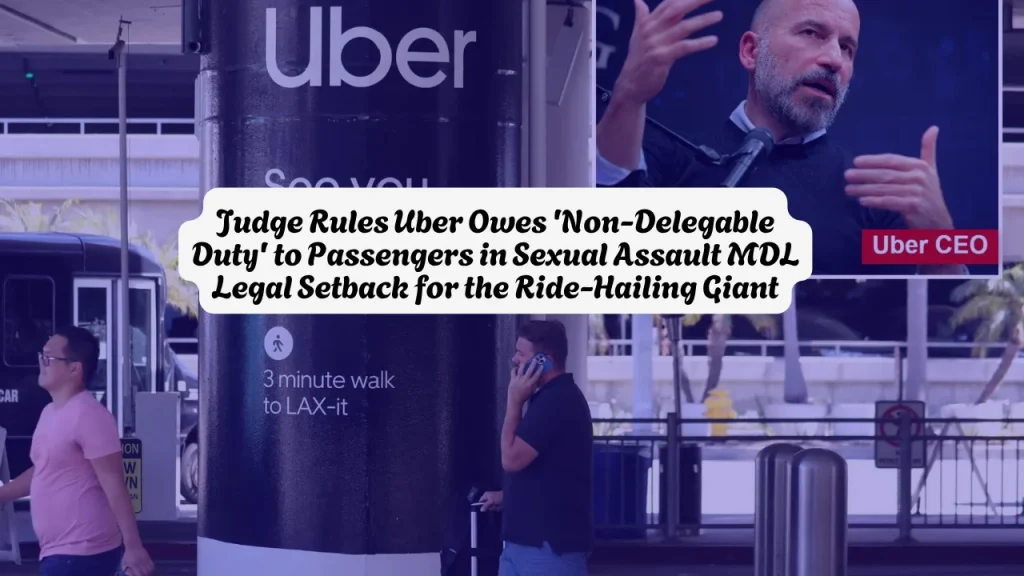
A federal judge dealt a major blow to Uber’s central legal defense on April 10, 2026, ruling that the ride-hailing company is a “common carrier” and therefore cannot escape liability for a driver’s sexual assault of a passenger by claiming it is merely a technology platform. The decision — issued in a bellwether case inside one of the largest personal injury MDLs in U.S. history — has sweeping implications for more than 3,000 pending lawsuits against the company.
Quick Case Snapshot
| Field | Detail |
| Plaintiff | WHB 823 (identity protected by pseudonym; North Carolina woman) |
| Defendant | Uber Technologies, Inc.; Rasier, LLC; Rasier-CA, LLC |
| Court | U.S. District Court, Northern District of California |
| MDL Case No. | 3:23-MD-03084 |
| Ruling Date | April 10, 2026 |
| Presiding Judge | U.S. District Judge Charles R. Breyer |
| Claims Alleged | Negligence; common carrier non-delegable duty; vicarious liability |
| Damages Sought | Not yet disclosed (trial pending) |
| Current Status | Summary judgment granted on common carrier issue; trial set for April 2026 |
What Just Happened — And Why It Matters
A California federal judge ruled on April 10, 2026 that Uber is a “common carrier” and thus owed a “non-delegable duty” to safely transport a woman who alleged that a driver on its platform sexually assaulted her — rejecting the ride-hailing company’s contention that it doesn’t carry passengers but merely connects them to others who independently provide transportation.
The ruling came in the case of plaintiff WHB 823, the second bellwether (test) case selected for trial in the massive federal MDL (multidistrict litigation) consolidating passenger sexual assault lawsuits against Uber nationwide.
The plaintiff, identified as WHB 823, alleges that an Uber driver in Wake County, North Carolina, sexually touched her thigh during a March 26, 2019, ride and made an inappropriate comment when the trip ended. She is pursuing a claim against Uber based on the theory that Uber, as a common carrier, had a non-delegable duty to provide safe transportation.
What the Lawsuit Alleges
According to court filings, the plaintiff booked a ride through the Uber app in Raleigh, North Carolina, in March 2019. When the plaintiff tried to exit her Uber, the driver grabbed her thigh and made sexualized comments. She filed suit in August 2024, asserting that Uber’s failure to adequately screen and oversee its drivers directly enabled the assault.
The plaintiff’s legal theory rests on a single but powerful claim: under North Carolina law, common carriers owe non-delegable duties to provide transportation safely and such duties are breached when the driver assaults a passenger.
This matters enormously because Uber has long argued that its drivers are independent contractors — not employees — and therefore the company cannot be held responsible for their actions. The non-delegable duty theory bypasses that argument entirely: it holds that certain safety obligations cannot be handed off to a third party, regardless of employment classification.
Uber’s Defense — And Why the Judge Rejected It
Uber filed its own motion for summary judgment on the same question, asserting it is not a common carrier and has no such heightened duty. The company has consistently maintained in this litigation and others that it is a technology platform connecting riders with independent transportation providers — not a transportation company itself.
Judge Breyer’s opinion focused on the fact that Uber did not contest the plaintiffs’ allegation that it is a “common carrier.” That concession was important for two reasons. First, California’s Civil Code imposes a duty on common carriers to use the utmost care and diligence for passengers’ safe carriage. Second, a 1952 California Supreme Court decision held that a common carrier’s duties are non-delegable.
Related article: Sony Sued Over WH-1000XM5 Headphones, Defective Hinges, Denied Warranties, and a Class Action Explained
Where a duty is non-delegable, one cannot avoid liability by claiming that discharge of the duty was somebody else’s responsibility. In short, even if Uber’s drivers are independent contractors, the company cannot legally outsource its duty to keep passengers safe.
As of publication, Uber has not issued a public statement specifically addressing the April 10 ruling.
The Bigger Picture — What This MDL Involves
This ruling does not stand alone. It is the latest in a series of escalating legal developments in one of the most closely watched personal injury MDLs in the country.
As of April 2026, the active case count for MDL No. 3084 — In re Uber Technologies, Inc., Passenger Sexual Assault Litigation — stands at 3,391, pending before U.S. District Judge Charles Breyer of the Northern District of California.
Uber’s own safety reports document 12,522 sexual assault reports across 2017–2022 in the five most severe categories. Plaintiffs argue this internal data shows Uber knew about the systemic risk to passengers and failed to act.
The MDL’s first bellwether trial — the case of Jaylynn Dean of Arizona, who alleged she was raped by an Uber driver in November 2023 — resulted in an $8.5 million verdict in compensatory damages in early February 2026, with no punitive damages awarded. The jury ruled that while Uber was not liable for failing to provide adequate safety features, it was responsible for the driver’s actions because he was acting as an agent of the company.
Legal Context: What Is a ‘Common Carrier’ and a ‘Non-Delegable Duty’?
For readers unfamiliar with these legal terms, here is what they mean in plain language:
Common Carrier
A common carrier is any business that offers transportation services to the general public for a fee — think buses, taxis, trains, and now ride-hailing apps. Under the law, common carriers are held to a higher standard of care than ordinary businesses precisely because passengers place their physical safety entirely in the carrier’s hands.
Non-Delegable Duty
A non-delegable duty means the legal obligation is so fundamental that the company cannot escape responsibility by pointing to someone else — like a contractor or a driver — as the responsible party. Even if an Uber driver is technically an independent contractor, Uber cannot use that classification as a legal shield against liability for a passenger’s assault.
Judge Breyer’s ruling emphasized that common carrier status creates non-delegable duties, meaning Uber cannot escape liability by claiming drivers are independent contractors.
It is worth noting that outcomes vary by state. California plaintiffs can pursue claims based on Uber’s status as a common carrier with non-delegable safety duties to passengers. Texas plaintiffs face limitations under state TNC (Transportation Network Company) statutes unless they prove gross negligence with clear and convincing evidence.
Current Status & What Happens Next
The April 10 ruling resolves a critical pre-trial legal question: Uber is liable under the common carrier theory as a matter of law in the WHB 823 case. The remaining factual questions — including the specific circumstances of the alleged assault and the extent of damages — are now set to go before a jury.
Judge Breyer is considering having 12 jurors for the upcoming WHB 823 trial, and proposed that at least nine jurors would be sufficient to reach a verdict rather than requiring a unanimous decision.
Judge Breyer has outlined five waves of bellwether trials, with 20 representative cases in each wave, each to be tried individually — the court denied requests for consolidated trials.
If no global settlement is reached, individual cases will eventually be remanded to their home districts across the country for trial. Legal experts project settlements of $300,000–$2 million per case depending on assault severity and evidence, with a court-approved qualified settlement fund already in place.
Are You Eligible to File a Claim?
Survivors of sexual assault during Uber rides may be eligible to file a lawsuit if they experienced sexual assault, harassment, rape, or other sexual misconduct during an Uber ride; the incident involved an Uber driver during a trip booked through the app; police reports, medical records, or other documentation support the claims (though these may not always be required); and the claim is filed within applicable time limits, which vary by state and many of which have been extended for sexual assault claims.
Important: Uber’s Terms of Service include arbitration clauses. An attorney can help determine whether a case can proceed in court or must go to arbitration. Many cases have been diverted out of the MDL for this reason — legal counsel is essential before taking action.
Frequently Asked Questions
What did the judge actually rule on April 10, 2026?
The judge ruled that Uber qualifies as a “common carrier” under North Carolina law and therefore owed a non-delegable duty to safely transport the plaintiff — meaning Uber cannot legally excuse itself from liability by pointing to the driver as an independent contractor.
Does this ruling apply to all cases in MDL 3084?
Not automatically. The ruling is specific to the WHB 823 bellwether case and North Carolina law. However, it strengthens the legal framework plaintiffs use in all states that recognize common carrier status for ride-hailing companies. Similar rulings have already been issued for California and other states within the same MDL.
What is the MDL, and how does it affect individual lawsuits?
An MDL (multidistrict litigation) consolidates thousands of similar federal cases before a single judge for coordinated pre-trial proceedings, including discovery and rulings on shared legal questions. Individual cases are not merged — each plaintiff retains their own lawsuit and potential recovery.
How much have victims received so far?
The first bellwether trial resulted in an $8.5 million compensatory damages verdict in February 2026. Legal experts project individual settlements in the range of $300,000–$2 million depending on case facts and evidence.
What is the deadline to file a claim?
Deadlines vary by state. Many states have enacted extended statutes of limitations specifically for sexual assault claims. Potential plaintiffs should consult an attorney immediately, as deadlines may be stricter than they appear.
What happens if Uber loses multiple bellwether trials?
Strong verdicts in bellwether trials typically increase pressure on defendants to reach a global settlement rather than risk jury trials on thousands of individual cases. The $8.5 million first verdict has already been cited as increasing the settlement value of remaining cases.
Last Updated: April 20, 2026
This article is for informational purposes only and does not constitute legal advice. Allegations in a complaint are not findings of fact. All parties are presumed innocent unless and until proven otherwise in court.
About the Author
Israr Ahmad is a legal content researcher with 4+ years of experience covering class action settlements and consumer rights cases. He has researched and published coverage of 2,500+ settlements using verified court records, settlement administrator filings, and government sources. Learn more about Israr.