
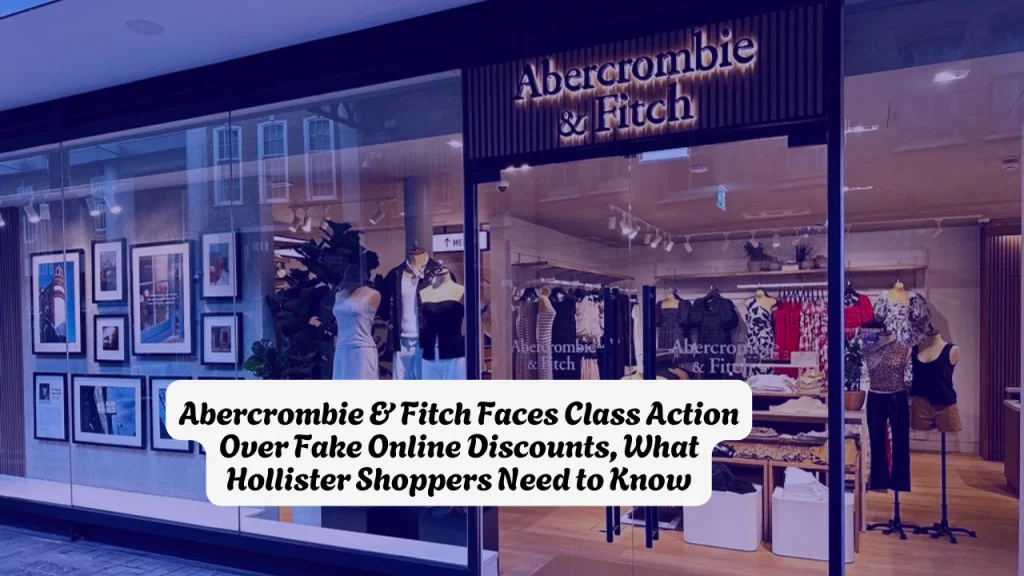
Abercrombie & Fitch Faces Class Action Over Fake Online Discounts, What Hollister Shoppers Need to Know
A California federal judge has ruled that Abercrombie & Fitch must stand trial over allegations that its Hollister brand systematically deceived online shoppers with fake “sale” prices — and the company’s attempt to quietly kill the case through arbitration has already failed.
The lawsuit, which targets a pricing practice used across the entire Hollister website, could affect millions of consumers who believed they were snagging a bargain, only to have allegedly paid the product’s real everyday price all along.
Quick Case Snapshot
| Field | Detail |
| Plaintiff | Rebeka Rodriguez, individually and on behalf of all others similarly situated |
| Defendant | Abercrombie & Fitch Trading Co. (d/b/a www.hollister.com) |
| Court | U.S. District Court, Southern District of California |
| Case Number | 3:25-cv-01890-JES-DEB |
| Original Filing | June 24, 2025 (California Superior Court, San Diego County; removed to federal court July 25, 2025) |
| Judge | U.S. District Judge JES-DEB (Southern District of California) |
| Claims Alleged | Violation of California Business & Professions Code § 17501 (false reference pricing); violation of California Consumers Legal Remedies Act (CLRA), Cal. Civil Code § 1750 et seq. |
| Damages Sought | Damages, restitution, injunctive relief; jury trial demanded |
| Current Status | Motion to compel arbitration and motion to dismiss both denied; case proceeding as class action |
The Core Deception: What Hollister Is Accused of Doing
Plaintiff Rebeka Rodriguez claims Hollister advertises fictitious regular prices and corresponding phantom discounts on products sold through its website.
The tactic at the center of the lawsuit is known as “strike-through pricing” — a common retail technique where a higher “original” or “reference” price appears crossed out next to a lower current price, signaling to the shopper that they are saving money. The lawsuit alleges this entire premise was a fabrication on Hollister’s website.
Rodriguez claims she purchased a short-sleeve crew baby tee from Hollister’s website on March 4, 2025, for what she believed was a discounted price of $6.99. The website compared this price to a “strike-through” reference price of $14.95, suggesting a significant discount.
But according to the complaint, that $14.95 “original” price was never a real price. The lawsuit claims the reference price was not the “prevailing market price” in the 90 days preceding her purchase, and the advertisement did not clearly state when the reference price was the prevailing market price. The reference price is therefore an artificially inflated price, making the advertised discounts nothing more than phantom markdowns.
In plain terms: the “sale” was not a sale. The discount was manufactured.
What the Complaint Alleges Against Hollister
The complaint alleges that Hollister advertises fictitious regular prices and corresponding phantom discounts on products sold through its website at www.hollister.com. This practice allows the defendant to fabricate a fake “reference price” and present the actual price as “discounted” when it is not. The result is a sham price disparity that is per se illegal under California law.
The lawsuit further alleges that Hollister was fully aware of what it was doing. Rodriguez claims Hollister knows that the prices for its products are fake and intentionally structured its website to induce purchases by creating a false sense of urgency and perceived value.
Related article: $15.2M Valsartan, Losartan & Irbesartan Contamination Settlement, Are You Eligible? Claim Deadline is June 2, 2026
The complaint was brought under California consumer protection laws, including false advertising and consumer remedies statutes, and seeks to represent a broader class of shoppers who purchased discounted items under similar conditions.
Rodriguez requested a jury trial, damages, restitution, and injunctive relief to prevent Hollister from continuing to use its alleged deceptive pricing practices.
Key Court Ruling: Abercrombie Loses Its First Fight
Before the case could even proceed to discovery, Abercrombie & Fitch mounted an aggressive early defense — attempting to eliminate the lawsuit on two fronts simultaneously. Both efforts failed.
A US district court denied attempts by Abercrombie & Fitch, operating as Hollister, to compel arbitration in the consumer lawsuit alleging deceptive pricing practices, allowing the case to move forward as a potential class action.
Compelling arbitration is a strategy large retailers frequently use to route consumer disputes away from public courts and into private arbitration proceedings, which typically have lower payouts, less transparency, and no jury. The court’s refusal to allow this is a meaningful early victory for the plaintiff and the potential class.
With arbitration denied, the case against Hollister will proceed in court, potentially increasing legal exposure for the retailer and adding to ongoing regulatory and legal pressure around promotional pricing transparency in e-commerce.
Abercrombie & Fitch’s Position
Abercrombie & Fitch has not issued a public statement specifically addressing the substance of the lawsuit’s allegations. The company’s litigation strategy — attempting to compel arbitration and dismiss the case — signals a denial of liability, as does the company’s implicit position that its pricing practices comply with applicable law. No settlement offer has been publicly disclosed.
The Law Behind the Lawsuit: California’s Strike-Through Pricing Rules
California has some of the strictest consumer pricing laws in the country, and they sit at the heart of this case.
California Business and Professions Code section 17501 governs advertisements that reference a “former,” “original,” “regular,” or “compare at” price. The statute is designed to prevent deceptive pricing practices that mislead consumers into believing they are receiving a discount when, in reality, the reference price was never a bona fide price. Under section 17501, a former or original price must reflect the actual, prevailing market price of the product — meaning the reference price must be one at which the product was openly and actively offered for sale for a reasonably substantial amount of time.
The 90-day rule is the critical standard: if a product was not offered for sale at the former price within the immediately preceding 90 days, the advertisement must clearly disclose the date when that price was last in effect to avoid a technical violation of the statute.
The lawsuit also invokes the California Consumers Legal Remedies Act (CLRA), one of the most powerful consumer protection tools in any state. The CLRA provides for actual damages, punitive damages, attorney’s fees, and mandatory injunctive relief when deceptive conduct in consumer transactions is proven.
Why This Matters Beyond One T-Shirt Purchase
The Hollister case is not an isolated incident. It reflects a broader and accelerating legal trend targeting fake discount practices across e-commerce.
California is setting the pace and raising the stakes for online retailers facing deceptive pricing class actions, with recent cases and enforcement actions turning reference pricing from a clever marketing tool into a major legal risk. As plaintiff firms and regulators sharpen their focus on fake discounts, strike-through pricing, and algorithmic surveillance pricing, brands that sell into California now need to treat pricing disclosures like high-risk compliance territory, not just marketing copy.
The ruling puts Abercrombie & Fitch and its Hollister brand under closer legal and public scrutiny at a time when the company is working to reposition around inclusivity and authenticity. Any court findings on how its online discounts were presented could influence how retailers across the sector think about reference pricing.
The reputational dimension is significant. A brand’s pricing credibility is foundational to consumer trust — and for a youth-facing lifestyle brand like Hollister, the allegation that its “sales” aren’t real sales is particularly damaging to the image it projects.
What This Means for Hollister Shoppers — Could You Qualify?
The lawsuit seeks to represent a class of California consumers who purchased items from Hollister’s website under conditions similar to Rodriguez’s — believing they were receiving a genuine discount based on a strike-through reference price that was allegedly never a real market price.
To potentially qualify as a class member, you would generally need to have:
- Purchased a product from www.hollister.com while residing in California
- Made the purchase while a strike-through reference price was displayed
- Reasonably believed you were receiving a genuine discount
Class membership will be formally determined once the court rules on class certification — a procedural step that has not yet occurred. Consumers who believe they may have been affected should document their purchases and consider consulting a consumer protection attorney.
Current Status & What Happens Next
The case is past its first major hurdle. Abercrombie’s motions to dismiss and compel arbitration have been denied, and the case is now proceeding toward class certification and discovery in the Southern District of California.
The typical roadmap from here includes:
- Class certification motion — Rodriguez must formally ask the court to certify a class of all similarly situated Hollister shoppers. This is often the most contested phase of consumer class actions.
- Discovery — Both sides will exchange evidence, including Hollister’s internal pricing data, historical price records, website analytics, and internal communications about its promotional strategy.
- Possible settlement — Deceptive pricing class actions in California frequently settle once defendants calculate the full scope of potential liability across thousands or millions of transactions. Settlements in similar cases have required retailers to change pricing practices and provide compensation to affected buyers.
- Trial — If no settlement is reached, the case proceeds to a jury trial on the merits.
No trial date has been set and no settlement has been announced.
The Bigger Industry Picture: Fake Discounts Are Under Siege
The Hollister lawsuit fits squarely inside a wave of consumer litigation targeting exactly this kind of pricing sleight of hand. Retailers from fast fashion to luxury brands have long used inflated reference prices to make everyday pricing look like a deal. Courts and regulators are increasingly treating this as fraud, not just aggressive marketing.
The Federal Trade Commission issued its Rule on Unfair or Deceptive Fees, effective May 12, 2025, requiring that in certain types of transactions all mandatory charges must be disclosed in the advertised total price, and prohibiting misleading fee disclosures. While that rule currently focuses on live-event tickets and lodging, the FTC has signaled broader enforcement authority over deceptive pricing practices generally — and state attorneys general in California, New York, and other states are actively pursuing similar enforcement actions against retailers.
For Abercrombie & Fitch specifically, the case arrives at a moment when the company has been working hard to rebuild its brand image after years of controversy. A public finding that its signature brand misled millions of shoppers about its prices would cut directly against that narrative.
Frequently Asked Questions
What exactly is Hollister accused of doing?
The lawsuit alleges that Hollister displayed artificially inflated “original” prices next to lower current prices on its website, using a crossed-out or “strike-through” format to suggest shoppers were receiving a meaningful discount. Plaintiffs claim the higher reference prices were never genuine market prices and therefore the “discounts” were entirely fabricated, violating California consumer protection law.
Did I have to pay extra hidden fees at checkout?
This particular case is not about surprise fees added at the end of a transaction in the traditional sense. Instead, it targets deceptive reference pricing — the practice of showing a fake “original” price to make the actual price appear discounted. Under California law, this qualifies as a deceptive and unlawful pricing practice.
What is the 90-day rule, and why does it matter?
Under California Business & Professions Code § 17501, any “original” or “former” price displayed in an advertisement must have been the genuine prevailing market price for the product within the 90 days before the ad runs. If it was not, the retailer must disclose the last date that price was in effect. Hollister allegedly failed to meet either requirement.
Has a court ruled against Abercrombie & Fitch yet?
No judgment on the merits has been issued. What the court has ruled is that Abercrombie cannot force this dispute into private arbitration and cannot have the complaint dismissed at this early stage. The substantive question — whether Hollister’s pricing was deceptive — will be decided later, either at trial or through a settlement.
Could I receive money from a settlement or verdict?
Potentially, if you are a California resident who purchased from Hollister’s website under similar conditions. No settlement has been announced and no damages have been awarded yet. Class membership must be formally certified by the court before any recovery becomes possible.
Is Hollister the only brand involved?
The named defendant is Abercrombie & Fitch Trading Co., operating through www.hollister.com. The lawsuit as filed targets Hollister’s online pricing practices specifically. It does not, as currently filed, extend to Abercrombie.com or other Abercrombie & Fitch brands.
Last Updated: April 20, 2026
This article is for informational purposes only and does not constitute legal advice. Allegations in a complaint are not findings of fact. All parties are presumed innocent unless and until proven otherwise in court.
About the Author
Israr Ahmad is a legal content researcher with 4+ years of experience covering class action settlements and consumer rights cases. He has researched and published coverage of 2,500+ settlements using verified court records, settlement administrator filings, and government sources. Learn more about Israr.