
ICE Re-Arrests SoCal Plaintiff Vasquez Perdomo Who Sued Over LA Immigration Raids — Lawyers Allege Retaliation, Court Order Violated
A man who helped bring a landmark federal class action lawsuit against the Trump administration’s immigration raids in Los Angeles has been arrested by ICE for the second time — this time while the lawsuit he helped file is still active in court.
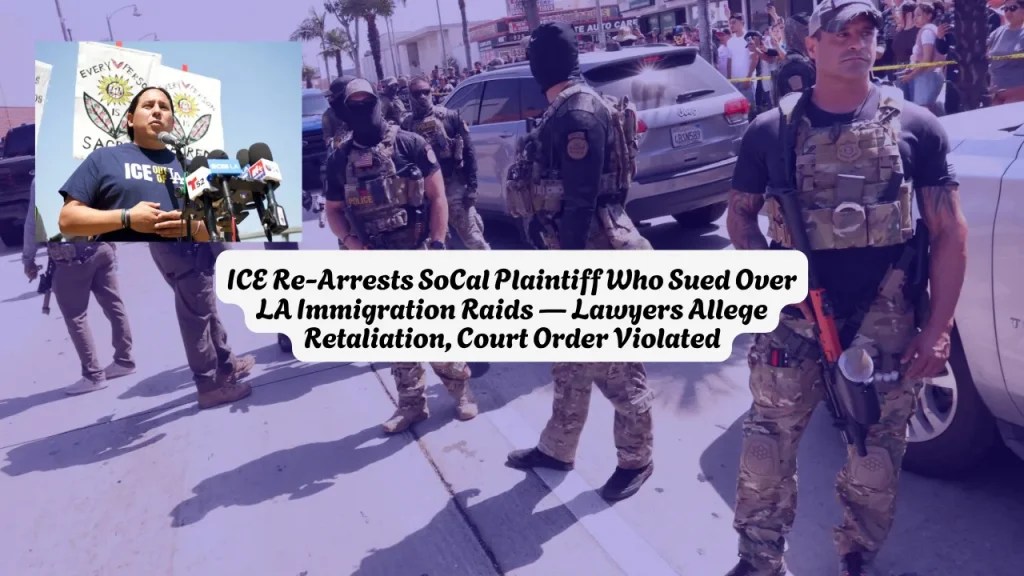
Isaac Villegas Molina, a plaintiff in the federal class action Vasquez Perdomo v. Mullin, was arrested and jailed by ICE on Thursday, April 16, 2026, without notice, in apparent violation of an immigration judge’s order last summer releasing him on bond. His immigration attorney filed an emergency habeas petition in federal court the same day demanding his release, and advocacy groups held a rally at the detention site the following morning. The arrest has drawn immediate condemnation from civil liberties lawyers who are calling it unlawful retaliation against a man who dared to sue the federal government.
Quick Case Snapshot
| Field | Detail |
| Case Name | Vasquez Perdomo v. Mullin (formerly Vasquez Perdomo v. Noem) |
| Case Number | 2:25-cv-05605-MEMF-SP |
| Court | U.S. District Court, Central District of California |
| Presiding Judge | Hon. Maame Ewusi-Mensah Frimpong |
| Original Filing Date | June 20, 2025 |
| Plaintiff Re-Arrested | Isaac Antonio Villegas Molina |
| Date of Re-Arrest | April 16, 2026 |
| Where Held | B-18 detention facility / Adelanto ICE Processing Center, Los Angeles |
| Emergency Legal Filing | Habeas corpus petition, filed April 16, 2026 by attorney Stacy Tolchin |
| Defendants | DHS Secretary Kristi Noem; Acting ICE Director Todd Lyons; AG Pam Bondi; multiple regional ICE, CBP, and FBI officials |
| Core Claims | Fourth Amendment violations, warrantless arrests, racial profiling, denial of counsel, inhumane detention conditions |
| Relief Sought | Injunctive relief, declaratory relief, class certification, fees and costs |
| Current Status | Active litigation; plaintiff re-detained; habeas petition pending |
Who Is Isaac Villegas Molina — And Why Does His Arrest Matter?
Isaac Villegas is an immigrant worker who became a civil-rights leader as one of several people who came forward to challenge the Trump administration’s immigration raids across the Los Angeles area. After his unlawful arrest and incarceration last June, Isaac and other day laborers brought a class action lawsuit in federal court challenging the LA raids. He has since spoken out about his unconstitutional treatment by ICE, hoping to prevent others from being harmed as he was.
In the early morning of June 18, 2025, in Pasadena, California, Villegas Molina was waiting to be picked up for work with his co-workers. When federal agents approached, an agent yelled at Villegas Molina not to run, even though he was still and calm. He was told to provide his identification, and he provided his California ID, but the agent kept questioning him. No warrant was shown. Agents did not inform Villegas Molina that they were immigration officers authorized to make an arrest or of the basis for his arrest.
He was then transported to B-18 — a makeshift detention facility in the basement of a federal building in downtown Los Angeles — where he and the other initial plaintiffs filed the lawsuit that would grow into one of the most significant immigration cases in the country. An immigration judge released him on bond last summer, finding he posed no danger and was not a flight risk.
Now, months after that release, he has been taken into custody again.
What Happened on April 16, 2026
According to advocacy group NDLON, ICE detained Isaac Villegas Molina at a routine check-in and he is now being held at the Adelanto ICE Processing Center. The arrest occurred without advance notice and, according to his legal team, without any indication that he had violated any condition of his bond or done anything wrong.
His immigration attorney Stacy Tolchin on Thursday April 16 filed a habeas petition in federal court challenging his unlawful incarceration and demanding his immediate release.
A habeas corpus petition is a legal demand that the government justify why it is holding a person in custody. It is one of the oldest and most fundamental protections in the American legal system, and it can result in a federal judge ordering a person’s immediate release if the detention is found to be unlawful.
Related article: Former Amazon Employees Sue Over Alleged Systematic Underpayment of Women Through Job Misclassification
What Lawyers Are Saying: “Shocking Retaliation”
The legal response was swift and pointed. Three different attorneys went on record with language that went well beyond standard legal filings.
Stacy Tolchin, Mr. Villegas’ immigration attorney, said: “Mr. Villegas was released from detention because a judge determined he was not a danger or flight risk. Since then he has diligently pursued his immigration case and complied with all of ICE’s requirements. ICE’s redetention of Mr. Villegas without notice, explanation, or indication that he did anything wrong violates his constitutional right to due process.”
Mohammad Tajsar, a lawyer with the ACLU of Southern California, said: “It is a shocking act of retaliation for the federal government to arrest someone who has courageously dared to call out the government’s unlawful immigration raids. Because the First Amendment protects everyone’s right to sue the government, we expect Isaac to be released immediately.”
Lauren Michel Wilfong, a lawyer with the National Day Laborer Organizing Network, said: “We demand Isaac Villegas’s immediate release. When Isaac and other unjustly targeted immigrant workers decided to bring the Vasquez Perdomo lawsuit, they bravely stood up not just for themselves but for the Constitutional rights of all people.”
If the retaliation allegation holds, it would represent a serious constitutional violation. The First Amendment protects the right to petition the government — including through litigation — and courts have consistently held that government retaliation against someone for exercising that right is itself unconstitutional.
Background: The Vasquez Perdomo Class Action
To understand why this re-arrest has generated immediate legal and political alarm, it helps to understand what the underlying lawsuit is about and how far it has already reached.
Filed on July 2, 2025, in the U.S. District Court for the Central District of California, the amended complaint in Vasquez Perdomo v. Noem seeks to halt what plaintiffs describe as unconstitutional and racially targeted immigration enforcement actions across Los Angeles, Orange County and surrounding areas. The lawsuit was filed on behalf of individuals stopped and detained in the raids, as well as labor and immigrant rights groups including the Los Angeles Worker Center Network, United Farm Workers, Coalition for Humane Immigrant Rights, and Immigrant Defenders Law Center.
The amended complaint details allegations including stops based on racial profiling, warrantless arrests, denial of access to counsel, and inhumane conditions in the notorious B-18 holding facility in downtown Los Angeles. Plaintiffs are seeking injunctive relief to stop further violations and certification of several plaintiff classes corresponding to the government’s stop-and-arrest practices.
Joining the suit in favor of the plaintiffs are multiple immigration advocacy groups, Los Angeles County, and the cities of Los Angeles, Pasadena, Santa Monica, Culver City, Pico Rivera, Montebello, Monterey Park, and West Hollywood.
The case scored a major early win. The 9th U.S. Circuit Court of Appeals upheld maintaining a temporary restraining order against indiscriminate immigration stops and arrests in seven Southern California counties, including LA.
The Government’s Position
The federal government has denied the core allegations of the lawsuit. Homeland Security denied all the claims in the lawsuit, saying that any accusations of racial profiling are “disgusting and categorically false.”
The government has not publicly addressed the specific allegations surrounding Villegas Molina’s April 16 re-arrest, including whether it violated the immigration judge’s bond order.
Legal Context: A Pattern of Alleged Court Order Violations
The Villegas Molina arrest is not occurring in a vacuum. Courts across the country have been grappling with allegations that immigration agents are continuing enforcement activities in defiance of judicial orders — a pattern that legal advocates say is becoming systematic.
A federal judge in Minnesota recently identified 96 court orders that ICE allegedly violated in 74 separate cases since January 1 of this year alone. Lawyers representing immigrants in Colorado argued in a February 2026 filing that immigration agents are still targeting and detaining people without first determining their immigration status or their flight risk, citing recent immigration raids near Vail, among others — in violation of a Nov. 25 preliminary injunction calling such arrests “unlawful.”
The claims raised in the Vasquez Perdomo suit rest on multiple constitutional and statutory foundations. Counts in the complaint include: violation of 8 U.S.C. § 1357(a)(2) — warrantless arrests without probable cause of flight; failure to identify authority and reason for arrest; and violation of 8 U.S.C. § 1362 — access to counsel.
The Fourth Amendment, which protects against unreasonable searches and seizures, is the central constitutional pillar of the case. Courts have consistently held that arrests based solely on someone’s appearance or ethnicity — without reasonable suspicion of specific criminal or immigration violations — violate the Fourth Amendment regardless of immigration enforcement priorities.
What Happens Next
The immediate legal question is whether the federal court will grant the habeas corpus petition and order Villegas Molina’s release. Given that he was previously released on a judge’s bond order and his lawyers assert he complied with all conditions, there is a strong legal argument that his re-arrest lacks lawful basis.
The broader question is whether his arrest will prompt new emergency motions in the Vasquez Perdomo case itself — particularly if the court finds that the government targeted him because of his role as a plaintiff in active litigation. Such a finding could result in contempt proceedings or additional injunctive relief.
The case continues to be one of the most closely watched immigration lawsuits in the country. With class certification still pending and the 9th Circuit’s temporary restraining order in effect, any escalation in the government’s conduct toward named plaintiffs is likely to accelerate legal proceedings rather than slow them.
FAQs
Who is Isaac Villegas Molina and why was he arrested the first time?
Villegas Molina is a resident of Pasadena, California, who was arrested at a bus stop on June 18, 2025, while waiting to be picked up for work. Agents did not show a warrant, did not identify themselves as immigration officers, and did not explain the basis for his arrest. He was taken to the B-18 detention facility and filed the Vasquez Perdomo lawsuit while still detained there.
Why is his April 2026 re-arrest potentially illegal?
According to his immigration attorney, an immigration judge released him on bond last summer after determining he posed no flight risk and no danger to the community. His re-arrest — reportedly at a routine ICE check-in, without prior notice and without any alleged new violation — appears to contradict that court order. His lawyer has filed an emergency habeas corpus petition arguing the detention is unlawful.
What is the B-18 detention facility?
B-18 is a makeshift federal jail in the basement of the Federal Building in downtown Los Angeles where ICE prisoners have been locked away in dangerous, overcrowded, and unsanitary conditions. It has been a focal point of the Vasquez Perdomo litigation and has been subject to court orders restricting its use.
Has the 9th Circuit already ruled in this case?
Yes. The 9th U.S. Circuit Court of Appeals upheld maintaining a temporary restraining order against indiscriminate immigration stops and arrests in seven Southern California counties, including LA — a significant early ruling in favor of the plaintiffs.
What does “habeas corpus” mean in this situation?
A habeas corpus petition is a formal demand filed in federal court requiring the government to justify why a person is being held in custody. If the court finds the detention unlawful, it can order the person’s immediate release. It is one of the oldest civil liberties protections in American law.
Could this arrest affect the broader class action lawsuit?
Potentially, yes. If a court finds that the government arrested a named plaintiff because he is a party to ongoing litigation, that could constitute retaliation in violation of the First Amendment — opening the door to contempt proceedings, additional injunctive orders, or other court-imposed consequences against the government defendants.
Last Updated: April 19, 2026
This article is for informational purposes only and does not constitute legal advice. Allegations in a complaint and in press statements are not findings of fact. All parties, including government defendants, are presumed innocent of wrongdoing unless and until a court finds otherwise.
About the Author
Israr Ahmad is a legal content researcher with 4+ years of experience covering class action settlements and consumer rights cases. He has researched and published coverage of 2,500+ settlements using verified court records, settlement administrator filings, and government sources. Learn more about Israr.