
Center for Biological Diversity vs. U.S. Interior Department — BP Kaskida Ultra-Deepwater Drilling Lawsuit, Full Case Breakdown
This article covers a lawsuit filed on April 20, 2026 — yesterday. Information is limited to the petition as filed and verified press statements. This page will be updated as the case develops.
Center for Biological Diversity v. U.S. Department of the Interior is a federal environmental law challenge in which a coalition of conservation groups alleged that the Trump administration’s Bureau of Ocean Energy Management (BOEM) violated administrative law by approving BP’s $5 billion Kaskida ultra-deepwater oil drilling project in the Gulf of Mexico without completing a legally adequate environmental review.
On April 20, 2026 — the 16th anniversary of the Deepwater Horizon disaster — Earthjustice filed a lawsuit against the Trump administration for greenlighting Kaskida, BP’s new ultra-deepwater drilling project in the Gulf of Mexico. The petitioners ask the U.S. Court of Appeals for the Eleventh Circuit to vacate BOEM’s approval of the project. BP calls the lawsuit unfounded and says it stands fully behind its development plan.
Quick Facts
| Field | Detail |
| Plaintiffs | Center for Biological Diversity, Sierra Club, Healthy Gulf, Habitat Recovery Project, Turtle Island Restoration Network, and other Gulf and environmental groups |
| Defendants | U.S. Department of the Interior; Secretary Doug Burgum; Bureau of Ocean Energy Management (BOEM); BOEM Director Matthew Giacona |
| Case Name & Number | Center for Biological Diversity v. U.S. Department of the Interior, 11th Cir., No. filed 4/20/26 (full docket number TBD — not yet assigned by court as of publication) |
| Court | U.S. Court of Appeals for the Eleventh Circuit |
| Date Filed | April 20, 2026 |
| Legal Claims | Violations of the Outer Continental Shelf Lands Act and federal administrative law (Administrative Procedure Act); failure to conduct an adequate environmental review under applicable regulations |
| Relief Sought | Vacatur of BOEM’s approval of BP’s Kaskida development plan; court-ordered compliance with environmental review requirements |
| Current Stage | Recently filed — petition for review submitted; no response from defendants yet |
| Next Scheduled Date | TBD — no hearing date set as of April 21, 2026 |
| Lead Attorney for Plaintiffs | Brettny Hardy, Senior Attorney, Earthjustice |
| BP’s Position | BP is not a named defendant but stated the lawsuit is unfounded and expressed full confidence in the Kaskida development plan |
| Last Updated | April 21, 2026 |
Case Timeline
| Date | Event |
| 2006 | BP discovers the Kaskida oil field in the Gulf of Mexico |
| April 20, 2010 | BP’s Deepwater Horizon rig explodes — worst offshore oil spill in U.S. history |
| 2024 | BP makes a final investment decision to develop Kaskida |
| March 2026 | Trump administration’s BOEM approves BP’s Kaskida development plan |
| April 20, 2026 | Environmental groups, represented by Earthjustice, file petition for review in the U.S. Court of Appeals for the Eleventh Circuit |
| TBD | Defendants’ response due — date not yet set |
| TBD | Oral arguments, if scheduled — date not yet set |
What Is the Center for Biological Diversity vs. U.S. Interior Department Lawsuit About? Center for Biological Diversity v. U.S. Department of the Interior, 11th Cir., filed 4/20/26
The Bureau of Ocean Energy Management’s environmental review for the Kaskida Project contains information that is “missing or significantly flawed” in violation of administrative law, according to the groups’ statement. Groups including the Center for Biological Diversity, Sierra Club, and Healthy Gulf say the agency approved a plan with faulty estimates for a “worst-case oil spill” from the drilling project, which is set to be about 250 miles off the coast of Louisiana and produce 80,000 barrels of oil per day.
The groups are challenging the approval of BP’s development proposal because legally-required information is either missing or significantly flawed. BP failed to demonstrate it has the experience, expertise, and certified equipment necessary to drill safely at those depths. According to the groups, BP did not show it will have the necessary containment capabilities in case the company needs to stop a blown-out well from spilling 4.5 million barrels of oil or more across the Gulf. The plaintiffs argue BOEM’s approval set a “dangerously low bar” for offshore drilling in federal waters and ask the Eleventh Circuit to vacate it.
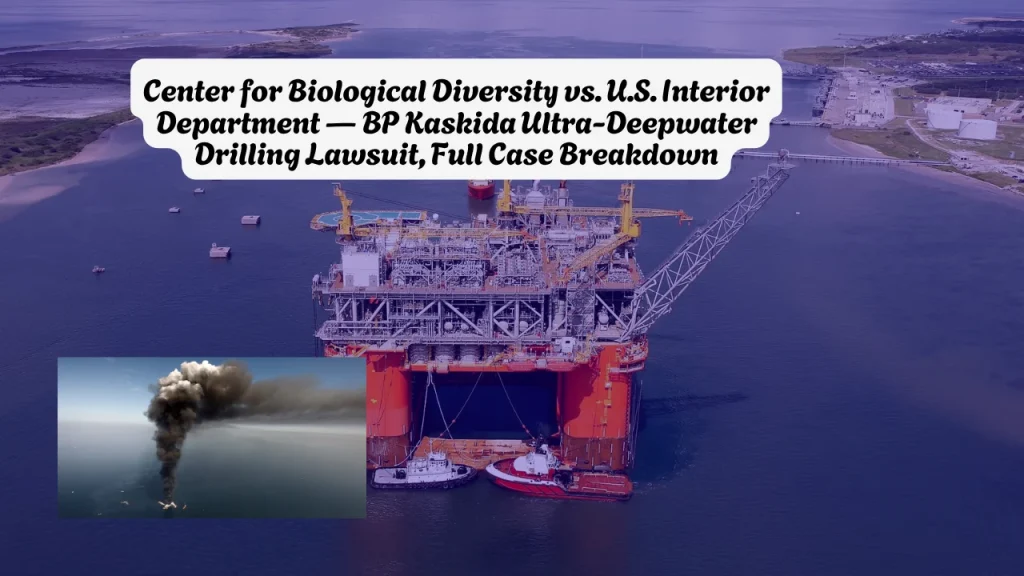
Kaskida’s location will draw from oil wells at greater depths than BP’s Deepwater Horizon project, which exploded in 2010 and led to the biggest oil spill in U.S. history. BP will drill for oil as far down as six miles below the sea floor — deeper than the height of Mount Everest. The deeper the well, the harder it is to contain a blowout, making the plaintiffs’ concerns about worst-case spill estimates central to their legal argument.
Who Are the Parties Involved?
The Plaintiffs are a coalition of Gulf-focused and national environmental organizations. The Center for Biological Diversity is a national nonprofit focused on protecting endangered species and ecosystems through litigation. Sierra Club is one of the country’s largest environmental advocacy organizations. Healthy Gulf and Habitat Recovery Project focus specifically on the protection of Gulf Coast communities and marine ecosystems. Turtle Island Restoration Network advocates for sea turtle and ocean protection. All plaintiffs are represented by Earthjustice, a nonprofit environmental law firm.
The Defendants are federal government officials and agencies. The groups requested a review of the project approval in their Monday filing against the U.S. Interior Department, Secretary Doug Burgum, the Bureau of Ocean Energy Management, and director Matthew Giacona. BOEM is the federal agency within the Interior Department responsible for overseeing offshore energy development on the Outer Continental Shelf.
BP is not a named defendant in this lawsuit. The suit targets the government’s approval decision, not BP’s conduct directly. BP stated it believes the lawsuit is unfounded and is “fully confident in our Kaskida development plan and our ability to deliver this offshore project safely, responsibly and in compliance with U.S. regulations and industry standards.”
Related article: Kash Patel vs. The Atlantic Monthly $250 Million Defamation Lawsuit, Full Case Breakdown
What Is at Stake in This Lawsuit?
If the Eleventh Circuit rules for the plaintiffs, BOEM’s approval of the Kaskida development plan would be vacated — effectively halting the project unless and until BP submits a new application that satisfies the court’s legal requirements. BP made a final investment decision on the project in 2024, and the future platform is expected to be BP’s sixth installation in the Gulf region when it comes online in 2029. The production rate is expected to reach about 80,000 barrels per day in phase one of development.
Work on a similar parallel project — Tiber — is also in preparation and will lean heavily on the engineering and design work from Kaskida. Taken together, the two projects are expected to yield about 10 billion barrels of oil. A court ruling against BOEM could therefore affect both projects and signal broader limits on how the Trump administration may fast-track offshore drilling approvals.
The Trump administration has also proposed weakening “well control” rules developed to tighten up safety protocols in the wake of Deepwater Horizon, and last month the White House exempted federally-authorized Gulf oil and gas operations from certain requirements of the Endangered Species Act. The Kaskida lawsuit lands in that broader regulatory context, making it a significant test case for the administration’s offshore energy policy.
What Happens Next in This Case?
The petition was filed on April 20, 2026. The Eleventh Circuit will next set a briefing schedule, giving the government defendants a deadline to file a response. No hearing date has been set as of April 21, 2026.
In federal administrative law challenges of this type, courts review whether the agency’s decision was “arbitrary and capricious” under the Administrative Procedure Act — meaning the court does not re-decide the policy question but rather examines whether BOEM followed proper legal procedures and relied on accurate, complete information. If the court finds BOEM’s review was legally deficient, it typically remands the matter back to the agency to redo its analysis.
The plaintiffs may also file a motion for a preliminary injunction asking the court to pause any further project activity while the case proceeds. As of publication, no such motion has been reported. All upcoming dates are TBD — reason: the case was filed yesterday and no scheduling order has been entered.
Frequently Asked Questions
1. Who filed the BP Kaskida lawsuit and why?
A coalition of environmental groups — including the Center for Biological Diversity, Sierra Club, and Healthy Gulf — filed suit on April 20, 2026, represented by Earthjustice. According to their petition, the Trump administration’s Bureau of Ocean Energy Management approved BP’s Kaskida drilling project without a legally sufficient environmental review, including fatally flawed worst-case spill estimates.
2. What court is handling this case?
The petition for review was filed in the U.S. Court of Appeals for the Eleventh Circuit. Federal challenges to BOEM decisions go directly to federal appellate courts under the Outer Continental Shelf Lands Act.
3. What is the current status of the Kaskida lawsuit?
As of April 21, 2026, the case was filed yesterday and is in its earliest stage. No briefing schedule, hearing date, or response from the government defendants has been set. The case is active and no ruling has been issued.
4. How much money is involved in the Kaskida project?
The Trump administration approved BP’s $5 billion Kaskida project in March 2026 — BP’s first new oil field developed in the Gulf since 2010, with a stated capacity of 80,000 barrels of crude oil per day. The lawsuit does not seek monetary damages — it seeks to vacate the government’s approval of the project.
5. Can I read the Kaskida lawsuit court documents?
Yes. Earthjustice published the legal filing directly on its website at earthjustice.org. The case is also indexed by Bloomberg Law as Center for Biological Diversity v. U.S. Dep’t of the Interior, 11th Cir., 4/20/26.
6. Why did the groups file on April 20, 2026 specifically?
April 20, 2026 marks the 16th anniversary of the Deepwater Horizon disaster. Earthjustice filed the lawsuit on that date deliberately, noting that Kaskida is BP’s first completely new oilfield approved in the Gulf since the Deepwater Horizon accident, which killed 11 people and caused the worst oil spill in U.S. history.
7. Is BP a defendant in this lawsuit?
No. The lawsuit names the U.S. Department of the Interior, Secretary Doug Burgum, BOEM, and BOEM Director Matthew Giacona as defendants. The legal challenge targets the government’s approval decision, not BP’s conduct directly. BP has publicly stated it considers the lawsuit unfounded.
Sources & References
- Earthjustice press release and legal filing, April 20, 2026: earthjustice.org
- Associated Press reporting, April 20, 2026
Case Type Classification Tag: Other Civil Litigation — Federal Administrative / Environmental Law Challenge
Prepared by the AllAboutLawyer.com Editorial Team and reviewed for factual accuracy against official court records and verified public sources on April 21, 2026. Last Updated: April 21, 2026
Disclaimer: This article is for informational purposes only and does not constitute legal advice. Information about ongoing or concluded legal cases is based on publicly available court records and verified reporting. Allegations described in this article have not necessarily been proven in court. For advice regarding a particular legal situation, consult a qualified attorney.
About the Author
Israr Ahmad is a legal content researcher with 4+ years of experience covering class action settlements and consumer rights cases. He has researched and published coverage of 2,500+ settlements using verified court records, settlement administrator filings, and government sources. Learn more about Israr.