
Petter et al Vs Washington Department of Revenue Washington State Millionaires Tax Lawsuit
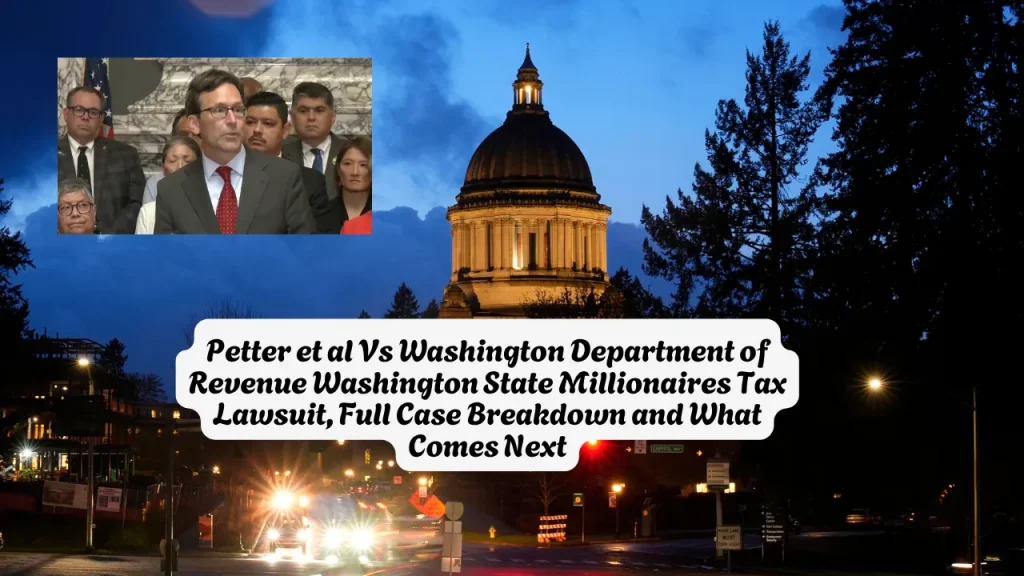
Petter et al. vs. Washington Department of Revenue is a constitutional challenge lawsuit in which a coalition of business owners, farmers, and trade organizations allege that Washington’s newly enacted 9.9% income tax on earnings above $1,000,000 per year violates two provisions of the Washington State Constitution — one requiring all property taxes to be levied uniformly, and one capping property taxes at 1% of assessed value. The lawsuit was filed April 9, 2026, in Klickitat County Superior Court, and seeks to invalidate the tax entirely through a declaratory judgment. A parallel emergency petition by Let’s Go Washington asking the state Supreme Court to allow a public referendum on the law is scheduled for conference before the full court on April 30, 2026. Both proceedings are active and no rulings have been issued as of April 22, 2026.
Quick Facts
| Field | Details |
| Lead Plaintiffs | Benjamin and Lauren Petter; Robert and Brenda Mercer; Curtis Nuccitelli; Building Industry Association of Washington; National Federation of Independent Business; Ethnic Chamber of Commerce Coalition; Yakima Klickitat Farm Association |
| Defendants | Washington State Department of Revenue; Director John Ryser |
| Court | Klickitat County Superior Court (constitutional challenge); Washington State Supreme Court (referendum petition) |
| Case Number | TBD — not yet confirmed in public docket as of April 22, 2026 |
| Date Filed | April 9, 2026 (constitutional challenge); April 4, 2026 (referendum petition/LGW lawsuit) |
| Legal Claims | Violation of Article VII of the Washington Constitution (uniformity requirement; 1% cap on property taxes) |
| Relief Sought | Declaratory judgment invalidating Senate Bill 6346 in its entirety; injunction blocking implementation |
| Damages Sought | No monetary damages — injunctive and declaratory relief only |
| Current Stage | Active — no hearing date set in Klickitat County; Supreme Court en banc conference set for April 30, 2026 |
| Next Scheduled Date | April 30, 2026 — Washington Supreme Court en banc conference on LGW referendum petition |
| Attorneys for Plaintiffs | Rob McKenna (former Washington Attorney General); Phil Talmadge (former Washington Supreme Court Justice); Jackson Maynard (Citizen Action Defense Fund) |
| Last Updated | April 22, 2026 |
Case Timeline
| Date | Event |
| March 30, 2026 | Gov. Bob Ferguson signs Senate Bill 6346 — the “millionaires tax” — into law |
| April 3, 2026 | Let’s Go Washington (LGW) files referendum petition with Secretary of State Steve Hobbs |
| April 4, 2026 | Secretary of State rejects referendum filing, citing the law’s “necessity clause” |
| April 4, 2026 | LGW files lawsuit against Secretary of State Hobbs challenging the necessity clause |
| April 5, 2026 | LGW founder Brian Heywood files emergency petition with Washington Supreme Court |
| April 7, 2026 | Washington Supreme Court grants emergency motion for accelerated review |
| April 9, 2026 | Petter et al. file constitutional challenge in Klickitat County Superior Court |
| April 10, 2026 | Attorney General files answer to LGW petition per court order |
| April 14, 2026 | LGW files reply per court order |
| April 30, 2026 | Washington Supreme Court en banc conference on LGW referendum petition (scheduled) |
| TBD | Klickitat County Superior Court hearing date — not yet set as of April 22, 2026 |
| TBD | Expected Washington Supreme Court argument on constitutional challenge — early 2027 per plaintiffs’ counsel |
What Is the Washington Millionaires Tax Lawsuit About? Petter et al. v. Washington Department of Revenue, Klickitat County Superior Court (2026)
The central legal question in this case is whether Washington state can impose a graduated income tax on high earners — a structure courts have blocked in the state for nearly a century.
Gov. Bob Ferguson signed Senate Bill 6346 on March 30, 2026, creating a 9.9% levy on households with income above $1,000,000 per year, with collections set to begin in 2029 and projected to generate around $3,000,000,000 annually from an estimated 21,000 filers. Supporters argued the tax is a critical step toward reducing a regressive tax code that places a disproportionate burden on lower-income residents.
The constitutional challenge argues the income tax is unconstitutional because it does not tax all incomes in the state uniformly. The plaintiffs’ legal theory rests on Article VII of the Washington Constitution, which governs taxation. Plaintiffs argue the structure of the tax violates two provisions: one requiring all property to be taxed uniformly, and a second limiting property taxes to 1% of the property’s value. Because Washington courts have historically treated income as a form of property, plaintiffs argue the graduated rate structure is flatly unconstitutional under that same framework.
McKenna pointed to a series of court decisions dating back to 1933 that have banned graduated income taxes as illegal taxes on property — and noted that he and Talmadge previously teamed up to successfully block a Seattle income tax on the same constitutional grounds. For more background on how constitutional tax challenges work in state courts,
Related article: $1.85M Walmart TeleCheck Check Disclosure Settlement, Are You Eligible?
Who Are the Parties Involved?
The Plaintiffs are a coalition of individual taxpayers and business organizations. The lead plaintiffs are Benjamin and Lauren Petter, a married couple — Benjamin is a builder and Lauren owns a marketing business — who together would be subject to the tax. Other plaintiffs include Wyoming residents Robert and Brenda Mercer, who own a farm spanning Klickitat and Benton counties with combined incomes exceeding $1,000,000, along with the Building Industry Association of Washington, the National Federation of Independent Business, and the Ethnic Chamber of Commerce Coalition. The legal team is led by former Washington Attorney General Rob McKenna, former Washington Supreme Court Justice Phil Talmadge, and Jackson Maynard, executive director of the Citizen Action Defense Fund.
The Defendants are the Washington State Department of Revenue and its director, John Ryser, named in their official capacities as the agency responsible for implementing and collecting the tax. In the parallel referendum proceeding, the named defendant is Secretary of State Steve Hobbs, whose office rejected Let’s Go Washington’s referendum filing.
Washington State is represented by the Office of the Attorney General, which filed its answer to the LGW petition on April 10, 2026, per the Supreme Court’s accelerated briefing schedule. The state defends the law on the grounds that income is not property under a modern reading of the constitution, a position the Washington Supreme Court moved toward in its 2023 ruling upholding the state’s capital gains tax. For further context on Washington’s capital gains tax legal history,
What Is at Stake in This Lawsuit?
The stakes in this case extend well beyond the tax itself. If the law is struck down, the legislature will likely continue to test constitutional boundaries and there will be more lawsuits. If the income tax is upheld through reasoning that removes “income” from the constitutional concept of “property,” another sea change in Washington taxation could follow.
On the referendum track, the consequences are equally significant. If the Supreme Court rules the necessity clause is unconstitutional, the legislature may need to call a special session, because the state’s budget for the next four years was balanced partially with revenue collected from the tax. Should the court side with Heywood, opponents of the tax must submit signatures of 154,455 voters by June 10 to qualify for the fall ballot.
The constitutional challenge in Klickitat County also carries long-term implications for judicial composition. Five open state Supreme Court races in November 2026, driven by a round of retirements, could bring major turnover to the nine-member court — and whoever sits on that court will likely decide whether the tax survives its final constitutional test, expected in early 2027.
What Happens Next in This Case?
Two timelines are running simultaneously. On the referendum track, the Washington State Supreme Court will consider the petition for writ of mandamus at its April 30, 2026, en banc conference. That ruling will determine whether voters get a direct say on the tax this November. A decision is expected shortly after the conference.
On the constitutional challenge track, the case in Klickitat County Superior Court has no hearing date set as of April 22, 2026. The lawsuit will start with an initial decision from a superior court judge and then likely work its way to the state Supreme Court for a final judgment, with Talmadge speculating it could be early next year before the case is argued before the state Supreme Court.
Meanwhile, the tax itself does not take effect until 2028, and collections would begin in 2029 — that is, if the tax withstands the court challenge and any ballot initiative.
FAQs: Washington State Millionaires Tax Lawsuit
Who filed the lawsuit and why?
Two separate legal actions were filed. On April 9, 2026, a coalition of business owners and trade groups led by former Attorney General Rob McKenna filed a constitutional challenge in Klickitat County Superior Court, arguing the 9.9% tax on income above $1,000,000 violates Washington’s constitutional requirements for uniform property taxation. Separately, conservative PAC Let’s Go Washington filed an emergency petition with the state Supreme Court on April 5, 2026, challenging the legislature’s use of a “necessity clause” to block a public vote.
What court is handling this case?
The constitutional challenge is filed in Klickitat County Superior Court. The referendum petition is before the Washington State Supreme Court, which fast-tracked the matter for an en banc conference on April 30, 2026.
What is the current status of the case?
Both proceedings are active. No hearing date has been set in Klickitat County. The Washington Supreme Court is scheduled to conference the referendum petition on April 30, 2026, with a ruling expected shortly after.
What is the millionaires tax and when does it take effect?
Senate Bill 6346, signed into law by Gov. Bob Ferguson on March 30, 2026, imposes a 9.9% tax on household wage income above $1,000,000 per year. Tax collections are set to begin in 2029, pending the outcome of the legal challenges.
Can I read the court documents?
The constitutional challenge was filed in Klickitat County Superior Court and is accessible through the Washington Courts public portal at courts.wa.gov. The Supreme Court referendum petition documents are also publicly accessible through the same portal under Let’s Go Washington v. Hobbs.
What does the “necessity clause” mean, and why does it matter?
A necessity clause is language inserted into legislation by the legislature declaring the law “necessary for the support of the state government and its existing public institutions.” Under Washington law, such language has historically shielded revenue bills from the referendum process. Let’s Go Washington argues the legislature’s use of the clause here is an unconstitutional overreach that strips voters of their right to challenge tax laws at the ballot box.
What happens if the tax is struck down?
If the Klickitat County court — or ultimately the Washington Supreme Court — declares Senate Bill 6346 unconstitutional, the law is void and no tax is collected. The state legislature would then need to either revise the law to comply with constitutional limits or pursue a constitutional amendment, which requires a two-thirds vote in both chambers plus majority voter approval.
Sources & References
- Washington State Standard, Income Tax Signed in Washington With a Legal Challenge Close Behind, March 30, 2026 — washingtonstatestandard.com
- The Spokesman-Review, Opponents Sue to Block Washington’s New ‘Millionaires Tax’, April 9, 2026 — spokesman.com
- OPB / Washington State Standard, Court Battle Ignites Over WA’s New Income Tax, April 9, 2026 — opb.org
- KNKX Public Radio, New Lawsuit Challenges Constitutionality of Washington’s ‘Millionaires Tax’, April 9, 2026 — knkx.org
Prepared by the AllAboutLawyer.com Editorial Team and reviewed for factual accuracy against official court records and verified public sources on April 22, 2026. Last Updated: April 22, 2026
Disclaimer: This article is for informational purposes only and does not constitute legal advice. Information about ongoing legal cases is based on publicly available court records and verified reporting. Allegations described in this article have not been proven in court. For advice regarding a particular legal situation, consult a qualified attorney.
About the Author
Israr Ahmad is a legal content researcher with 4+ years of experience covering class action settlements and consumer rights cases. He has researched and published coverage of 2,500+ settlements using verified court records, settlement administrator filings, and government sources. Learn more about Israr.