
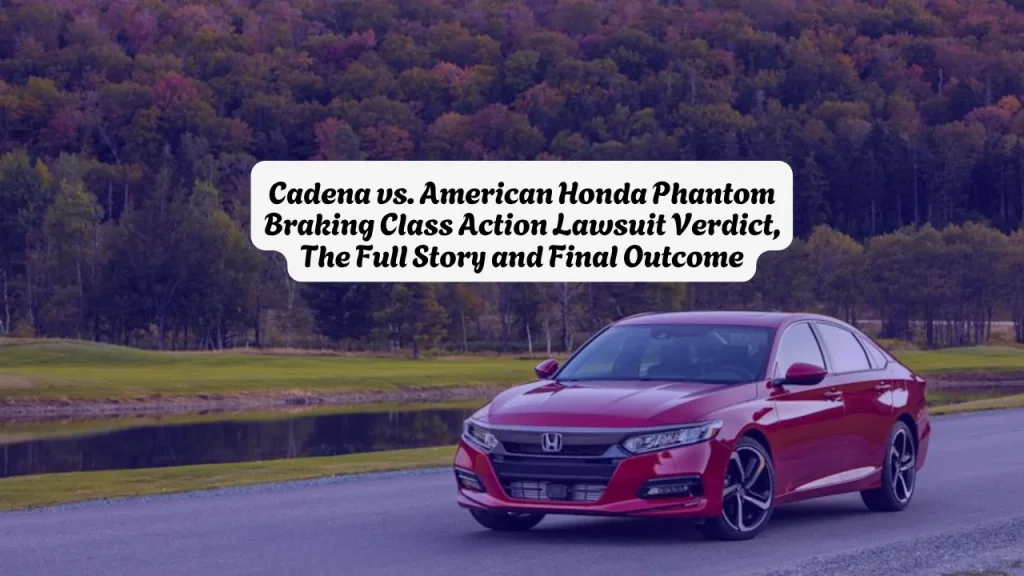
Cadena vs. American Honda Phantom Braking Class Action Lawsuit Verdict, The Full Story and Final Outcome
Cadena, et al., v. American Honda Motor Co., Inc. is a product defect class action lawsuit in which owners of 2017–2019 Honda CR-V and 2018–2020 Honda Accord vehicles alleged that Honda’s Collision Mitigation Braking System activated without any forward obstacles present — a phenomenon widely known as “phantom braking” — creating dangerous sudden stops on public roads.
A Honda “phantom braking” trial is over after a jury reached a verdict in favor of Honda. The original “Honda Sensing” class action lawsuit was filed eight years ago and included alleged defects in the Collision Mitigation Braking, Road Departure Mitigation, Adaptive Cruise Control with Low-Speed Follow, and Lane Keeping Assist systems. The jury sided with Honda on April 17, 2026, ending one of the longest-running automotive class actions in recent memory.
Quick Facts
| Field | Detail |
| Plaintiffs | Kathleen A. Cadena, et al. (class of vehicle owners) |
| Defendant | American Honda Motor Co., Inc. |
| Case Name & Number | Kathleen A. Cadena, et al., v. American Honda Motor Co., Inc., No. CV 18-4007-MWF (MAAx) |
| Court | U.S. District Court for the Central District of California |
| Date Lawsuit Filed | 2018 |
| Legal Claim | Product defect — Collision Mitigation Braking System (CMBS); alleged violations of state consumer protection laws |
| Outcome | Jury verdict in favor of Honda — plaintiffs’ claims rejected in full |
| Settlement/Judgment Amount | No damages awarded to plaintiffs |
| Attorneys for Plaintiffs | Gibbs Law Group LLP; Greenstone Law APC |
| Vehicles Affected | 2017–2019 Honda CR-V; 2018–2020 Honda Accord |
| States at Trial | California, Florida, New York, Ohio, North Carolina, New Jersey, Arizona, Iowa |
| Last Updated | April 21, 2026 |
Case Timeline
| Date | Event |
| 2018 | Original “Honda Sensing” class action lawsuit filed in U.S. District Court, Central District of California |
| 2018–2024 | Multiple related class actions filed and consolidated into Cadena, et al., v. American Honda; nationwide claims dismissed; case narrowed to Collision Mitigation Braking System only |
| March 2026 | Case proceeds to trial in Central District of California |
| April 17, 2026 | Jury returns verdict in favor of American Honda Motor Co., Inc. — all plaintiffs’ claims rejected |
What Is the Cadena vs. American Honda Phantom Braking Lawsuit About? Kathleen A. Cadena, et al., v. American Honda Motor Co., Inc., No. CV 18-4007-MWF (MAAx)
According to the plaintiffs, the Collision Mitigation Braking (automatic emergency braking) system can activate without any forward objects in the path of a Honda vehicle. This “phantom braking” — where the car’s automatic emergency braking fires without a real obstacle — can cause sudden, hard stops at highway speeds, leaving drivers at risk of being rear-ended by following traffic. NHTSA received 1,294 complaints related to this issue at the time the case headed to trial.
The lawsuit originally swept in four Honda Sensing driver-assistance features but was significantly narrowed over its eight-year life. By the time the class action lawsuit reached trial, the case involved only the Collision Mitigation Braking Systems in 2017–2019 Honda CR-V and 2018–2020 Honda Accord vehicles, and included only certain states as nationwide claims had been previously dismissed. The legal theories at trial centered on product defect and consumer protection law violations in the eight remaining states — California, Florida, New York, Ohio, North Carolina, New Jersey, Arizona, and Iowa.
The Collision Mitigation Braking System uses a combination of camera and radar sensors to identify obstacles and apply the brakes automatically. But if the car brakes when it shouldn’t, this can increase the chances of a crash. Real-world reports of the issue were vivid: on March 15, 2026, one owner of a 2019 CR-V said their vehicle suddenly braked hard at an intersection when the light was green and the road was clear, with the speed being roughly 40 mph — saying they felt close to being rear-ended because they had not engaged any braking at all.
Related article: Brianna Mensing vs. Uber Technologies Sexual Assault Bellwether Lawsuit, The Full Story and Final Outcome
Who Were the Parties Involved?
The Plaintiffs were a certified class of owners and purchasers of 2017–2019 Honda CR-V and 2018–2020 Honda Accord vehicles who purchased their vehicles new from Honda dealerships in the eight named states. Lead plaintiff Kathleen A. Cadena and the other named plaintiffs alleged that Honda knew about the phantom braking defect and failed to disclose it at the time of sale. The class was represented at trial by Gibbs Law Group LLP and Greenstone Law APC.
American Honda Motor Co., Inc. is the U.S. subsidiary of Honda Motor Co., Ltd., responsible for distributing, marketing, and supporting Honda vehicles in the United States. Honda emphasized at trial that the Collision Mitigation Braking system is designed to assist a driver and isn’t perfect — because perfect is not possible — and argued that just because the braking system sometimes has problems does not mean it is legally defective.
How Did the Cadena vs. American Honda Lawsuit End?
The jury returned a verdict in favor of American Honda Motor Co., Inc. on April 17, 2026, rejecting all of the plaintiffs’ claims. No damages were awarded to any class member.
Honda told the jury that the collision mitigation braking systems aren’t perfect, but also not defective. The automaker argued that a non-perfect system can still help prevent rear-end collisions, and that the owner’s manuals clearly warn customers of numerous limitations of the automatic braking systems. Honda also pointed to damaging testimony from one plaintiff who, despite suing Honda over a supposedly dangerous defect in his 2018 Accord, subsequently sold that vehicle to CarMax without disclosing the alleged defect — undermining the credibility of his safety claims before the jury.
Honda told CarComplaints.com: “American Honda is committed to the safety and satisfaction of our customers, and we applaud the jury’s decision. During the trial, clear evidence was presented that the allegations in this lawsuit did not reflect the common real-world performance of the Collision Mitigation Braking System (CMBS) in Honda vehicles, and this result is consistent with those facts.” The verdict is a complete defense win at the trial level. No appeal had been announced as of April 21, 2026 — any appeal by the plaintiffs would go to the U.S. Court of Appeals for the Ninth Circuit.
What Does the Cadena vs. American Honda Case Mean for Vehicle Owners?
This verdict does not end all Honda phantom braking litigation. The NHTSA opened an investigation into the phantom braking issue and this remains ongoing, with a total of 1,294 complaints noted at the time the case headed to trial. A separate ongoing NHTSA investigation covers 2019–2023 Honda Passport and Insight vehicles, upgraded to an Engineering Analysis in January 2025 — meaning a recall remains possible on those models regardless of this trial outcome.
In January 2025, NHTSA’s Office of Defects Investigation upgraded that investigation to an Engineering Analysis and included 2023 Honda Passport SUVs in its vehicle list. The Engineering Analysis will assess the frequency and safety-related consequences of the Honda AEB issues, and the results of the broader investigation can determine if a recall is needed. Owners of vehicles not covered by the Cadena trial — including Honda Insight, Passport, Civic, Odyssey, and other models with Honda Sensing — may still have legal and regulatory options available.
The verdict also carries broader significance for the automotive technology industry. The lawsuit exposes the double-edged sword of modern vehicle safety technologies — they make driving safer when they work as intended, but have also made cars more complicated, and the very features designed to save lives can be dangerous when they malfunction. The jury’s finding that imperfect performance does not equal legal defect may influence how future phantom braking cases are litigated against all automakers.
Frequently Asked Questions
1. Who filed the Honda phantom braking lawsuit and why?
Lead plaintiff Kathleen A. Cadena and dozens of other Honda owners filed the original lawsuit in 2018, alleging that Honda’s Honda Sensing driver-assistance system caused their vehicles to brake suddenly without any forward obstacle. The case was consolidated in the U.S. District Court for the Central District of California as No. CV 18-4007-MWF (MAAx).
2. What court handled this case?
The case was tried in the U.S. District Court for the Central District of California, before Judge Michael W. Fitzgerald. The case number is CV 18-4007-MWF (MAAx).
3. Has the case been resolved?
Yes. The jury returned a verdict in favor of American Honda Motor Co., Inc. on April 17, 2026 — eight years after the lawsuit was originally filed. All of the plaintiffs’ claims were rejected and no damages were awarded.
4. How much money was at stake?
Honda faced potential damages covering a class of owners across eight states — California, Florida, New York, Ohio, North Carolina, New Jersey, Arizona, and Iowa — who purchased 2017–2019 CR-V or 2018–2020 Accord models. Had the verdict gone the other way, the automaker could have faced a substantial payout to plaintiffs and owners of affected vehicles, potentially running into the millions. The jury awarded nothing to the plaintiffs.
5. Can I still read the court documents?
Yes. The case docket for Cadena, et al., v. American Honda Motor Co., Inc., No. CV 18-4007-MWF (MAAx) is publicly available through PACER for the U.S. District Court, Central District of California. The official class action settlement website at hondacmbsclassaction.com also contains public case documents.
6. Does this verdict affect my Honda if I have experienced phantom braking?
The verdict covers only 2017–2019 Honda CR-V and 2018–2020 Honda Accord vehicles purchased new in the eight named states. NHTSA’s Office of Defects Investigation continues a separate Engineering Analysis into 2019–2023 Honda Passport and Insight vehicles, which could still result in a recall regardless of this trial outcome. Owners of other Honda models should monitor NHTSA’s investigation results.
7. What was Honda’s main argument at trial?
Honda emphasized that the Collision Mitigation Braking system is designed to assist a driver and is not perfect — because perfect is not possible — and that the owner’s manuals clearly warn customers of numerous limitations of the automatic braking systems. Honda also argued that a system that occasionally has problems can still reduce rear-end collisions and is therefore not legally defective.
8. Can the plaintiffs appeal this verdict?
Yes. The plaintiffs — represented by Gibbs Law Group LLP and Greenstone Law APC — may appeal the jury verdict to the U.S. Court of Appeals for the Ninth Circuit. As of April 21, 2026, no appeal has been publicly announced.
Sources & References
- CarComplaints.com trial verdict report (April 17, 2026): carcomplaints.com
- Official case website: Kathleen A. Cadena, et al., v. American Honda Motor Co., Inc.: hondacmbsclassaction.com
- NHTSA Engineering Analysis — Honda AEB (January 2025): nhtsa.gov
Case Type Classification Tag: Product Defect — Automotive Safety Technology
Prepared by the AllAboutLawyer.com Editorial Team and reviewed for factual accuracy against official court records and verified public sources on April 21, 2026. Last Updated: April 21, 2026
Disclaimer: This article is for informational purposes only and does not constitute legal advice. Information about ongoing or concluded legal cases is based on publicly available court records and verified reporting. Allegations described in this article have not necessarily been proven in court. For advice regarding a particular legal situation, consult a qualified attorney.
About the Author
Israr Ahmad is a legal content researcher with 4+ years of experience covering class action settlements and consumer rights cases. He has researched and published coverage of 2,500+ settlements using verified court records, settlement administrator filings, and government sources. Learn more about Israr.