
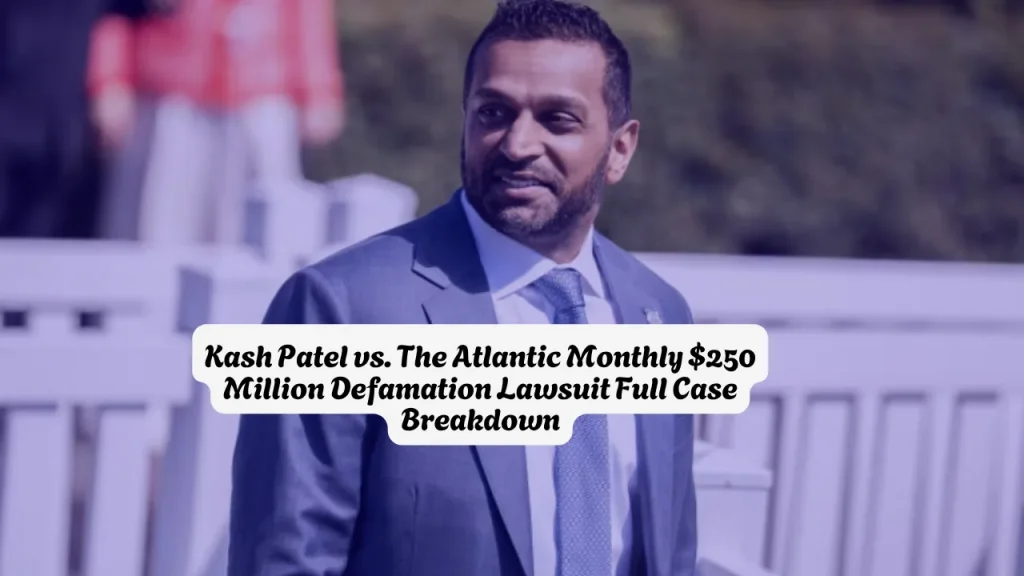
Kash Patel vs. The Atlantic Monthly $250 Million Defamation Lawsuit, Full Case Breakdown
This article covers a lawsuit filed on April 20, 2026. Information is limited to the complaint as filed and verified press reporting. This page will be updated as the case develops.
Patel v. Atlantic Monthly is a defamation lawsuit in which FBI Director Kash Patel alleged that The Atlantic magazine and staff writer Sarah Fitzpatrick published a story containing numerous false statements of fact about his conduct, including claims that he drinks to excess, has been difficult to wake due to intoxication, and has repeatedly gone missing from FBI headquarters in ways that delayed national security decisions.
FBI Director Kash Patel filed a defamation lawsuit against The Atlantic magazine on Monday, saying a recent story about his alleged frequent drinking and absences included “false and obviously fabricated” claims. The 19-page lawsuit, filed in the District of Columbia, seeks $250 million in damages. Sarah Fitzpatrick, the reporter who wrote the story, is also named as a defendant. The Atlantic called the lawsuit meritless and stated it stands fully behind its reporting.
Quick Facts
| Field | Detail |
| Plaintiff | Kash Patel, FBI Director |
| Defendants | Atlantic Monthly Group LLC (The Atlantic); Sarah Fitzpatrick, staff writer |
| Case Name & Number | Patel v. Atlantic Monthly, No. 26-cv-1329, U.S. District Court, District of Columbia |
| Court | U.S. District Court for the District of Columbia |
| Date Filed | April 20, 2026 |
| Legal Claim | Defamation / Libel — false statements of fact published with alleged actual malice |
| Damages Sought | $250,000,000 plus disgorgement of revenue earned from the article |
| Current Stage | Recently filed — no response from defendants yet |
| Next Scheduled Date | TBD — no hearing date set as of April 21, 2026 |
| Attorney for Plaintiff | Jesse R. Binnall, Binnall Law Group (Alexandria, VA) |
| Defendants’ Position | The Atlantic: “We stand by our reporting and will vigorously defend against this meritless lawsuit” |
| Last Updated | April 21, 2026 |
Case Timeline
| Date | Event |
| April 17, 2026 | The Atlantic publishes article headlined “Kash Patel’s Erratic Behavior Could Cost Him His Job” |
| April 17, 2026 (approx. 4:00 PM ET) | Patel’s attorney Jesse Binnall sends pre-publication letter to Atlantic editors and legal department identifying specific alleged falsehoods and requesting more time |
| April 17, 2026 (6:20 PM ET) | The Atlantic publishes the article, approximately two hours after receiving Binnall’s letter |
| April 19, 2026 | Patel announces on Fox News he will file suit the following day |
| April 20, 2026 | Patel files 19-page defamation complaint in U.S. District Court, D.C. |
| TBD | Defendants’ response due — date not yet set by court |
| TBD | Discovery phase, if case survives early motions — date not yet set |
What Is the Kash Patel vs. The Atlantic Lawsuit About? Patel v. Atlantic Monthly, No. 26-cv-1329
The complaint, filed Monday in federal court in Washington, targets an April 17 article headlined “Kash Patel’s Erratic Behavior Could Cost Him His Job.” The story alleged Patel drank to the point of obvious intoxication at a Washington private club and at a Las Vegas venue, that meetings were rescheduled due to alcohol-fueled nights, and that his security detail had difficulty waking him on multiple occasions.
The suit alleges The Atlantic gave the FBI less than two hours to respond to 19 detailed allegations, ignored a pre-publication letter identifying specific falsehoods, buried a denial from the FBI’s assistant director calling the claims “completely false at a nearly 100% clip,” and later stealth-edited the headline to “The FBI Director Is MIA.” Patel’s legal team argues those facts collectively establish “actual malice” — the legal standard under New York Times Co. v. Sullivan (1964) that a public figure must satisfy to win a defamation claim. Actual malice means the publisher either knew the statements were false or published them with reckless disregard for their truth or falsity.
According to the complaint, Binnall’s letter was sent shortly before 4:00 PM on Friday, and The Atlantic published the story at 6:20 PM — approximately two hours later. The lawsuit calls the publication’s handling of that letter “among the strongest possible evidence of actual malice.” Patel also seeks disgorgement — meaning he wants the court to strip The Atlantic of any advertising or subscription revenue it generated from the article, on top of the $250,000,000 in damages.
Related article: Mitchell Winehouse vs. Naomi Parry and Catriona Gourlay Amy Winehouse Estate Dispute Lawsuit, The Full Story and Final Outcome
Who Are Kash Patel and The Atlantic?
Kash Patel has served as FBI Director since February 2025, confirmed by the U.S. Senate following his nomination by President Donald Trump. Patel has filed defamation lawsuits before. In 2023, he sued Substack writer Jim Stewartson for libel over statements accusing him of sedition, planning the January 6 riots, and being an agent of Russia. In 2025, a federal judge granted Patel’s motion for a default judgment and awarded Patel and his foundation $250,000 in punitive and compensatory damages. As the sitting FBI Director, Patel qualifies as a public official under defamation law, which means he faces the heightened “actual malice” burden to prevail at trial.
The Atlantic is one of the oldest and most widely read general-interest magazines in the United States, covering politics, culture, and national affairs. Reporter Sarah Fitzpatrick, who is also named as a defendant, cited multiple unnamed current and former officials in the article. Fitzpatrick responded to Patel’s legal threats by stating, “I stand by every word of this reporting.” The Atlantic’s senior vice president of communications, Anna Bross, stated the magazine will vigorously defend itself against what it called a meritless lawsuit.
What Is at Stake in This Lawsuit?
Patel seeks $250,000,000 in damages plus disgorgement of any revenue The Atlantic earned from the article. The suit specifically lists 17 statements Patel contests, including that he “is known to drink to the point of obvious intoxication” at a Washington private club called Ned’s and at the Poodle Room in Las Vegas, that meetings had to be rescheduled due to alcohol-fueled nights, and that members of his security detail had difficulty waking him on multiple occasions because he was seemingly intoxicated.
Legal experts note that if the case survives early motions to dismiss, it could open the door to the discovery phase — where both sides exchange evidence and take sworn testimony. Patel or others could be required to answer questions under oath about the alleged behavior. At the same time, The Atlantic would have the same opportunity to take discovery to confirm the accuracy of its reporting, which would include taking sworn testimony not just of Patel but of others with knowledge of the underlying facts.
The bar to prove actual malice when covering a public figure is extremely high, and courts have repeatedly upheld that standard throughout defamation lawsuits during the Trump administration. The Trump administration and the president have a losing track record when it comes to legal entanglements with the media. Some legal commentators have noted the lawsuit may function strategically to signal to other news organizations that covering Patel carries legal and financial risk.
What Happens Next in This Case?
The complaint was filed April 20, 2026. The court will next assign a judge and issue a scheduling order setting a deadline for The Atlantic and Fitzpatrick to respond. Defendants in defamation suits of this type typically file a motion to dismiss early in the proceedings, arguing the plaintiff cannot satisfy the actual malice standard as a matter of law.
This is the second lawsuit Patel has filed in connection with media reports about allegations of his drinking and partying. Last year, he sued Frank Figliuzzi, an MSNBC analyst and former FBI agent, over a claim suggesting Patel was spending more time in nightclubs than at FBI headquarters. That case’s status as of publication is TBD — further detail not yet confirmed in available court records.
No hearing date, briefing schedule, or judge assignment has been publicly reported as of April 21, 2026.
Frequently Asked Questions
1. Who filed the lawsuit and why?
FBI Director Kash Patel filed suit on April 20, 2026, in the U.S. District Court for the District of Columbia. According to the 19-page complaint, The Atlantic published an April 17 article containing 17 specific statements that Patel’s legal team alleges were false, defamatory, and published with actual malice — the legal standard required to hold a media organization liable for defaming a public official.
2. What court is handling this case?
The case is filed in the U.S. District Court for the District of Columbia, case number 26-cv-1329, captioned Patel v. Atlantic Monthly.
3. What is the current status of the Kash Patel vs. The Atlantic lawsuit?
As of April 21, 2026, the case was filed yesterday and is in its earliest stage. No judge assignment, briefing schedule, or hearing date has been publicly set. The Atlantic has stated it will vigorously defend the suit and calls it meritless.
4. How much money is Kash Patel seeking in damages?
Patel seeks $250,000,000 in compensatory and other damages, plus disgorgement of any advertising or subscription revenue The Atlantic generated from the specific article at issue.
5. Can I read the court documents?
Yes. The complaint is a public record filed in the U.S. District Court for the District of Columbia and is available through PACER under case number 26-cv-1329. Bloomberg Law also indexed the filing on April 20, 2026.
6. What specific claims in The Atlantic’s article does Patel dispute?
Patel’s complaint lists 17 specific disputed statements. Among them: that he drinks to obvious intoxication at Ned’s private club in Washington, D.C. and at the Poodle Room in Las Vegas; that early in his tenure, meetings had to be rescheduled due to alcohol-fueled nights; and that members of his security detail had difficulty waking him on multiple occasions because he appeared intoxicated. Patel’s complaint states he does not drink to excess at any of those venues.
7. What is “actual malice” and why does it matter in this case?
Actual malice is the legal standard that public officials must meet to win a defamation claim, established by the U.S. Supreme Court in New York Times Co. v. Sullivan (1964). A public figure must show that the publisher acted with actual malice — meaning the publisher knowingly printed false information or acted with reckless disregard for whether the information was true or false. Patel argues that The Atlantic’s decision to publish the article roughly two hours after receiving his attorney’s letter identifying specific alleged falsehoods constitutes evidence of that standard.
8. Has Patel won a defamation case before?
Yes. In 2023, Patel sued Substack writer Jim Stewartson for libel. In 2025, a federal judge granted Patel’s motion for a default judgment and awarded Patel and his foundation $250,000 in punitive and compensatory damages, though the judge noted that Patel’s reputation was not “significantly sullied” by the defamatory statements in that case.
Sources & References
- Bloomberg Law case record: Patel v. Atlantic Monthly, No. 26-cv-1329, U.S. District Court, D.C. (April 20, 2026)
- Claims Journal (Bloomberg Law summary with case number): claimsjournal.com
Case Type Classification Tag: Defamation / Libel / Slander
Prepared by the AllAboutLawyer.com Editorial Team and reviewed for factual accuracy against official court records and verified public sources on April 21, 2026. Last Updated: April 21, 2026
Disclaimer: This article is for informational purposes only and does not constitute legal advice. Information about ongoing or concluded legal cases is based on publicly available court records and verified reporting. Allegations described in this article have not necessarily been proven in court. For advice regarding a particular legal situation, consult a qualified attorney.
About the Author
Israr Ahmad is a legal content researcher with 4+ years of experience covering class action settlements and consumer rights cases. He has researched and published coverage of 2,500+ settlements using verified court records, settlement administrator filings, and government sources. Learn more about Israr.