
NPCA vs. Interior Department Mojave Mine Lawsuit, Full Case Breakdown
Note: This article covers a lawsuit filed April 15, 2026 — one of the most recently filed cases in our database. Information is based on the complaint as filed and official statements from parties of record. This page will be updated as the case develops.
The National Parks Conservation Association v. Burgum lawsuit is a federal environmental action filed April 15, 2026, in which the National Parks Conservation Association (NPCA), represented by Earthjustice, alleges that the Department of the Interior broke numerous federal laws that protect America’s national parks from mining impacts when it approved the resumption of industrial mining at the Colosseum Mine within the Mojave National Preserve.
The lawsuit asserts that in April 2025, the Department of the Interior dramatically reversed course and allowed Australian mining company Dateline Resources Ltd. to rely on an expired environmental review and a mining plan of operations approved over 40 years ago — nearly a decade before Congress established Mojave National Preserve. The case is active, and no ruling has been issued as of April 2026.
Quick-Facts
| Field | Detail |
| Plaintiff | National Parks Conservation Association (NPCA) |
| Defendants | U.S. Department of the Interior; National Park Service; Interior Secretary Doug Burgum; Acting NPS Director Jessica Bowron; Acting Mojave National Preserve Superintendent Kevin Schluckebier |
| Third Party (Mine Operator) | Dateline Resources Ltd. (Australia, ASX: DTR) |
| Case Type | Federal Administrative / Environmental Law |
| Court | U.S. District Court for the Central District of California, Western Division |
| Date Filed | April 15, 2026 |
| Legal Claims | Violations of multiple federal laws protecting national parks from mining impacts — including the National Environmental Policy Act (NEPA), the California Desert Protection Act (1994), and the National Park Service Organic Act |
| Relief Sought | Court order halting mining operations at Colosseum Mine; invalidation of Interior’s 2025 approval decision |
| Current Stage | Recently filed — awaiting government response and initial scheduling order |
| Next Scheduled Date | TBD — no hearing dates set as of April 21, 2026 |
| Counsel for Plaintiff | Katrina Tomas and Earthjustice (California Office) |
| Last Updated | April 21, 2026 |
Case Timeline
| Date | Event |
| 1860s–1942 | Colosseum Mine operates intermittently as a gold and silver shaft mine in the Clark Mountains of the Mojave Desert |
| 1985 | Bureau of Land Management (BLM) approves a Plan of Operations for Colosseum Mine |
| 1993 | Colosseum Mine closes and enters reclamation — ceases all active operations |
| November 1994 | Congress passes the California Desert Protection Act, establishing Mojave National Preserve as a unit of the National Park System — transferring jurisdiction over the Clark Mountains from BLM to NPS |
| 2021 | Australian company Dateline Resources Ltd. acquires Colosseum Mine, announcing plans to focus primarily on gold mining and explore for rare earth elements |
| 2021–2024 | National Park Service repeatedly orders Dateline Resources to cease operations and submit a new, NPS-approved plan of operations before any mining activity may proceed |
| 2024 | Despite NPS cease-and-desist orders, Dateline allegedly bulldozes park land and destroys fragile habitat without authorization — NPS seeks $213,387 in costs and damages for two unpermitted roadwork incidents |
| April 2025 | Shortly after President Trump takes office, the Department of the Interior reverses course — tells Dateline it does not need to reimburse damages, does not need a new NPS-approved plan, and may rely on the expired 1985 BLM Plan of Operations |
| April 2025 | BLM formally authorizes resumption of mining, describing Colosseum as “America’s second rare earth elements mine” and citing national security interests |
| April 15, 2026 | NPCA, represented by Earthjustice, files lawsuit in U.S. District Court for the Central District of California challenging the Interior Department’s 2025 approval as unlawful |
| April 21, 2026 | Case active — no government response or hearing dates yet scheduled |
What Is the Mojave National Preserve Mining Lawsuit About? National Parks Conservation Association v. Burgum, U.S. District Court for the Central District of California (Western Division)
The lawsuit asserts that the Department of the Interior broke numerous federal laws that protect America’s national parks from mining impacts, detailing how the National Park Service spent years rebuffing Dateline Resources’ efforts to conduct exploratory drilling in the park — before abruptly reversing its position following the change in federal administration. The core legal claims center on three federal statutes. The National Environmental Policy Act (NEPA) requires federal agencies to conduct a full environmental review before approving projects with significant impacts on public lands. The National Park Service Organic Act mandates that the NPS manage national park units to preserve them unimpaired for future generations. The California Desert Protection Act of 1994 established Mojave National Preserve as a protected unit of the National Park System — stripping BLM of jurisdiction over these lands and transferring it to NPS, which means any 1985 BLM-approved plan carries no current legal authority over the Preserve.
The mining company, according to the complaint, continues to operate on an expired plan of operations approved by an agency — the BLM — that no longer has jurisdiction over these Mojave National Preserve lands. Dateline Resources has also not submitted a plan of operations that the National Park Service must approve prior to mining activities being allowed in national parks. In plain terms: the 1985 BLM approval that the Interior Department is relying on predates the very law that created Mojave National Preserve and pre-dates NPS authority over the land by nearly a decade. For context on how federal agencies are required to conduct environmental reviews before approving major land-use changes, our [Guide to NEPA and Federal Environmental Law] covers how these requirements work in practice.
The Park Service also sought to recover $213,387 in costs and damages stemming from two incidents in which Dateline and its contractors allegedly performed unpermitted roadwork, razing sensitive land and destroying hundreds of plants. After years of back and forth, the Park Service last April — shortly after Trump took office — informed Dateline that it no longer had to seek agency authorization to keep mining. That reversal — from cease-and-desist to full authorization — forms the central factual dispute in the case.
Related article: Commonwealth of Pennsylvania vs. Gillece Services Consumer Protection Lawsuit, Full Case Breakdown
Who Are the Parties Involved?
Plaintiff — National Parks Conservation Association (NPCA)
The NPCA is a nonprofit conservation organization founded in 1919 with a mission to protect and enhance America’s national park system. NPCA is represented in this case by Earthjustice, the premier nonprofit environmental law organization, through its California office. The NPCA has standing to sue as an organization directly affected by the alleged degradation of Mojave National Preserve — a park it has worked to protect for decades. Its California Desert Program Manager, Chance Wilcox, is the named spokesperson in all public filings and statements.
Defendants — Interior Department and Named Officials
In addition to the National Park Service and the Interior Department, the NPCA’s suit names Interior Secretary Doug Burgum, Acting Park Service Director Jessica Bowron, and Acting Mojave National Preserve Superintendent Kevin Schluckebier as individual defendants. Naming individual officials is standard practice in federal administrative law cases — it allows a court to order specific agency officers to comply with any injunction. The Interior Department and Park Service have declined to comment, stating they do not weigh in on open litigation.
Mine Operator — Dateline Resources Ltd.
Dateline Resources Ltd. is an Australian corporation that acquired the formerly decommissioned Colosseum Mine in 2021, announcing plans to focus primarily on gold mining while also exploring for rare earth elements for use in electric vehicle technologies. Dateline is not named as a defendant in the lawsuit — the suit targets the federal agency decisions, not the mining company directly. However, any court order halting operations would directly affect Dateline’s ability to continue work at the site.
What Is at Stake in This Lawsuit?
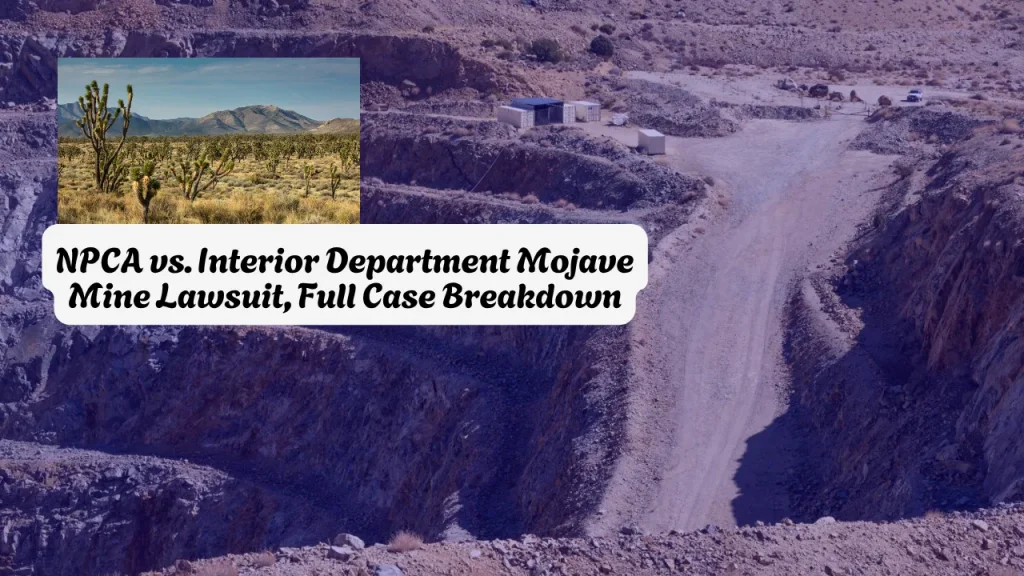
The immediate stakes are the physical condition of Mojave National Preserve’s Clark Mountain region. Industrial mining activity is already harming the park’s landscape through new drilling activity, bulldozing of sensitive habitat, and road development. The formerly decommissioned Colosseum Mine sits in Mojave’s Clark Mountain region — an area with the second-highest concentration of rare plants of any of California’s mountain ranges and vital desert bighorn sheep habitat.
The broader stakes extend well beyond this single mine. Dateline Resources’ efforts to restart operations at Colosseum Mine reflect the company’s wider effort to expand mine claim holdings across the landscape, including new claims near Joshua Tree National Park. A renewed rush for mining claims across the California Desert is putting added pressure on national parks and protected public lands, threatening delicate landscapes and wildlife habitat with unchecked development.
The BLM, in approving the mining resumption, stated: “The resumption of mining at Colosseum Mine, America’s second rare earth elements mine, supports efforts to bolster America’s capacity to produce the critical materials needed to manufacture the technologies to power our future. For too long, the United States has depended on foreign adversaries like China for rare earth elements for technologies vital to our national security.” This national security framing — used to justify fast-tracking the approval — is directly at odds with the legal argument that proper environmental review procedures were bypassed. The court must decide whether national security policy goals can override statutory environmental protection requirements for national parks.
If NPCA prevails, the court could vacate the Interior Department’s 2025 approval decision and order a halt to all mining operations at Colosseum Mine pending a lawful environmental review. If the government prevails, the 1985 BLM plan would stand as sufficient legal authority — setting a precedent that decades-old approvals by agencies with no current jurisdiction can authorize industrial mining inside national parks.
What Happens Next in This Case?
The lawsuit was filed April 15, 2026, making it just days old as of this publication. The typical sequence of events in a federal administrative law case of this type is as follows:
The government defendants — Interior, NPS, and the named officials — will have 60 days to file a formal answer or motion to dismiss after service of the complaint. NPCA and Earthjustice may also file a motion for a preliminary injunction asking the court to immediately halt mining operations while the case is decided — a common step in environmental cases where ongoing harm is alleged.
Key dates and milestones to watch:
- Government response deadline: TBD — approximately June 2026, depending on service date
- Motion for preliminary injunction: TBD — NPCA has not publicly confirmed whether it will seek emergency relief
- Administrative Record submission: The government must produce the full administrative record of Interior’s 2025 decision — this will be critical evidence
- Briefing schedule: TBD — assigned judge will set deadlines after the initial scheduling conference
- Trial or ruling: TBD — administrative law cases are often decided on the record without a full trial; a ruling on cross-motions for summary judgment is the most likely outcome
Frequently Asked Questions
1. Who filed the Mojave National Preserve mining lawsuit and why?
The National Parks Conservation Association, represented by Earthjustice, filed the lawsuit on April 15, 2026, challenging the Department of the Interior’s decision to allow Dateline Resources Ltd. to renew industrial mining at the formerly decommissioned Colosseum Mine inside Mojave National Preserve, arguing that the Interior Department broke numerous federal laws that protect national parks from mining impacts.
2. What court is handling this case?
The lawsuit was filed in the U.S. District Court for the Central District of California’s Western Division. No judge has been publicly assigned as of April 21, 2026.
3. What is the current status of the case?
The case was filed April 15, 2026 — less than one week ago. The Interior Department and Park Service have declined to comment, stating they do not weigh in on open litigation. No government response, hearing dates, or preliminary injunction motions have been filed as of April 21, 2026.
4. What is NPCA asking the court to do?
The lawsuit calls for a halt to mining operations that are already damaging the park’s landscape through new drilling activity, bulldozing of sensitive habitat, and road development. NPCA seeks a court order invalidating the Interior Department’s 2025 approval decision and requiring a full, lawful environmental review before any mining may proceed.
5. Can I read the court documents?
Yes. The full complaint is publicly available through Earthjustice at earthjustice.org/document/colosseum-mine-complaint-4-15-2026. Federal docket filings will be available through PACER at pacer.gov once the case is assigned a docket number in the Central District of California.
6. Why does the government say this mining is legal?
The Bureau of Land Management stated that the Colosseum Mine is “America’s second rare earth elements mine” and that its resumption supports efforts to produce critical materials for national security and reduce dependence on foreign adversaries like China for rare earth elements. The government’s legal position is that the original 1985 Plan of Operations remains valid authority for mining at the site.
7. What laws does the lawsuit allege were violated?
According to the complaint as filed, the lawsuit alleges the Interior Department violated the National Environmental Policy Act (NEPA) by relying on an outdated and expired environmental review, the California Desert Protection Act of 1994 by treating a post-1994 national park unit as subject to pre-1994 BLM authority, and the National Park Service Organic Act by allowing operations that impair the Preserve’s resources and values. The mining company has not submitted a plan of operations that the NPS must approve prior to mining activities being allowed in national parks, and the 1985 BLM-approved plan predates the agency that now has jurisdiction over the land.
8. What is Dateline Resources and why is it mining inside a national park?
Dateline Resources Ltd. is an Australian corporation that acquired Colosseum Mine in 2021, which had been decommissioned since 1993. The company announced plans to focus primarily on gold mining while also exploring for rare earth elements for use in electric vehicle technologies. Dateline’s efforts at Colosseum Mine reflect a broader pattern — a new analysis by NPCA found more than 1,200 mine claims exist within the boundaries of units managed by the National Park Service, representing part of a 33% increase in federal mining claims since 2019.
Sources & References
- Official Lawsuit Filing: Earthjustice — Colosseum Mine Complaint, April 15, 2026
- Earthjustice Press Release: earthjustice.org
- NPCA Official Statement: npca.org
- U.S. District Court for the Central District of California — PACER: pacer.gov
Prepared by the AllAboutLawyer.com Editorial Team and reviewed for factual accuracy against the official complaint filed April 15, 2026, Earthjustice press materials, and NPCA official statements on April 21, 2026. Last Updated: April 21, 2026
Disclaimer: This article is for informational purposes only and does not constitute legal advice. Information about ongoing legal cases is based on publicly available court records and verified public sources. Allegations described in this article have not been proven in court. For advice regarding a particular legal situation, consult a qualified attorney.
About the Author
Israr Ahmad is a legal content researcher with 4+ years of experience covering class action settlements and consumer rights cases. He has researched and published coverage of 2,500+ settlements using verified court records, settlement administrator filings, and government sources. Learn more about Israr.