
Logan Land vs. City of Keokuk, Iowa Fourth Amendment Wrongful Arrest Lawsuit, Full Story and Final Outcome
Land v. City of Keokuk, Iowa is a federal civil rights lawsuit in which Logan Vincent Land alleged that a Keokuk, Iowa police officer violated his Fourth Amendment right to be free from unlawful arrest after detaining and arresting him in a city park for refusing to produce identification — conduct Land argued the officer had no legal authority to demand.
The “Logan Land lawsuit” stemmed from a 2019 incident that escalated into a federal civil rights claim filed on June 7, 2021. The lawsuit was filed in the U.S. District Court for the Southern District of Iowa, Eastern Division, and assigned the case citation Land v. City of Keokuk, Iowa, 3:21-cv-00051. The city settled the lawsuit for $30,490 in November 2022, with insurance provider Iowa Communities Assurance Pool covering the bulk of the settlement and the city responsible for a $3,000 deductible.
Quick Facts
| Field | Detail |
| Plaintiff | Logan Vincent Land |
| Defendants | City of Keokuk, Iowa; Officer Tanner Walden (individually and in his official capacity) |
| Case Name & Number | Land v. City of Keokuk, Iowa, No. 3:21-cv-00051 (S.D. Iowa) |
| Court | U.S. District Court for the Southern District of Iowa, Eastern Division |
| Date Lawsuit Filed | June 7, 2021 |
| Legal Claim | Violation of Fourth Amendment rights under 42 U.S.C. § 1983 — unlawful arrest |
| Outcome | Settled — November 23, 2022 |
| Settlement Amount | $30,490 total ($3,000 city deductible; remainder paid by Iowa Communities Assurance Pool) |
| Attorneys of Record | Eric David Puryear for Plaintiff Land; Wilford H. Stone and Tristan Michael Kretsch for Defendants |
| Assigned Judge | U.S. District Judge Robert W. Pratt; Magistrate Judge Stephen B. Jackson Jr. |
| Last Updated | April 21, 2026 |
Case Timeline
| Date | Event |
| June 7, 2019 | Officer Tanner Walden responds to a call about a person possibly sleeping near a flagpole in Rand Park, Keokuk, Iowa; encounters Logan Land sitting on a bench watching the sunset |
| June 7, 2019 | Land refuses to provide ID; Officer Walden arrests him for misdemeanor interference with official acts; a search incident to arrest reveals drug paraphernalia, adding a second charge |
| August 27, 2019 | All criminal charges against Logan Land dismissed in Lee County District Court |
| June 7, 2021 | Land files federal civil rights complaint in U.S. District Court, Southern District of Iowa |
| September 2, 2021 | Officer Walden served with complaint; City of Keokuk served September 7, 2021 |
| October 2022 | Federal judge grants partial summary judgment — City of Keokuk dismissed from the lawsuit; summary judgment denied as to Officer Walden individually |
| November 2022 | Keokuk City Council approves $30,490 settlement; case terminated November 23, 2022 |
What Is the Logan Land vs. City of Keokuk Lawsuit About? Land v. City of Keokuk, Iowa, No. 3:21-cv-00051
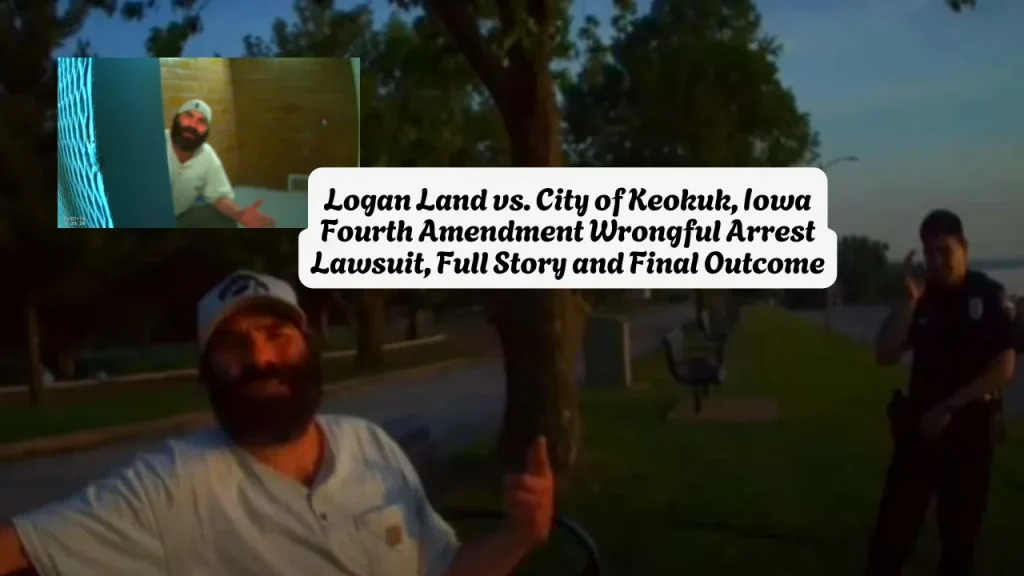
The story begins in 2019, when Officer Tanner Walden of the Keokuk Police Department was dispatched to investigate a man in a park. During the encounter, Officer Walden requested Land to produce identification. When Land reportedly refused to comply, the situation escalated, leading to his arrest. Crucially, the entire incident was captured on Officer Walden’s body-worn camera.
Land had a trial pending in federal court in the Southern District of Iowa concerning his arrest in 2019 in Rand Park in Keokuk after the police received a call of a person possibly sleeping near the flag pole. Officer Tanner Walden responded and Land refused to give the officer any identification, resulting in a charge from the officer for interference with official acts. Due to that arrest, Land’s belongings were searched, which resulted in a charge of possession of drug paraphernalia. Charges were later dropped against Land in Lee County District Court.
With the criminal charges against him dismissed, Logan Land decided to pursue justice through the civil court system. The core of Land’s complaint alleged a violation of his clearly established rights under the Fourth Amendment to the United States Constitution — specifically, the right to be free from unlawful arrest. The legal cause cited was 42 U.S.C. § 1983, the federal civil rights statute that allows individuals to sue government officials who violate constitutional rights under color of state law. Iowa is not a “stop and identify” state — meaning police in Iowa generally cannot lawfully demand identification from a person without reasonable suspicion of criminal activity.
Who Are Logan Land and Officer Tanner Walden?
Logan Vincent Land is a private individual who was sitting on a park bench in Rand Park in Keokuk, Iowa on the evening of June 7, 2019, watching the sunset. Land told Walden that he was not sleeping or in distress, but he refused to provide his identification when requested. After his criminal charges were dismissed, Land chose to pursue a civil rights claim rather than let the matter end there — a decision that ultimately resulted in a financial settlement from the city.
Officer Tanner Walden is a Keokuk Police Department officer who responded to the park call and made the arrest. The defendants’ legal position throughout the litigation was that neither the city nor Officer Walden acted improperly or illegally. The settlement document states the city and “released parties” deny they have done anything improper or illegal concerning the incidents alleged in the litigation, and that the settlement does not constitute an admission of liability on the part of any person or entity.
How Did the Logan Land vs. City of Keokuk Lawsuit End?
The case settled in November 2022 for a total of $30,490. The settlement was approved by the Keokuk City Council.
The city would be responsible for a $3,000 deductible with insurance provider Iowa Communities Assurance Pool, or ICAP, covering the rest of the $30,490 settlement to Logan Vincent Land. Before the settlement, a federal judge had partially resolved the case through summary judgment — a ruling on the law before trial. The two charges Land had against the city itself saw summary judgment approved, meaning the city was out of the lawsuit as a direct defendant, but the judge denied summary judgment for Walden, leaving Officer Walden’s individual liability to be decided at trial or through settlement.
The case was terminated in the U.S. District Court for the Southern District of Iowa on November 23, 2022. The dismissal was with prejudice — meaning Land cannot refile the same claims arising from this incident. No admission of wrongdoing was made by either defendant as a condition of the settlement.
What Does the Logan Land vs. City of Keokuk Case Mean for Civil Liberties?
The Logan Land case attracted significant public attention because of what it represented: a private citizen arrested in a public park for watching the sunset and declining to show identification. The body-worn camera footage of the encounter became widely circulated online in 2025, years after the case had already concluded, prompting renewed discussion about the scope of police authority and the rights of individuals during police encounters.
The case underscores a critical point about state law variation in police authority. Iowa does not have a “stop and identify” statute — unlike some states, Iowa law does not empower officers to demand identification from individuals absent reasonable suspicion of criminal activity. When the criminal charges were dropped and Land successfully pursued his civil rights claim, the city’s decision to settle — rather than take the case to trial — provided Land with both financial compensation and a degree of public accountability. The outcome serves as a practical example of how 42 U.S.C. § 1983 operates as a remedy for constitutional violations by individual officers even when criminal charges against the citizen have already been dismissed.
Frequently Asked Questions
1. Who filed the lawsuit and why?
Logan Vincent Land filed a federal civil rights lawsuit on June 7, 2021, against the City of Keokuk, Iowa and Officer Tanner Walden. Land alleged his Fourth Amendment right to be free from unlawful arrest was violated when Officer Walden arrested him in Rand Park for refusing to show identification — conduct Land argued was constitutionally protected under Iowa law.
2. What court handled this case?
The case was filed in the U.S. District Court for the Southern District of Iowa, Eastern Division, before U.S. District Judge Robert W. Pratt and Magistrate Judge Stephen B. Jackson Jr. The case number is 3:21-cv-00051.
3. Has the case been resolved?
Yes. The case settled on November 23, 2022 for $30,490, following the Keokuk City Council’s approval of the settlement. The case is fully closed.
4. How much money was involved?
The total settlement was $30,490. The city was responsible for a $3,000 deductible, with its insurance provider, Iowa Communities Assurance Pool (ICAP), covering the remaining amount. No punitive damages were awarded, as the matter was resolved through settlement before trial.
5. Can I read the court documents?
Yes. The full docket for Land v. City of Keokuk, Iowa, No. 3:21-cv-00051 is publicly available on CourtListener and through PACER at the U.S. District Court for the Southern District of Iowa.
6. Was Officer Walden personally held liable?
The settlement resolved Land’s remaining claim against Officer Walden after the court dismissed the City of Keokuk from the case via summary judgment. The settlement does not constitute an admission of liability on the part of any person or entity, and Officer Walden did not admit wrongdoing as a condition of the settlement.
7. Did Logan Land have to show his ID to the officer?
Iowa is not a “stop and identify” state — state law does not require individuals to provide identification to police without a lawful basis for detention. The dismissal of Land’s criminal charges by the Lee County District Court, followed by the federal court’s refusal to dismiss the Fourth Amendment claim against Officer Walden at summary judgment, suggests the court found a viable legal argument that the arrest lacked proper constitutional justification.
8. Why did this case go viral years after it settled?
Body-worn camera footage of the June 2019 arrest circulated widely online in 2025, reigniting public discussion about police authority and the right to refuse identification requests. The case had concluded in November 2022 — more than two years before it attracted widespread social media attention.
Sources & References
- CourtListener full docket: Land v. City of Keokuk, Iowa, No. 3:21-cv-00051 (S.D. Iowa): courtlistener.com
- Daily Gate City / Keokuk settlement reporting (November 2022), as cited by verified public sources
- Detailed case analysis (June 2025): delta.almondhouse.com
Case Type Classification Tag: Criminal Case with Civil Component — Fourth Amendment / Civil Rights (42 U.S.C. § 1983)
Prepared by the AllAboutLawyer.com Editorial Team and reviewed for factual accuracy against official court records and verified public sources on April 21, 2026. Last Updated: April 21, 2026
Disclaimer: This article is for informational purposes only and does not constitute legal advice. Information about ongoing or concluded legal cases is based on publicly available court records and verified reporting. Allegations described in this article have not necessarily been proven in court. For advice regarding a particular legal situation, consult a qualified attorney.
About the Author
Israr Ahmad is a legal content researcher with 4+ years of experience covering class action settlements and consumer rights cases. He has researched and published coverage of 2,500+ settlements using verified court records, settlement administrator filings, and government sources. Learn more about Israr.