
The Supreme Court Just Weakened the Voting Rights Act Here Is What It Means for Voters in Tennessee, Alabama, and Beyond
What did the Supreme Court’s 2026 Voting Rights Act ruling change for voters?
In Louisiana v. Callais, the Supreme Court ruled 6-3 on April 29, 2026 that states can no longer be required to draw majority-minority congressional districts unless plaintiffs prove intentional racial discrimination — a far harder legal standard that significantly weakens Section 2 of the Voting Rights Act.
In a matter of days, a Supreme Court ruling has set off a chain reaction across the American South that could reshape who represents millions of voters for years to come.
On April 29, 2026, the Supreme Court issued its decision in Louisiana v. Callais — a 6-3 ruling along ideological lines that fundamentally changed how Section 2 of the Voting Rights Act works in redistricting cases. Within 48 hours, the governors of Tennessee and Alabama called special legislative sessions to redraw their congressional maps. Louisiana had already suspended its May 16 congressional primaries. Florida had already passed new maps that could net Republicans up to four additional seats.
For Black voters and other minority communities in the South, the decision carries enormous stakes. Here is what the law said before, what it says now, and what your rights look like going forward.
What Section 2 of the Voting Rights Act Actually Did — Until Now
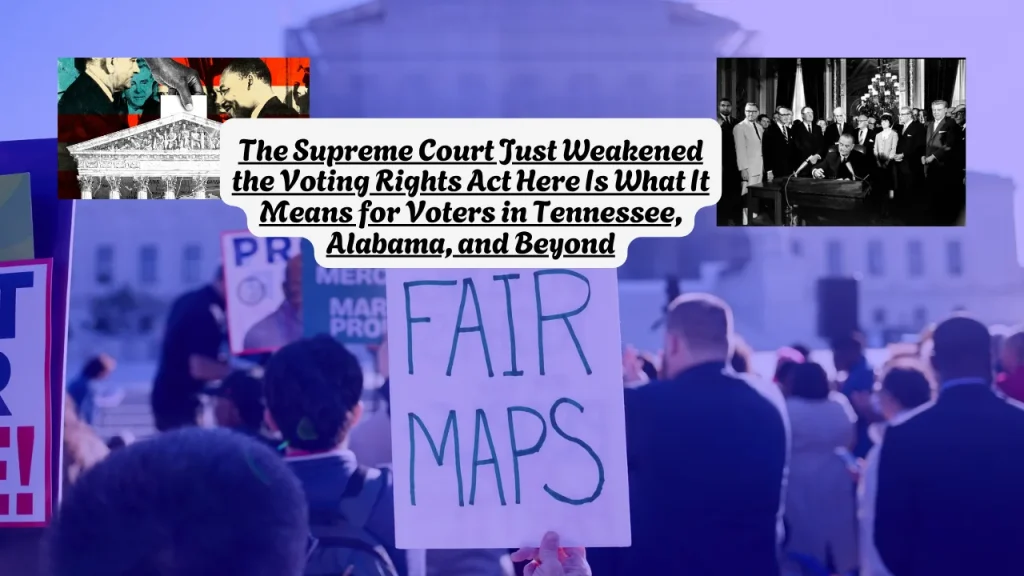
The Voting Rights Act of 1965 is one of the most significant pieces of civil rights legislation ever passed. Section 2 specifically prohibits any voting practice or law that discriminates based on race — including the drawing of congressional district maps that dilute minority voting power.
For decades, Section 2 was enforced through a legal framework established in Thornburg v. Gingles (1986). Under that framework, minority voters could challenge a redistricting map if they could show three things: that the minority group was large and geographically compact enough to form a majority in a district, that the minority group voted consistently as a bloc, and that the white majority voted consistently enough against minority-preferred candidates to usually defeat them.
If those three conditions were met — the “Gingles preconditions” — courts could order states to draw majority-minority districts to ensure fair representation. This is how Louisiana came to draw a second majority-Black congressional district, how Alabama was ordered to create one, and how dozens of majority-minority districts across the country exist today.
Long considered the jewel in the crown of the Civil Rights Movement, the Voting Rights Act has been largely dismembered since 2013 by the increasingly conservative Supreme Court. The major exception was a decision just two years ago that upheld past rulings on Section 2 in a redistricting case out of Alabama. That exception is now effectively overridden.
What the Supreme Court Changed in Louisiana v. Callais
The case arose from Louisiana’s post-2020 redistricting battle. After years of litigation, Louisiana first fought and then agreed to draw a second majority-Black district. A self-described group of “non-African-American voters” then intervened to challenge that new map as an unconstitutional racial gerrymander. The Trump administration supported them.
In a 36-page opinion, Justice Alito explained that “the Constitution almost never permits the Federal Government or a State to discriminate on the basis of race,” and asked whether “compliance with the Voting Rights Act should be added to our very short list of compelling interests that can justify racial discrimination.” The court said no.
The ruling did not formally strike down Section 2. But it rebuilt Section 2 from the ground up with a far more demanding standard. Writing for the majority in Callais, Justice Alito wrote that the court was “properly” interpreting Section 2 as “imposing liability only when circumstances give rise to a strong inference that intentional discrimination occurred.” Justice Elena Kagan, in dissent, accused the majority of making changes that “eviscerate the law.”
What does intentional discrimination mean in practice? Atiba Ellis, a professor at Case Western Reserve University’s law school, explained the problem: “We are essentially asking plaintiffs now to find a smoking gun — the proof of racist intent that is objectively and consciously articulated. The problem with discrimination cases is that most legislators know better than to say that.”
The ruling also established that plaintiffs must now prove four additional factors beyond the original Gingles framework: that entrenched discrimination in Southern states has been eliminated; that race and party affiliation are now so intertwined they cannot be separated; that partisan gerrymandering claims are non-justiciable under Rucho v. Common Cause (2019); and that computer modeling now makes it easy to show whether a more racially balanced map could still meet a state’s political goals. Combined, the majority concluded that plaintiffs were previously “dressing their political-gerrymandering claims in racial garb.”
Combined with the Supreme Court’s 2019 decision in Common Cause v. Rucho, which held that courts cannot block partisan gerrymandering, the Callais decision effectively declares all gerrymandering constitutional.
If you believe your district was drawn specifically to dilute your vote based on race — and you want to understand whether any legal challenge remains viable — a civil rights attorney can review your specific state’s situation. Most offer a free legal consultation.
Related article: JPMorgan’s Lorna Hajdini Lawsuit Complaint Withdrawn, Plaintiff Identified, and What Happens Next
What Tennessee and Alabama Are Moving to Do Right Now
The special sessions called by both governors are direct responses to the ruling — and both target specific seats.
Tennessee: Republican Gov. Bill Lee announced a special session for the GOP-controlled legislature to break up the state’s one Democratic-held House district, centered on the majority-Black city of Memphis. Lee said districts must “accurately reflect the will of Tennessee voters” and that changes “must be enacted as soon as possible.” President Trump had publicly stated he had spoken with Lee about a new map, and Sen. Marsha Blackburn called for immediate action to draw a map giving Republicans an advantage in all nine of Tennessee’s congressional districts.
The target is clear: Rep. Steve Cohen, the only Democrat in Tennessee’s congressional delegation, holds the Memphis-area 9th District. Republicans have always been constrained by the Voting Rights Act in their desire to spread that district’s Democratic voters into neighboring conservative districts — but the law may no longer be an impediment.
Alabama: Gov. Kay Ivey reversed her earlier position and called a special legislative session to redraw the state’s congressional maps. Alabama has been under a court order — stemming from Allen v. Milligan (2023) — requiring two majority-Black congressional districts. Alabama’s Attorney General filed emergency motions asking the Supreme Court to lift those injunctions immediately, arguing the Callais decision overrides the earlier mandate.
Alabama’s Attorney General Steve Marshall told CNN: “The Alabama in 2026 is not the Alabama of the early 1960s. It’s a new time and a different era.” Civil rights groups and legal scholars strongly dispute that characterization.
What Are Your Rights as a Voter Under the Weakened Voting Rights Act
Section 2 still exists. It has not been repealed. But what it now requires plaintiffs to prove — intentional racial discrimination — is significantly harder to establish than what was required before.
Here is what the law still allows voters and civil rights organizations to do:
Challenge maps that show direct evidence of intentional racial discrimination. If legislators made statements, sent communications, or documented reasons that demonstrate they drew maps specifically to reduce minority representation because of race — those can still form the basis of a Section 2 claim. The bar is higher, but it is not zero.
Pursue state-level voting rights claims. Several states have their own voting rights laws that operate independently of the federal VRA. California, New York, and other states have enacted state-level protections that provide broader grounds for challenging discriminatory maps than the federal standard now requires.
File challenges through the political process and state courts. Democrats in Tennessee noted that in 2022, the state supreme court blocked additional redistricting because it was too close to an election, and argued that the court remains their best hope this time around. State constitutional provisions and timing arguments remain available legal tools.
Monitor and object during the redistricting process. Public comment periods, state legislative hearings, and community testimony are all part of the redistricting process. Organized community participation — particularly from groups who can document the racial impact of proposed maps — creates a record that can support future legal challenges.
What This Ruling Means Beyond 2026
While legal and logistical hurdles may limit how much can change before November 2026 given that most states have already closed candidate filing windows, the ruling is expected to have a far greater impact on future elections, particularly in 2028, when states will have the time and flexibility to redraw the lines comprehensively.
Legal scholars described it as “one of the most consequential Supreme Court decisions ever,” saying it will allow partisan gerrymandering to move forward and significantly gut Section 2 of the Voting Rights Act, which had protections in place for decades.
The implications extend well beyond Congress. In recent years, Section 2 had been used to restore democracy to local elections in a small, majority-Black Alabama town where white mayors had picked their successors, help Hispanics win city council representation for the first time in a Washington city where they make up a third of the population, and lead to three Native Americans winning seats in the North Dakota legislature. All of those types of challenges now face the same newly elevated burden of proof.
Frequently Asked Questions About the 2026 Voting Rights Act Ruling
Does the Supreme Court’s ruling eliminate the Voting Rights Act entirely?
No. Section 2 of the VRA remains law. The ruling did not strike it down. But it now requires plaintiffs to prove intentional racial discrimination — not just discriminatory effect — which legal scholars say makes meaningful enforcement far more difficult in most redistricting cases.
Can voters still sue over maps they believe dilute minority representation?
Yes, but the legal standard is now significantly harder to meet. Plaintiffs must demonstrate a strong inference of intentional discrimination, not simply statistical evidence of racial dilution. Consulting a civil rights attorney who specializes in voting rights is essential before pursuing such a challenge.
What happens to existing majority-minority districts created under the old VRA standard?
They remain in place for now. The ruling affects future challenges and future maps, not districts already drawn and in use. However, states that have been under court orders to maintain majority-minority districts — like Alabama — are now asking courts to lift those orders in light of Callais.
How does this affect the 2026 midterm elections?
The timing limits immediate impact on 2026, as most states have already begun the primary process. However, Tennessee and Alabama have called special sessions specifically to attempt redistricting before November. Louisiana has already suspended its House primaries. Legal challenges to those moves are already underway.
What can minority voters do right now to protect their representation?
Contact your state legislators during the special session public comment periods. Connect with civil rights organizations like the NAACP Legal Defense Fund or the Lawyers’ Committee for Civil Rights Under Law, who are already litigating challenges to the post-Callais redistricting moves. Document and preserve any statements made by legislators about the racial intent behind new maps.
Legal Terms Used in This Article
Section 2 of the Voting Rights Act: The provision of the VRA (52 U.S.C. § 10301) that prohibits any voting law or practice that discriminates on the basis of race, including congressional maps that dilute minority voting power.
Majority-Minority District: A congressional district drawn so that a racial or ethnic minority group makes up a majority of the voting-age population, intended to give that community a realistic opportunity to elect a representative of their choice.
Gerrymandering: Drawing district boundaries to give one political party or group a systematic advantage over another. Partisan gerrymandering was declared non-justiciable in federal courts in 2019. Racial gerrymandering remains unconstitutional but now harder to prove.
Intentional Discrimination: The new standard required under Callais to prove a Section 2 violation — plaintiffs must now show the state specifically drew maps to harm minority voters because of their race, not merely that the maps have a racially discriminatory effect.
The Gingles Framework: The legal test from Thornburg v. Gingles (1986) that courts have used for 40 years to evaluate Section 2 claims. The Callais ruling added significant new requirements on top of this framework, raising the bar for plaintiffs substantially.
The Law Changed — But the Fight for Fair Representation Has Not
The Supreme Court’s ruling in Louisiana v. Callais did not end the Voting Rights Act. It made it dramatically harder to enforce in the cases that matter most — where politicians redraw lines to dilute Black and minority communities’ political power while insisting they are acting for partisan, not racial, reasons.
Tennessee, Alabama, Louisiana, and Florida are already moving. More states will follow before 2028. If you live in one of these states and believe your congressional representation is being deliberately dismantled, you have fewer federal tools than you did last week — but you still have tools. Use them.
Prepared by the AllAboutLawyer.com Editorial Team and reviewed for factual accuracy against the Supreme Court’s opinion in Louisiana v. Callais, 608 U.S. ___ (2026), official reporting from NPR, PBS NewsHour, SCOTUSblog, CNN, and the Washington Post. Last Updated: May 3, 2026
Disclaimer: This article is for informational purposes only and does not constitute legal advice. Laws vary by state and individual circumstances differ. For advice regarding your specific situation, consult a qualified attorney licensed in your state.
About the Author
Israr Ahmad is a legal content researcher with 4+ years of experience covering class action settlements and consumer rights cases. He has researched and published coverage of 2,500+ settlements using verified court records, settlement administrator filings, and government sources. Learn more about Israr.