
Paul Miller’s Law in Pennsylvania What Drivers Must Know Before June 5, 2026
What is Paul Miller’s Law in Pennsylvania?
Paul Miller’s Law (Senate Bill 37, Act 18 of 2024) is Pennsylvania’s hands-free driving law, signed by Governor Josh Shapiro in 2024. It bans drivers from holding or using a handheld device while operating a vehicle — including at red lights and in traffic. Warnings were issued from June 5, 2025 through June 4, 2026. Beginning June 5, 2026, violations carry a $50 fine plus court costs.
Quick Facts — Paul Miller’s Law at a Glance
| Detail | Information |
| Full Name | Paul Miller’s Law (Senate Bill 37, Act 18 of 2024) |
| Signed By | Governor Josh Shapiro |
| Date Signed | June 5, 2024 |
| Warning Period | June 5, 2025 – June 4, 2026 |
| Fines Begin | June 5, 2026 |
| Fine Amount | $50 + court costs and fees |
| Points on License | None for non-commercial drivers |
| Primary Offense | Yes — police can stop you solely for this violation |
| Enhanced Penalty | Up to 5 additional years prison if convicted of homicide by vehicle while distracted |
| Enforced By | Pennsylvania State Police + local law enforcement |
Who Was Paul Miller Jr. and Why Is This Law Named After Him
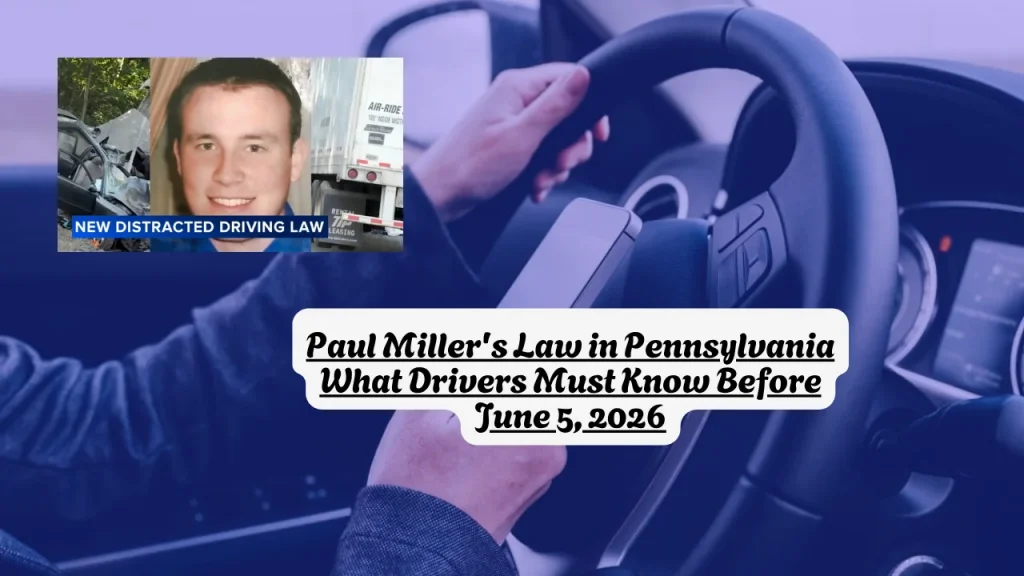
The law is named for Paul Miller Jr., a 21-year-old killed in 2010 when a distracted commercial truck driver crossed the median and struck his vehicle. He was from Scranton, Monroe County.
Since Paul’s death, his mother Eileen Miller has become a national advocate for stronger laws to curb distracted driving. “Nearly 15 years ago, two Dunmore state troopers knocked on my door to tell me that my son was killed,” she said.
Eileen spent years lobbying the Pennsylvania legislature for this law. She became a traffic safety advocate after her son’s death and has tirelessly pushed for its passage. When Governor Shapiro signed Senate Bill 37, she was standing beside him. She noted: “I tell everybody, turn their phones off behind the wheel. Once you lose a child, there is nothing that important. Nothing’s that important.”
Understanding why this law exists matters — because it shapes how courts and juries will view drivers who violate it. A jury in a civil case brought by an injured victim will hear Paul Miller’s story before they hear the facts of the crash.
What Paul Miller’s Law Actually Bans — in Plain Terms
Effective June 5, 2025, the law prohibits as a primary offense any driver from using an interactive mobile device while driving a motor vehicle — and the law defines “driving” broadly to include not just moving vehicles, but any time a driver is operating a motor vehicle on a public road, even when stopped at a red light, stop sign, or due to traffic delays.
That last part catches a lot of drivers off guard. Sitting at a red light with your phone in your hand is a violation. Being stopped in bumper-to-bumper traffic with your phone in your hand is a violation.
The law defines “use” of a device to include holding it in your hand or supporting it with another part of your body, pressing more than one button to interact with it, or reaching for it in a way that removes you from a proper seated, seat-belted position.
An “interactive mobile device” includes any handheld phone, smartphone, tablet, personal digital assistant, or similar wireless device capable of calling, texting, emailing, browsing the internet, using apps, playing games, recording or sharing media, or sending and receiving electronic data.
So this is not just about texting. Holding your phone to check Google Maps, scrolling your playlist, glancing at a notification — all of it is now a ticketable offense in Pennsylvania.
Related article: $100M Walmart Spark Driver Pay Settlement, Check If You Qualify for an Automatic Payment
What Is Still Allowed Under Paul Miller’s Law
The law is not a total ban on phone use in a vehicle. Several things remain fully legal.
Drivers can still use their phones to alert emergency responders and, if they are using hands-free technology, to make phone calls, use a GPS, and listen to music.
A driver may use an interactive mobile device if the driver moves the vehicle to the side of or off a highway and halts in a location where the vehicle can safely remain stationary. So pulling completely off the road and stopping — not just pulling to the shoulder at a light — is the legal way to use your phone when you need it.
Drivers can make a single tap or swipe on a securely mounted device. The key word is mounted — on a dashboard holder or windshield mount, not held in your hand.
The law does not apply to a GPS device, a system or device that is physically or electronically integrated into the vehicle, or a communications device that is affixed to a mass transit vehicle, bus, or school bus. Built-in car navigation systems are fine. A phone sitting in a cupholder being used as a GPS is not.
The Fines and Penalties — What Happens If You Are Caught
Beginning June 5, 2026, drivers convicted of using a hand-held device while driving will pay a $50 fine, plus court costs and other fees. Court costs in Pennsylvania typically add $75 to $150 on top of the base fine, so the real out-of-pocket cost is closer to $125–$200 per violation.
The violation carries no points as a penalty and will not be recorded on the driver record for non-commercial drivers. That is important — a citation under Paul Miller’s Law will not directly affect your driver’s license or cause automatic insurance surcharges the way a moving violation would.
However, many insurance companies treat handheld-device violations as risk indicators. A citation could lead to increased premiums. Your insurer may learn of the violation even without points attaching.
For commercial drivers, the stakes are higher. The violation will be recorded on commercial drivers’ records as a non-sanction violation. Commercial drivers can also face consequences under Federal Motor Carrier Safety Administration rules, separate from the state fine.
Enhanced Criminal Penalties for Serious Crashes
The $50 fine is only part of the picture. Beyond summary offenses, the law significantly increases penalties for serious crashes: a conviction for homicide by vehicle due to a violation of this law could result in an additional five years of confinement, and aggravated assault by vehicle could lead to an additional two years.
This is not a minor enhancement. If a driver kills someone while holding their phone, they now face a potential prison sentence that is five years longer than they would have faced before this law existed.
How Paul Miller’s Law Creates Civil Liability for Injured Victims
This is the section that matters most if you were hurt by a distracted driver — and it is the part most general news coverage skips entirely.
Pennsylvania follows common-law negligence rules, but violating a safety statute can create negligence per se, which is an automatic breach of duty. When the at-fault driver in a crash receives a citation under Paul Miller’s Law, that ticket can make it much easier to prove liability in civil court.
Negligence per se is a powerful legal doctrine. Normally, if you sue a driver who hurt you, you must prove they failed to act as a reasonable person would. When a driver violates a safety statute like Paul Miller’s Law, that proof is significantly simplified — the violation itself establishes the breach of duty. Your attorney still needs to prove causation and damages, but the hardest part of a negligence case becomes easier.
Phone records may be subpoenaed to show device usage at the time of the crash, and witness testimony about seeing a driver with a handheld device becomes more significant under this law.
If you were in an accident with a driver you believe was on their phone, the first call you make should be to a personal injury attorney — not weeks later, but as soon as you are medically able. Electronic evidence from phone records and crash data recorders can be lost or overwritten quickly. Most personal injury attorneys offer a free legal consultation and take distracted driving cases on contingency, meaning no upfront cost to you.
How Pennsylvania Is Enforcing Paul Miller’s Law
From June 5 through September 30, 2025, troopers statewide issued 674 warnings. From January 1 through September 30 of 2025, troopers investigated 6,164 distracted driving motor vehicle crashes statewide.
According to PennDOT data, in 2024 there were 9,950 crashes involving a distracted driver, resulting in more than 6,000 injuries and 49 fatalities. Distracted driving crash data is believed to be underreported due to many drivers’ reluctance to admit to being distracted at the time of a crash.
Pennsylvania State Police Acting Commissioner Lieutenant Colonel George L. Bivens stated: “As the warning period for Paul Miller’s Law concludes, troopers will begin issuing citations to drivers using handheld devices behind the wheel.”
Because this is a primary offense, officers do not need any other reason to pull you over. Seeing a phone in your hand through your car window is sufficient justification for a traffic stop.
In a move aimed at preventing bias in policing, Paul Miller’s Law also mandates data collection on all self-initiated traffic stops. That data is shared with the Transportation Committees of the Senate and the House of Representatives, as well as the Pennsylvania Commission on Crime and Delinquency, for analysis.
How Paul Miller’s Law Compares to the Old Texting Ban
Pennsylvania already had a texting-while-driving ban before this law. Many drivers are confused about the difference. Here is the key distinction:
The previous texting ban prohibits drivers from using mobile devices to send, read, or write text-based communications while their vehicle is in motion. That ban only covered texting, only applied while moving, and was a secondary offense — meaning officers needed another reason to pull you over first.
Paul Miller’s Law is broader and stronger in every way. It covers all handheld device use, applies even when stopped at lights, and is a primary offense. The old texting ban still exists alongside it, but Paul Miller’s Law supersedes and preempts any local ordinances on the topic, creating a uniform statewide standard.
Frequently Asked Questions
Can I get pulled over for holding my phone at a red light in Pennsylvania?
Yes. Paul Miller’s Law defines driving to include being stopped at a red light, stop sign, or in traffic. Officers can pull you over solely for holding your phone, even if your car is not moving. This has been the law since June 5, 2025 — fines begin June 5, 2026.
What is the fine for violating Paul Miller’s Law in Pennsylvania?
The base fine is $50, plus court costs and fees. Court costs typically add $75–$150, making the real cost closer to $125–$200 per citation. No license points are added for non-commercial drivers, but insurance companies may still raise your rates.
Does Paul Miller’s Law apply to GPS use on my phone?
If your phone is mounted on a dashboard or windshield holder and you are making a single tap or swipe, that is permitted. If you are holding your phone to look at navigation, that violates the law. A built-in car navigation system is always permitted.
What happens if I cause an accident while violating Paul Miller’s Law?
Criminally, if you kill someone while violating the law and are convicted of homicide by vehicle, you face up to five additional years in prison. In a civil lawsuit, your citation under Paul Miller’s Law creates negligence per se — making it significantly easier for the injured person to prove you were at fault and recover compensation.
How long do I have to file a personal injury lawsuit in Pennsylvania if I was hit by a distracted driver?
Under Pennsylvania’s statute of limitations, 42 Pa. C.S. § 5524, personal injury claims generally must be filed within two years of the date of the accident. Missing that deadline permanently bars your claim.
Does Paul Miller’s Law affect commercial drivers differently?
Yes. While the $50 fine applies to all drivers, violations are recorded on commercial drivers’ records as a non-sanction violation. Commercial drivers can also face consequences under FMCSA federal regulations, separate from state penalties, including potential job and certification consequences.
Can police seize my phone during a traffic stop under this law?
No. The law does not authorize the seizure of an interactive wireless device. An officer can cite you for holding your phone, but they cannot take it from you during the stop.
What should I do if I was injured by a driver violating Paul Miller’s Law?
Call 911, get medical attention, and contact police to ensure a report is filed. Document the scene and your injuries. Then consult a Pennsylvania personal injury attorney as soon as possible — phone records that show the other driver was on their phone can be subpoenaed, but this evidence must be preserved quickly. Most personal injury attorneys offer a free consultation with no upfront cost.
Legal Terms Used in This Article
Primary Offense: A violation for which police can stop you without needing any other reason. Paul Miller’s Law is a primary offense — seeing a phone in your hand is enough justification to pull you over.
Negligence Per Se: A legal doctrine that means a defendant automatically breached their duty of care by violating a safety statute. In a civil lawsuit, a Paul Miller’s Law citation against the at-fault driver significantly simplifies proving negligence.
Negligence: Failure to act with the care a reasonable person would exercise in similar circumstances. The foundation of most personal injury claims arising from distracted driving crashes.
Summary Offense: The lowest level of criminal offense in Pennsylvania. A Paul Miller’s Law violation is a summary offense — similar to a traffic ticket — rather than a misdemeanor or felony, unless the distracted driving causes serious injury or death.
Statute of Limitations: The deadline by which a lawsuit must be filed. For personal injury claims in Pennsylvania, this is generally two years from the date of injury. Missing it permanently eliminates your right to sue.
Homicide by Vehicle: A Pennsylvania criminal charge that applies when a driver causes a death through a violation of traffic law. Under Paul Miller’s Law, conviction for homicide by vehicle while using a handheld device can add up to five years to the sentence.
Contingency Fee: A fee arrangement where your attorney is paid only if you win your case. Most Pennsylvania personal injury attorneys handle distracted driving cases on contingency — meaning no upfront cost to the injured person.
You now know exactly what Paul Miller’s Law requires, what the fines are, how enforcement works starting June 5, 2026, and how a violation creates serious legal consequences in both criminal and civil court. If you were injured by a distracted driver — before or after this law took effect — the citation and phone records from that driver can be powerful evidence in your case. Visit AllAboutLawyer.com to connect with a Pennsylvania personal injury attorney who can evaluate your situation and tell you what your claim may be worth.
Prepared by the AllAboutLawyer.com Editorial Team and reviewed for factual accuracy against PennDOT official sources (pa.gov), Pennsylvania State Police announcements, and verified news reporting as of May 3, 2026. Last Updated: May 3, 2026.
Disclaimer: This article is for informational purposes only and does not constitute legal advice. Laws and enforcement practices may vary. For advice regarding your specific situation, consult a qualified attorney licensed in Pennsylvania.