
Can You Sue Amazon, FedEx, or UPS If Their Delivery Truck Hit You?
What happens legally if an Amazon, FedEx, or UPS truck hits you?
Yes — you can sue Amazon, FedEx, or UPS if one of their delivery trucks hits you, but the answer depends on who was actually driving and how that driver was classified. These companies use layered contractor structures designed to limit their legal exposure, but courts across the country are increasingly holding them responsible regardless.
You’re driving through your neighborhood when a blue Amazon van blows a stop sign and T-bones your car. Or a FedEx truck rear-ends you at a red light. You pull over, you’re shaken up, and you look at the logo on the side of that truck — and you assume you know exactly who to call a lawyer about.
Here’s where it gets complicated.
The logo on the side of the truck does not always tell the whole legal story. Liability depends heavily on the employment status of the driver and the corporate structure of the delivery company. Amazon, FedEx, and UPS have each built their delivery networks differently — and those differences directly affect who you can sue, which insurance policy pays, and how hard your case will be to win.
This article breaks down exactly how each company is structured, why the “independent contractor” defense keeps coming up in court, what compensation you can recover, and what steps to take right now if you were recently hit by a delivery truck.
Why Delivery Truck Accident Claims Are More Complex Than Ordinary Car Crashes
When a regular driver hits you, you sue that driver — and usually their insurance company. Simple.
Delivery truck accident claims involve complex issues of liability. The trucks may be owned by one company, driven by another company’s employee, and delivering packages for a third company entirely. That’s three potentially separate defendants — and three separate insurance policies — all created by corporate structures designed to push responsibility away from the company whose name is on the van.
Due to the increase in online shopping, many delivery companies have been hiring additional support and growing their third-party delivery network. In some cases, this may mean that drivers are untrained and may speed or break other laws to deliver packages on time, which can cause major accidents.
The pressure is relentless. Some delivery drivers report making over 250 stops a day — nearly double what was expected five years ago. That pace creates real danger on residential streets, and when accidents happen, real victims often find themselves up against some of the most sophisticated legal defense teams in the country.
The good news: more potentially liable defendants usually means more insurance coverage available to compensate you. But you have to know who to target first — and an experienced personal injury attorney can identify every liable party in a single consultation, most at no upfront cost to you.
How Amazon, FedEx, and UPS Structure Their Delivery Drivers — and Why It Changes Your Case
Each of the three major carriers uses a fundamentally different employment model. That model is the single most important factor in determining who is legally responsible when a crash happens.
Amazon and the Delivery Service Partner System
Amazon often says their drivers don’t actually work for them. Instead, Amazon calls them “independent contractors” who work for small businesses known as Delivery Service Partners, or DSPs.
As of January 2024, Amazon has 3,500 Delivery Service Partner companies with 275,000 employees working for those companies to make sure over 20 million packages are delivered every day across 19 countries. On paper, those blue Amazon vans are owned and operated by local small businesses — not Amazon itself. Amazon uses this structure to argue that when one of those drivers causes a crash, the DSP is responsible, not Amazon.
Courts are rejecting that argument with increasing force.
Amazon controls major parts of the process: who gets hired, required training, routing and tracking through apps, and performance standards. Amazon keeps an eye on drivers’ movements, speed, and delivery times — and penalizes DSPs for missed or late deliveries.
Amazon also operates Amazon Flex, where individuals deliver packages using their own personal vehicles. They are classified as independent contractors. While Amazon provides liability insurance for Flex drivers while they are active on the app, coverage disputes are common.
Related article: What Happens If You Get Hit by an Amazon Truck And Who Pays
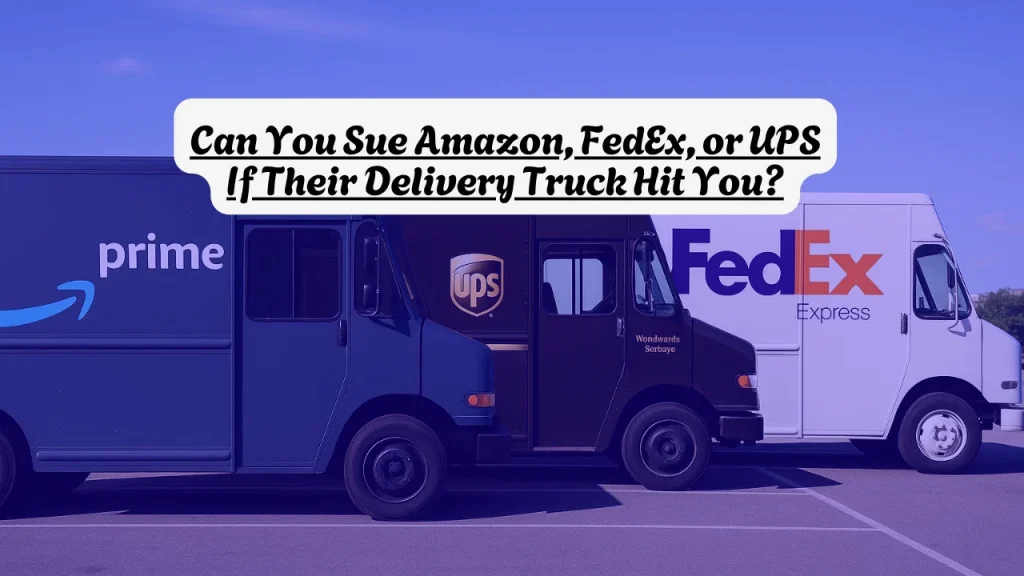
FedEx — Two Companies Under One Name
“FedEx” is not one uniform employer, and this distinction matters enormously to your case.
FedEx Express uses company employees driving company-owned trucks. FedEx Ground operates through Independent Service Providers (ISPs) who own their trucks and employ their own drivers. These contractors purchase routes from FedEx and run their own small businesses under the FedEx brand.
If a FedEx Express truck hits you, FedEx is directly on the hook — those are W-2 employees. If a FedEx Ground truck hits you, FedEx will argue the ISP is a separate business and push responsibility toward them. An experienced attorney knows how to pierce that structure when evidence shows FedEx exercises real operational control.
UPS — The Most Direct Employment Model
UPS primarily uses employee drivers operating company-owned vehicles. Drivers wear UPS uniforms, drive UPS trucks, and follow UPS procedures. This traditional employment model generally makes UPS more directly liable for driver negligence.
That does not mean UPS will simply accept responsibility. Their legal and claims teams are aggressive. But it does mean the corporate structure is simpler — and the legal doctrine of respondeat superior applies cleanly, making UPS accountable for what its employees do on the clock.
If you are unsure which model applies to your crash, a personal injury attorney can investigate the driver’s actual employment relationship in one consultation — most offer a free case review.
The Independent Contractor Defense — and Why Courts Are Rejecting It
Every time one of these companies gets sued after a crash, their first line of defense is almost always identical: “That driver didn’t work for us.”
Under most state laws, just because parties label themselves “independent contractors” doesn’t mean the hiring company is off the hook legally. Control over the driver is the most important factor — in court, an “independent” driver can be the legal responsibility of the company that controls their work.
Another concept called “ostensible agency” can also make Amazon liable. This applies when a contractor appears to be an employee — the drivers are driving an Amazon Prime van, wearing an Amazon Prime uniform, and communicating with the customer through the Amazon app.
Courts are dismantling this defense in real cases with real money at stake.
In December 2023, a South Carolina jury returned a $44.6 million verdict against Amazon — including $30 million in punitive damages — after a motorcyclist sustained a traumatic brain injury when an Amazon Delivery Associate failed to yield and turned left directly into his path in Summerville, South Carolina. Amazon argued the DSP and driver were independent contractors and therefore Amazon was not vicariously liable. The jury disagreed, finding overwhelming evidence that Amazon controls and directs nearly every aspect of its Delivery Service Partners and their delivery routes.
Then in August 2024, a Gwinnett County, Georgia jury awarded $16.2 million and found Amazon 85% at fault after a boy was struck by an Amazon contract driver. The jury found that Amazon’s control over delivery operations was sufficient to establish liability despite the independent contractor arrangement.
The independent contractor defense is not bulletproof. It is simply Amazon’s opening argument — and juries are increasingly refusing to accept it.
Who Can You Sue After a Delivery Truck Hits You?
The short answer is: potentially several parties at once. Identifying all of them is your attorney’s first job.
Potentially liable parties include the delivery company itself depending on driver employment status and safety policies, the trucking company, vehicle or parts manufacturers for defective equipment, maintenance providers for faulty repairs, and third-party logistics firms.
Here is how it breaks down based on who hit you:
Amazon DSP van: You can name the driver, the local DSP company, and Amazon itself. The more control Amazon exercised over that driver’s daily work, the stronger the case against Amazon directly. Amazon’s own in-app monitoring data, driver scorecards, and GPS logs are powerful evidence.
FedEx accident: First determine whether it was a FedEx Express truck (employees — FedEx is directly liable) or a FedEx Ground truck (ISP contractor — you need to pierce the contractor layer). Your attorney will pull the driver’s employment records to confirm.
UPS accident: UPS drivers are typically direct employees. The doctrine of respondeat superior makes UPS automatically liable for accidents caused by their drivers while on the clock.
Naming multiple defendants increases the pool of available insurance coverage. Commercial delivery operations typically carry substantial liability policies, which means more compensation may be available for serious injuries than in a typical car accident case.
What Compensation Can You Recover in a Delivery Truck Accident Lawsuit?
If a delivery driver’s negligence caused your accident, you may be entitled to compensation for damages across several categories.
Economic damages are the losses you can calculate with receipts: emergency room bills, surgeries, physical therapy, follow-up care, future medical treatment, lost wages while you recovered, and any long-term reduction in your earning capacity if you suffered a permanent injury.
Non-economic damages cover what cannot be put on a receipt — the daily physical pain you now live with, the emotional distress, the hobbies and activities you can no longer do, and the loss of enjoyment in your life.
In cases involving corporate negligence or reckless delivery practices, punitive damages may also be available. These are not designed to cover your losses — they are designed to punish the company and make an example. The $30 million in punitive damages in the South Carolina Amazon verdict was a direct response to the company’s documented failure to act on 90 recorded distracted driving alerts before that crash happened.
A personal injury attorney can assess your specific injuries and losses and tell you which damage categories apply — most work on a contingency fee, meaning no upfront cost to you.
Evidence That Makes or Breaks a Delivery Truck Accident Case
Move quickly. Delivery companies and their insurers begin investigating immediately after any truck accident. Electronic data from the truck, GPS records, and delivery route logs may be overwritten or deleted within weeks or even days.
Your attorney will send a spoliation letter demanding the preservation of scanner data showing whether the driver was interacting with their device at the moment of impact, GPS and telematics data tracking speed and braking behavior, and dash cam footage. Amazon vans are often equipped with Netradyne cameras that record both the driver’s behavior and the road ahead.
Beyond the truck’s own data, the following evidence is critical in delivery truck accident lawsuits: the police report from the scene, your medical records starting from day one, photographs of both vehicles and the location of the crash, witness contact information collected at the scene, and any written communications you receive from the company’s insurance adjusters.
One warning that cannot be stated strongly enough: do not give a recorded statement to any insurance company — the delivery company’s or your own — before speaking with an attorney. These corporations have huge resources dedicated to reducing their responsibility, including dispatching investigators to accident scenes immediately to control evidence and witness statements.
For more on how trucking companies structure liability across drivers, carriers, and maintenance contractors, see our full breakdown of overloaded truck accident liability at AllAboutLawyer.com — the multi-party liability analysis applies directly to delivery truck crashes.
How Long You Have to File a Lawsuit Against Amazon, FedEx, or UPS
Every state sets a deadline — called the statute of limitations — by which you must file your lawsuit or permanently lose the right to sue. Here are the verified deadlines for the most commonly affected states:
Texas: Two years from the date of the accident, under Texas Civil Practice and Remedies Code § 16.003(a). Under § 16.003, a person must bring suit for personal injury not later than two years after the day the cause of action accrues.
California: Two years from the date of injury, under California Code of Civil Procedure § 335.1. Cal. CCP § 335.1 establishes a two-year deadline for an action for injury to, or the death of, an individual caused by the wrongful act or neglect of another.
Georgia: Two years from the date of the accident, under O.C.G.A. § 9-3-33. Under O.C.G.A. § 9-3-33, actions for injuries to the person shall be brought within two years after the right of action accrues.
New York: Three years from the date of the accident for a personal injury lawsuit. For wrongful death claims, the deadline is two years from the date of death.
Florida: Two years from the date of injury for accidents occurring on or after March 24, 2023. Florida Statute § 95.11(4)(a) was amended by HB 837, reducing the statute of limitations for negligence claims from four years to two years, effective March 24, 2023. This applies to causes of action accruing on or after that date.
The legal deadline is not your practical deadline. Insurance companies may delay the process hoping you run out of time. Hiring an attorney early lets you push back against those tactics and ensures the claim is taken seriously. Digital evidence disappears in days. Act the same week as the crash.
Common Mistakes That Can Sink a Delivery Truck Accident Claim
People make the same preventable errors after getting hit by a delivery truck. These are the ones that cause the most damage.
Accepting the first settlement offer without attorney review. Insurance adjusters are trained to offer quick, low settlements before you understand your injuries or your rights. The first offer is almost always far below what your case is worth — particularly in cases involving Amazon or FedEx, where corporate defense teams set those opening numbers deliberately low.
Assuming the company whose logo is on the truck is the only defendant worth pursuing. That assumption leaves significant insurance coverage on the table. An attorney may identify the DSP, the driver individually, and the parent corporation as separate defendants with separate coverage.
Waiting too long to hire an attorney. The evidence timeline in these cases is unforgiving. GPS data gets overwritten. Cameras get recycled. Witnesses become harder to locate. Every week of delay makes the case harder to build.
Posting anything about the accident or your injuries on social media. Insurance defense attorneys monitor social media actively. A photo of you at a family event or on a short walk three weeks after the crash can be used to minimize your claimed injuries.
Giving a recorded statement to any insurance adjuster without legal counsel. You are not required to do this. Every word you say will be scrutinized for ways to reduce or deny your claim.
Frequently Asked Questions
What is the statute of limitations to sue Amazon, FedEx, or UPS after a delivery truck accident?
Most states set the deadline at two years from the date of the accident for personal injury claims — including Texas (Tex. Civ. Prac. & Rem. Code § 16.003), California (CCP § 335.1), Georgia (O.C.G.A. § 9-3-33), and Florida (Fla. Stat. § 95.11 as amended by HB 837). New York gives three years. Miss the deadline and your right to sue is permanently gone, regardless of how strong your case is.
Can Amazon avoid liability by calling its drivers independent contractors?
Increasingly, no. Courts apply the “control test” to determine who is the real employer. Because Amazon sets routes, controls training, monitors speed and braking in real time, and disciplines DSPs for missed deliveries, juries in South Carolina and Georgia have found Amazon directly liable — even when drivers technically worked for DSP subcontractors. The $44.6 million South Carolina verdict and the $16.2 million Georgia verdict are both based on this legal theory.
How long does a delivery truck accident lawsuit take to settle?
Most cases resolve through negotiated settlement within six to eighteen months. Cases that involve disputed liability — which most Amazon cases do — can take longer. Cases that go to trial typically take two to three years. The severity of your injuries and how many defendants are named both affect the timeline.
What if I was partially at fault for the accident — can I still recover damages?
In most states, yes. Under modified comparative negligence rules, your compensation is reduced by your percentage of fault. In Texas, Georgia, and most other states, as long as you were less than 51% responsible, you can still recover. Florida moved to a 50% bar under HB 837 in 2023. Talk to an attorney about how your state’s rule applies to your specific situation.
Do I need a lawyer to sue a delivery company, or can I handle it myself?
You can file a claim yourself, but these cases involve corporate legal teams, multiple layered insurance policies, and digital evidence that disappears within days. A personal injury attorney — most take these cases on contingency, meaning zero upfront cost — significantly increases both the odds of recovery and the final amount you receive.
What if the Amazon or FedEx driver fled the scene?
An attorney can subpoena the delivery company’s GPS records, pull route data from the driver’s app, and obtain traffic or security camera footage to identify both the vehicle and the driver. The truck’s digital data does not lie and is often preserved even when the driver is not cooperative.
What damages can I actually recover in a delivery truck accident case?
You may recover medical expenses, future medical costs, lost wages, reduced earning capacity for permanent injuries, pain and suffering, emotional distress, and — in cases involving especially reckless corporate conduct — punitive damages. The $44.6 million South Carolina verdict against Amazon included $30 million in punitive damages alone, reflecting the jury’s response to Amazon’s failure to remove a driver flagged 90 times for distracted driving before the crash.
Is it worth pursuing a case if my injuries seem minor?
Always get a medical evaluation first. Whiplash, soft tissue injuries, concussions, and internal injuries are not always immediately apparent after a crash. An attorney can assess whether a case is worth pursuing after a free consultation — and most will tell you directly if the damages don’t support it.
Legal Terms Used in This Article
Vicarious liability: The legal principle that holds an employer responsible for harm caused by an employee acting within the scope of their job duties. Also called respondeat superior.
Independent contractor: A worker legally classified as self-employed rather than an employee. Companies use this label to argue they are not responsible for a contractor’s accidents — but courts look past the label to examine who actually controlled the work.
Respondeat superior: Latin for “let the master answer.” The legal doctrine that makes employers directly liable for negligent acts of their employees committed while on the job.
Statute of limitations: The legal deadline by which you must file a lawsuit. Miss it, and you permanently lose the right to sue — regardless of how strong your case is or how severe your injuries are.
Punitive damages: Money courts award on top of actual losses, specifically to punish a defendant for reckless or malicious conduct. Not available in every case — but powerful when courts find corporate willfulness.
Contingency fee: A legal fee arrangement where your attorney gets paid only if you win or settle. You pay nothing upfront — the attorney takes a percentage of the final recovery.
Spoliation letter: A formal legal notice sent immediately after an attorney is hired, demanding the opposing party preserve all relevant evidence. In delivery truck cases, this targets GPS data, in-cab camera footage, driver monitoring app data, and dispatch records — all of which can be deleted within days.
Ostensible agency: A legal theory that holds a company liable for a contractor’s actions when the contractor reasonably appeared to be the company’s employee — for example, a driver operating an Amazon-branded van in an Amazon uniform communicating through the Amazon app.
Delivery Service Partner (DSP): Amazon’s term for the small, independently owned delivery businesses it contracts to handle last-mile package delivery. Amazon uses DSPs to argue its drivers are not Amazon employees — courts are increasingly rejecting this argument.
You Have More Legal Options Than These Companies Want You to Believe
You now understand that the logo on the truck is a starting point, not the finish line. Whether you were hit by an Amazon van driven by a DSP contractor, a FedEx Ground truck operated by an ISP, or a UPS driver who is a direct employee, you may have claims against the driver, the subcontracting company, and the corporation behind the brand — with separate insurance policies and separate legal exposure at each level.
These companies send investigators to crash scenes within hours of an accident to protect themselves. You deserve someone working just as hard on your side from day one.
Visit AllAboutLawyer.com to connect with a personal injury attorney in your area. Most offer free consultations and work on contingency — so you pay nothing unless you win. The sooner you act, the more evidence your attorney can preserve, and the stronger your case will be.
For more on how liability works when commercial trucks involve multiple responsible parties, see our guide on overloaded truck accident liability and our personal injury law overview — both cover multi-party liability analysis that applies directly to delivery truck accident claims.
Prepared by the AllAboutLawyer.com Editorial Team and reviewed for factual accuracy against official government and court sources on May 3, 2026. Last Updated: May 3, 2026
Disclaimer: This article is for informational purposes only and does not constitute legal advice. Laws vary by state and individual circumstances differ. For advice regarding your specific situation, consult a qualified attorney licensed in your state.