
Louisiana vs. Callais, Voting Rights Act Redistricting Lawsuit — Full Case Breakdown and Final Ruling
Louisiana v. Callais is a federal redistricting case in which a group of Louisiana voters challenged the state’s 2024 congressional map as an unconstitutional racial gerrymander for creating a second majority-Black congressional district. The U.S. Supreme Court struck down the map in a 6-3 ruling on April 29, 2026, leaving in place a lower court order that bars the state from using the map in future elections. The decision significantly narrows how voters of color can bring claims under Section 2 of the Voting Rights Act.
| Field | Detail |
| Plaintiffs | Phillip Callais and a group of self-described “non-African American” Louisiana voters |
| Defendants | State of Louisiana; Nancy Landry, Louisiana Secretary of State |
| Defendant-Intervenors | Press Robinson et al. (Black Louisiana voters defending the map); NAACP Legal Defense Fund |
| Case Name & Number | Louisiana v. Callais, No. 24-109, consolidated with Robinson v. Callais, No. 24-110 |
| Court | U.S. Supreme Court (on appeal from the Western District of Louisiana) |
| Date Filed (Original Suit) | January 31, 2024 — Western District of Louisiana |
| Legal Claim | Unconstitutional racial gerrymander under the Equal Protection Clause of the 14th Amendment |
| Outcome | Ruled for plaintiffs — map struck down 6-3, April 29, 2026 |
| Justice Writing for Majority | Justice Samuel Alito (joined by Roberts, Thomas, Gorsuch, Kavanaugh, Barrett) |
| Dissenters | Justices Kagan, Sotomayor, and Ketanji Brown Jackson |
| Settlement/Judgment Amount | N/A — structural/injunctive ruling, no monetary award |
| Last Updated | April 30, 2026 |
Case Timeline
| Date | Event |
| 2021 | Louisiana redraws congressional map after 2020 census with one majority-Black district |
| June 2022 | Federal judge in Robinson v. Ardoin rules the 2021 map likely violates the Voting Rights Act — orders a second majority-Black district |
| January 2024 | Louisiana legislature passes SB 8, creating a second majority-Black district connecting communities in Baton Rouge and Shreveport |
| January 31, 2024 | Callais plaintiffs file suit in the Western District of Louisiana challenging SB 8 as a racial gerrymander |
| April 30, 2024 | Three-judge district court rules 2-1 that SB 8 violated the Equal Protection Clause and orders it blocked |
| May 15, 2024 | Supreme Court grants emergency stay, allowing the 2024 elections to proceed using the SB 8 map with two majority-Black districts |
| November 4, 2024 | Supreme Court notes probable jurisdiction and agrees to hear the case |
| March 24, 2025 | First round of oral arguments at the Supreme Court |
| June 27, 2025 | Supreme Court takes the rare step of ordering re-argument rather than issuing a ruling |
| October 15, 2025 | Second round of oral arguments — court asks whether SB 8 violates the 14th or 15th Amendments |
| April 29, 2026 | Supreme Court issues 6-3 ruling striking down Louisiana’s congressional map |
What Is the Louisiana v. Callais Case About? Louisiana v. Callais, No. 24-109
After years of litigation over Louisiana’s congressional maps, the state legislature passed SB 8 in January 2024 — a map that created a second majority-Black congressional district, Congressional District 6 (CD6), stretching roughly 250 miles from Shreveport in the northwest to Baton Rouge in the southeast. Black residents make up about a third of Louisiana’s population, but the state’s original post-2020 map had included only one Black-majority district out of six total districts.
A group of non-Black Louisiana voters immediately challenged SB 8, arguing that drawing CD6 based primarily on race violated the Equal Protection Clause of the 14th Amendment — a legal theory known as racial gerrymandering. Racial gerrymandering means drawing district lines in a way that sorts voters predominantly by race rather than by other legitimate redistricting criteria like geography, population, or political affiliation.
The case raised a direct conflict between two legal principles: the Voting Rights Act’s Section 2, which prohibits voting procedures that dilute minority voting power, and the 14th Amendment’s prohibition on sorting voters by race. Louisiana — which originally defended the map — eventually switched sides and argued that all race-based redistricting is unconstitutional.
Who Are the Parties?
Phillip Callais and the non-Black voter plaintiffs
Are Louisiana residents who argued that CD6’s irregular shape — slicing through metropolitan areas to connect pockets of majority-Black population — proved that race was the map’s driving purpose, which they argued makes it unconstitutional regardless of the reason.
The state of Louisiana
Initially defended the map as a lawful response to a federal court order under the Voting Rights Act, but reversed its position and argued against the map before the Supreme Court’s second round of arguments.
Press Robinson and the intervenor-defendants
Are Black Louisiana voters — represented in part by the NAACP Legal Defense Fund — who defended SB 8 throughout the litigation. They argued that the map should stand because it satisfies both the Voting Rights Act and the Equal Protection Clause, and that the ruling threatens the political power of Black Louisiana communities. They were the only party still defending the map before the Supreme Court.
How Did the Louisiana v. Callais Case End?
The Supreme Court’s six-justice conservative majority ruled that the Voting Rights Act did not require Louisiana to create an additional majority-minority district, and therefore there was no compelling interest to justify the state’s use of race in drawing the map — making SB 8 an unconstitutional racial gerrymander.
The court did not strike down Section 2 of the Voting Rights Act entirely — but it significantly raised the bar for winning a Section 2 claim. The majority updated the long-standing legal test from Thornburg v. Gingles, adding four new considerations that plaintiffs must now meet, including that plaintiffs cannot use race as a criterion when drawing illustrative maps to show a majority-minority district is possible.
Related article: DHS Shutdown of 2026, Senate Funding Bill, Congressional Deadlock, and What It Means for TSA and Secret Service Workers
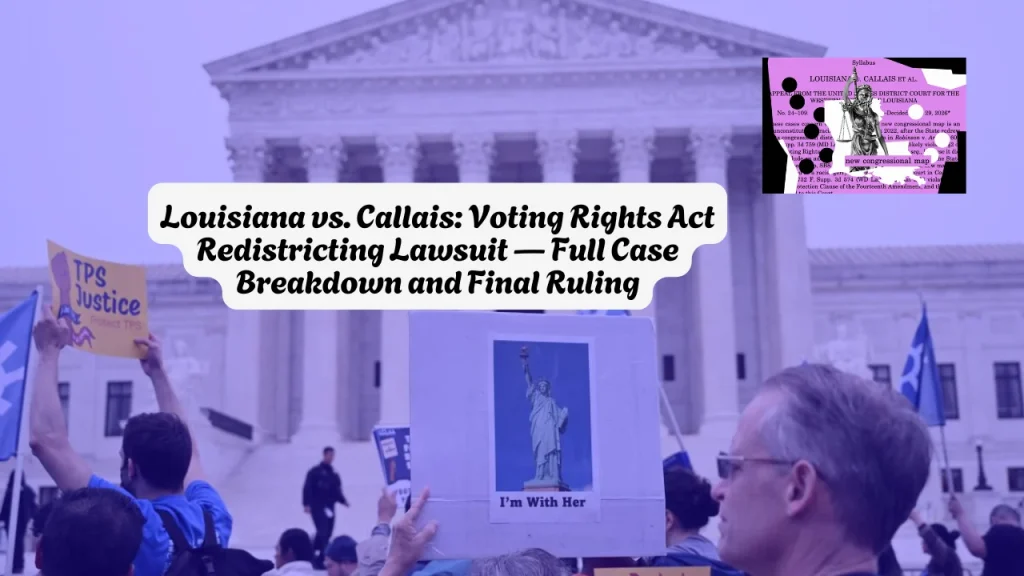
The ruling was decided with the map struck down and the case remanded back to the lower court — meaning it is not a dismissal with or without prejudice in the traditional sense, but a final merits ruling that bars use of the SB 8 map going forward. On the evening of the ruling, lawyers representing the Callais plaintiffs asked the Supreme Court to expedite sending down its judgment — normally a 32-day process — to give Louisiana’s legislature time to draw a new map before the November 2026 midterm elections.
Justice Elena Kagan wrote the dissent, joined by Justices Sotomayor and Ketanji Brown Jackson, accusing the majority of making Section 2 of the Voting Rights Act “all but a dead letter” and threatening the political power of Black communities nationwide.
What Does the Louisiana v. Callais Decision Mean?
The ruling narrows Voting Rights Act precedent on race-conscious redistricting and could prompt challenges in other states that could flip multiple congressional seats — though it may be too late in the year for most states to redraw maps ahead of the November 2026 midterms.
The decision came as Florida legislators were already debating a proposed redrawing of congressional lines, submitted by Republican Gov. Ron DeSantis and intended to give Republicans a chance to pick up as many as four House seats. The Florida legislature approved the new map on the same day the Supreme Court issued its ruling.
Nearly 70 of the 435 congressional districts are protected by Section 2, according to election law expert Nicholas Stephanopoulos. The ruling could now open those districts to legal challenge.
Frequently Asked Questions
Who filed the lawsuit and why?
In January 2024, a group of non-Black Louisiana voters filed suit in the Western District of Louisiana, claiming that race was the sole reason for the district lines drawn in SB 8, which they argued violated the Equal Protection Clause of the 14th Amendment.
What court handled the case?
The case was heard by a three-judge panel in the U.S. District Court for the Western District of Louisiana at the trial level, then appealed directly to the U.S. Supreme Court. The Supreme Court case numbers are No. 24-109 and No. 24-110, consolidated together.
Has the case been resolved?
Yes. The Supreme Court issued its final ruling on April 29, 2026, striking down the Louisiana congressional map in a 6-3 decision and affirming the lower court order that barred the state from using the map in future elections.
How much money was involved?
This case did not seek monetary damages. The plaintiffs asked the court to block use of Louisiana’s congressional map — which the court agreed to do.
Can I read the court documents?
Yes. The full Supreme Court opinion in Louisiana v. Callais, No. 24-109, is publicly available at supremecourt.gov and through SCOTUSblog at scotusblog.com.
What does this mean for Louisiana’s elections?
Louisiana will need to draw a new congressional map. Early voting begins May 2, 2026 and the primary is scheduled for May 16, leaving a very tight window. Louisiana Gov. Jeff Landry said it was too early to confirm whether the state would attempt to redraw the map before the midterms.
Does this ruling strike down the Voting Rights Act?
No — but it weakens it significantly. The court did not find Section 2 of the Voting Rights Act unconstitutional, but it modified the requirements for winning a Section 2 claim in ways that legal experts say will make it far harder or impossible for voters of color to use it to challenge discriminatory maps.
Sources & References
- Full Supreme Court Opinion — Louisiana v. Callais, No. 24-109, April 29, 2026: supremecourt.gov
- Louisiana Illuminator: lailluminator.com
Prepared by the AllAboutLawyer.com Editorial Team and reviewed for factual accuracy against the official Supreme Court opinion and verified public sources on April 30, 2026. Last Updated: April 30, 2026
Disclaimer: This article is for informational purposes only and does not constitute legal advice. Information is based on publicly available court records and verified reporting. For advice regarding a particular legal situation, consult a qualified attorney.
About the Author
Israr Ahmad is a legal content researcher with 4+ years of experience covering class action settlements and consumer rights cases. He has researched and published coverage of 2,500+ settlements using verified court records, settlement administrator filings, and government sources. Learn more about Israr.