
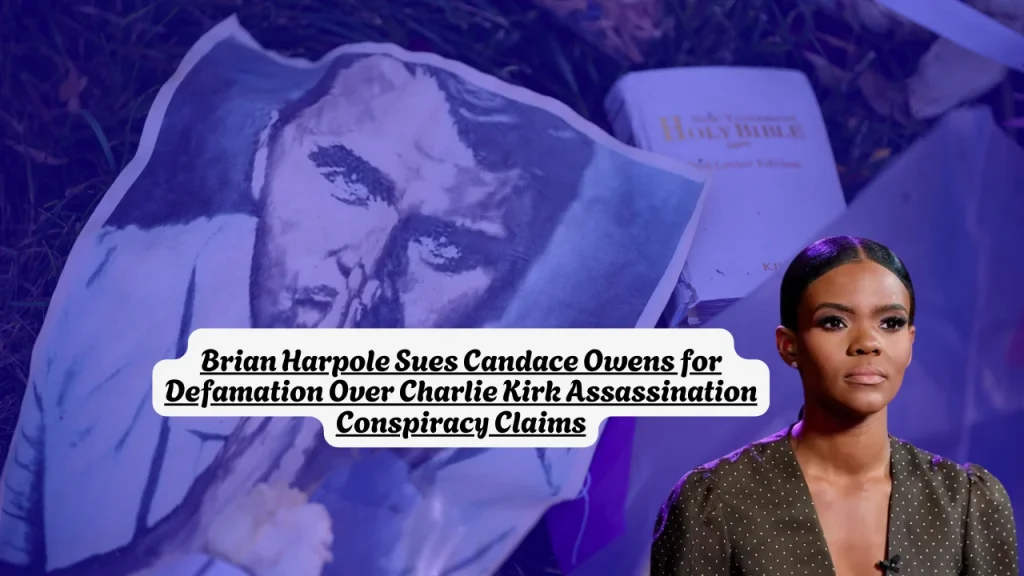
Brian Harpole Sues Candace Owens for Defamation Over Charlie Kirk Assassination Conspiracy Claims
Filed April 30, 2026 in the U.S. District Court for the Middle District of Tennessee. This article will be updated as the case develops.
What is the Brian Harpole vs. Candace Owens lawsuit about?
Brian Harpole, the founder of Integrity Security Solutions and Charlie Kirk’s personal security chief, filed a federal defamation lawsuit against conservative commentator Candace Owens on April 30, 2026, alleging she falsely accused him of conspiring to assassinate Kirk. The suit was filed in the U.S. District Court for the Middle District of Tennessee and seeks more than $75,000 in damages. All allegations are from the complaint as filed. No court has made any findings.
Quick Facts — Harpole v. Owens
| Field | Detail |
| Plaintiff | Brian Harpole, Integrity Security Solutions |
| Defendants | Candace Owens; Mitchell Snow; Owens’ media companies |
| Court | U.S. District Court, Middle District of Tennessee (Nashville) |
| Date Filed | April 30, 2026 |
| Legal Claims | Defamation, false light invasion of privacy, civil conspiracy to defame |
| Damages Sought | More than $75,000 |
| Plaintiff’s Attorney | Matt Sarelson, Dhillon Law Group |
| Owens’ Response | Denies claims; called lawsuit a publicity stunt; says it gives her “power of subpoena” |
| Case Status | Active — complaint filed, defendants have not yet formally responded |
| Last Updated | May 3, 2026 |
Who Is Brian Harpole and What Did He Have to Do With Charlie Kirk’s Assassination?
Brian Harpole is the founder and head of Integrity Security Solutions, a private security firm based in Texas. He began working for Charlie Kirk around 2018, with Integrity Solutions providing security for Turning Point USA and personal protective services for Kirk from 2022 to 2025. Integrity Solutions was providing those services at Utah Valley University on September 10, 2025, the day Kirk was fatally shot.
Kirk was shot in the neck with a single bullet by a gunman positioned on the roof of a building approximately 142 yards away as he was speaking to a crowd of around 3,000 people. He was taken to a local hospital, where he was pronounced dead. A manhunt ended the following day when Tyler James Robinson, a 22-year-old from Washington, Utah, surrendered to local police.
Harpole was on the ground when Kirk was shot. According to the complaint, Owens knew and conceded that Harpole ran over to Kirk with his medical bag to provide care after he was shot — yet continued to spread claims that Harpole had foreknowledge of and involvement in the killing.
What Candace Owens Said — The Specific Statements at the Center of the Lawsuit
This is where the legal case lives or dies. Defamation requires proving specific false statements of fact, not just harsh opinions. The complaint catalogs what Harpole says are exactly those kinds of statements.
Shortly after the assassination, Owens began disseminating content asserting that Kirk was betrayed by individuals close to him, that the government orchestrated a cover-up of the assassination, and advancing numerous additional conspiracy theories suggesting that someone other than Tyler Robinson was responsible.
The core false claim, according to the lawsuit, centers on a story spread by Owens’ podcast guest Mitchell Snow. According to the filing, Owens boosted what Harpole calls a “completely and obviously fabricated” story that he secretly met with Army intelligence officers at Fort Huachuca the day before Kirk was killed, and then used that tale in multiple X posts and podcast segments.
The complaint stated she received a “credible” tip from a member of the military that Harpole was in attendance for a classified meeting with senior government officials at a U.S. military installation. The lawsuit says this was false, and that Owens knew it was false.
The complaint reads: “The claim that Harpole was present at Fort Huachuca on September 9, 2025, for an alleged meeting is verifiably false — as Harpole’s travel records plainly place him in Dallas, Texas.”
The complaint goes further, pointing to a pattern of statements made between December 2025 and early 2026. Between December 9 and December 28, 2025, Owens, through at least eight separate statements published on X and disseminated via her podcast, falsely and negligently — if not intentionally — spread claims about Harpole. Those included a December 12 post questioning whether Harpole lied about calling 911 after Kirk was shot, and January 2026 statements suggesting that because Harpole’s team planned Kirk’s security for the Utah Valley University event two weeks in advance, something suspicious was happening.
The complaint also alleged that Owens intentionally ignored all documents and evidence contradicting her narrative and chose to publish the statements anyway, and that she failed to investigate obvious doubts about the authenticity of an incident report she cited.
If you have been publicly accused of wrongdoing online by a high-profile figure and your professional reputation has suffered as a result, a defamation attorney can tell you in one consultation whether you have a viable claim — most offer a free legal consultation.
Who Is Mitchell Snow and Why Is He Also Named as a Defendant?
The complaint says the Fort Huachuca narrative started with Mitchell Snow, whose account Owens allegedly leaned on — even after, the complaint says, she saw travel records placing Harpole in Dallas on the day in question.
Snow is named alongside Owens and her media companies in the civil conspiracy to defame claim. Under defamation law, a civil conspiracy to defame requires showing that two or more defendants agreed to publish false and defamatory material and then carried out that plan. Harpole’s complaint treats Snow as the originator of the false Fort Huachuca story and Owens as the amplifier who gave it a mass audience — even after evidence contradicting it was available.
The Three Legal Claims — Defamation, False Light, and Civil Conspiracy
Harpole is not just suing for defamation. The complaint includes three separate legal theories, and understanding each one matters.
Defamation is the primary claim. To win, Harpole must prove that Owens made specific false statements of fact about him, that those statements were published to third parties, that Owens acted with the required level of fault, and that the statements caused him real harm. The fault standard — whether it is negligence or actual malice — will depend heavily on whether the court classifies Harpole as a private figure or a public figure. The complaint insists he is a private person, which would require Owens to meet only a negligence standard, not the much harder “actual malice” standard that applies to public figures.
False light invasion of privacy is a related but distinct claim. It does not require the statement to be entirely false — it requires that the defendant portrayed the plaintiff in a false and highly offensive way to a reasonable person, with the required level of fault. Accusing someone of conspiring to murder their employer fits that standard easily on its face.
Civil conspiracy to defame ties Owens and Snow together legally. If the court finds they coordinated in spreading the false Fort Huachuca story, both can be held jointly liable for the resulting harm.
What Real Harm Does Harpole Claim to Have Suffered?
Defamation claims require more than hurt feelings — courts look for concrete, documented harm. Harpole claims her actions destroyed his reputation, cost him major security clients, and subjected him to widespread online harassment.
His security firm, Integrity Security Solutions, depends entirely on its reputation. A private security firm accused — even falsely — of involvement in the assassination of its own client has, as a practical matter, lost its core selling point. Harpole’s attorneys will need to document specific lost contracts and revenue to support the damages claim. The complaint seeks more than $75,000, which is the federal jurisdictional threshold — the actual damages sought could be substantially higher once discovery reveals the full financial impact.
The lawsuit alleges that Harpole’s personal and professional reputations have been damaged, that he has lost out on business opportunities, and that he suffered a great deal of emotional distress.
What Candace Owens Said in Response to the Lawsuit
Owens did not go quiet when the lawsuit was filed. She addressed it the same day in a podcast episode and on X, and her response sets up what will likely be her legal defense.
Owens said the suit gives her the “power of subpoena” and pushed back, saying that Harpole never asked her for a retraction or demand prior to filing. “You never issued any sort of retraction demand. You never answered me when I reached out. This is not at all how it normally goes,” she said.
She claimed the lawsuit has no basis and that her criticism of his security skills is a matter of opinion. “Confidence is a matter of opinion. Brian, I don’t believe you can sue people for thinking that you’re stupid,” she said.
On X, Owens also wrote: “It’s certainly an interesting claim that Brian Harpole is losing clients/contracts because of me — and not like, you know, how his last job ended.”
Her legal strategy is becoming visible from these public statements. She will almost certainly argue that her statements were opinion, not fact — and that Harpole, by going on national podcasts after the assassination, made himself a public figure who must meet the much harder “actual malice” standard to win. If she can establish that standard applies, Harpole would need to prove not just that she was wrong, but that she knew she was wrong or acted with reckless disregard for the truth. The Fort Huachuca travel records will be central to that fight.
Related article: Paul Miller’s Law in Pennsylvania What Drivers Must Know Before June 5, 2026
The Public Figure vs. Private Figure Question — Why It Could Decide This Case
This is the single most important legal question in Harpole v. Owens, and it has not been resolved yet.
Under the landmark Supreme Court ruling in Gertz v. Robert Welch, Inc. (1974), public figures must prove “actual malice” — that the defendant knew the statement was false or acted with reckless disregard for its truth or falsity. Private figures only need to show negligence.
Owens has already signaled she will argue Harpole is a public figure because he gave national podcast interviews about the assassination. Forbes reported that Owens disputed Harpole’s version of events and said he had opportunities to respond before she aired Snow’s account.
Harpole’s complaint counters by insisting he is a private citizen. Courts look at whether someone voluntarily injected themselves into a public controversy. Going on a podcast to defend yourself after you are publicly accused of murder conspiracy is different from voluntarily seeking public prominence — and courts have drawn that distinction before.
If the judge rules Harpole is a private figure, Owens faces a much lower bar to clear. If Harpole is deemed a public figure, this becomes a significantly harder case to win.
Where the Charlie Kirk Murder Case Stands Right Now
Because the Harpole-Owens lawsuit exists entirely in the shadow of Kirk’s assassination, readers need to understand where the criminal case is.
Tyler Robinson has not yet entered pleas for the charges he faces, including aggravated murder, felony use of a firearm, obstruction of justice, and witness tampering. Prosecutors intend to seek the death penalty.
An ATF analysis could not definitively match the bullet jacket fragment recovered from Kirk’s autopsy to the rifle allegedly tied to Robinson. However, prosecutors say additional testing identified DNA consistent with Robinson’s on the firearm, a towel, and three of the four cartridges inside the alleged murder weapon — a Mauser 98 30-06 rifle Robinson reportedly received as a gift from his grandfather.
On April 17, a hearing was held in which Robinson’s defense attorneys argued for cameras to be banned from the proceedings, with Judge Tony Graf indicating he would issue a ruling on May 8. A preliminary hearing was scheduled for May 18, though the defense has sought delays.
The conspiracy theories Owens spread — that Harpole or the government orchestrated Kirk’s killing — exist alongside an active criminal prosecution of a specific individual with DNA evidence and alleged confessions. That context will sit in the background of every hearing in the Harpole defamation case.
What Happens Next in Harpole v. Owens
The lawsuit asks for discovery that could force Owens and Snow to turn over their sources and travel records. That is the part of this case that should concern Owens most. Discovery in a defamation case means Harpole’s attorneys can depose her under oath and demand documents showing what she knew, when she knew it, and whether she saw the travel records that contradicted the Fort Huachuca story before broadcasting it.
Owens framed this as advantageous to her — claiming the subpoena power works both ways and she can dig into Harpole’s background. That is technically true, but the asymmetry matters: the complaint already identifies specific statements, dates, and the contradicting travel records. The burden of proof is on Harpole, but the factual terrain has already been mapped out in ways that will be uncomfortable to defend under oath.
Owens’ attorneys will likely file a motion to dismiss arguing the statements were protected opinion, and separately argue for the public figure standard. Those motions will be the first real legal test of how strong Harpole’s case is.
You now understand the legal framework, what specific statements triggered the lawsuit, and why the public-figure question will likely decide the outcome. If you are dealing with false public accusations that have damaged your professional reputation, visit AllAboutLawyer.com to connect with a defamation attorney in your area who can evaluate your specific situation.
Frequently Asked Questions
What does Brian Harpole claim Candace Owens did that was defamatory?
Harpole’s complaint alleges Owens spread a false story that he secretly attended a classified military meeting at Fort Huachuca the day before Kirk’s assassination — and did so even after seeing travel records showing he was in Dallas at the time. The complaint documents at least eight statements on X and her podcast between December 2025 and January 2026.
Does Candace Owens face criminal charges in this case?
No. This is a civil defamation lawsuit, not a criminal proceeding. Owens faces potential monetary damages if Harpole wins, not criminal penalties. No law enforcement agency has brought charges related to her statements about the Kirk assassination.
What is the difference between defamation and opinion in a case like this?
Courts distinguish between statements of fact — which can be proven true or false — and pure opinion, which cannot. Saying someone “conspired to assassinate” a specific person at a specific military base on a specific date is a factual claim, not opinion. Saying someone is a bad security professional is opinion. That line will be central to this case.
Why was the lawsuit filed in Tennessee rather than New York or Texas?
Owens is based in Tennessee, which gives Tennessee federal courts personal jurisdiction over her. Filing in the Middle District of Tennessee — Nashville — follows standard practice of suing defendants where they are located or where the tort occurred.
How long does a federal defamation case typically take to resolve?
Federal civil cases of this complexity typically take one to three years from filing to resolution. If early motions to dismiss are denied, discovery alone could take a year. Most defamation cases settle before trial, though high-profile ones involving public figures sometimes go to verdict.
Could Harpole lose because he went on podcasts after the assassination?
Possibly, in the sense that appearing on national podcasts could lead a judge to classify him as a “limited purpose public figure,” which would require him to prove actual malice — a much harder legal standard. His complaint specifically argues against that classification. The judge will decide.
What is the statute of limitations for defamation in Tennessee?
Under Tennessee Code Annotated § 28-3-104, the statute of limitations for defamation is one year from the date of publication. Because the alleged statements run from December 2025 through at least January 2026, the April 2026 filing date appears to be within the window for the more recent statements.
What damages is Harpole actually seeking?
The complaint seeks more than $75,000 — which is the threshold required to bring a diversity case in federal court. The actual damages claimed for lost clients, reputational harm, and emotional distress could be substantially higher. Punitive damages are possible if Harpole can show Owens acted with actual malice.
Legal Terms Used in This Article
Defamation: A false statement of fact published to a third party that causes harm to someone’s reputation. In written form it is called libel; spoken, it is slander. Social media posts and podcast statements can qualify as libel.
Actual Malice: The legal standard that applies when the plaintiff is a public figure. It requires proving the defendant knew the statement was false or acted with reckless disregard for whether it was true or false. Much harder to prove than negligence.
False Light Invasion of Privacy: A tort claim that arises when someone portrays another person in a false and highly offensive way, even if the specific statement is not entirely false. Related to defamation but focused on the overall impression created.
Civil Conspiracy to Defame: A claim that two or more defendants agreed to work together to publish defamatory material. If proven, all parties to the conspiracy can be held jointly liable for the resulting harm.
Private Figure vs. Public Figure: A critical legal distinction in defamation law. Private figures only need to prove negligence. Public figures must prove actual malice. Courts look at whether the person voluntarily sought public prominence or was thrust into a public controversy involuntarily.
Punitive Damages: Additional money awarded by a court to punish egregious conduct — such as deliberately spreading false information with knowledge of its falsity — beyond what is needed to compensate the plaintiff’s actual losses.
Jurisdiction: The legal authority of a specific court to hear and decide a case. Federal courts require either a federal question or diversity of citizenship between parties, plus damages exceeding $75,000.
Prepared by the AllAboutLawyer.com Editorial Team and reviewed for factual accuracy against verified reporting from Newsweek, Reason, NewsNation, Hoodline, and court documents published via CourtListener as of May 3, 2026. Last Updated: May 3, 2026.
Disclaimer: This article is for informational purposes only and does not constitute legal advice. All allegations described are drawn from publicly available court filings and verified news reporting. They have not been proven in court. For advice regarding your specific situation, consult a qualified attorney licensed in your state.
About the Author
Israr Ahmad is a legal content researcher with 4+ years of experience covering class action settlements and consumer rights cases. He has researched and published coverage of 2,500+ settlements using verified court records, settlement administrator filings, and government sources. Learn more about Israr.