
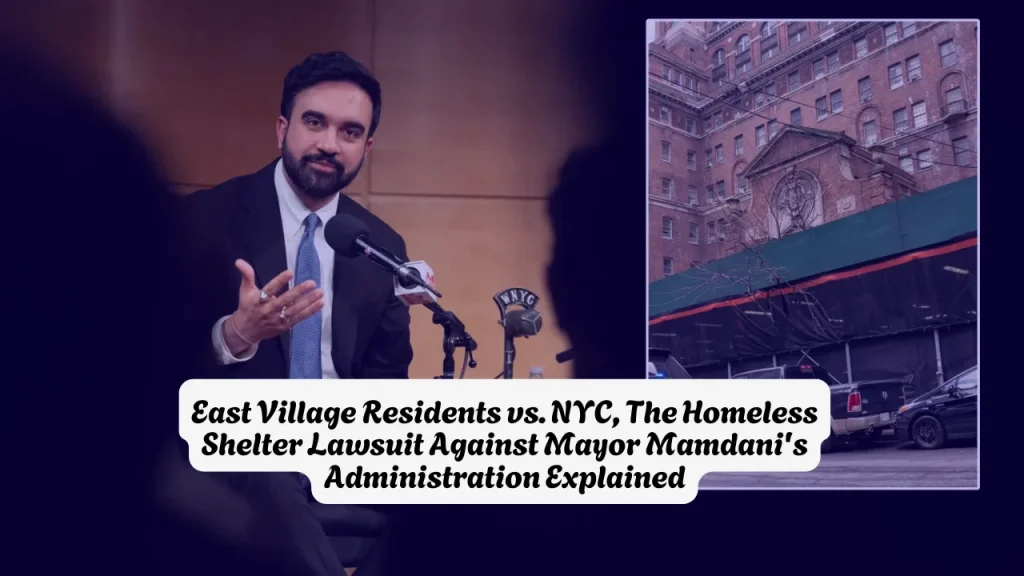
East Village Residents vs. NYC, The Homeless Shelter Lawsuit Against Mayor Mamdani’s Administration Explained
Note: This article covers an active lawsuit filed April 20, 2026. Information is based on the complaint as filed and verified news reporting. This page will be updated as the case develops.
Prepared by the AllAboutLawyer.com Editorial Team and reviewed for factual accuracy against the official court filing (Index No. 154997/2026), NY1, amNewYork, and the Coalition for the Homeless on April 25, 2026. Last Updated: April 25, 2026
VOICE (Village Organization for the Integrity of Community Engagement) et al. v. City of New York is an administrative law and land-use challenge filed in the New York Supreme Court in which a group of East Village residents and a neighborhood organization argue that Mayor Zohran Mamdani’s administration illegally fast-tracked a plan to convert a building at 8 East 3rd Street into a citywide homeless men’s intake center. A State Supreme Court judge issued a temporary restraining order on April 23, pausing the city’s plan, with a full court hearing now set for May 7.
Quick Facts: VOICE et al. v. City of New York
| Field | Detail |
| Plaintiffs | Village Organization for the Integrity of Community Engagement (VOICE) and 10 individual East Village residents |
| Defendant | City of New York (Mamdani administration) |
| Case Type | Administrative Law / Land-Use Challenge |
| Court | New York Supreme Court, County of New York |
| Date Filed | April 20, 2026 |
| Index Number | 154997/2026 |
| Legal Claim | Improper invocation of emergency powers; failure to conduct required environmental review, Fair Share analysis, and community review under New York Administrative Code § 21-312 |
| Relief Sought | Temporary restraining order; preliminary and permanent injunction blocking conversion of 8 East 3rd Street into a homeless intake center |
| Current Stage | Temporary restraining order granted April 23, 2026; hearing scheduled May 7, 2026 |
| Next Scheduled Date | May 7, 2026 |
| Plaintiffs’ Attorneys | TBD — not yet confirmed in public reporting |
| Last Updated | April 25, 2026 |
Case Timeline
| Date | Event |
| March 5, 2026 | Mamdani administration announces plan to close Bellevue Intake Shelter and relocate services to 8 East 3rd Street |
| April 7, 2026 | City holds community Q&A session — more than a month after announcement and less than a month before planned opening |
| April 20, 2026 | VOICE and 10 residents file lawsuit in New York Supreme Court (Index No. 154997/2026) seeking TRO and injunction |
| April 23, 2026 | Justice Sabrina B. Kraus issues temporary restraining order blocking the May 1 opening |
| May 1, 2026 | Originally planned opening date for 8 East 3rd Street as a men’s intake center — now on hold |
| May 7, 2026 | Next court hearing scheduled; city must respond to the TRO |
What Is the VOICE vs. NYC Lawsuit About? VOICE et al. v. City of New York, Index No. 154997/2026
The lawsuit has nothing to do with whether homeless shelters are good or bad. The plaintiffs are not arguing the city should have no shelter — they are arguing the city broke its own procedural rules to open this one.
The city announced on March 5 that it would close the longstanding Bellevue men’s intake shelter on East 30th Street over safety concerns and convert 8 East 3rd Street — currently a 175-bed transitional housing site run by Project Renewal — into the city’s new main intake site for single adult men, with the transfer set for May 1. According to the complaint, the administration invoked a 2022 emergency declaration — one originally issued to handle the surge of asylum-seekers — to sidestep the normal review process.
The court filing argues the emergency order is “ultra vires and without legal effect” because the city’s own statements confirm the Bellevue closure is “a proactive measure” with “no immediate danger” — meaning no active disaster justifying emergency powers under New York Executive Law § 24. In plain English: the plaintiffs argue you cannot use an emergency declaration to rush a non-emergency decision. The filing also raises a specific physical argument: the certificate of occupancy for 8 East 3rd Street limits the basement to 90 persons and the first floor to 208 persons — far less capacity than the Bellevue shelter, which housed approximately 250 people as an intake facility.
The legal theories in the complaint include failure to conduct a required Fair Share analysis (a city rule requiring that social service facilities be distributed fairly across neighborhoods), failure to conduct an environmental review, and violation of New York Administrative Code § 21-312, which governs how the city must site shelter facilities. The lawsuit was filed in the New York Supreme Court, County of New York — the trial-level court in New York State’s naming system, not the appellate court most people picture when they hear “Supreme Court.”
Who Are the Parties?
VOICE is a community organization based in the East Village of Manhattan. Ten individual residents joined the group as named plaintiffs. A key affidavit supporting the case comes from Robert Mascali, a former Department of Homeless Services official who served from 1999 to 2007, who argued that turning 8 East 3rd Street into the primary citywide intake site would be a major shift that could lead to overcrowding and public safety concerns in the surrounding neighborhood. He also stated that the city had already moved intake services away from that same address in 1984 precisely because the site was too small.
Related article: Citizens Bank Data Breach Class Action Lawsuit 2026, What Happened, Who Is Affected, and What to Do Now
The City of New York — the defendant — is represented by the Mayor’s office and the Department of Social Services. The city has defended the plan, with a spokesperson saying the conditions at the Bellevue shelter “have been unacceptable for years” and that vacating the site was necessary for safety. The city’s position is that the 8 East 3rd Street site is consistent with its prior use and that any opposition is motivated by NIMBY concerns rather than legal substance.
The Legal Aid Society and Coalition for the Homeless are not parties, but they filed a public statement opposing the lawsuit. They argued that the site at 8 East 3rd Street has historically served as a shelter and previously functioned as a men’s intake center, and that opposition from neighbors “lacks a good-faith basis and appears to be little more than NIMBYism.”
What Is at Stake in This Lawsuit?
If the plaintiffs succeed, the city cannot open 8 East 3rd Street as a men’s intake center — at least not through the emergency declaration it used. The city would need to either restart the process with proper environmental reviews and community input, or find a different site entirely.
If the city wins, the shelter opens. In the meantime, the city will continue to operate at the 30th Street Bellevue shelter while the TRO is in effect. The city has said it plans to relocate the approximately 250 men currently at Bellevue once the legal path is clear.
The broader political irony — widely noted in news coverage — is that Election District 45, the area that includes East Village, voted for Mamdani in a 70.1% victory over independent candidate Andrew Cuomo, who garnered just 26.0% of the vote, and those same voters are now the ones hauling his administration into court. The lawsuit does not represent a reversal of political support — it represents a very old tension in urban politics: residents who support progressive housing policy in the abstract but resist specific placements in their immediate neighborhood. That tension has a name in land-use law: NIMBY — “Not In My Backyard” — and courts have dealt with it in New York City for decades.
What Happens Next?
Justice Sabrina Kraus issued the temporary restraining order, which does not mean the shelter move is permanently off the table. It shifts back the city’s timeline while the court hears the full arguments. The May 7 hearing is where both sides will present fuller arguments on whether a preliminary injunction should continue the TRO while the entire case is litigated.
At that hearing, the judge will weigh three things under New York law: whether the plaintiffs have a likelihood of success on the merits of their procedural claims, whether they would suffer irreparable harm without the injunction, and whether the balance of equities tips in their favor. Given that the city acknowledges conditions at Bellevue are unsafe, the city will likely argue urgency. Given that the plaintiffs have a former DHS official testifying about the inadequate capacity of the East 3rd Street site, they have something substantive to argue beyond pure neighborhood opposition.
Any full ruling on whether the city violated the Administrative Code or misused its emergency powers would likely come weeks or months after May 7, depending on how the court sets the briefing schedule.
Frequently Asked Questions
1. Who filed this lawsuit and why?
According to the complaint (Index No. 154997/2026), VOICE and 10 individual East Village residents filed suit in New York Supreme Court on April 20, 2026. They argue the Mamdani administration bypassed legally required environmental and community review processes by improperly invoking a 2022 emergency declaration.
2. What court is handling this case?
The New York Supreme Court, County of New York — the trial-level court in Manhattan. The presiding judge who issued the temporary restraining order is Justice Sabrina B. Kraus.
3. What is the current status of the case?
Justice Kraus issued a temporary restraining order on April 23, 2026, pausing the city’s plan to open the 8 East 3rd Street shelter. The next court date is May 7, 2026.
4. Is this lawsuit about being against homeless people?
The plaintiffs say no. The complaint states it “challenges only the City’s hastily made and legally invalid decision” to site the facility at 8 East 3rd Street “without following any of the legal requirements.” The Legal Aid Society and Coalition for the Homeless disagree, characterizing the opposition as NIMBYism given the building’s long history as a shelter site.
5. Can I read the court documents?
Yes. The filing is publicly available through the New York State Courts Electronic Filing system (NYSCEF) under Index No. 154997/2026.
6. What does “temporary restraining order” mean in plain English?
A temporary restraining order (TRO) is a short-term court order that pauses an action while the court decides whether a longer injunction is warranted. It does not mean the plaintiffs have won — it means a judge found enough merit in their arguments to hit pause while the full hearing takes place on May 7.
7. What would the plaintiffs have to prove to win permanently?
They would need to show the city violated specific procedural laws — primarily that invoking the 2022 emergency declaration was improper for a non-emergency closure, and that the city failed to conduct the Fair Share analysis and environmental review required before siting a shelter facility under New York Administrative Code § 21-312.
Sources & References
- Official court filing: VOICE et al. v. City of New York, Index No. 154997/2026, NYSCEF
- NY1: Judge puts plans for East Village shelter on hold — April 23, 2026
- amNewYork: East Village residents sue to halt NYC’s ‘rushed’ opening of homeless men’s intake center — April 21, 2026
Disclaimer: This article is for informational purposes only and does not constitute legal advice. Information about ongoing legal cases is based on publicly available court records and verified reporting. Allegations described in this article have not been proven in court. For advice regarding a particular legal situation, consult a qualified attorney.
About the Author
Israr Ahmad is a legal content researcher with 4+ years of experience covering class action settlements and consumer rights cases. He has researched and published coverage of 2,500+ settlements using verified court records, settlement administrator filings, and government sources. Learn more about Israr.