
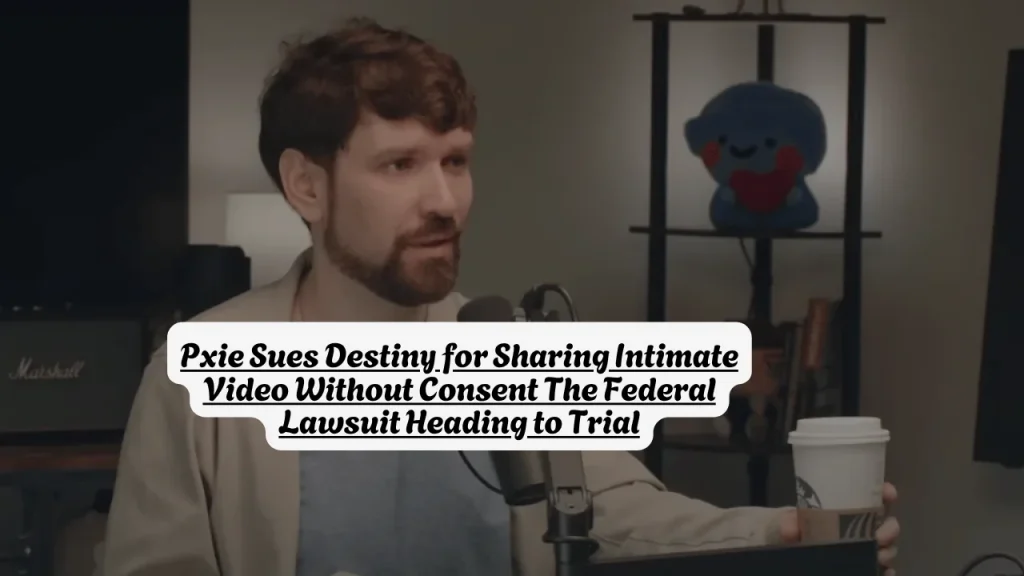
Pxie Sues Destiny for Sharing Intimate Video Without Consent The Federal Lawsuit Heading to Trial
Prepared by the AllAboutLawyer.com Editorial Team and reviewed for factual accuracy against federal court records from PACER and CourtListener (Case No. 1:25-cv-20757, S.D. Fla.), reporting from WFLA and TheWrap, and official case filings on May 15, 2026. Last Updated: May 15, 2026
Doe v. Bonnell is a federal civil lawsuit filed on February 18, 2025, in the U.S. District Court for the Southern District of Florida, in which a content creator known as Pxie accuses streamer Steven “Destiny” Bonnell of sharing an intimate video without her consent in violation of federal and Florida law. The case is active, with summary judgment motions filed as recently as March 2026, and trial is set for May 18, 2026. No criminal charges have been filed, and no settlement has been announced.
Pxie v. Destiny Lawsuit — Quick Case Facts
| Field | Detail |
| Case Name | Jane Doe v. Steven K. Bonnell, II |
| Case Number | 1:25-cv-20757-CIV-BECERRA/TORRES |
| Court | U.S. District Court, Southern District of Florida |
| Judge | Hon. Jacqueline Becerra |
| Filed | February 18, 2025 |
| Plaintiff | Jane Doe (publicly known as Pxie) |
| Defendant | Steven K. Bonnell II (publicly known as Destiny) |
| Laws Allegedly Violated | 15 U.S.C. § 6851 (SHIELD Act); Florida Statute § 784.049; IIED; Invasion of Privacy |
| Damages Sought | $3,150,000 plus attorneys’ fees |
| Trial Date | May 18, 2026 at 9:30 a.m. |
| Defendant’s Lawyer | Andrew Brettler, Berk Brettler LLP |
| Last Updated | May 15, 2026 |
What the Pxie Lawsuit Against Destiny Actually Alleges
A federal lawsuit filed in the Southern District of Florida alleged that Destiny, whose real name is Steven K. Bonnell II, sent a sexual video to a “random fan,” who then spread it to various websites.
The plaintiff, identified in the lawsuit only by her influencer username Pxie, had a sexual encounter with Bonnell in 2020, according to the complaint. Bonnell was accused of sending the sexual video to a fan identified as “Rose” in 2022. Two years later, the video surfaced publicly.
The lawsuit says the video was leaked online and viewed at least 78,000 times, and that the plaintiff was identified by internet trolls once the video was leaked — leading her to become “suicidal” due to extreme humiliation and emotional suffering. She also alleges she received hundreds of harassing messages as a result.
The complaint includes four separate legal claims:
- Count I — Violation of 15 U.S.C. § 6851, the federal Intimate Image Protection Act (also called the SHIELD Act)
- Count II — Violation of Florida Statute § 784.049, Sexual Cyberharassment
- Count III — Intentional Infliction of Emotional Distress
- Count IV — Invasion of Privacy (Public Disclosure of Private Facts)
The lawsuit called for a jury trial to determine the monetary amount needed to compensate Pxie, as well as potential injunctive relief against Bonnell, compensation for attorneys’ fees, and further relief.
What Is the Federal SHIELD Act — the Law at the Center of This Case?
The federal Intimate Image Protection Act, known as the SHIELD Act and codified at 15 U.S.C. § 6851, is the primary legal vehicle for Pxie’s lawsuit. It is one of the strongest legal tools currently available to victims of non-consensual intimate image sharing in the United States.
Under the SHIELD Act, a person can sue in federal court if someone intentionally disclosed an intimate image of them without their consent, knowing or recklessly disregarding that the person had not consented. The law covers images and videos that depict sexual conduct and were shared in a context in which the subject had a reasonable expectation of privacy. The statute allows victims to recover actual damages, statutory damages of up to $150,000 per violation, and attorneys’ fees.
This is why Pxie chose federal court. Florida’s state law on sexual cyberharassment — Florida Statute § 784.049 — can only be enforced through criminal prosecution or civil action. The SHIELD Act gives her an independent federal civil claim that carries its own financial remedies, regardless of whether any prosecutor brings criminal charges. For context on how courts have handled similar claims involving online content creators and deepfakes, the Megan Thee Stallion defamation and deepfake lawsuit also proceeded in the Southern District of Florida under a similar framework — and resulted in a jury verdict awarding both compensatory and attorneys’ fees.
Related article: Universal Music Is Suing for the Beatles’ First Known Recording Here Is What the Fight Is Actually About
Are You Part of This Lawsuit? Who This Case Covers
This is not a class action — it is a civil lawsuit filed by one plaintiff against one defendant. It does not have a settlement fund or claim process open to the public. The only parties are Pxie and Steven Bonnell.
However, this case directly affects how you think about your own legal rights if you were a victim of similar conduct. This case applies to you as background legal knowledge if:
- A current or former partner shared intimate images or videos of you without your permission — online or privately
- You are a content creator whose private material was distributed without consent
- You experienced online harassment following a non-consensual intimate image disclosure
- You are in Florida, where both state law and federal law provide overlapping civil remedies
If you were directly affected by a similar situation, a free legal consultation with an attorney specializing in cyber privacy law is worth pursuing before a statute of limitations expires.
Destiny’s Defense — What Bonnell Says Happened
Bonnell has denied the core allegations since the lawsuit was filed. In a YouTube video titled “Destiny Addresses His Lawsuit,” the streamer said he had waited to comment on the matter to “minimize publicizing both mine and other people’s explicit material.”
Destiny officially answered the lawsuit, and his response made it clear he is not backing down. The claims center on a sexual encounter between the two that was recorded with her consent. The controversy ignited when she alleged that Destiny later shared the video with another person without her permission, causing emotional distress and reputational harm.
Bonnell’s defense team is led by Andrew Brettler of Berk Brettler LLP in West Hollywood — the same firm known for defending high-profile clients in entertainment and media litigation. The defense has argued that key factual claims in the complaint are incorrect and filed a Motion to Dismiss on September 19, 2025. That motion did not result in dismissal, and the case remained active with summary judgment motions filed as recently as March 2026, with trial set for May 18, 2026.
A notable development during discovery: the person identified as “Rose” — the fan Bonnell allegedly sent the video to — turned out not to be who she appeared to be. A third party named “Solo” had been catfishing Bonnell using another woman’s identity, and that woman testified under deposition that she had no contact with Bonnell. This created significant factual complications for both sides regarding who actually received and distributed the content.
The Pxie v. Destiny Case Timeline
| Milestone | Date |
| Sexual encounter between parties | 2020 |
| Bonnell allegedly shares video with “Rose” | 2022 |
| Video appears on Kiwi Farms | 2024 |
| Pxie publicly announces intent to sue | January 20, 2025 |
| Federal lawsuit filed in S.D. Florida | February 18, 2025 |
| Bonnell files answer to complaint | 2025 |
| Pxie files for Temporary Restraining Order | April 2025 |
| TRO denied by court | April/May 2025 |
| Protective Order Governing Discovery issued | ~September 2025 |
| Bonnell files Motion to Dismiss | September 19, 2025 |
| Last reply on Motion to Dismiss | November 13, 2025 |
| Summary judgment motions filed | March 2026 |
| Calendar Call | May 12, 2026 |
| Jury Trial Date | May 18, 2026 at 9:30 a.m. |
Frequently Asked Questions — Pxie v. Destiny Lawsuit
Is there a federal lawsuit against Destiny over the Pxie video?
Yes. A federal lawsuit was filed on February 18, 2025 in the Southern District of Florida alleging that Destiny violated a federal revenge porn law and Florida’s cyber sexual harassment statute by sharing a sexual video without the plaintiff’s consent. The case carries Case No. 1:25-cv-20757.
Is the Pxie v. Destiny case the same as criminal charges?
No. This is a civil lawsuit, not a criminal prosecution. There are no confirmed criminal charges against Bonnell in connection with this case. Pxie is seeking financial compensation and injunctive relief through federal civil court — she cannot put Bonnell in prison through this lawsuit. A separate criminal complaint was filed by another individual, Chaeiry, on January 23, 2025, but that is a distinct matter.
What law governs non-consensual intimate image sharing at the federal level?
The federal Intimate Image Protection Act, 15 U.S.C. § 6851, also called the SHIELD Act, is the governing federal statute. It allows victims to file civil suits in federal court, recover actual damages, up to $150,000 in statutory damages per violation, and attorneys’ fees, without needing a criminal prosecution to proceed.
How much money is Pxie seeking in this lawsuit?
Among the damages Pxie’s team has specified, they are asking for $3,150,000 plus legal fees. This includes at least $1 million in punitive damages under the federal SHIELD Act and at least $1 million in compensatory damages for intentional infliction of emotional distress.
Does Destiny’s denial mean the case will be dismissed?
Not at this stage. The Motion to Dismiss filed on September 19, 2025 did not result in dismissal. Summary judgment motions were filed as recently as March 2026, and the court has set a jury trial for May 18, 2026 — meaning the case has survived long enough to reach a trial-ready stage. Whether it proceeds to a full verdict or settles before then is unknown.
How does this case relate to other streamer lawsuits?
This lawsuit is part of a growing pattern of content creators facing civil liability over online conduct. Similar legal dynamics appeared in the Asmongold and Mizkif defamation lawsuit — also filed in federal court — where another streamer faced claims of reputational harm arising from allegations made on a livestream. Courts are increasingly being asked to apply traditional privacy and harassment law to online creator conduct.
Sources & References
- Federal Court Docket: Jane Doe v. Steven K. Bonnell, II, Case No. 1:25-cv-20757-CIV-BECERRA/TORRES, U.S. District Court, Southern District of Florida — CourtListener | PACER Monitor
- Federal Intimate Image Protection Act (SHIELD Act): 15 U.S.C. § 6851
- Florida Sexual Cyberharassment Statute: Fla. Stat. § 784.049
Disclaimer: This article is for general informational and educational purposes only and does not constitute legal advice. Laws vary by state and jurisdiction. For advice about your specific situation, consult a qualified attorney.
About the Author
Israr Ahmad is a legal content researcher with 4+ years of experience covering class action settlements and consumer rights cases. He has researched and published coverage of 2,500+ settlements using verified court records, settlement administrator filings, and government sources. Learn more about Israr.