
Papa John’s Founder John Schnatter Settles Six-Year Lawsuit Against Ad Firm Over Secretly Recorded Conference Call
Prepared by the AllAboutLawyer.com Editorial Team and reviewed for factual accuracy against official court records, WDRB News investigative reporting, and the official joint settlement statement issued via PR Newswire on May 14, 2026. Last Updated: May 15, 2026
Papa John’s founder John Schnatter and advertising firm Laundry Service reached a settlement on May 14, 2026, ending a six-year federal lawsuit that Schnatter filed after a secretly recorded conference call was leaked to Forbes in 2018 — a leak that cost him his role as chairman and public face of the pizza company he built over 34 years. According to the joint filing, Schnatter dismissed the lawsuit with prejudice, and Laundry Service consented. The settlement includes a charitable donation from Laundry Service, though the specific financial terms were not disclosed.
Schnatter v. Laundry Service Settlement — Quick Case Facts
| Field | Detail |
| Case Name | John H. Schnatter v. 247 Group, LLC d/b/a Laundry Service and Wasserman Media Group, LLC |
| Trial Court Case No. | 3:20-cv-00003-BJB-CHL, U.S. District Court, W.D. Kentucky, Louisville |
| Appeals Case No. | 24-5916, U.S. Court of Appeals for the Sixth Circuit |
| Filed | December 2019 |
| Defendants | Laundry Service (247 Group, LLC); Wasserman Media Group, LLC |
| Laundry Service Owner | Casey Wasserman (chairman of 2028 Los Angeles Olympics) |
| Incident Date | May 22, 2018 — secretly recorded conference call |
| Core Claim | Unauthorized recording and malicious leak of a private media training call |
| Settlement Date | May 14, 2026 |
| Settlement Terms | Dismissed with prejudice; Laundry Service agreed to charitable donation — amount undisclosed |
| Last Updated | May 15, 2026 |
What the Schnatter Lawsuit Was About
On May 22, 2018, John Schnatter participated in a conference call with employees from Papa John’s and Laundry Service — the ad firm Papa John’s had just hired. The meeting was recorded by an employee of Laundry Service without Mr. Schnatter’s knowledge and consent. A portion of the meeting, which Mr. Schnatter contends was taken out of context and was misleading, was thereafter disclosed publicly. Thereafter, an edited version of the recording was turned over by Laundry Service to Papa John’s.
The call was a media coaching and training session — an exercise designed to prepare Schnatter for public appearances during a tense period when Papa John’s was navigating its relationship with the NFL amid player anthem protests. During that session, Schnatter used a racial slur while discussing how Colonel Sanders had used similar language and, Schnatter argued, faced no consequences. He later said he was “role-playing” a scenario about racial language, not directing the word at anyone.
One month after the call, a dispute arose between Papa John’s and Laundry Service. On July 10, Schnatter received a call from the company’s general counsel saying someone at Laundry Service was talking with Forbes. The Forbes story was published July 11, 2018. Schnatter acknowledged using the slur and resigned as chairman within days.
The complaint alleges that Casey Wasserman, CEO of Laundry Service’s parent company, told Papa John’s then-CEO Steve Ritchie that he would “bury the founder” if Laundry Service was not paid a $6 million payment Papa John’s was disputing. Schnatter argued the leak was not whistleblowing — it was retaliation over a contract payment fight.
Related article: Supreme Court Rules 9-0, Freight Brokers Like C.H. Robinson Can Be Sued When They Hire Unsafe Truckers
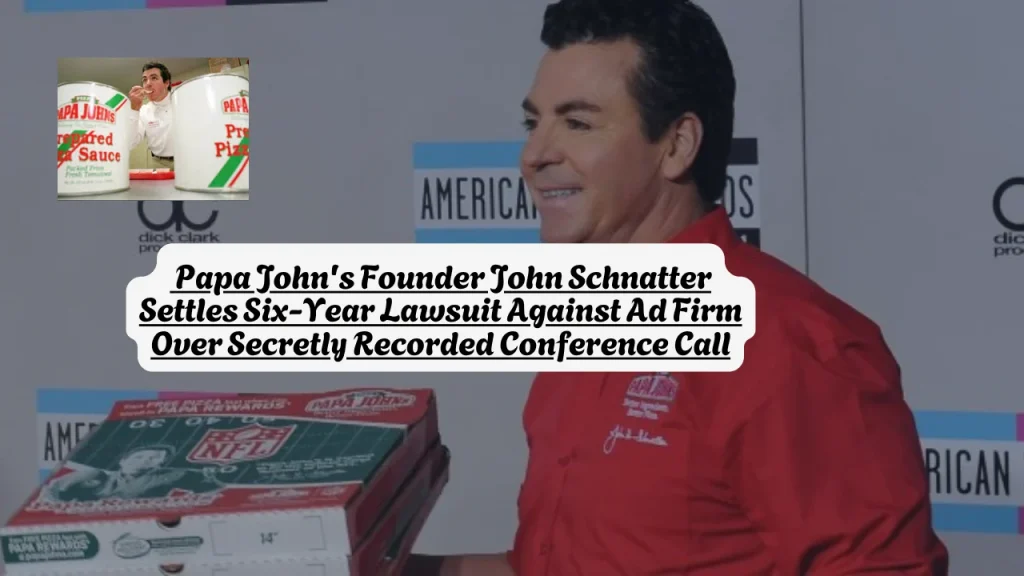
He filed suit in December 2019. His legal claims included breach of the services agreement between Papa John’s and Laundry Service, tortious interference with his business relationships, invasion of privacy through false light, and unauthorized recording of a private call. Similar cases involving unauthorized recording of business communications have tested the boundaries of workplace privacy and confidentiality agreements in courts across the country — an area explored in depth in the Blake Lively and Justin Baldoni sexual harassment lawsuit, where confidential communications and coordinated retaliation campaigns were also at the center of competing legal claims.
How the Lawsuit Unfolded Over Six Years
2019 — Lawsuit filed. Schnatter filed the lawsuit in a Kentucky court, pledging to donate all net proceeds to charity. He alleged Laundry Service breached its services agreement with Papa John’s and interfered with his valid business relationships.
2022 — Motion to dismiss denied; complaint expanded. Judge Benjamin Beaton denied Laundry Service’s attempt to have the case thrown out. Schnatter filed a Second Amended Complaint presenting new claims, including that Laundry Service “placed Schnatter in a false light” and that the recording of the May 22 call constituted an unreasonable intrusion upon his privacy done “recklessly, maliciously, and/or with the intent to harm Schnatter.”
2023 — Case approved for trial. Judge Beaton approved the case for trial, another significant win for Schnatter.
2024 — Laundry Service attempts to force arbitration; denied. After failing to win on the merits through multiple court rulings, Laundry Service moved to compel arbitration under the Federal Arbitration Act — arguing the parties’ contract required disputes to go to private arbitration rather than a public jury trial. Judge Beaton denied the motion.
September 2025 — Sixth Circuit upholds jury trial. Laundry Service appealed the arbitration denial to the U.S. Court of Appeals for the Sixth Circuit. The Sixth Circuit found that Laundry Service, owned by Casey Wasserman, forfeited its right to arbitration by aggressively litigating the case before seeking arbitration under the Federal Arbitration Act. “By aggressively litigating this case in court before moving to compel, Laundry Service had given up its contractual right to arbitrate,” the court wrote. The Sixth Circuit called Laundry Service’s approach a “heads I win, tails you lose” strategy the law could not permit.
April–May 2026 — Settlement talks and resolution. During the discovery phase leading up to trial, evidence emerged that Schnatter had entered in-patient rehab for alcohol abuse at Caron Treatment Centers in Pennsylvania in 2017–2018 — months before the call. The defense used this to paint Schnatter as “the architect of his own demise.” On May 5, 2026, the two sides said they had begun “substantive settlement discussions through a third-party mediator.” On May 11, they settled the case.
What the Joint Settlement Statement Says
The joint statement issued on May 14, 2026 is notable for what it both says and does not say. Both sides acknowledged the recording happened without Schnatter’s consent and that media coverage caused him harm — but neither side admitted legal wrongdoing.
The joint statement reads in part: “The meeting was recorded by an employee of Laundry Service without Mr. Schnatter’s knowledge and consent. A portion of the meeting, which Mr. Schnatter contends was taken out of context and was misleading, was thereafter disclosed publicly. The Parties acknowledge that the news stories reporting the statements caused harm to many people and communities, including Mr. Schnatter.”
The acknowledgment that the recording was made “without Mr. Schnatter’s knowledge and consent” is significant — it validates the core factual allegation Schnatter had been making since 2019. The settlement did not include a finding of liability. Laundry Service agreed to make a charitable donation. Specific financial terms were not disclosed.
What “Dismissed With Prejudice” Means
When Schnatter dismissed the lawsuit “with prejudice,” he permanently gave up his right to refile these same claims against Laundry Service in any court. That is a standard feature of most civil settlements — it gives the defendant finality in exchange for whatever was agreed upon.
It is different from a dismissal “without prejudice,” which would allow a plaintiff to refile later. Dismissed with prejudice means this chapter is permanently closed. Schnatter cannot return to court over the same May 2018 incident against Laundry Service, regardless of any future developments.
Frequently Asked Questions
What was the Schnatter lawsuit against Laundry Service about?
Schnatter sued Laundry Service, arguing that the ad firm deliberately leaked out-of-context details of a private conference call to Forbes in a dispute over a $6 million payment, intentionally damaging his reputation and his role at Papa John’s. He alleged the recording was made without his knowledge and that the excerpts were edited to misrepresent what he said.
Did Schnatter win or lose?
Neither side won a court verdict — the case settled before trial. However, the joint settlement statement acknowledged that the May 22, 2018 meeting was recorded without Schnatter’s knowledge and consent, and that the news coverage caused harm to him. Laundry Service agreed to make a charitable donation consistent with Schnatter’s longstanding pledge to donate proceeds to charity.
What is the Federal Arbitration Act and why did it matter here?
The Federal Arbitration Act (9 U.S.C. § 1 et seq.) is a federal law that gives parties the ability to contractually agree to resolve disputes through private arbitration rather than in public court. The Sixth Circuit found Laundry Service forfeited its arbitration rights by aggressively litigating in court for years before attempting to invoke arbitration, calling the approach “entirely inconsistent” with later requesting arbitration. This ruling was critical — it locked the case into public court where Schnatter wanted it.
How much did Schnatter receive in the settlement?
The financial terms were not publicly disclosed. Laundry Service agreed to make a charitable donation as part of the settlement. Schnatter had pledged from the start of the lawsuit to donate all net proceeds to charity. The amount of any donation has not been announced.
Did this lawsuit affect Papa John’s International?
Papa John’s was not a defendant in this lawsuit — the suit was between Schnatter personally and Laundry Service. Papa John’s moved on from Schnatter years ago. The company named Todd Penegor, formerly of Wendy’s, as CEO in August 2024.
Do I need a lawyer if a private conversation or meeting is secretly recorded?
If you were recorded without your consent, you may have civil and/or criminal claims depending on your state. Federal law under the Wiretap Act (18 U.S.C. § 2511) and many state wiretapping statutes protect people from unauthorized recording of private conversations. A consumer rights lawyer can help you understand your options — particularly in states that require all parties to consent to a recording.
Sources & References
- Joint Settlement Statement — PR Newswire, May 14, 2026: prnewswire.com
- Trial Court: Civil Action No. 3:20-cv-00003-BJB-CHL, U.S. District Court for the Western District of Kentucky, Louisville
- Federal Arbitration Act: 9 U.S.C. § 1 et seq.
Disclaimer: This article is for general informational and educational purposes only and does not constitute legal advice. Laws vary by state and jurisdiction. For advice about your specific situation, consult a qualified attorney.
About the Author
Israr Ahmad is a legal content researcher with 4+ years of experience covering class action settlements and consumer rights cases. He has researched and published coverage of 2,500+ settlements using verified court records, settlement administrator filings, and government sources. Learn more about Israr.