
Universal Music Is Suing for the Beatles’ First Known Recording Here Is What the Fight Is Actually About
Prepared by the AllAboutLawyer.com Editorial Team and reviewed for factual accuracy against reporting from Billboard, Guitar.com, and Pro Music News, and court records from the Los Angeles probate proceeding on May 15, 2026. Last Updated: May 15, 2026
Universal Music Group is locked in a Los Angeles probate court dispute with the estate of legendary Abbey Road engineer Geoff Emerick over a 1962 Beatles demo tape that UMG’s lawyers have called the “first known Beatles recording” and “a highly valuable artifact of rock and roll history that was stolen.” The estate says Emerick rescued the tape from destruction — not theft. A judge has not yet ruled on who owns it.
Beatles 1962 Tape Lawsuit — Quick Case Facts
| Field | Detail |
| What Is Being Disputed | Physical ownership of a 1962 Beatles demo tape found in Emerick’s home after his death |
| Plaintiff/Petitioner | Universal Music Group (acquired EMI in 2012) |
| Respondent | Estate of Geoff Emerick (administrator: Maya Rubin; heirs: Emerick’s cousins) |
| Court | Los Angeles Probate Court |
| Songs on the Tape | “Bésame Mucho,” “Love Me Do,” “PS, I Love You,” “Ask Me Why” |
| Recorded | June 6, 1962 — EMI Studios (later renamed Abbey Road) |
| Drummer on the Tape | Pete Best (Ringo Starr had not yet joined) |
| Estimated Value | Up to $6.3 million |
| Copyright to the Music | UMG — not in dispute; estate has already provided digital copies |
| Current Status | Active litigation — no ruling issued |
| Last Updated | May 15, 2026 |
What the Beatles 1962 Tape Lawsuit Is About
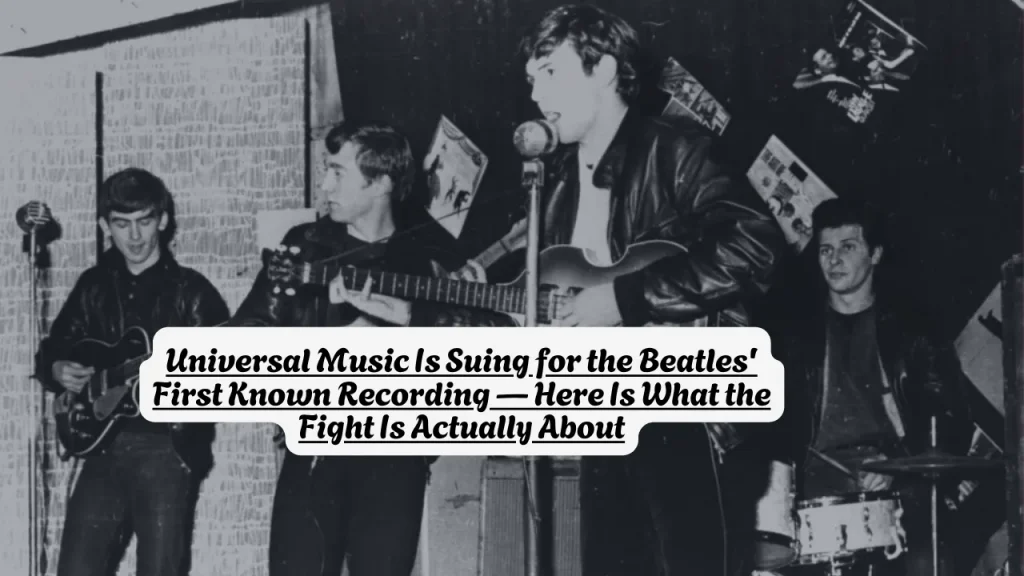
In June 1962, John Lennon, Paul McCartney, George Harrison, and drummer Pete Best laid down four tracks at EMI Studios — “Bésame Mucho,” “Love Me Do,” “PS, I Love You,” and “Ask Me Why” — on a magnetic recording tape, which was then sent to record producer George Martin at EMI’s headquarters on Manchester Square.
The tape was then sent to a squash court across the street from Abbey Road — a space EMI used to store old tapes it no longer needed. Both sides agree that in 1964, fellow EMI engineer Ken Scott alerted Emerick about the existence of the demo tape, noticing it had been left there. Emerick took the tape and kept it for the next 54 years.
When Emerick passed away suddenly of a heart attack in 2018, a Los Angeles judge eventually named a group of his cousins as heirs and appointed an administrator, Maya Rubin, to figure out what they would inherit. While searching through his Laurel Canyon house, Rubin and others came upon the 1962 demo.
UMG, which had acquired EMI in 2012, quickly found out about it. The label’s lawyers said the company had been alerted to the tape’s existence when it was listed online for sale to “the highest bidder” just weeks after Emerick’s death. With ownership of that object disputed, both sides filed formal petitions in probate court, asking the judge to confirm them as the owner.
Related article: Papa John’s Founder John Schnatter Settles Six-Year Lawsuit Against Ad Firm Over Secretly Recorded Conference Call
The Physical Tape vs. The Music Copyright — The Legal Distinction That Matters Most
Here is the most important thing to understand about this lawsuit — and the thing most coverage misses entirely.
The estate explicitly acknowledges that it has no rights to the music itself and that UMG owns the copyrights to the songs. The estate has already handed over digital copies to UMG, meaning the label could theoretically release the songs without recovering the physical tape.
This dispute is entirely about who owns the physical object — the magnetic tape itself. That matters because the tape, as a piece of rock and roll history, carries enormous standalone value as a collectible artifact, separate from any rights to exploit the music recorded on it.
Under California law, property found in a deceased person’s home generally passes to their estate. UMG’s argument cuts against that default rule — the company claims Emerick never had lawful possession of the tape in the first place, so it cannot pass through his estate. The estate argues the opposite: that EMI had effectively abandoned the tape by ordering it destroyed and sending it to a squash court storage room, and that Emerick’s act of taking it was a rescue, not a theft. The legal term for abandoned property — property an owner has intentionally relinquished — is relevant here, though courts treat corporate abandonment differently than individual abandonment.
Neither the music copyright law (the Copyright Act, 17 U.S.C. § 101 et seq.) nor the standard music industry framework governs this fight. This is fundamentally a California property law and probate law question about who has lawful title to a physical object.
For comparison, UMG has faced similar property and copyright ownership disputes in other contexts — including the ongoing Drake streaming manipulation lawsuit, which AllAboutLawyer.com covered in depth in the Spotify lawsuit and Drake streaming fraud case — where the line between what a label owns and what an artist controls has been sharply contested
UMG’s Argument: The Tape Was Stolen Corporate Property
UMG’s position is straightforward: the tape was made on EMI’s equipment, in EMI’s studio, on EMI’s time, and remained EMI’s property from the moment the session ended. UMG’s lawyers wrote in court filings that “at issue in this action is a highly valuable artifact of rock and roll history that was stolen.”
UMG says that whether or not the tape was sent to a squash court storage room, that storage room was EMI’s — the company had not abandoned the tape, only moved it. The fact that Emerick took it from a company facility makes the act a conversion of corporate property, not a rescue of discarded goods.
UMG says Emerick was “employed at EMI during the recording,” though the estate disputes whether he was physically present at the June 1962 session itself. UMG’s broader point is that employment at EMI at any relevant time creates an obligation to return company property — not a right to keep it for decades.
The Estate’s Argument: Emerick Saved It From Destruction
According to reporting citing court documents, EMI at the time judged the demo to be of insufficient quality and ordered it destroyed. Emerick kept the recording, apparently believing it was being thrown away.
The estate says in court filings that Emerick was “not at the test recording session” in June 1962, but that he came across the tape two years later when engineer Ken Scott noticed it sitting in the squash court storage area and alerted him. The estate frames Emerick’s act as preserving a piece of history that EMI had effectively sentenced to destruction — not stealing corporate property.
The estate’s legal theory is that a company that orders a tape destroyed and routes it to a disposal area has abandoned its ownership interest. If EMI no longer wanted the tape — evidenced by the destruction order — then Emerick taking it was not theft.
This argument faces one serious challenge: the squash court storage was still an EMI-controlled facility, and “ordered to be destroyed” does not necessarily mean “ownership relinquished.” Courts have generally held that placing property in storage, even with an intent to dispose of it later, does not constitute abandonment under California law.
How Much Is the Tape Worth?
In 2016, a 10-inch acetate record from 1962 — the first known Beatles disc to be cut — sold at auction for $110,000. Elvis Presley’s first recording, a 1953 acetate, sold for $300,000 in 2015. The Beatles’ first contract with manager Brian Epstein sold at auction for more than $550,000. A handwritten sheet of lyrics to “A Day in the Life” sold for $1.2 million at Sotheby’s.
One estimate for the tape’s value clocks in at $6.3 million. Beatles historian Bob Spitz put the historical significance bluntly: “It’s like finding another original copy of the Constitution. It’s a part of Beatles history, and that Beatles history is one of the most valuable parts of rock and roll history.”
Beatles 1962 Tape Lawsuit Timeline
| Milestone | Date |
| Beatles demo session at EMI Studios | June 6, 1962 |
| Emerick comes across tape in squash court | 1964 |
| Emerick keeps tape in personal possession | 1964–2018 |
| Geoff Emerick dies (no will, no spouse, no children) | October 2, 2018 |
| Tape discovered in Emerick’s Laurel Canyon home | 2018/2019 |
| Tape listed online for sale; UMG notified | Late 2018 |
| Los Angeles probate court appoints estate administrator | 2019 |
| Both parties file competing petitions for ownership | 2019 onward |
| UMG acquires EMI (predecessor entity) | 2012 |
| Case reported publicly | May 14, 2026 |
| Ruling on ownership | TBD — no ruling issued as of publication |
Frequently Asked Questions
Is there a lawsuit over the Beatles’ first known recording?
Yes. The dispute is currently being addressed in a Los Angeles probate court, where both parties are petitioning the judge to declare rightful ownership of the tape. UMG’s attorneys have described the matter as involving a stolen item, while the estate argues Emerick was rescuing what was otherwise lost to time.
Does UMG already own the music on the tape?
Yes — that part is not disputed. The estate explicitly acknowledges that it has no rights to the music itself and that UMG owns the copyrights to the songs. The estate has already handed over digital copies to UMG, meaning the label could theoretically release the songs without recovering the physical tape. The fight is exclusively over who owns the physical object.
What law governs who owns the physical tape?
California probate law and property law govern this dispute — not copyright law. The central legal question is whether EMI abandoned the tape when it sent it to be destroyed, or whether it remained company property that Emerick had no right to take. No federal statute directly controls the answer; it turns on California state law standards for abandonment and conversion of personal property.
What songs are on the tape and why does the Pete Best connection matter?
The Beatles laid down four tracks that day — “Bésame Mucho,” “Love Me Do,” “PS, I Love You,” and “Ask Me Why” — with original drummer Pete Best, not Ringo Starr, on drums. This makes the tape a historically unique artifact. Every other recording featuring the lineup that became the world-famous Beatles — including all of their iconic albums — features Starr. This tape is the only known recording of the Beatles with their original drummer, at their first-ever Abbey Road session.
Could UMG release the songs even if it loses the ownership case?
Yes. Since UMG already holds the copyright and has digital copies of the recordings, it could release the music commercially regardless of who wins physical ownership of the tape. What the physical tape represents is an irreplaceable artifact with auction value — not a prerequisite for releasing the music.
Is there a connection between this case and how music rights generally work?
This case is unusual because it separates physical property rights from intellectual property rights — two things that normally travel together. For a closer look at how music industry ownership battles play out in court, see the Drake vs. UMG streaming manipulation lawsuit, where questions about what a label controls versus what an artist owns also sit at the center of the dispute.
Sources & References
- Billboard — Original reporting by Bill Donahue, May 14, 2026: billboard.com
- California Probate Code — Property administration: leginfo.legislature.ca.gov
- U.S. Copyright Act — 17 U.S.C. § 101 et seq.: copyright.gov
Disclaimer: This article is for general informational and educational purposes only and does not constitute legal advice. Laws vary by state and jurisdiction. For advice about your specific situation, consult a qualified attorney.
About the Author
Israr Ahmad is a legal content researcher with 4+ years of experience covering class action settlements and consumer rights cases. He has researched and published coverage of 2,500+ settlements using verified court records, settlement administrator filings, and government sources. Learn more about Israr.