
ICE Violated a Federal Court Order on Warrantless Arrests Of Ramirez Ovando in Colorado, Here Is What That Means for You
The ACLU of Colorado filed a class action lawsuit on October 9, 2025 against the Trump administration to stop ICE from conducting warrantless arrests in Colorado without probable cause that a person is both a flight risk and in the country without legal documentation. On November 25, 2025, a federal judge issued an injunction ordering ICE to follow the law. ICE ignored it. On May 12, 2026, the court found that ICE officers materially violated both the preliminary injunction and federal law by continuing to make unlawful warrantless arrests in Colorado. No settlement exists. No claim form exists. But if you live in Colorado — or have family there — this ruling directly affects your rights.
Quick Facts: Ramirez Ovando et al. v. Mullin et al.
| Field | Detail |
| Case Name | Ramirez Ovando et al. v. Mullin et al. |
| Case Number | 1:25-cv-03183 (D. Colorado); Appeal No. 26-1027 (10th Cir.) |
| Filed | October 9, 2025 |
| Plaintiffs | Refugio Ramirez Ovando, Caroline Dias Goncalves, J.S.T., G.R.R. — and a certified class of all similarly situated individuals arrested without warrant in Colorado since January 20, 2025 |
| Defendants | Trump administration’s top immigration officials (ICE Acting Director, Denver Field Office Director) |
| Represented By | ACLU of Colorado, Meyer Law Office, Olson Grimsley Kawanabe Hinchcliff & Murray LLC |
| Court | U.S. District Court for the District of Colorado; Judge R. Brooke Jackson |
| Alleged Violation | 8 U.S.C. § 1357(a) — federal warrantless arrest statute |
| Current Stage | Preliminary injunction in force; judge found ICE in material violation on May 12, 2026; mandatory retraining ordered |
| ICE Appeal | Filed January 23, 2026 — pending before the 10th U.S. Circuit Court of Appeals |
| Last Updated | May 15, 2026 |
What Is the Colorado ICE Warrantless Arrest Lawsuit About? Ramirez Ovando et al. v. Mullin et al., No. 1:25-cv-03183
This case is about a federal law that has been on the books for over 80 years — and ICE ignoring it.
Federal law requires that ICE agents must have probable cause to believe that an individual is both “in the United States in violation of any immigration law” and “is likely to escape before a warrant can be obtained for his arrest.” Agents must make individualized determinations for each person before conducting a warrantless arrest. That requirement comes from 8 U.S.C. § 1357(a) and is not new. What is new is ICE’s pattern of skipping it entirely.
The lawsuit alleges that ICE is conducting indiscriminate stops and arrests in violation of the law without making the required determinations about people’s immigration status or flight risk — instead arresting and detaining people because of their skin color, accent, or perceived nationality, all to fulfill arbitrary arrest quotas set by Trump administration officials. The four original plaintiffs — a Lawful Permanent Resident wrongfully arrested by mistake, a college student arrested after a traffic stop, an asylum seeker, and a business owner — all lived in the U.S. for over a decade, had no criminal records, and had no flight risk assessment performed before their arrests.
Related article: Spirit Airlines Class Action Lawsuit, 17,000 Workers Fired Without Notice, Are You Owed Back Pay?
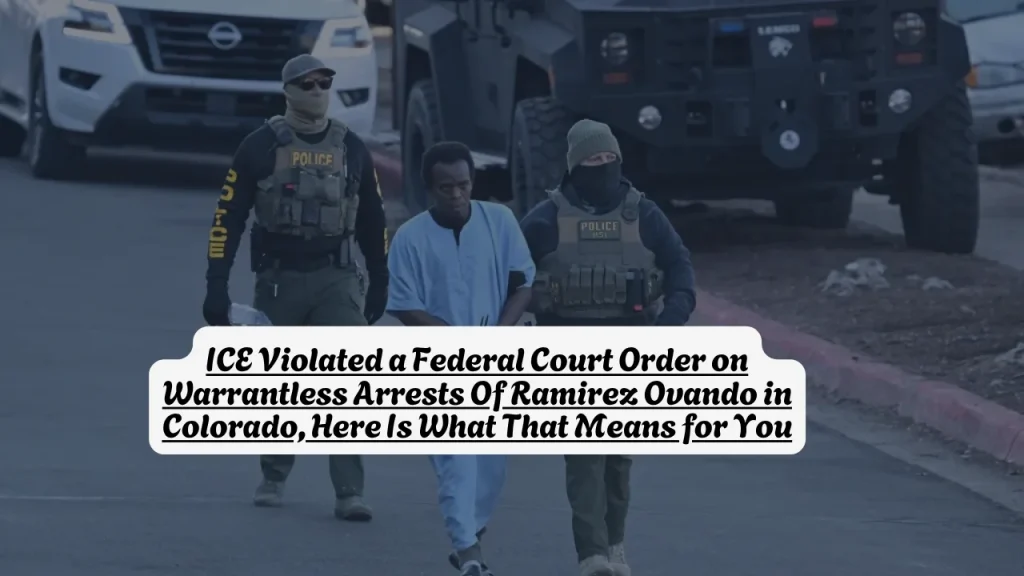
The case is part of a broader wave of legal challenges across the country. Courts in Oregon, California, and Washington, D.C. have issued similar orders limiting warrantless arrests in their districts. Colorado’s case is now one of the most advanced, with the court moving to enforcement proceedings after ICE failed to comply. If you want to understand your full rights during any ICE encounter, the AllAboutLawyer.com guide to your rights when ICE stops you covers what every person — citizen, green card holder, and undocumented — is legally protected against.
Are You Part of the Colorado ICE Class Action?
This is a certified class action. You do not need to sign up or file anything to be included.
You are likely part of this class if:
- You were arrested without a warrant by ICE in Colorado on or after January 20, 2025
- ICE agents did not ask about your community ties, family, employment, or court history before arresting you — and did not document any flight risk assessment
- You were arrested as a so-called “collateral” arrest — meaning ICE was looking for someone else and arrested you when they found you nearby
- You were stopped by a local officer who then contacted ICE, and ICE arrested you without a judicial warrant or any flight risk analysis
You are likely NOT included if:
- You were arrested outside Colorado
- ICE had a judicial warrant — signed by a federal judge — before arresting you
- You were arrested after January 20, 2025 but ICE documented a full, individualized flight risk determination before making the arrest
Jackson’s injunction grants provisional class-action status to all individuals “who have been arrested or will be arrested” unlawfully in Colorado since January 20, 2025. That means the injunction protects future arrests too — not just the original plaintiffs. A related case out of Minnesota covers similar racial profiling and warrantless arrest allegations; you can read about it at the Minnesota ICE lawsuit article on AllAboutLawyer.com.
What ICE Did After the Court Ordered Them to Stop
The November 2025 injunction could not have been clearer. Judge Jackson ordered ICE to document, for every warrantless arrest, the specific facts showing the person was likely to flee before a warrant could be obtained. ICE then had to provide those records to the ACLU so the court could verify compliance.
They did not comply. Not one of the 36 I-213 arrest reports produced by ICE after the injunction complied with the court’s mandate. None of them mentioned flight risk. None of them included specific, articulable facts supporting the conclusion that the person was likely to escape. The judge wrote: “It is as if this court’s order never happened.”
At a hearing in March 2026, ICE agents struggled to answer basic questions about warrantless arrests and admitted they had not received training about how to comply with the court’s order. The then-assistant field office director for Denver acknowledged the office had hired dozens of new officers and was making 15 to 25 arrests per day while training hours had been cut. The Trump administration’s own attorney did not deny the improper arrests — he argued they were limited and that the agency was “working to comply.”
The judge also found that in the case of Dionisio Castillo, a 53-year-old construction worker arrested at his job site in January while ICE was looking for someone else, ICE claimed to have a field warrant — but the record showed Castillo was placed under arrest before the field warrant was issued. In other words: ICE was creating paperwork after the fact to justify arrests it had already made.
What the May 12, 2026 Court Order Requires ICE to Do
Judge Jackson’s 60-page ruling on May 12 goes significantly further than his November injunction.
ICE must develop and conduct additional training within 45 days on how to make arrests that comply with federal law and the court’s preliminary injunction. ICE agents are prohibited from conducting warrantless arrests if they fail to complete this training within the court’s timeframe. Any agents hired after May 12 cannot make warrantless arrests until they have undergone this training.
Each month, ICE must turn over to the lawyers representing the immigrants a list of officers who have been trained, training materials, and a list of people arrested without a warrant. ICE must also produce all administrative warrants, I-213 forms, and related records so the ACLU can verify compliance. The government must also pay the plaintiffs’ attorneys’ fees.
The most blatant violations, Jackson found, occurred in the greater Denver metropolitan area. He declined to say the noncompliance extended statewide — but the training requirement applies to every ICE officer currently authorized to make warrantless arrests in Colorado.
What You Should Do Right Now If You or a Family Member Was Arrested Without a Warrant in Colorado
This is active litigation. No money is available, and no claim form exists. But the court’s injunction is now the law in Colorado — and ICE is being monitored for compliance.
- If you were arrested without a warrant in Colorado since January 20, 2025, and you believe ICE did not assess your flight risk before arresting you, contact the ACLU of Colorado at aclu-co.org. Your case may be relevant to the ongoing litigation.
- Save all documentation. Keep your arrest record, any I-213 form you were given, any paperwork from your detention, and records of your community ties, employment, and family. These documents matter if your case is later reviewed in connection with this lawsuit.
- If you are currently detained in Colorado, you or your attorney can point to this injunction. ICE is currently under a court order — if your arrest did not include a documented flight risk determination, that may be grounds for a legal challenge.
- Contact an immigration attorney immediately if you or a family member faces arrest or detention by ICE in Colorado. The injunction is in place, but ICE is appealing it — knowing your rights in real time matters. Most immigration legal aid organizations in Colorado offer free consultations.
- Monitor the 10th Circuit. The government filed its appeal of Judge Jackson’s injunction on January 23, 2026, in the 10th U.S. Circuit Court of Appeals, Case No. 26-1027. If the appeals court overturns the injunction, the rules change. A ruling is expected later in 2026.
Colorado ICE Lawsuit Timeline
| Milestone | Date |
| ICE warrantless arrest campaign begins in Colorado | January 2025 |
| ACLU files class action lawsuit | October 9, 2025 |
| Judge Jackson grants preliminary injunction and class certification | November 25, 2025 |
| Government appeals injunction to 10th Circuit | January 23, 2026 |
| ACLU files motion alleging ICE noncompliance | March 4, 2026 |
| Evidentiary hearing — ICE agents testify | March 10–11, 2026 |
| Judge finds ICE materially violated injunction; orders mandatory retraining | May 12, 2026 |
| ICE retraining deadline (or ban on warrantless arrests for untrained officers) | Within 45 days of May 12, 2026 |
| 10th Circuit appeal ruling | TBD — pending |
Frequently Asked Questions
Is there a class action lawsuit against ICE in Colorado?
Yes. The ACLU of Colorado filed a class action lawsuit on October 9, 2025, against the Trump administration to stop ICE from conducting warrantless arrests in Colorado without required probable cause determinations. On November 25, 2025, the court certified a class and issued a preliminary injunction. The case is Ramirez Ovando et al. v. Mullin et al., No. 1:25-cv-03183.
Do I need to do anything right now to be protected by the injunction?
No. If you are in Colorado and were arrested by ICE without a warrant since January 20, 2025, you are likely already part of the certified class. The injunction covers future arrests too — you do not need to register or file anything. If you believe your rights were violated, contact the ACLU of Colorado.
What is a warrantless arrest under federal immigration law?
A warrantless arrest is when ICE arrests someone without first obtaining a judicial warrant. Under 8 U.S.C. § 1357(a), ICE may only make warrantless arrests when agents have probable cause to believe the person is both unlawfully present in the U.S. and likely to flee before a warrant can be obtained. The court has clarified that “mere presence in the U.S. in violation of immigration law is not, by itself, sufficient” to justify a warrantless arrest.
What happens if ICE arrests me without a warrant in Colorado right now?
The injunction requires ICE to document a flight risk assessment before every warrantless arrest. If they fail to do so, it violates the court’s order. You or your attorney can raise this in immigration proceedings. Contact an immigration attorney or the ACLU of Colorado immediately. The AllAboutLawyer.com guide on suing ICE explains what legal options exist for those whose constitutional rights were violated.
Can I file my own lawsuit against ICE for an unlawful warrantless arrest in Colorado?
You can pursue individual legal remedies including habeas corpus petitions and civil rights claims. However, the class action in this case is already certified — meaning your situation is likely covered by the existing injunction. Consult an immigration attorney or civil rights lawyer to determine whether individual action makes sense for you.
When will the Colorado ICE case settle?
TBD — the case has not reached any settlement discussions. It is in active enforcement proceedings, with the government simultaneously appealing the injunction to the 10th Circuit. A ruling from the appeals court is expected later in 2026 and will significantly shape what happens next.
Does this injunction apply outside Colorado?
No. This injunction only applies to ICE operations in the U.S. District of Colorado. However, federal judges in Oregon, California, and Washington, D.C. have issued similar orders in their districts. If you are outside Colorado, check whether a similar court order covers your state.
Sources & References
- ACLU of Colorado — Official Case Page, Ramirez Ovando et al. v. Noem et al.: aclu-co.org/cases/ramirez-ovando-et-al-v-noem-et-al
- Court Complaint, Case No. 1:25-cv-03183, U.S. District Court for the District of Colorado (October 9, 2025): aclu-co.org/app/uploads/2025/10/20251009-No.-1-Complaint.pdf
- 8 U.S.C. § 1357(a) — Immigration and Nationality Act, warrantless arrest authority: uscode.house.gov
Prepared by the AllAboutLawyer.com Editorial Team and reviewed for factual accuracy against official ACLU of Colorado case filings, the U.S. District Court docket (No. 1:25-cv-03183), and credible news reporting on May 15, 2026. Last Updated: May 15, 2026
Disclaimer: This article is for general informational and educational purposes only and does not constitute legal advice. Laws vary by state and jurisdiction. For advice about your specific situation, consult a qualified attorney.
About the Author
Israr Ahmad is a legal content researcher with 4+ years of experience covering class action settlements and consumer rights cases. He has researched and published coverage of 2,500+ settlements using verified court records, settlement administrator filings, and government sources. Learn more about Israr.