
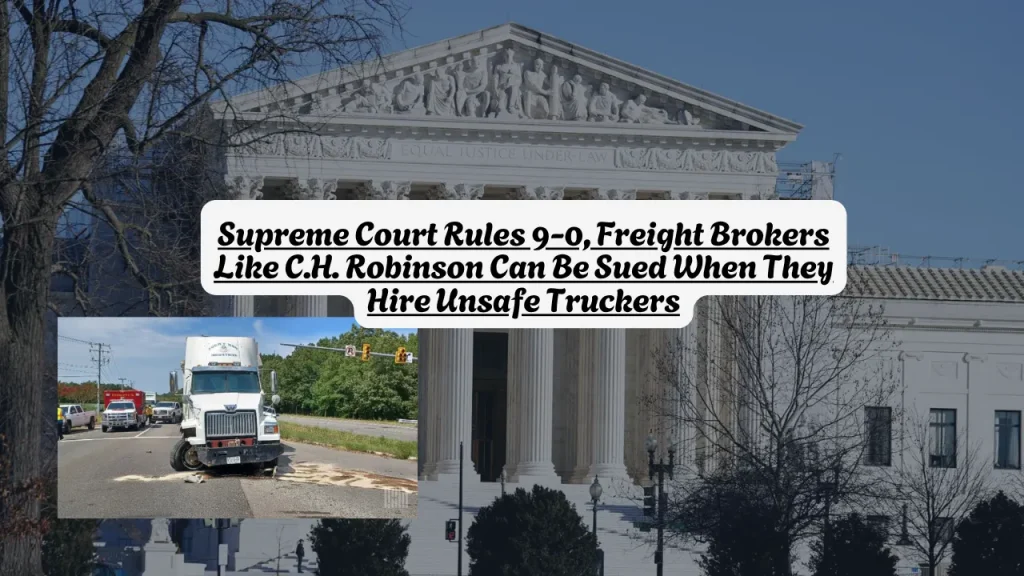
Supreme Court Rules 9-0, Freight Brokers Like C.H. Robinson Can Be Sued When They Hire Unsafe Truckers
Prepared by the AllAboutLawyer.com Editorial Team and reviewed for factual accuracy against the official Supreme Court opinion in Montgomery v. Caribe Transport II, LLC, No. 24-1238, 608 U.S. ___ (2026), reporting from the Associated Press and FreightWaves, and LII/Cornell Law School on May 15, 2026. Last Updated: May 15, 2026
The U.S. Supreme Court ruled unanimously on May 14, 2026, that freight brokers can be held liable under state negligence law when they hire unsafe trucking companies that then cause catastrophic crashes on American highways. In Montgomery v. Caribe Transport II, LLC, the Court held that a negligent-hiring claim against a freight broker falls within the safety exception to the Federal Aviation Administration Authorization Act, which saves it from federal preemption. The ruling was written by Justice Amy Coney Barrett and joined by all nine justices — no dissents.
CH Robinson Supreme Court Ruling — Quick Case Facts
| Field | Detail |
| Case Name | Montgomery v. Caribe Transport II, LLC et al. |
| Case Number | No. 24-1238 |
| Decided | May 14, 2026 |
| Vote | 9-0 Unanimous |
| Opinion Author | Justice Amy Coney Barrett |
| Concurrence | Justice Brett Kavanaugh, joined by Justice Samuel Alito |
| Plaintiff | Shawn Montgomery — Illinois driver who lost part of his leg |
| Defendant | C.H. Robinson Worldwide, Inc. (freight broker); Caribe Transport II, LLC (carrier) |
| Crash Location | Illinois highway, 2017 |
| Key Statute | Federal Aviation Administration Authorization Act (FAAAA), 49 U.S.C. § 14501(c)(2)(A) |
| Holding | Negligent-hiring claims against freight brokers are NOT preempted by federal law |
| What Happens Next | Case returns to lower court — Montgomery has not yet won on the merits |
| Last Updated | May 15, 2026 |
What Happened to Shawn Montgomery
Shawn Montgomery sustained severe and permanent injuries after his parked tractor-trailer was struck by a truck driven by Yosniel Varela-Mojena. Varela-Mojena was driving a load of plastic pots through Illinois for motor carrier Caribe Transport II, LLC. C.H. Robinson Worldwide, Inc. — a transportation broker — had coordinated the shipment.
Montgomery’s vehicle was parked on the shoulder when it was struck. Montgomery lost part of his leg in the crash. The trucker had been cited for careless driving in another crash months earlier, and the carrier he worked for had been involved with at least three crashes in a span of about five months.
Montgomery filed a lawsuit in federal district court arguing that C.H. Robinson was liable for his injuries because it negligently hired Varela-Mojena and Caribe Transport. Montgomery claimed that C.H. Robinson knew, or should have known, from Caribe Transport’s safety rating that hiring it to transport goods was reasonably likely to result in crashes that would injure others.
The district court threw the case out. The Seventh Circuit Court of Appeals agreed. Montgomery appealed to the Supreme Court — and won.
What the Supreme Court Decided and Why
The entire case turned on a single legal question: does a federal law called the FAAAA — passed in 1994 to deregulate the trucking industry — block Shawn Montgomery from suing C.H. Robinson under state negligence law?
The FAAAA has two relevant parts. The first is a broad preemption clause that bars state laws related to the “price, route, or service” of motor carriers or brokers. C.H. Robinson argued this clause wiped out Montgomery’s claim. But the FAAAA also has a safety exception: the preemption provision “shall not restrict the safety regulatory authority of a State with respect to motor vehicles.” 49 U.S.C. § 14501(c)(2)(A).
Justice Barrett’s analysis was straightforward. She wrote: “Montgomery argues that even if the FAAAA otherwise preempts his negligent-hiring claim against C.H. Robinson, the safety exception saves it. We agree.” The question became: is a negligent-hiring claim “with respect to motor vehicles”? Barrett concluded it was — noting that requiring C.H. Robinson to exercise ordinary care in selecting a carrier “concerns” motor vehicles, most obviously the trucks that will transport the goods.
Related article: Pxie Sues Destiny for Sharing Intimate Video Without Consent The Federal Lawsuit Heading to Trial
The safety exception saves only claims involving motor vehicle safety. State laws related to prices, routes, and services that have nothing to do with safety remain preempted. The clause still does work — it just does not protect brokers from accountability when their carrier selection puts dangerous trucks on the road.
C.H. Robinson made several counterarguments. Barrett rejected each one. When C.H. Robinson argued that Montgomery’s reading would “swallow” the preemption clause whole, Barrett said no — the safety exception only saves a narrow subset of claims specifically involving motor vehicle safety, not every preempted claim. On a textual argument about surplusage, Barrett said the overlap exists regardless of how you define the phrase — it comes from the word “safety,” not the breadth of the clause.
For a broader look at how courts have handled trucking company accountability when corporate hiring decisions put dangerous drivers on the road, see the Tracy Morgan $90 million Walmart truck crash lawsuit — which established a landmark precedent that trucking companies cannot escape liability by blaming individual drivers when their own carrier selection and supervision failures contributed to the crash.
What Negligent Hiring Actually Requires — The Legal Standard
This ruling did not hand Montgomery a check. It handed him a courtroom. To actually win his negligent-hiring claim at trial, he must still prove specific elements under state tort law.
Negligent hiring is a long-established common-law theory. The Restatement (Second) of Torts, Section 411, imposes a duty of reasonable care in employing a contractor for work carrying a risk of physical harm — a doctrine Barrett cited directly in the opinion. Applied to freight brokers, that means a plaintiff must generally show:
- The broker hired a carrier to perform work that carried a foreseeable risk of physical harm — which transporting goods by truck plainly does
- The broker knew or should have known the carrier was incompetent or unsafe for the work
- The broker failed to exercise reasonable care in investigating or selecting the carrier
- That failure caused the plaintiff’s injury
The phrase “knew or should have known” is critical. The FMCSA assigns safety ratings to carriers — including “satisfactory,” “conditional,” and “unsatisfactory” — and Caribe Transport had a “conditional” rating when C.H. Robinson hired them. That public rating, available to any broker through FMCSA’s free SAFER database, is exactly the kind of evidence that supports a negligent-hiring claim.
“Brokers can now be sued in state court for negligently selecting unsafe carriers,” law firm Husch Blackwell Partner Julie Maurer said. “The decision does not, however, mean automatic liability. Brokers who conduct reasonable due diligence in carrier selection should be well-positioned to defend against such claims.”
If you were injured in a truck crash and want to understand whether a freight broker’s carrier selection contributed to your injuries, the same FMCSA database is publicly accessible and your attorney can use it to examine the carrier’s safety history at the time the broker made the hire. The overloaded truck accident lawyer guide on AllAboutLawyer.com explains how truck crash attorneys investigate and preserve evidence against multiple defendants — including carriers, shippers, and now brokers.
The Kavanaugh Concurrence — Why It Matters
Justice Kavanaugh agreed with the result but wrote separately to add two things. First, a warning against reading the ruling too broadly. C.H. Robinson pointed to part of his concurrence where he said the decision does not mean brokers will be “routinely subject” to state tort liability following truck accidents. Brokers who vet carriers responsibly can and will win on the merits even after this ruling.
Second, a clear statement of why the policy result was right. Kavanaugh wrote that “truck safety is a matter of life and death.” He wrote: “It is hard to read the statute as written and conclude that Congress subtly sliced and diced state tort law so that trucking companies would be subject to state tort suits for accidents, but brokers would operate free of any such tort liability.”
Kavanaugh cited the human cost directly in his concurrence: approximately 5,000 deaths and 114,000 injuries from roughly 500,000 reported truck accidents in the U.S. in 2022 alone. His point — if brokers can face liability for disregarding poor safety records, they have a powerful financial incentive to stop choosing carriers based only on price and speed.
What the Ruling Means for the Freight Industry and Crash Victims
Before May 14, 2026, freight brokers operating in the 7th and 11th Circuits could almost always get negligent-hiring lawsuits thrown out before trial by invoking the FAAAA preemption defense. That defense is now gone nationwide. The Seventh Circuit is reversed. The case goes back for proceedings consistent with the opinion. The freight brokerage industry’s federal preemption defense is over.
The ruling resolves a circuit split. The Seventh and Eleventh Circuits had ruled that brokers were protected from those claims, while the Sixth and Ninth Circuits allowed them to proceed. Every freight broker in the country now operates under the same legal standard.
The Trump administration and companies such as Amazon had argued that letting the suit go forward would expose logistics companies to liability under a “patchwork” of state laws. The Court was not persuaded. The Transportation Intermediaries Association, an industry group, said the decision was “deeply disappointing,” comparing it to “asking travel agents to evaluate the safety of a given airline despite the fact that the airline has been licensed to fly by the federal government.”
Brian Watt, who runs a freight logistics company in Florida, said brokers will now have to focus more on the safety records of the truckers they contract with to haul all kinds of goods — including hazardous materials — instead of just looking for the cheapest and fastest option.
CH Robinson Supreme Court Case Timeline
| Milestone | Date |
| Illinois highway crash — Montgomery injured | 2017 |
| Montgomery files lawsuit in federal district court | Post-2017 |
| District court dismisses case (FAAAA preemption) | — |
| Seventh Circuit affirms dismissal | January 2025 |
| Supreme Court grants certiorari | — |
| Oral argument before Supreme Court | March 4, 2026 |
| Supreme Court issues 9-0 ruling | May 14, 2026 |
| Case sent back to lower court for further proceedings | May 2026 onward |
| Montgomery’s trial on the merits | TBD — not yet scheduled |
Frequently Asked Questions
What did the Supreme Court actually decide in the C.H. Robinson case?
The Supreme Court held that a negligent-hiring claim against a freight broker is not preempted by the FAAAA. The FAAAA’s safety exception, 49 U.S.C. § 14501(c)(2)(A), saves it. States retain authority to regulate safety “with respect to motor vehicles,” and requiring a broker to use ordinary care in selecting a carrier directly concerns the motor vehicles that will be on the road.
Did Shawn Montgomery win his lawsuit?
Not yet. The decision does not mean Montgomery will necessarily win the lawsuit, which the company is contesting. The Supreme Court only resolved the threshold preemption question. The case now returns to the lower courts where C.H. Robinson will still contest the underlying negligence claims on their merits.
Does this ruling apply to all freight brokers, or just C.H. Robinson?
It applies to every freight broker operating in interstate commerce in the United States. The ruling resolved a split among federal circuits and now applies uniformly in all 50 states. Any broker that hires an unsafe carrier and coordinates a shipment that results in a crash can now be sued for negligent hiring under state tort law — provided the plaintiff can prove the required elements.
What is the FAAAA and why does it matter?
The Federal Aviation Administration Authorization Act, passed in 1994, was a federal deregulation law that preempted state laws targeting the prices, routes, and services of motor carriers and brokers. The trucking industry used its preemption clause for decades to block state tort claims. The safety exception in § 14501(c)(2)(A) carves out state safety regulation — and the Supreme Court ruled that negligent-hiring claims fall squarely within that exception.
What is negligent hiring and how is it proven against a broker?
Negligent hiring requires proving the broker knew or should have known the carrier was unsafe — typically through the carrier’s FMCSA safety rating, crash history, inspection records, or driver-qualification problems — and that the broker failed to conduct reasonable due diligence before dispatching that carrier. A broker who checked FMCSA’s SAFER database and hired a carrier with a clean record is in a much stronger defensive position than one that ignored red flags to get a cheaper rate.
If I was injured in a truck crash, can I now sue the freight broker?
Possibly. The Supreme Court’s ruling removed the federal preemption barrier, but you still need to prove the broker acted negligently in selecting the carrier that caused your crash. The broker’s knowledge of the carrier’s safety record at the time of hire is the key factual question. Contact a personal injury attorney who handles truck accident cases — they can access FMCSA records to evaluate whether negligent broker selection contributed to your injuries.
Sources & References
- Supreme Court Opinion: Montgomery v. Caribe Transport II, LLC et al., No. 24-1238, 608 U.S. ___ (2026), decided May 14, 2026: law.cornell.edu | supremecourt.gov
- FMCSA SAFER carrier safety database: safer.fmcsa.dot.gov
- Federal Aviation Administration Authorization Act: 49 U.S.C. § 14501
Disclaimer: This article is for general informational and educational purposes only and does not constitute legal advice. Laws vary by state and jurisdiction. For advice about your specific situation, consult a qualified attorney.
About the Author
Israr Ahmad is a legal content researcher with 4+ years of experience covering class action settlements and consumer rights cases. He has researched and published coverage of 2,500+ settlements using verified court records, settlement administrator filings, and government sources. Learn more about Israr.