
Charlotte MacInnes vs. Rebel Wilson Defamation Trial: What the Court Has Heard So Far
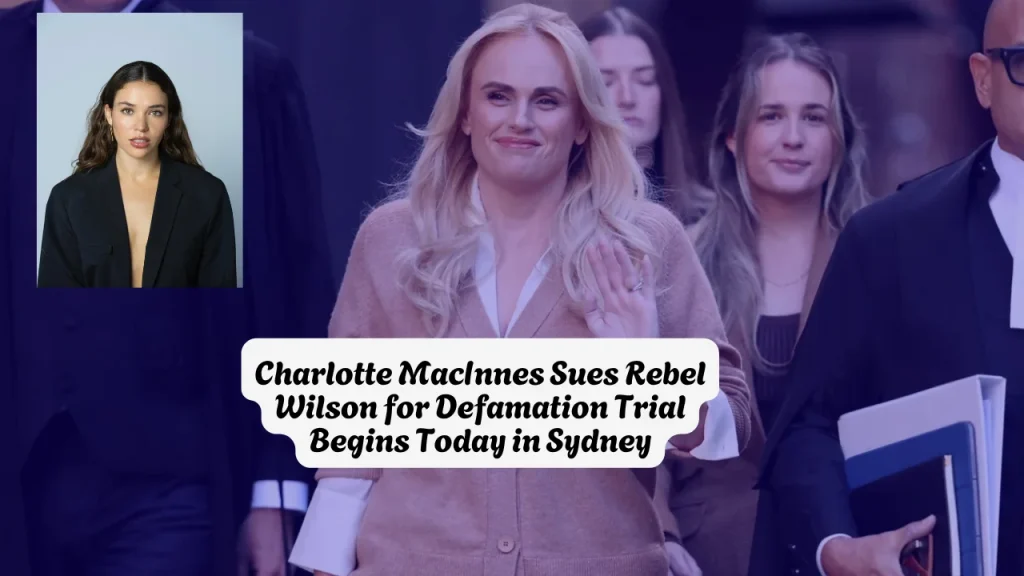
Rebel Wilson is in her third day of trial in Sydney’s Federal Court, defending a defamation lawsuit filed by Charlotte MacInnes, 25, the lead actress in Wilson’s directorial debut The Deb.— and she’s the defendant. The Pitch Perfect star, 46, faces a defamation lawsuit filed by Charlotte MacInnes, 25, the lead actress in Wilson’s directorial debut The Deb. MacInnes claims Wilson falsely suggested in Instagram posts that she had privately confided in her about being sexually harassed by one of the film’s producers, and that court filings allege Wilson failed to seek verification from MacInnes and made the claims despite knowing no complaint had been made. The nine-day trial opened Monday, April 20, 2026, in the Federal Court of Australia in Sydney — and it is being streamed live on YouTube.
Quick Case Snapshot
| Field | Details |
| Plaintiff | Charlotte MacInnes |
| Defendant | Rebel Wilson |
| Court | Federal Court of Australia, NSW Division, Sydney |
| Presiding Judge | Justice Elizabeth Raper |
| Filing Date | August 7, 2025 (defamation concerns notice); formal proceedings followed |
| Claims Alleged | Defamation; conspiracy to injure reputation |
| Damages Sought | Aggravated damages + injunction (amount not disclosed) |
| Trial Start | April 20, 2026 |
| Estimated Trial Length | Nine days |
| Current Status | Trial underway — Day 3 of 9 (April 22, 2026) |
What the Charlotte MacInnes Lawsuit Is Actually About
The dispute traces back to September 2023, during the production of The Deb — a musical film set around a debutante ball in regional New South Wales, directed by Wilson.
On September 5, 2023, producer Amanda Ghost and MacInnes had gone swimming at Bondi Beach. Ghost suffered from cold urticaria — an allergic reaction that left her shaking uncontrollably with red hives. MacInnes helped her back to a nearby penthouse apartment, where both women, wearing swimsuits, entered a large bath together to warm Ghost up. A third person in the apartment, Pia Ashcroft, was present and brought hot drinks including chamomile tea and hot chocolate, and both women spoke to Wilson by phone at the time.
Wilson’s team argues that the following day at a Surry Hills recording studio, MacInnes told her she felt sexually harassed by what happened in the bath. Wilson then began posting about it publicly on Instagram, claiming she was acting as a whistleblower protecting a young actress.
MacInnes denies she ever said any such thing.
MacInnes claims Wilson damaged her reputation by alleging that she was sexually harassed by The Deb producer Amanda Ghost, and then colluded with Ghost to cover up what took place.
In September 2024, Wilson posted that MacInnes had been cast in a Gatsby stage production and received a record deal because she changed her story about the alleged sexual harassment, effectively calling MacInnes a money-grabbing opportunist seeking career advantages.
MacInnes says the posts wrongly suggested she had told Wilson she felt uncomfortable around co-producer Amanda Ghost, and that she later retracted that concern in exchange for a lead role and a record deal. Wilson accepts that she posted the material, but denies that two of the posts were specifically about MacInnes.
What Wilson’s Defence Says
Wilson’s legal team is not denying the posts exist. Their argument is that the content was true — or substantially true — and that Wilson was acting in the public interest by raising a workplace concern.
Wilson’s lawyer told the court the central dispute is whether MacInnes reported to Wilson that she had been asked by Ghost to shower and bathe with her and whether she said it made her feel uncomfortable — and whether she later changed that story.
Wilson’s legal team argued the “wealth of prizes and opportunities” that MacInnes received following the bathing incident were because she “decided to tie herself” to Ghost.
Wilson is also defending on the basis that she was passing on a genuine workplace complaint made directly to her as the film’s director. Her Instagram post asked followers: “When an actress on her first film is asked by a producer to stay in the same apartment as them, and then makes a complaint to me as the director saying the producer asked her to have a bath and shower with her and it made her feel uncomfortable — what am I supposed to do?”
Related article: In-N-Out Burger Sued CaliBurger for Copying Its Entire Brand Here’s What Really Happened
What MacInnes Says Wilson Really Did — and Why
MacInnes’s barrister, Sue Chrysanthou SC, put a very different framing before the court on day one.
Chrysanthou told the court Wilson was a “bully” for publicly attacking MacInnes in Instagram posts, and argued that Wilson raised concerns about MacInnes “as leverage” amid a dispute with producers about budgets and contracts on The Deb.
Chrysanthou told the court that Wilson only made the Instagram allegations against MacInnes after she fell out with The Deb’s producers about writing credits and its financing.
In one of the most striking claims of the day, the court heard that Wilson had taken out a defamation insurance policy in March 2024 so she could, in Chrysanthou’s words, “go ballistic” about Ghost and other producers online.
In court, MacInnes’s barrister described it as a “malignant allegation” that her client had sold the allegation of sexual harassment in exchange for her own commercial and professional benefit.
MacInnes has alleged in court filings: “I was deeply disturbed by this behaviour, and felt very bullied and harassed by Wilson, who was the director of the film and in a position of authority over me. Nothing that I told Wilson could reasonably have conveyed that I was reporting any misconduct, because there was no misconduct.”
The Cannes Post That Made It Worse
The case didn’t stop at one Instagram story. In May 2025, Wilson attracted attention after posting on The Deb’s Instagram account about MacInnes, who was performing on a yacht at the 2025 Cannes Film Festival. Wilson captioned the video describing MacInnes as wearing a “culturally inappropriate” outfit and singing a song from a movie “that will never get released because of her lies.”
That post was cited in court as further evidence of what MacInnes describes as a coordinated smear campaign rather than a single, impulsive outburst.
Day 2: The PR Smear Campaign Allegations
New testimony on April 21 took the trial into a fresh area of dispute. MacInnes’s legal team told the court that Wilson allegedly hired Melissa Nathan, a crisis publicist at The American Agency Group, to build websites designed to smear producer Amanda Ghost. One of those sites, according to court evidence, was amandaghostsucks.com. According to MacInnes’s barrister, the site referred to an actress who had been rewarded for “remaining silent about the abuse she suffered” — an allegation MacInnes denies entirely.
Wilson has denied any involvement in the websites. She told a U.S. court last year that she played no role in conceiving, planning, registering, or directing any such content. Her legal team has not shifted from that position in the Sydney proceedings.
Wilson’s lawyer David Sibtain told the court that MacInnes denied the original complaint to protect her career and relationship with producer Ghost, arguing that her subsequent career gains — including a U.S. theatre production and music releases — demonstrate she suffered no reputational harm from Wilson’s posts.
The Bigger Legal Picture: Three Separate Cases
This is not Wilson’s only legal battle. The Federal Court matter is separate from another legal battle already underway in the NSW Supreme Court, brought by Ghost, Gregor Cameron, and Vince Holden against Wilson over alleged breaches of contract and damaging statements.
In November 2024, Wilson lost a motion in a California court to protect herself from the film’s producers’ defamation lawsuit under anti-SLAPP laws. The judge found her statements were “made in the context of her private business dispute” and that despite some of the allegations being criminal in nature, Wilson had not sought any criminal prosecution.
That California loss is significant: anti-SLAPP laws are designed to protect people speaking out on matters of public interest. The court’s rejection of Wilson’s claim to that protection will likely surface again in the Sydney proceedings.
What Is Defamation Law in Australia?
Australian defamation law operates differently from U.S. law and is generally considered more plaintiff-friendly. Under the Defamation Act 2005 (as amended), a plaintiff like MacInnes does not need to prove the statements are false — the burden shifts to the defendant (Wilson) to prove a defence such as truth (justification), honest opinion, or qualified privilege (good-faith communication on a matter of duty).
If Wilson cannot prove the substance of her claims is true, or that she had a genuine duty to communicate them, MacInnes could succeed — even without proving significant financial loss. Aggravated damages can be awarded where a court finds the defendant acted maliciously or continued the harmful conduct after becoming aware of its impact.
The “money-grabbing” framing Wilson used publicly is exactly the kind of imputation that Australian courts examine closely: it directly attacks a person’s honesty and integrity, and such imputations carry significant weight in defamation assessments.
What’s Happening Right Now and What Comes Next
Wilson is expected to give evidence herself in the second week of the Federal Court hearing. Her wife is also expected to testify. MacInnes and Ghost are also expected to take the stand.
The trial, pitting an unknown actress against one of the best-known Australian actors in the world, is set to last around two weeks.
The hearing is being live-streamed on the Federal Court of Australia’s YouTube channel in the interest of open justice — meaning anyone can watch testimony as it happens.
MacInnes is seeking aggravated damages for serious harm and a court order stopping Wilson from repeating the alleged defamatory claims online. No settlement discussions have been publicly reported.
FAQs: Charlotte MacInnes vs. Rebel Wilson
What is Charlotte MacInnes suing Rebel Wilson for?
MacInnes is suing for defamation. She claims Wilson made false and seriously damaging statements across at least four Instagram posts, suggesting MacInnes had initially complained of sexual harassment by a producer and then recanted those claims to advance her career.
What did Rebel Wilson actually post?
Wilson posted Instagram stories and videos claiming a producer had made MacInnes uncomfortable in a shared bath, that MacInnes had complained directly to her, and that MacInnes later changed her story after landing a record deal and a role in a Gatsby stage musical produced by the same person.
Did Rebel Wilson call Charlotte MacInnes “money-grabbing”?
According to court reporting on April 20, 2026, Wilson’s posts carried the clear implication that MacInnes traded her story for career benefits — a characterisation MacInnes’s legal team called a “malignant allegation.” The exact wording of each post is under examination by the court.
How long will the trial last?
The trial began April 20, 2026, and is scheduled to last approximately nine days. Wilson herself is expected to testify in the second week.
Can I watch the trial?
Yes. The Federal Court of Australia is live-streaming proceedings on its YouTube channel to ensure open access to justice.
What does MacInnes want from the court?
She is seeking aggravated damages (a higher level of compensation the court can award when it finds conduct was deliberate or malicious) and a permanent injunction preventing Wilson from repeating the claims.
What happens if Wilson loses?
She could face a significant damages award, a court order silencing further posts about MacInnes, and reputational consequences compounding her existing legal losses in California. She is also fighting parallel defamation proceedings in the NSW Supreme Court brought by The Deb’s producers.
Last Updated: April 22, 2026
This article is for informational purposes only and does not constitute legal advice. Allegations made in court and in complaints are not findings of fact. All parties are presumed innocent of any wrongdoing unless and until a court determines otherwise.
About the Author
Israr Ahmad is a legal content researcher with 4+ years of experience covering class action settlements and consumer rights cases. He has researched and published coverage of 2,500+ settlements using verified court records, settlement administrator filings, and government sources. Learn more about Israr.