
Poway Gang Drug Case, 42 Charged, 35 Arrested in Federal San Diego Fentanyl and Meth Indictments
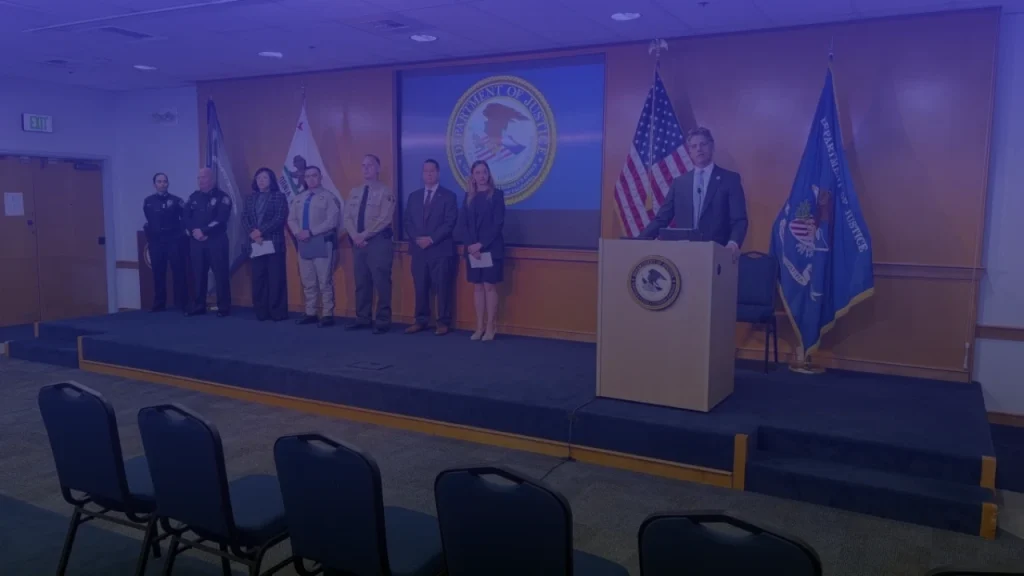
Federal prosecutors have charged 42 alleged members and associates of San Diego County street gangs in a two-year drug-trafficking investigation that began with a Poway gang called Varrio Hidden Hills. Four federal grand jury indictments, announced by the U.S. Attorney’s Office for the Southern District of California on Friday, October 30, 2026, accuse the defendants of distributing methamphetamine, fentanyl and cocaine.
Agents and officers arrested 35 defendants in coordinated raids on Wednesday, October 28, and Thursday, October 29. As of 2:30 p.m. on October 30, seven were still being sought. During the first morning of the operation, someone inside a Lemon Grove home fired through the front door and a window at FBI agents who were serving an arrest warrant. No one was hit.
These are accusations, not convictions. An indictment means a grand jury found probable cause. Every defendant is presumed innocent unless and until the government proves the charges beyond a reasonable doubt or the defendant pleads guilty.
Poway Gang Drug Case: Quick Facts
| Detail | What is known |
| Court / office | U.S. Attorney’s Office, Southern District of California |
| Announced | Friday, October 30, 2026 |
| Indictments | Four federal grand jury indictments (case numbers 26cr3883, 26cr3887, 26cr3886, 26cr3884) |
| Defendants charged | 42 alleged members and associates of various San Diego County street gangs |
| Arrests | 35, during raids on October 28–29 |
| Still sought | 7, as of 2:30 p.m. on October 30 |
| Gang that started the case | Varrio Hidden Hills, based in Poway |
| Alleged leader | John Marquez, 49, of Poway, also known as “Guero” |
| Drugs named | Methamphetamine, fentanyl, cocaine |
| Search warrants | 10, at homes and vehicles |
| Investigation began | Mid-2024 |
| Statutes | 21 U.S.C. §§ 841 and 846 |
| Prosecutors | Assistant U.S. Attorneys Jill Streja and Shivanjali A. Sewak |
| Task force framing | Homeland Security Task Force (HSTF), San Diego, under Executive Order 14159 |
| Agent shooting | October 28, 2026, 6:10 a.m., Lemon Grove; no one hit |
What happened in the Poway gang investigation?
According to the U.S. Attorney’s Office, the case grew out of an FBI investigation opened in mid-2024 into Varrio Hidden Hills and criminal activity in Poway. Agents focused on a senior-ranking documented member, John Marquez, and his associates. Prosecutors say the case quickly spread across San Diego County and other parts of California because of what they call expansive and overlapping criminal networks.
Hundreds of FBI agents, members of the North County Regional Gang Task Force and other federal, state and local officers took part in the takedown. They executed 10 search warrants at homes and vehicles in Poway, Lemon Grove, San Diego, National City, Chula Vista, Imperial Beach, El Cajon, Oceanside, Escondido, Vista, Temecula, Murrieta, Riverside and Tulare. Authorities say they seized drugs, guns, ammunition and cash during the takedown and over the two-year investigation.
The public release doesn’t give totals. It doesn’t say how much of any drug was seized, how many firearms were recovered, or how much cash was taken. That means no one can fairly calculate the network’s size from the announcement alone.
Timeline
| Date | Event |
| Mid-2024 | FBI opens investigation into Varrio Hidden Hills and John Marquez |
| Wednesday, Oct. 28, 2026, 6:10 a.m. | FBI agents come under fire serving an arrest warrant in Lemon Grove |
| Oct. 28–29 | Coordinated arrests and 10 search warrants across Southern California |
| Friday, Oct. 30, 2026 | U.S. Attorney’s Office announces four indictments against 42 people; 7 still sought as of 2:30 p.m. |
| Oct. 31, 2026 | Officials say the investigation continues and more arrests are expected, per local reporting |
Who is John Marquez, the alleged leader?
Prosecutors identify John Marquez, 49, of Poway, as a senior-ranking documented member of Varrio Hidden Hills and the alleged leader of an international drug-trafficking organization associated with the Mexican Mafia, also known as La Eme.
According to court documents described in the DOJ release, Marquez:
- Organized a multi-tiered distribution scheme using other San Diego County gang members and associates as distributors
- Oversaw separate chains of supply and set pricing
- Collected drug proceeds from sub-distributors to take back to sources of supply in Mexico
- Traveled repeatedly to and from Mexico to meet cartel-linked sources and arrange the importation of narcotics
The release quotes one series of messages in which Marquez allegedly told a primary methamphetamine and fentanyl source he was preparing to go to Mexico to pick up fentanyl and had to count money and “send it to Sinaloa.” That is the government’s description of its evidence. It hasn’t been tested in court.
Marquez has been accused, not convicted.
What are the alleged Mexican Mafia and cartel connections?
The Justice Department describes the Mexican Mafia as a U.S.-based prison gang that has major influence over Hispanic street gangs in Southern California, directs criminal activity from prisons and collects a share of drug proceeds. It also says the group has ties to criminal networks designated as foreign terrorist organizations, including the Sinaloa Cartel, CJNG and MS-13. FBI San Diego Special Agent in Charge Mark Remily described the alleged leader as having suspected cartel associations.
Those are claims about Marquez and the wider network. They don’t prove that all 42 defendants belonged to the Mexican Mafia or worked for a cartel. The government has to prove each person’s own conduct.
How much money was involved?
The DOJ release says court documents show Marquez regularly supplied methamphetamine at $750 to $900 per pound and worked with others to import fentanyl at $12,500 to $13,000 per kilogram. It also says the organization earned substantial profits.
Those are alleged supply prices. The release doesn’t state total revenue, profit or the value of anything seized.
Are all 42 defendants members of Varrio Hidden Hills?
No. The release describes the 42 as alleged members and associates of various San Diego County street gangs, including Varrio Hidden Hills. A person can be charged with joining a drug conspiracy without being a documented member of the gang that first drew investigators’ attention. Some of the defendants are listed with addresses in Mexico.
The release lists defendants by name, age and city under each case number. Defendants range from 26 to 70 years old. Two people appear under more than one case number, so adding up the names in each list gives 44 entries, not 44 different people.
What charges do the defendants face?
Different defendants face different charges. The announcement doesn’t say everyone is charged with every count.
| Case number | Defendants listed | Charges summarized by prosecutors |
| 26cr3883 | 22 | Conspiracy to distribute methamphetamine and fentanyl; distribution of methamphetamine, fentanyl and cocaine; possession with intent to distribute methamphetamine, fentanyl and cocaine |
| 26cr3887 | 13 | Conspiracy to distribute methamphetamine and cocaine; distribution of methamphetamine and cocaine; possession with intent to distribute both |
| 26cr3886 | 8 | Conspiracy to distribute methamphetamine and fentanyl; distribution and possession with intent to distribute methamphetamine |
| 26cr3884 | 1 | Conspiracy to distribute methamphetamine and fentanyl |
Which federal laws apply?
Distribution and possession with intent to distribute: 21 U.S.C. § 841(a)(1). It’s illegal to knowingly or intentionally manufacture, distribute or dispense a controlled substance, or to possess one with intent to do any of those things. Prosecutors must prove the elements against each defendant. They can use things like quantity, packaging, communications and money records.
Conspiracy: 21 U.S.C. § 846. A person who conspires to commit a federal drug offense faces the same penalties as for the offense itself. Prosecutors must prove the defendant knowingly joined an agreement to commit the offense. They don’t have to prove the defendant personally handed drugs to anyone, but being near an alleged gang member or living in a certain neighborhood isn’t enough on its own.
What prison time could the defendants face?
The sentence depends on the drug, the quantity attributed to the person, prior convictions and other factors. The DOJ release cites specific subsections of § 841(b)(1), and those subsections are tied to quantity thresholds:
- § 841(b)(1)(A)(viii) (methamphetamine at the highest threshold, 50 grams of pure meth or 500 grams of a mixture): 10 years to life.
- § 841(b)(1)(B) (the lower tier, which includes fentanyl at 40 grams or more, cocaine at 500 grams or more and smaller methamphetamine amounts): 5 to 40 years.
The subsections cited suggest the indictments allege quantities at those thresholds, but the public release doesn’t list weights for each defendant. So it would be wrong to say all 42 face the same minimum. A prior serious drug felony can raise the penalties (21 U.S.C. § 851), and some lower-level defendants may qualify for relief from mandatory minimums under the “safety valve” in 18 U.S.C. § 3553(f). The actual guideline range is set at sentencing under U.S.S.G. § 2D1.1.
For another recent federal fentanyl case, see Moises Freire Charged After FIT Student’s Death, Federal Indictment Alleges Fentanyl Was Disguised as Cocaine. It involves different defendants and allegations.
FBI agents fired on during the Lemon Grove arrest
The most dangerous moment of the operation came early Wednesday. At 6:10 a.m. on October 28, FBI agents arrived at a home in Lemon Grove to serve an arrest warrant. The DOJ says that after agents identified themselves, multiple shots were fired in their direction from inside the home, through the front door and a front window. Agents briefly returned fire and retreated. Tactical personnel responded, and the target of the arrest warrant came out and was taken into custody. No one was hit, and the FBI said its Inspection Division would review the agent-involved shooting.
The public statements don’t name the person who fired, and they don’t say which indictment, if any, covers that person. They also don’t announce a shooting-related charge. Federal law has separate statutes on assaulting federal officers, such as 18 U.S.C. § 111, but nothing in the DOJ summary says anyone has been charged under them. The indictments don’t establish that any particular defendant fired at agents.
Is this a RICO case?
Not based on the DOJ summary. The four indictments are described as drug trafficking charges under 21 U.S.C. §§ 841 and 846. The release doesn’t list a racketeering count under the Racketeer Influenced and Corrupt Organizations Act (18 U.S.C. § 1962). The release’s talk of gang leadership, the Mexican Mafia and cartel ties is context for the investigation, not a RICO charge. Likewise, although agents seized guns, the summary lists no firearms charge, such as 18 U.S.C. § 924(c).
For an example of a federal indictment that does include racketeering allegations, see L. Louise Lucas Indicted, Virginia Senator Faces Federal Racketeering, Marijuana Conspiracy and Money Laundering Charges. That is an unrelated Virginia case.
What happens next in the federal case?
Arrested defendants go through the normal federal process:
- Initial appearance before a magistrate judge (Fed. R. Crim. P. 5).
- Detention hearing. In drug cases with a maximum sentence of 10 years or more, federal law presumes no release conditions will assure the person’s appearance and community safety unless the defendant rebuts that (18 U.S.C. § 3142(e)). Judges still decide case by case.
- Arraignment on the indictment, where the defendant enters a plea (Fed. R. Crim. P. 10).
- Pretrial motions and discovery. Cases with dozens of defendants often take a long time. The Speedy Trial Act sets a 70-day trial clock (18 U.S.C. § 3161(c)(1)), but delays are routinely excluded in complex cases.
- Plea or trial. Most federal drug defendants plead guilty, but each defendant can go to trial.
The seven defendants still sought remain subject to arrest warrants. Local reporting says officials expect more arrests and possibly more charges. Those would be new filings, not part of the 42 announced.
What isn’t known yet
- Total drug weights, number of guns, and cash amounts seized
- Which defendants face which quantity-based penalty tiers
- The identity and charges of the person who fired at FBI agents in Lemon Grove
- Whether forfeiture of cash or property will be sought (federal drug law allows it under 21 U.S.C. § 853, but the release announces none)
- Court dates for individual defendants
- Whether additional defendants will be charged
FAQ: Poway gang drug case
How many people were charged in the Poway gang drug investigation?
Forty-two, in four federal grand jury indictments announced October 30, 2026.
How many have been arrested?
Thirty-five were arrested during the October 28–29 operation. Seven were still being sought as of 2:30 p.m. on October 30.
What gang is involved?
The investigation began with Varrio Hidden Hills, a Poway-based street gang. The release says the 42 defendants are members and associates of various San Diego County gangs.
Who is John Marquez?
A 49-year-old Poway man, also known as “Guero,” described by prosecutors as a senior documented member of Varrio Hidden Hills and the alleged leader of the drug organization. He has not been convicted.
What drugs are involved?
Methamphetamine, fentanyl and cocaine.
Is the Mexican Mafia involved?
Prosecutors say Marquez was associated with the Mexican Mafia. That is an allegation about him, not a finding about all 42 defendants.
Were FBI agents hurt in Lemon Grove?
No. The DOJ says no one was hit when shots were fired from inside a home on October 28.
Has anyone been convicted?
No. Indictments are allegations.
Does every defendant face the same charges?
No. Charges and drugs vary by indictment and by defendant.
Are RICO charges included?
Not according to the DOJ’s summary of charges.
Is there a settlement or claim form for residents?
No. This is a criminal prosecution. No settlement, claims process or compensation program has been announced.
Sources
- U.S. Attorney’s Office, Southern District of California, “Forty-two Alleged Gang Members and Associates Charged with Trafficking Fentanyl and Methamphetamine Following Homeland Security Task Force Investigation,” October 30, 2026 (Press Release CAS26-1030-Marquez), justice.gov/usao-sdca
- FBI San Diego, “Statement on Agent-Involved Shooting,” October 28, 2026, fbi.gov
- 10News San Diego, “42 Alleged Gang Members Countywide Indicted in Federal Drug Investigation,” October 31, 2026
- Times of San Diego, “Long Probe of Gang Activity, Drug Sales Ends in Dozens of SD County Arrests,” October 30, 2026
- FOX 5 San Diego, “Major Cross Border Drug Operation Discovered in San Diego County”
- 21 U.S.C. §§ 841, 846, 851, 853; 18 U.S.C. §§ 111, 924(c), 1962, 3142, 3161, 3553(f); Fed. R. Crim. P. 5, 10; U.S.S.G. § 2D1.1
Case numbers listed by the U.S. Attorney’s Office: 26cr3883, 26cr3887, 26cr3886 and 26cr3884.
Indictments and criminal complaints are merely allegations, and all defendants are presumed innocent until proven guilty beyond a reasonable doubt in a court of law.
Researched and written by Israr Ahmad, legal content researcher and founder of AllAboutLawyer.com. All facts verified against the U.S. Attorney’s Office for the Southern District of California press release of October 30, 2026 (Press Release CAS26-1030-Marquez), the FBI San Diego statement on the October 28 agent-involved shooting, and local reporting from 10News San Diego, Times of San Diego and FOX 5 San Diego, as of October 31, 2026. Last Updated: October 31, 2026.
This article is for informational purposes only and does not constitute legal advice. Laws vary by state and individual circumstances differ. For advice about your specific situation, consult a qualified attorney.
About the Author
Israr Ahmad is a legal content researcher with 4+ years of experience covering class action settlements and consumer rights cases. He has researched and published coverage of 2,500+ settlements using verified court records, settlement administrator filings, and government sources. Learn more about Israr.