
NYC Subway Shooting, Man Fatally Shot at Midtown Manhattan’s 53rd Street Station as NYPD Hunts Suspect
A man in his 30s was fatally shot on the northbound E train platform at the 53rd Street–Seventh Avenue subway station in Midtown Manhattan on Saturday, October 17, 2026, at approximately 12:21 p.m. The New York City Police Department (NYPD) is investigating the killing as a homicide and is seeking a masked suspect who fled on foot north along Seventh Avenue. As of October 18, no arrest had been confirmed and the victim had not been publicly named.
NYC Subway Shooting: Quick Facts
| Detail | Confirmed information |
| Date | Saturday, October 17, 2026 |
| Approximate time | 12:21 p.m. Eastern Time |
| Location | 53rd Street–Seventh Avenue subway station, Midtown Manhattan, New York City |
| Station served by | B, D and E lines |
| Platform | Northbound E train platform (toward Queens) |
| Victim | Adult man believed to be in his 30s; name not released |
| Injury / outcome | Single gunshot wound to the chest; pronounced dead at NYC Health + Hospitals/Bellevue |
| Cause of confrontation | Argument involving two or three men; motive not established |
| Suspect | At large; NYPD released surveillance images |
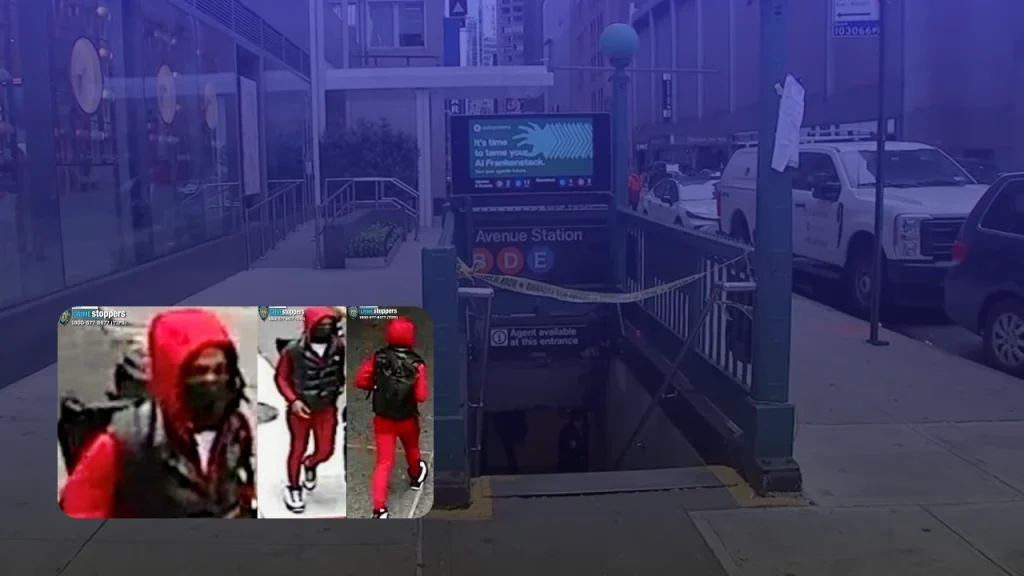
| Suspect’s reported clothing | Red tracksuit, black vest, black face mask, backpack (some reports add black-and-white sneakers) |
| Direction of flight | On foot, northbound on Seventh Avenue |
| Arrest status | No arrest confirmed in the latest reports reviewed |
| Investigating units | NYPD, including Midtown North Precinct and Transit District 1 |
| Service impact | A, C, D, E and F service disrupted during the investigation (reported October 17) |
| Tip line | NYPD Crime Stoppers: 1-800-577-TIPS (8477) |
| Spanish tip line | 1-888-57-PISTA (74782) |
| Online tips | NYPD Crime Stoppers page on nyc.gov; X: @NYPDTips |
| Official updates | NYPD (@NYPDnews on X) and MTA service alerts |
1. Where Did the NYC Subway Shooting Happen?
The shooting took place at the 53rd Street–Seventh Avenue station in Midtown Manhattan, a busy hub a short walk from Carnegie Hall, Broadway theaters and Times Square. The station is served by the B, D and E lines. The police account places the fatal shooting on the northbound E train platform, where Queens-bound passengers board.
Did the shooting happen on the platform or inside a train?
Early reporting described the argument moving between a train that had pulled into the station and the platform. At a Saturday press briefing, police had not definitively established whether the shots were fired inside the train car or on the platform. Until investigators say otherwise, the accurate description is that the fatal shooting occurred at the northbound E platform following a dispute that involved both the train and the platform.
2. What Happened Before the Fatal Shooting?
According to police information reported by local media, an argument broke out between two or three men at around 12:20 p.m. Witnesses described the dispute spilling from the platform into an open train car and back onto the platform. As train doors opened, a gunman fired, striking the victim once in the chest. Passengers fled the platform in panic. Police officers and emergency medical personnel arrived within minutes, and the victim was taken to Bellevue Hospital, where he was pronounced dead.
Several important facts have not been publicly established:
- What started the argument.
- Whether the victim and the gunman knew each other.
- Whether the confrontation began on the platform or in the train.
- Whether anyone else was directly involved in the dispute.
- Whether the victim was specifically targeted or the shooting grew out of a spontaneous argument.
The available information supports saying this was a fatal shooting that followed a dispute. It does not establish why the shooting happened. Claims of a feud, gang link, robbery or other motive are unverified.
3. Who Was the Victim?
The victim was an adult man believed to be in his 30s who suffered a gunshot wound to the chest. Reports reviewed as of October 18 did not name him. Police generally withhold a victim’s identity until next of kin have been notified, and the NYC Office of Chief Medical Examiner confirms the cause and manner of death.
Be careful with social media posts that claim to name the victim. Mistaken identification spreads quickly after high-profile violence and can harm innocent families. Wait for confirmation from the NYPD or the Medical Examiner.
Was anyone else injured?
Coverage reviewed did not report any other person being shot. MTA Chief Security Officer Michael Kemper said it was fortunate that nobody outside the confrontation was hurt.
4. Who Is the Suspect and Has He Been Arrested?
The NYPD released surveillance images of the person it is seeking. He is described as wearing:
- A red tracksuit
- A black vest (described in some reports as a puffer vest)
- A black face mask or balaclava
- Black-and-white sneakers
- A backpack
His face is covered in the released images, so clothing alone cannot establish identity. As of October 18, no arrest had been confirmed and no suspect had been publicly named. Anyone who recognizes the person should contact police and should not approach him.
Presumption of innocence: A person sought by police, or even arrested, has not been convicted of anything. Under the U.S. and New York constitutions, every defendant is presumed innocent until proven guilty beyond a reasonable doubt.
5. How to Help the NYPD Find the Suspect
- Phone (English): 1-800-577-TIPS (8477)
- Phone (Spanish): 1-888-57-PISTA (74782)
- Online: the NYPD Crime Stoppers page on nyc.gov
- Social media: direct message @NYPDTips on X
Crime Stoppers accepts anonymous tips. NYPD has historically offered cash rewards of up to $3,500 for information leading to an arrest and indictment in qualifying cases; confirm any reward amount with the NYPD before relying on it. Witnesses who saw the argument, the shooting or the suspect’s flight, or who recorded video on a phone, may hold useful evidence even if they never saw the gun.
6. What Did Witnesses Report?
Passengers described confusion and panic. Passenger Paul Sampson told CBS News New York that people on the train dropped to the floor after hearing gunshots, then exited and saw police tending to the injured man. Another witness described hearing several shots and seeing passengers rush out of the train. Witness accounts help investigators, but they are weighed against surveillance video, ballistic and physical evidence, and the medical examiner’s findings. Accounts of the exact number of shots and the shooter’s position remain unconfirmed.
7. Subway Service Disruptions
The shooting forced the MTA and NYPD to change service while detectives processed the scene.
| Line | Reported disruption (October 17) |
| C | Bypassed the Seventh Avenue station during the investigation |
| D | Bypassed the Seventh Avenue station during the investigation |
| E | Rerouted along the F line over part of its route |
| A | Reported delays |
| F | Reported delays |
Some outlets reported that A, C, D, E and F trains skipped the station at different times. Routing changed as the response developed. These are historical changes reported on October 17, not confirmation that they remain in effect. Check the MTA’s official service alerts before traveling.
8. What Has the MTA Said?
The MTA condemned the violence and said it is cooperating with the NYPD. Chief Security Officer Michael Kemper said guns have no place in transit, that the agency supports making firearm possession in the subway illegal, and that the MTA coordinated with police from the start, especially to provide video from platform and train-car cameras. The MTA’s statement did not establish a motive.
9. Possible Criminal Charges in a Case Like This (New York Law)
No one has been charged in this case. The following is general legal information about charges that New York prosecutors commonly consider when a person is killed by gunfire during an argument. Which charges apply depends entirely on the evidence and the prosecutor’s decision, including the shooter’s intent.
| Offense | New York statute | Basic description | Typical penalty range |
| Murder in the second degree | Penal Law § 125.25 | Causing death with intent to kill, or under circumstances showing depraved indifference to human life | Class A-I felony; indeterminate sentence with a minimum of 15 to 25 years and a maximum of life |
| Manslaughter in the first degree | Penal Law § 125.20 | Causing death with intent to cause serious physical injury, or in an extreme emotional disturbance situation | Class B violent felony; up to 25 years |
| Manslaughter in the second degree | Penal Law § 125.15 | Recklessly causing death | Class C felony; up to 15 years |
| Criminal possession of a weapon in the second degree | Penal Law § 265.03 | Possessing a loaded firearm outside the home or business | Class C violent felony; generally a minimum of 3½ years up to 15 years |
| Criminal possession of a weapon in the third degree | Penal Law § 265.02 | Various firearm possession circumstances, including prior-conviction situations | Class D felony; up to 7 years |
Murder in the first degree (Penal Law § 125.27) is reserved for specific aggravating circumstances and does not appear to be implicated by the facts released so far.
Is a subway a “sensitive location” for firearms in New York?
Yes. After the U.S. Supreme Court’s 2022 decision in New York State Rifle & Pistol Association v. Bruen, New York enacted the Concealed Carry Improvement Act, which restricts firearms in designated “sensitive locations,” including public transportation such as subways, under Penal Law § 265.01-e. Federal courts have heard challenges to parts of that law, and its status can change, so confirm current law before relying on it. The MTA’s security chief also publicly stated that guns do not belong in transit.
Could self-defense apply?
New York recognizes justification defenses under Penal Law Article 35. Under § 35.15, deadly physical force is allowed only if a person reasonably believes it is necessary to defend against deadly force or certain violent crimes, and in many situations a person must retreat if they can do so safely. Nothing in the information released so far establishes a self-defense claim, and police have not suggested one. Whether any defense applies is a matter for investigators, prosecutors and, if charges are filed, a court.
10. What Happens Next in the Investigation?
Detectives from the Midtown North Precinct and Transit District 1 are reviewing platform and train-car video, witness statements and digital evidence from bystanders’ phones. Possible next developments include formal identification of the victim, a named suspect, an arrest, charges or the release of a motive. None of these should be assumed before police or prosecutors announce them.
What happens after an arrest in New York?
- Arrest and rights warnings. Police must give Miranda warnings before custodial questioning. Statements obtained in violation of a person’s rights can be challenged in court.
- Arraignment. A person arrested must be brought before a judge without unnecessary delay (Criminal Procedure Law § 140.20), where charges are read and bail or release is decided.
- Bail. New York’s bail laws (CPL Article 510) govern release; a homicide charge can lead to the defendant being held.
- Grand jury indictment. Felony charges generally proceed through a grand jury, which decides if there is enough evidence to indict.
- Pretrial hearings and discovery. Prosecutors must share evidence with the defense under CPL Article 245, and the defense can challenge identifications, statements and searches.
- Trial or plea. The prosecution must prove guilt beyond a reasonable doubt.
There is no statute of limitations on murder in New York (CPL § 30.10), so a homicide case can be brought at any time.
Readers who want to understand constitutional protections during criminal investigations can read our guide, What Is The 5th Amendment? Your Rights Against Self-Incrimination.
11. Rights and Help for the Victim’s Family and Witnesses
Crime victim compensation
The New York State Office of Victim Services (OVS) can reimburse certain losses for victims of violent crime and, in homicide cases, eligible family members, under Executive Law Article 22. Covered losses can include funeral and burial costs, counseling and lost support, subject to program limits. Claims generally must be filed within one year of the crime, with exceptions for good cause, and the victim must cooperate with law enforcement. Confirm current deadlines and caps with OVS.
Wrongful death lawsuits
A wrongful death claim in New York is brought by the personal representative of the estate under Estates, Powers and Trusts Law §§ 5-4.1 and 5-4.3. The general limitation period is two years from the date of death. A civil case is separate from any criminal case, can proceed whether or not there is a conviction, and uses a lower standard of proof (preponderance of the evidence).
Claims against the MTA or a public authority
Claims alleging negligence by a public benefit corporation like the MTA or New York City Transit Authority are subject to short deadlines, including a notice of claim generally due within 90 days of the incident (Public Authorities Law § 1212). No reporting reviewed suggests the MTA is at fault here, and criminal acts by third parties raise difficult legal questions about liability. A family or injured person should speak with a New York attorney promptly.
Witnesses
Witnesses may be contacted by detectives or prosecutors and may later be subpoenaed to testify. You are free to speak with an attorney first. Do not post speculation about who did it online, which can interfere with an investigation or defame innocent people.
12. Is the NYC Subway Shooting Connected to Other Transit Violence?
News 12 reported that on September 30, 2026, 59-year-old Mesias Lojano was stabbed to death aboard a northbound J train in Queens. That was a separate incident, and reporting does not connect the two cases. Each requires its own investigation.
Does this shooting prove subway crime is rising?
One fatal shooting does not establish a trend. In an October 6, 2026 briefing, the NYPD reported record-low citywide numbers of murders, shooting incidents and shooting victims for the first nine months of 2026. Those figures cover the whole city, not subway crime specifically. Transit safety should be judged by transit-specific data over time. A serious incident remains important regardless of the larger statistics.
13. NYC Subway Crime Statistics: What the Data Shows
Transit crime data is mixed, and the numbers differ depending on the time period and the crime category. Figures below are NYPD-reported statistics as published by news outlets during 2026, and they change monthly.
| Period | Reported transit crime trend |
| Summer 2025 (June to August) | Overall transit crime down nearly 10% from 2024 and about 16.8% from summer 2019; felony assaults fell 21% (119 versus 150) |
| January 2026 | Major transit felonies up 6.1% (174 versus 164 a year earlier); arrests and fare-evasion summonses were down |
| January to February 2026 | Subway crime up 18.5%, about 30 more incidents than the prior year, even as citywide shootings and murders hit record lows |
| Through mid-April 2026 | Transit felonies down 1.5% and assaults down 5.5% year to date, but robberies up 15% (136 versus 118) and three transit murders versus none at the same point in 2025 |
| July 2026 | Major transit crime up 10.9%, largely driven by felony assaults and nonviolent grand larcenies, while citywide violent crime fell nearly 13% |
How safe is the subway per ride?
The subway carries roughly 4 million riders on a busy day. Researchers at the Vital City project, which analyzed per-ride rates, concluded that for any single trip it is extremely unlikely that a reported violent crime will occur. At the same time, they noted that violent crime on the subway has measurably risen since 2019 and that many riders say they do not feel safe. Both statements can be true at once.
Why do officials and critics disagree?
City and MTA officials have said subway crime is among its lowest levels in about 30 years and cite NYPD data showing declines versus last year and versus 2019. U.S. Transportation Secretary Sean Duffy has argued that certain categories, such as assaults, are up substantially since 2019. The answer depends on which crime category and which baseline year is used. Always check the NYPD’s most recent monthly transit crime report for current figures.
14. What Safety Measures Are in Place in the Subway?
Officials have announced a mix of policing, technology and outreach measures over the past two years:
- More police underground. The governor funded about 750 additional officers on the system, and in April 2026 the NYPD said it was adding 175 more. The state has also deployed additional patrols and, at times, state police and National Guard members. In September 2025, officials confirmed two officers on every overnight train.
- Cameras. MTA officials say there are cameras in every subway car in addition to roughly 15,000 cameras in stations. Camera footage is central to identifying and finding suspects, including in this case.
- Weapons detection pilots. In 2024, the city announced a testing period for electromagnetic weapons-detection technology in the subway. Check current MTA and NYPD announcements for the status of any scanning program.
- Weapons seizures. NYPD reported seizing 1,515 weapons in the transit system in 2023, including 45 illegal guns, up from 947 weapons and 35 guns in 2022. These are older figures and are provided for context only.
- Mental health outreach. The SCOUT program pairs a clinician with MTA police officers to connect people in crisis with care.
- Firearm restrictions. Subways are sensitive locations under New York’s Concealed Carry Improvement Act (see Section 9).
What should riders do in an emergency?
- Move away from the danger and take cover or exit if it is safe to do so.
- Call 911 as soon as you can, or alert an MTA employee or an NYPD officer.
- Use the emergency intercoms on subway platforms and in train cars.
- Do not confront an armed person. Note what you can safely observe, such as clothing, direction of travel and any weapon, and share it with police.
- Report anything suspicious through the MTA’s “See Something, Say Something” system.
Frequently Asked Questions About the NYC Subway Shooting
When did the Midtown Manhattan subway shooting happen?
Saturday, October 17, 2026, at about 12:21 p.m. Eastern Time.
Where did the NYC subway shooting happen?
At the 53rd Street–Seventh Avenue station in Midtown Manhattan, on the northbound E train platform. The station serves the B, D and E lines.
Did the man shot in the subway die?
Yes. He was shot once in the chest and pronounced dead at Bellevue Hospital.
What was the victim’s name?
Not released as of October 18. Police typically withhold the name until the family has been notified.
Has the NYPD caught the subway shooting suspect?
No arrest had been confirmed in the latest reports reviewed as of October 18. The NYPD released surveillance images of a person it is seeking.
What did the suspect look like?
He was described as wearing a red tracksuit, black vest, black face mask and a backpack, with some reports adding black-and-white sneakers.
Which subway lines were affected?
The A, C, D, E and F lines saw bypasses, reroutes or delays during the Saturday investigation. Check MTA alerts for current service.
Was the shooting random?
Unknown. Police described an argument involving multiple men, and no motive has been established.
Was anyone else hurt?
No other shooting victims were reported.
What charges could the shooter face?
Possible charges include murder or manslaughter under Penal Law Article 125 and criminal possession of a weapon under Article 265. No one has been charged.
Is there a statute of limitations for murder in New York?
No. Murder charges can be filed at any time.
Can the victim’s family receive financial help?
Eligible families may apply to the New York State Office of Victim Services for certain costs, such as funeral expenses, generally within one year, and may also have a civil wrongful death claim, generally within two years.
Is subway crime going up or down in 2026?
It depends on the category and time period. NYPD figures reported in 2026 showed increases in some months (January, February and July) and year-to-date declines in transit felonies and assaults through mid-April, with robberies up. Citywide shootings and murders were at record lows.
Is the NYC subway safe?
Per ride, a reported violent crime is very unlikely, but violent crime in the system has risen since 2019 by some measures. See the statistics and safety sections above and check the NYPD’s latest monthly report.
How can I give information to the NYPD?
Call 1-800-577-TIPS (8477), use the Spanish line at 1-888-57-PISTA (74782), submit a tip through the NYPD Crime Stoppers page on nyc.gov, or message @NYPDTips on X.
Sources and Reporting Notes
- The Guardian — New York City police seek suspect in fatal subway station shooting (October 17, 2026). https://www.theguardian.com/us-news/2026/oct/17/new-york-city-subway-station-shooting
- CBS News New York — Man killed in NYC subway station shooting, officials say (updated October 17, 2026). https://www.cbsnews.com/newyork/news/subway-shooting-7th-midtown-manhattan/
- amNewYork — Midtown subway shooting: Desperate search for gunman who killed man during argument on platform (October 17, 2026). https://www.amny.com/police-fire/midtown-subway-shooting-suspect-10172026/
- News 12 New York — Man shot and killed inside Midtown Manhattan subway station (October 17, 2026). https://newyork.news12.com/man-shot-and-killed-inside-midtown-manhattan-subway-station
- NYPD — official statement on X (@NYPDnews) and NYPD Crime Stoppers page. https://www.nyc.gov/site/nypd/services/see-say-something/crimestoppers.page
- NYPD — Record-low shooting incidents, shooting victims and murders during the first nine months of 2026 (October 6, 2026). https://www.nyc.gov/site/nypd/news/PR015/nypd-fewest-shooting-incidents-shooting-victims-murders-recorded-history-for
- MTA — Service alerts. https://www.mta.info
- New York Penal Law Articles 35, 125 and 265; Criminal Procedure Law §§ 30.10, 140.20, Articles 245 and 510 (New York State Senate Open Legislation: https://www.nysenate.gov/legislation/laws/CONSOLIDATED).
- New York Executive Law Article 22 (Office of Victim Services): https://ovs.ny.gov
- New York Estates, Powers and Trusts Law §§ 5-4.1 and 5-4.3; Public Authorities Law § 1212.
- U.S. Supreme Court — New York State Rifle & Pistol Association, Inc. v. Bruen, 597 U.S. 1 (2022).
- WABC / ABC7 New York — NYPD releases new transit crime data as patrols increase (April 15, 2026).
- amNewYork — NYC crime: fewest shootings and murders ever, but subway crime rises (March 2026); NYC subway crime, January 2026.
- FOX 5 New York — NYC on track for record-low murders, shootings, robberies in 2026 (August 2026).
- News 12 Brooklyn — NYPD says subway crimes hit historic lows this summer (September 10, 2025).
- Vital City — Crime on the New York City Subway: How Rare Is It Really? https://www.vitalcitynyc.org/how-rare-is-crime-on-the-subway/
- Straight Arrow News — NYC meets deadline to share subway crime data (MTA letter to U.S. DOT).
- City of New York — Weapons-detection pilot and SCOUT announcement (March 2024).
Disclaimer: This article reflects information available through October 18, 2026, and distinguishes confirmed police information from reporting and unresolved questions. Arrests, victim identification or other developments may change the account. Statutes, penalties and deadlines are summarized for general information, can change, and depend on specific facts. This is not legal advice; consult a licensed New York attorney about your situation.
About the Author
Israr Ahmad is a legal content researcher with 4+ years of experience covering class action settlements and consumer rights cases. He has researched and published coverage of 2,500+ settlements using verified court records, settlement administrator filings, and government sources. Learn more about Israr.