
Kraków Mass Shooting, Six Killed, 15 Injured in Main Market Square as Three Bodies Are Found at Suspect’s Home
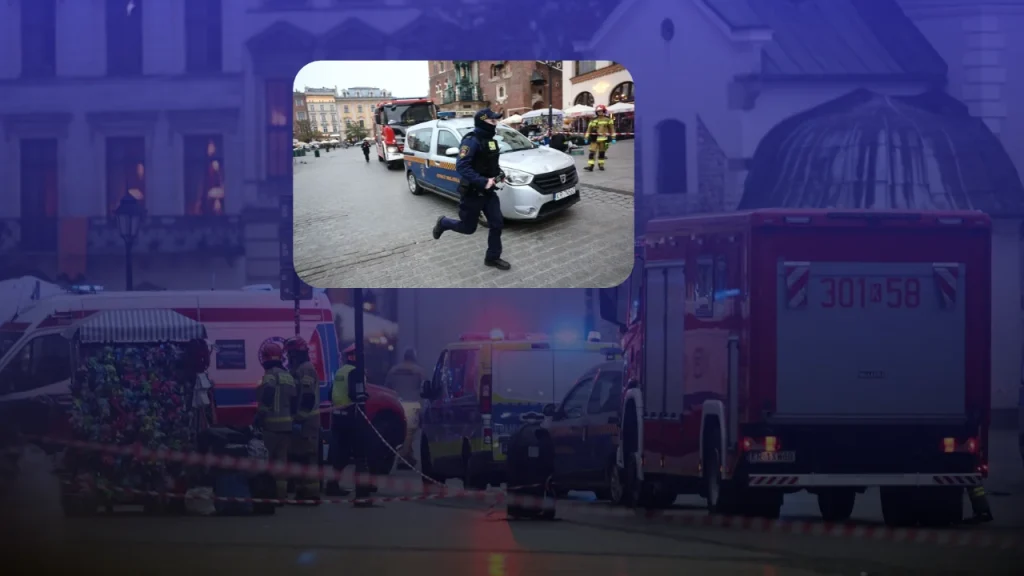
A gunman drove into Kraków’s Main Market Square (Rynek Główny) on the afternoon of Saturday, November 7, 2026, and fired at people from his car. Six people were killed and at least 15 others were injured. Police shot and detained the suspect, a Polish citizen reported as 24 or 25 years old, and he is in hospital in serious condition.
Hours later, Prime Minister Donald Tusk said three more bodies, two women and one man, had been found at a house connected to the suspect in Ostrowiec Świętokrzyski. Tusk said there were strong indications they were members of the suspect’s immediate family. Their identities and causes of death have not been officially established.
This article sets out what Polish authorities have confirmed, what is still unknown, and which provisions of Polish law may apply.
Kraków Mass Shooting: Quick Facts
| Detail | Latest verified information |
| Incident | Mass shooting in central Kraków |
| Date | Saturday, November 7, 2026 |
| Approximate start | About 3:00 p.m. local time |
| Primary location | Main Market Square (Rynek Główny), Kraków, Poland |
| Other affected locations | Area around Sławkowska Street; Plac Wszystkich Świętych (tram, Line 1) |
| Killed in the public shooting | 6 (4 women and 2 men) |
| Injured | At least 15; the Prime Minister’s briefing counted 16 including the wounded suspect |
| Police officers hurt | 2 wounded; one reported in critical condition |
| Suspect | Polish citizen, reported as 24–25 years old; name not officially released |
| Suspect’s condition | Shot by police, detained, hospitalized in serious condition |
| Reported weapon | Rifle reported as AR-15-style; exact model not confirmed |
| Additional bodies | 3 found at a property in Ostrowiec Świętokrzyski |
| Reported ideology | Interior Minister: preliminary indications of “very radical,” far-right views |
| Investigating bodies | Kraków police and prosecutors, Internal Security Agency, Military Counterintelligence Service |
| National mourning | November 8–9, 2026 |
| Kraków city mourning | November 8–11, 2026 |
| Status | Criminal investigation ongoing; no completed charging decision announced |
Where Did the Kraków Main Market Square Shooting Happen?
The attack began in Rynek Główny, the historic Old Town square and one of the largest medieval market squares in Europe. Defence24 reported that the suspect entered the square in a black Subaru from Sławkowska Street.
Police and city accounts show the shooting was not confined to one spot. The gunman moved by car through parts of the central area and fired at several points. Kraków’s transport operator confirmed that a Line 1 tram near Plac Wszystkich Świętych was hit and its driver’s cabin window shattered. The driver and passengers were not hurt.
Timeline: How the Kraków Shooting Unfolded on November 7, 2026
3:00:15 p.m. – First emergency report. National Police Chief Marek Boroń said the first report reached the emergency system at about 3:00:15 p.m. Around 40 calls followed.
About 3:03 p.m. – Police exchange fire with the suspect. Officers and the gunman exchanged fire roughly three minutes after the first report.
Suspect keeps firing, then is wounded. According to police statements reported by Polish Radio, he fired from his vehicle around the square, reportedly crashed into another vehicle, got out and kept shooting at officers. Police returned fire, wounded him and took him into custody.
About 30 police units respond. Boroń said around 30 police units were deployed, alongside paramedics, firefighters and specialist security personnel. Nearby buildings were evacuated while the vehicle was checked for explosives.
Evening – Six deaths confirmed. Authorities confirmed six dead: four women and two men.
Late Saturday – Three bodies found in Ostrowiec Świętokrzyski. Prime Minister Tusk announced the discovery at the suspect’s home, roughly 150 kilometers from Kraków.
Who Were the Six People Killed in the Kraków Main Market Square Shooting?
Four women and two men died. Polish officials said three of the dead were Polish citizens and one was a British national. Two had not been identified when the government gave its November 7 update.
The Interior Minister said five foreign nationals were among the injured. Reuters reported their nationalities as British, Austrian, Russian, German and Portuguese. Full victim identities had not been released. Out of respect for the families, this article names no one until authorities do.
What Do We Know About the Three Bodies Found at the Kraków Suspect’s Home in Ostrowiec Świętokrzyski?
The deceased are two women and one man. Prime Minister Tusk said there were strong indications they were the suspect’s immediate family. Counter-terrorism units assisted with the search.
Three points need to stay separate:
- Six deaths in Kraków are confirmed as the public attack. Nine bodies have been found across the two locations, but that is not the same as nine confirmed victims of one attacker.
- Responsibility for the three deaths at the home has not been established. Investigators still have to determine when and how those people died.
- The two scenes are being examined together. Authorities have not publicly said whether the deaths occurred before, during or independently of the market-square attack.
Reporting that “the gunman killed nine people” goes beyond what officials have confirmed.
Who Is the Kraków Main Market Square Shooting Suspect?
Authorities say he is a Polish citizen from the Świętokrzyskie region. His age was first reported as 24 and later as 25, which explains why reports differ. His full name has not been released in official briefings, and this article does not name him.
- Criminal record: Polish Radio, citing police, reported no known criminal record. A full background review is still under way.
- Military link: Defence Minister Władysław Kosiniak-Kamysz said publicly that the man “was not and is not a soldier” and has never had anything to do with the army, despite the military-style clothing.
- Clothing and equipment: He wore military-style attire and a bulletproof vest. Additional weapons and ammunition were reportedly found in his vehicle.
- Custody: He remains in hospital under police guard. No formal charges had been announced at the time of writing.
Did the Kraków Gunman Have a Firearms Permit Under Poland’s 1999 Firearms and Ammunition Act?
Reporting based on police information says he held a firearms permit. A permit does not make every weapon in his car lawful, and it does not make an attack lawful. Some early reports suggested weapons may have come from the family home, where the father reportedly held licensed firearms. That has not been confirmed.
Poland regulates guns under the Act of 21 May 1999 on Weapons and Ammunition. Under Article 10, permits are issued for stated purposes such as personal protection, sport, hunting and collecting. Article 15 sets eligibility conditions, including a minimum age of 21, medical and psychological examinations, and the absence of a threat to public order or safety. The Act also sets storage and safekeeping duties.
Investigators will need to establish:
- Which category of permit the suspect held and for which purpose.
- Which firearms his permit covered.
- Whether the rifle used in the attack was registered and lawfully held.
- Whether the other weapons and ammunition in the vehicle were lawfully possessed.
- Whether any storage, safekeeping or transport requirement was breached, including at the family home.
Was the Kraków Shooting Motivated by Far-Right Ideology, According to Interior Minister Marcin Kierwiński?
Interior Minister Marcin Kierwiński said preliminary indications showed the suspect held “very radical” and “ultra-nationalistic” views and was fascinated by far-right ideologies. Prime Minister Tusk called the attack a cruel one and said Poland had not experienced terrorism of this scale and nature before.
Officials stress these are initial assessments. Investigators are reviewing online activity, communications, any manifesto or extremist material, contacts, and whether victims were chosen for who they were or attacked at random. No named extremist group or outside direction has been publicly identified.
Is the Kraków Shooting Legally a Terrorist Offense Under Article 115 §20 of the Polish Penal Code?
Defence Minister Kosiniak-Kamysz called the shooting an “act of terror.” That is a political description. A legal classification is a separate step for prosecutors.
Article 115 §20 of the Polish Penal Code defines a terrorist offense as a prohibited act punishable by a maximum of at least five years’ imprisonment, committed with the aim of:
- seriously intimidating many people;
- compelling a public authority of Poland, another state or an international organization to act or refrain from acting; or
- causing serious disruption to the constitutional system or economy of Poland, another state or an international organization.
The definition also covers threats to commit such an act. Extremist beliefs alone do not satisfy it. Prosecutors must show the required purpose from the evidence. Involvement of the Internal Security Agency fits a case of this seriousness, but it is not a legal finding.
What Polish Penal Code Charges Could the Kraków Suspect Face?
No final charging list has been published. If investigators establish the suspect’s responsibility, these provisions may become relevant:
- Article 148 – Murder. As amended in 2022, §1 carries at least 10 years’ imprisonment, 25 years, or life. §2 raises the minimum to 15 years for aggravated forms, including killing with a firearm or explosives, with particular cruelty, or from motives deserving particular condemnation. §3 applies the §2 penalty to a perpetrator who kills more than one person. Life imprisonment in Poland generally bars conditional release before 25 years have been served (Article 77 §2).
- Articles 13–14 with Article 148 – Attempted murder. Attempted murder is punishable within the same statutory range as murder, which is relevant to the wounded, including the police officers.
- Article 156 – Grievous bodily harm. Applies to injuries that are life-threatening or cause serious, lasting harm.
- Articles 222–223 – Offenses against public officers. Cover attacks on police officers performing their duties.
- Article 263 – Unlawful weapons offenses. Relevant if any weapon was possessed without the required authorization or outside its scope. A valid permit makes this a question of evidence, not an assumption.
- Article 115 §20 – Terrorist offense character. Discussed above. If proven, it can affect classification and sentencing.
- Article 256 – Propagating fascist or other totalitarian systems. Could become relevant if investigators find the suspect produced, stored or spread such material, separate from the shooting itself.
- Article 288 – Destruction of property and Article 35 of the Animal Protection Act of 21 August 1997 – Cruelty to animals. Possibly relevant to the damage to the tram and the shooting of two carriage horses.
- Article 148 for the three deaths at the home. Only if evidence shows the suspect caused them. Their deaths must be examined on their own.
The suspect is presumed innocent under Article 42(3) of the Polish Constitution until a court convicts him.
How Do Criminal Proceedings Work After a Case Like the Kraków Shooting?
Polish prosecutors investigate, and a suspect is formally “presented with charges” under the Code of Criminal Procedure (Article 313). Where the offense carries a heavy penalty, courts can order pretrial detention (Article 258). Questioning depends on the suspect’s medical condition, and a court-ordered psychiatric assessment can follow in serious cases. The legal question of criminal responsibility for the three deaths at the home will be decided on its own evidence.
Can Kraków Shooting Victims and Families Claim Compensation in Poland?
No dedicated compensation scheme for this incident had been announced. General routes under Polish and EU law may be available depending on each person’s situation:
- Court-ordered redress in the criminal case. A convicted offender can be ordered to compensate victims (Article 46 §1 of the Penal Code), and victims can join a civil claim to the criminal case (Article 62 of the Code of Criminal Procedure).
- Civil damages. The Civil Code (Articles 415 and 446) allows claims for harm caused by a wrongful act, including claims by close relatives of a person who died.
- State compensation and victim support. Poland has state compensation for victims of certain intentional violent crimes, and EU Directive 2004/80/EC supports compensation for cross-border victims. Foreign nationals injured in Kraków should contact their embassy or consulate and the Polish victim-support services.
This is general information, not legal advice. Anyone affected should speak with a licensed Polish lawyer.
What Happened to the Two Horses and Carriage Workers in Kraków’s Main Market Square?
Local reporting said shots were fired toward the horse-carriage stand. According to animal-protection group OTOZ Animals, two horses were wounded: one grazed by a bullet and one hit in the leg. Both survived and received veterinary care. Local reports also described injuries among carriage workers, but that count was not separately confirmed in the government briefing. The City of Kraków closed the Main Market Square carriage stand and replacement stands until further notice.
How Did Poland’s Government and the City of Kraków Respond to the Shooting?
National mourning, November 8–9. President Karol Nawrocki announced two days of national mourning. Prime Minister Tusk travelled to Kraków, held crisis meetings and praised the officers, firefighters, medics and members of the public who helped. He urged politicians not to exploit the tragedy or spread unverified claims about motive.
Kraków mourning, November 8–11. Mayor Łukasz Gibała announced city mourning through Wednesday, November 11. Municipal flags are at half-mast or draped in black, city sporting events are cancelled, other city events are suspended, and a virtual condolence book has been opened.
Security elsewhere. Authorities announced added security measures in Warsaw. Poland’s Act of 10 June 2016 on Anti-Terrorist Activities provides the framework for heightened alert levels and coordinated response. Officials did not say another attack was expected.
Is Kraków Safe for Tourists After the Main Market Square Shooting?
Mayor Gibała said Kraków remains open to visitors. Police said the suspect acted alone and that no second attacker was being sought. Visitors should expect closures, cordons and cancelled events around the Old Town, follow police instructions, and rely on official city and police channels rather than unverified social media. Mass shootings of this kind are rare in Poland, which has relatively strict gun regulation.
What Happens Next in the Kraków Shooting Investigation?
- Forensics on the square, the vehicle, the weapons and any digital devices.
- Victim identification and notification of families.
- The Ostrowiec Świętokrzyski house: identifying the three people and establishing causes and times of death.
- Questioning of the suspect once doctors allow it.
- Motive inquiry: online activity, communications and possible accomplices.
- Charging decisions by prosecutors, including whether terrorism provisions apply.
Related AllAboutLawyer Coverage
These are separate U.S. incidents with no reported connection to Kraków. They show how investigators separate confirmed facts from early reports in developing shooting cases.
- Erie PA Shooting: Nine Reported Dead, Including Two Children
- Appleton Shooting Multiple Dead On South Hemlock Lane
- Butler PA Shooting, 2 Injured, Police Track Suspect Vehicle
Kraków Main Market Square Shooting: Frequently Asked Questions
How many people were killed in the Kraków Main Market Square shooting?
Six people were killed: four women and two men. Three more bodies were found at a property connected to the suspect in Ostrowiec Świętokrzyski, but the circumstances of those deaths have not been established.
How many people were injured in the Kraków shooting?
At least 15 people were injured. Prime Minister Tusk’s briefing counted 16 including the wounded suspect. Two police officers were among the wounded, one critically.
Who is the Kraków shooting suspect?
A Polish citizen reported as 24 or 25 years old from the Świętokrzyskie region. His full name has not been released in official briefings.
Is the Kraków gunman still alive?
Yes. Police shot and detained him, and he is hospitalized in serious condition under police custody.
Were the three bodies at the Ostrowiec Świętokrzyski home killed by the Kraków suspect?
Not established. Tusk said they were believed to be immediate family, but identities and causes of death were unconfirmed.
Was the Kraków attack motivated by far-right ideology?
Interior Minister Kierwiński said preliminary indications pointed to far-right, ultra-nationalist views. Prosecutors have not announced a confirmed motive.
Has Poland officially charged the Kraków suspect with terrorism?
No. The Defence Minister called it an act of terror, but no formal classification under Article 115 §20 of the Penal Code had been announced.
Did the Kraków suspect have a firearms license?
Reports based on police information say he held a firearms permit. Whether every weapon was lawfully held is under investigation.
What penalty can murder carry under Article 148 of the Polish Penal Code?
At least 10 years, 25 years, or life imprisonment under §1; at least 15 years, 25 years, or life under §2 and §3 for aggravated forms, including use of a firearm or killing more than one person.
Were the tram driver and passengers hurt in the Kraków shooting?
No. A Line 1 tram’s cabin window was shattered by gunfire, but the driver and passengers were reported unharmed.
Did the Kraków gunman have accomplices?
Police said he acted alone. Prosecutors are still checking whether anyone assisted him or knew of his plans.
Can foreign victims of the Kraków shooting claim compensation?
Possibly, through Polish court proceedings, civil claims and state compensation schemes, and through EU cross-border mechanisms. They should contact their consulate and a Polish lawyer.
Bottom Line: What Is Confirmed and What Is Not in the Kraków Shooting
Confirmed: six people were killed and at least 15 injured in Kraków’s Main Market Square on November 7, 2026. Police shot and detained the suspect, who survived. Three further bodies were found at a property in Ostrowiec Świętokrzyski, and officials believe they were his immediate family.
Not yet established: the motive, whether the attack meets the legal definition of terrorism, how the weapons were obtained, and how the three people at the home died. Until prosecutors publish findings, the six public deaths and the three deaths at the home should be treated as separate questions.
Sources and Official Legal References
Polish government and local authorities
- Prime Minister’s Office – November 7 briefing on the Kraków tragedy
- City of Kraków – official shooting update
- City of Kraków – mourning period, flags and cancelled events
- City of Kraków – closure of horse-carriage stands
Police, prosecution and news reporting
- Polish Radio – Poland in shock after six killed, 16 injured in Kraków
- Radio Kraków – prosecutors examine whether the attacker acted alone
- Associated Press – Polish gunman who killed six has ultranationalistic views, authorities say
- Reuters – Poland in shock after six die in Kraków shooting
- Anadolu Agency – Interior Minister says attacker may have been influenced by far-right ideology
- Defence24 – Mass shooting in Poland: six killed and 15 injured in Kraków attack
Polish criminal and firearms law
- Polish Penal Code (Sejm legal database)
- Polish Ministry of Interior – Penal Code, Article 115 §20
- Act on Weapons and Ammunition – official legal text
- UNODC – Poland Penal Code, English translation
AllAboutLawyer.com is an independent legal information website, not a law firm. This article is for general information only and is not legal advice. The suspect is presumed innocent unless convicted, and no unconfirmed motive or responsibility for the three deaths at his home should be treated as established fact.
Researched and written by Israr Ahmad, legal content researcher and founder of AllAboutLawyer.com. All facts verified against official Polish Prime Minister’s Office and City of Kraków announcements, police and prosecution statements as reported by Polish Radio and Radio Kraków, and the official texts of the Polish Penal Code and the Act on Weapons and Ammunition, as of November 8, 2026. Last Updated: November 8, 2026.
About the Author
Israr Ahmad is a legal content researcher with 4+ years of experience covering class action settlements and consumer rights cases. He has researched and published coverage of 2,500+ settlements using verified court records, settlement administrator filings, and government sources. Learn more about Israr.