
SS United States Sinking Lawsuit, Judge Denies Emergency Bid, Case Continues
On November 6, 2026, U.S. District Judge M. Casey Rodgers denied, without prejudice, an emergency request to stop the SS United States from being towed and sunk off Florida’s Panhandle. She pointed to the lack of a verified complaint or sworn affidavit and to the missing bond proposal. The denial was about the emergency filing. It was not a final ruling on whether the Army Corps of Engineers followed federal law. A renewed motion with an affidavit was filed the same day, and as of November 8 the county’s announced schedule had not changed.
Key Facts at a Glance
- Case: SS United States Preservation Foundation v. U.S. Army Corps of Engineers, et al., reported as No. 3:26-cv-05339-MCR-HTC
- Court: U.S. District Court, Northern District of Florida, Pensacola Division
- Judge: M. Casey Rodgers
- Filed: November 3, 2026 (emergency motion filed November 4)
- Defendants (as reported): the Army Corps of Engineers, two Corps officials, the acting Secretary of the Navy and Okaloosa County, Florida
- Main claims: violations of the National Environmental Policy Act (NEPA) and the National Historic Preservation Act (NHPA), reportedly with an Endangered Species Act claim mentioned in a footnote
- Relief sought: set aside the Corps’ permit modification and finding of no significant impact, and bar the tow and sinking until the agency complies
- Status: first emergency motion denied November 6; renewed motion filed; outcome not confirmed in the reporting reviewed
- Planned dates: tow from Mobile, Alabama on November 9; sinking on November 12, weather permitting
What Happened: Timeline
- November 3, 2026: The SS United States Preservation Foundation sues in federal court in Pensacola.
- November 4: The group files an emergency motion for a temporary restraining order (TRO) and preliminary injunction.
- November 6: Judge Rodgers denies the TRO motion without prejudice.
- November 6 (later): The foundation files a new TRO motion and an affidavit from co-founder Carlos Camacho Jr.
- November 7: Local reports still describe the renewed request as undecided. Some outlets reported no change to the schedule.
- November 9 (planned): Tow out of Mobile.
- November 12 (planned): Sinking about 22 nautical miles southwest of Destin-Fort Walton Beach, starting around 10 a.m. per the county.
Why the Judge Denied the First Emergency Request
A TRO is an extraordinary remedy, and federal courts expect the person asking for one to back up the facts with sworn evidence. Rule 65 of the Federal Rules of Civil Procedure allows a TRO only when specific facts shown by affidavit or a verified complaint clearly demonstrate immediate and irreparable harm.
According to reporting, Judge Rodgers found two problems:
- No sworn facts. The docket had no verified complaint or affidavit swearing to the truth of the facts in the complaint and motion.
- No workable bond. Rule 65(c) requires the party seeking an injunction to post security to cover costs the other side may suffer if the injunction turns out to be wrongful. The judge noted the obvious expense of keeping a 990-foot vessel berthed, moored and docked, and said any new TRO motion must propose a bond supported by a reasonable factual basis.
Because the denial was without prejudice, the foundation was free to try again. That is why the renewed motion matters. A denial for missing paperwork says nothing about whether the underlying NEPA and NHPA claims are strong.
The Legal Claims Explained
1. National Environmental Policy Act (NEPA)
NEPA, 42 U.S.C. § 4321 and following, requires federal agencies to consider environmental effects before approving major federal actions. For actions that may significantly affect the environment, the agency prepares a full environmental impact statement (EIS). If it concludes the effects are not significant, it can instead issue an environmental assessment and a finding of no significant impact (FONSI).
The foundation argues the Corps should have prepared a full EIS. Its central concern is zinc chromate primer applied when the ship was built. Its expert estimate is roughly 59,000 pounds, a figure the filing reportedly says comes from historical specifications and modeled surface area rather than direct measurement. The primer contains hexavalent chromium. The foundation says testing found chromium in sampled coatings, and that the Corps predicted minimal harm despite uncertainty about how much contaminant remains and how fast it could be released.
Okaloosa County has said the project meets applicable standards and has previously argued that the chromium converts to a less harmful form in the marine environment. The county also reports it removed fuel, wiring and other hazardous materials during the roughly 20 months the ship spent in Mobile.
Why NEPA cases are hard to win. NEPA is a procedural statute. It requires agencies to take a “hard look” at environmental effects but does not require a particular outcome. In Seven County Infrastructure Coalition v. Eagle County (2025), the U.S. Supreme Court emphasized that courts should give substantial deference to agencies’ NEPA determinations. A challenger usually must show the agency’s analysis was unreasonable or incomplete, not simply that reasonable people could disagree.
2. National Historic Preservation Act (NHPA), Section 106
Section 106 of the NHPA, now codified at 54 U.S.C. § 306108, requires federal agencies to consider the effects of their undertakings on historic properties and to consult with interested parties. The implementing rules are at 36 C.F.R. Part 800. Section 106 is also procedural: it requires a process, not preservation.
The foundation alleges the Corps’ historic review was incomplete and that the county kept removing historic features, including funnels, the radar mast, the last propeller and portholes, while that review was still open. A National Park Service historian has described the ship as exceptionally important for its hull design and propulsion engineering.
The county and supporters counter that the plan includes a land-based museum, funded by roughly $10 million allocated for cleaning, preparation and interpretation, to preserve the ship’s story.
Special Rules for National Historic Landmarks
The SS United States is a designated National Historic Landmark. Section 110(f) of the NHPA, 54 U.S.C. § 306107, asks federal agencies to plan to the maximum extent possible to minimize harm to landmarks their undertakings may directly and adversely affect. Public reporting does not say whether the complaint relies on this provision, so readers should check the filed complaint for the exact claims.
3. Administrative Procedure Act (APA)
Challenges to federal permits like this are brought under the APA, 5 U.S.C. § 706(2)(A), which lets courts set aside agency action that is arbitrary, capricious, an abuse of discretion or otherwise not in accordance with law. The question is not whether the court would have made the same decision, but whether the agency examined the relevant data and gave a rational explanation.
4. Endangered Species Act (ESA)
Reporting indicates a footnote in the motion says the complaint also alleges ESA violations. Section 7 of the ESA, 16 U.S.C. § 1536, requires federal agencies to ensure their actions do not jeopardize listed species. Details of this claim have not been widely reported.
Other Federal Laws That Frame the Project
These laws are not all part of the lawsuit, but they explain why the Corps is involved at all:
- Rivers and Harbors Act, Section 10 (33 U.S.C. § 403) and Clean Water Act, Section 404 (33 U.S.C. § 1344): the Corps regulates structures and fill placed in navigable waters, which is the usual route for artificial reef permits.
- National Fishing Enhancement Act of 1984 (33 U.S.C. § 2101 and following): sets national standards for artificial reefs, including that they be sited and constructed to enhance fisheries and minimize harm.
- Marine Protection, Research, and Sanctuaries Act (33 U.S.C. § 1401 and following): the “ocean dumping” law, which is why EPA’s role in vessel reefing matters. The Conservancy says EPA did not oppose the project.
- EPA and MARAD vessel-reefing guidance: federal best-practice guidance on cleaning vessels before they are sunk as reefs.
The Legal Test for an Injunction
In federal court, a party seeking a TRO or preliminary injunction must generally show, under Winter v. Natural Resources Defense Council, 555 U.S. 7 (2008):
- A likelihood of success on the merits
- A likelihood of irreparable harm without relief
- That the balance of equities tips in its favor
- That an injunction serves the public interest
The foundation will argue that sinking is irreversible, so harm is irreparable by definition. The defendants will point to cost, the Corps’ finding, the delay already built into the project, and the public interest in completing a reef the county has spent years preparing.
Why This Is the Second Court Loss for Save-the-Ship Efforts
A different group, the New York Coalition to Save the Steam Ship United States, sued in 2025. Judge Rodgers dismissed that case on August 6, 2025, ruling the group lacked standing. She described its claimed injury as manufactured and self-inflicted.
Standing comes from Article III of the Constitution and cases such as Lujan v. Defenders of Wildlife, 504 U.S. 555 (1992): a plaintiff must show a concrete injury, caused by the defendant, that a court can fix. A dismissal for lack of standing is not a ruling that the project is environmentally safe. It means the court never reached the merits.
The new plaintiff is a different organization, with different arguments focused on the Corps’ approvals. Whether it has standing and can win on the merits are separate questions the court has not yet decided in a final ruling.
Background: How the Ship Got Here
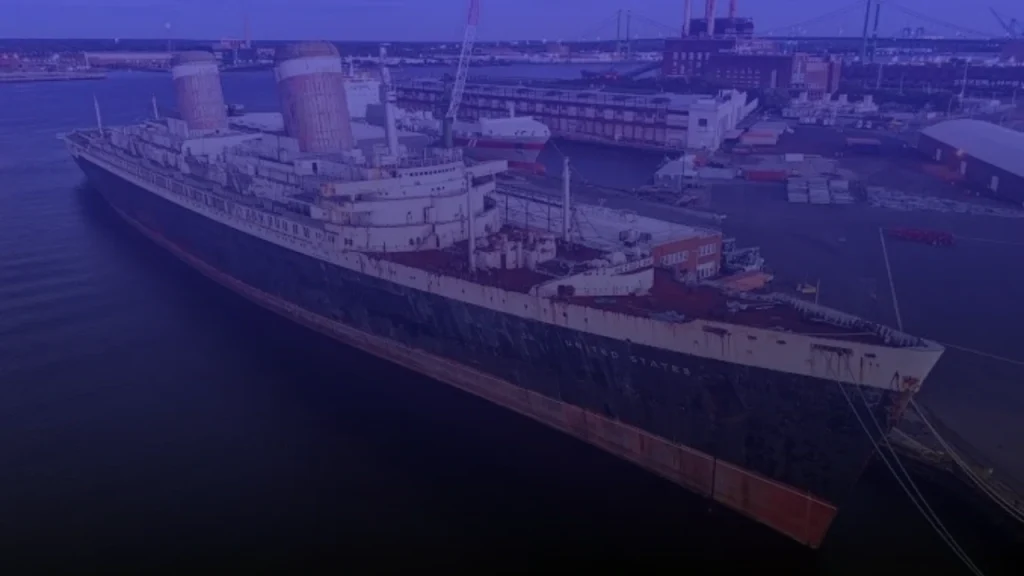
The SS United States was built in Newport News, Virginia, launched in 1951 and held the Blue Riband for the fastest transatlantic crossing by a passenger liner. It left commercial service in 1969 and sat for decades at Pier 82 in Philadelphia. After a dispute with its landlord, the SS United States Conservancy sold the ship to Okaloosa County for $1 million. The ship moved to Mobile, Alabama in 2025 for remediation.
The county plans to sink the 990-foot hull using controlled flooding, without explosives, so it settles upright in roughly 180 feet of water. County officials describe it as the world’s largest artificial reef and expect it to become a major dive destination.
Both Sides of the Debate
Supporters of the reefing plan say: the ship was deteriorating, preservation efforts ran out of money and time, the county completed cleanup and received federal approval, and a reef plus a museum is a practical, dignified outcome.
Opponents say: the Corps underestimated contamination risk, a full environmental review was required, historic review was incomplete while features were being stripped, and better alternatives existed. The foundation says it does not oppose the county’s reef program, only the choice of this ship.
What Could Happen Next
- The renewed TRO is granted: the tow or sinking could be paused while the court considers further relief. This would require the judge to find the legal test met and set an adequate bond.
- The renewed TRO is denied: the ship could leave Mobile on schedule. The lawsuit could technically continue, but the practical remedy of stopping the sinking would be gone once the ship is on the seafloor.
- Appeal: an emergency appeal to the Eleventh Circuit is possible after a ruling, though appellate courts rarely overturn TRO and injunction decisions on short notice.
- Mootness: after sinking, the court may treat requests to block it as moot, though other claims could theoretically remain.
All dates remain subject to weather and any court order.
What This Means for Readers
If you follow environmental or preservation litigation, this case shows how often these fights are decided on procedure: standing, sworn evidence, bonds and deference to agencies. Strong environmental or historical arguments can still lose an emergency request if the filing is not built to meet federal court rules.
This is not a consumer class action. There is no settlement fund or claim form tied to this case.
What Is Hexavalent Chromium and Why Does It Matter?
Hexavalent chromium, or chromium(VI), is a form of chromium that the U.S. EPA treats as a known human carcinogen when inhaled and that is toxic to aquatic life at sufficient concentrations. It is the compound the foundation says is present in the ship’s original primer.
The scientific dispute is about what happens after the hull is underwater. The county’s position is that chromium(VI) generally converts to the far less harmful chromium(III) in marine conditions, while the foundation argues the Corps relied on uncertain estimates of how much is present and how fast it could leach. A court reviewing the Corps’ decision under the APA would ask whether the agency examined this question reasonably, not which side’s science is better.
Key Legal Terms Explained
- Temporary restraining order (TRO): a short-term emergency order that preserves the status quo, often issued before the other side can fully respond.
- Preliminary injunction: a longer court order that stays in place while the case is decided, issued after a hearing.
- Without prejudice: the ruling does not bar the party from filing again.
- Verified complaint / affidavit: a filing sworn under penalty of perjury, which courts rely on for emergency relief.
- Bond (Rule 65(c)): money the requesting party posts to cover the other side’s losses if the injunction was wrongly granted.
- Standing: the legal right to sue, which requires a concrete injury traceable to the defendant.
- Environmental impact statement (EIS): the detailed review NEPA requires for actions that significantly affect the environment.
- Finding of no significant impact (FONSI): an agency’s conclusion that an environmental assessment shows no need for a full EIS.
- Arbitrary and capricious: the APA standard for striking down an agency decision that lacks a rational basis.
- Moot: a claim a court can no longer remedy because events have already happened, such as the ship being sunk.
How to Follow the Case
The case is reported as No. 3:26-cv-05339-MCR-HTC in the Northern District of Florida. Federal dockets are available through PACER, and many filings in high-profile cases appear on CourtListener’s RECAP archive. Okaloosa County’s official project announcements are the best source for tow and sinking updates.
Frequently Asked Questions
Did a judge stop the SS United States from being sunk?
No. On November 6, 2026, Judge M. Casey Rodgers denied the first emergency request without prejudice. A renewed request was filed afterward, and its outcome had not been confirmed in the reporting reviewed as of November 8.
Is the lawsuit over?
No. The emergency denial did not decide the main claims. The challenge to the Army Corps’ approvals remains pending unless the court rules otherwise.
What does “denied without prejudice” mean?
It means the judge rejected the request as filed but allowed the party to submit a corrected or renewed request.
Who is suing?
The SS United States Preservation Foundation, a nonprofit that describes itself as a group of veterans and seafarers.
Who is being sued?
The Army Corps of Engineers, two Corps officials, the acting Secretary of the Navy and Okaloosa County, as reported.
What laws does the lawsuit rely on?
The National Environmental Policy Act, the National Historic Preservation Act and the Administrative Procedure Act, with a reported Endangered Species Act claim.
What is the environmental concern?
Zinc chromate primer that contains hexavalent chromium. The foundation estimates about 59,000 pounds were used and warns of contamination risks. The county says the project meets environmental standards, and the Corps found no significant impact.
Why was the earlier lawsuit dismissed?
In August 2025, Judge Rodgers dismissed the New York Coalition’s case for lack of standing. That ruling did not decide whether the sinking is environmentally safe.
When will the ship be sunk?
The county plans to tow it from Mobile on November 9 and sink it on November 12, weather permitting, about 22 nautical miles southwest of Destin-Fort Walton Beach.
Could the sinking still be delayed?
Yes, if the court grants emergency relief or weather interferes. Otherwise the announced schedule stands.
Is there a settlement or compensation available?
No. This is a challenge to federal permits, not a damages or class action case.
Why do courts often defer to agencies in NEPA cases?
NEPA requires a process, not a result, and the Supreme Court’s 2025 decision in Seven County Infrastructure Coalition v. Eagle County stressed substantial deference to agency judgments about what environmental review is needed.
Can the sinking be undone after it happens?
Practically, no. That is why the foundation sought emergency relief first, and why a court may treat requests to block the sinking as moot afterward.
Where can I read the court filings?
Use the case number 3:26-cv-05339-MCR-HTC on PACER or CourtListener’s RECAP archive.
Sources and Further Reading
- Maritime Executive, “Lawsuit Seeks to Stop Planned Sinking of S.S. United States” (Nov. 6, 2026)
- FOX10/WALA, “SS United States set to become artificial reef in Okaloosa County after last-ditch challenge fails” (Nov. 6-7, 2026)
- Cruise Hive, “Court Rejects Last-Minute Bid to Stop SS United States Sinking” (Nov. 7, 2026)
- The Scuba News, “SS United States Artificial Reef Lawsuit: Judge Rejects Bid” (Nov. 7, 2026)
- Philadelphia Inquirer, “Stop the sink? People are still fighting, and failing, to ‘save’ the SS United States” (Nov. 6, 2026)
- Get The Coast, coverage of the August 2025 dismissal
- PhillyVoice, “When will the SS United States be sunk?”
- Okaloosa County official project announcements
- Federal Rules of Civil Procedure, Rule 65; 42 U.S.C. § 4321 et seq.; 54 U.S.C. § 306108; 5 U.S.C. § 706
Disclaimer: This article is for general information only and is not legal advice. AllAboutLawyer.com is not a law firm, and nothing here creates an attorney-client relationship. For advice about a specific legal matter, consult a licensed attorney.
About the Author
Israr Ahmad is a legal content researcher with 4+ years of experience covering class action settlements and consumer rights cases. He has researched and published coverage of 2,500+ settlements using verified court records, settlement administrator filings, and government sources. Learn more about Israr.