
Novartis Tasigna (Nilotinib) Products Liability Lawsuit, Full Case Breakdown Atherosclerosis Claims
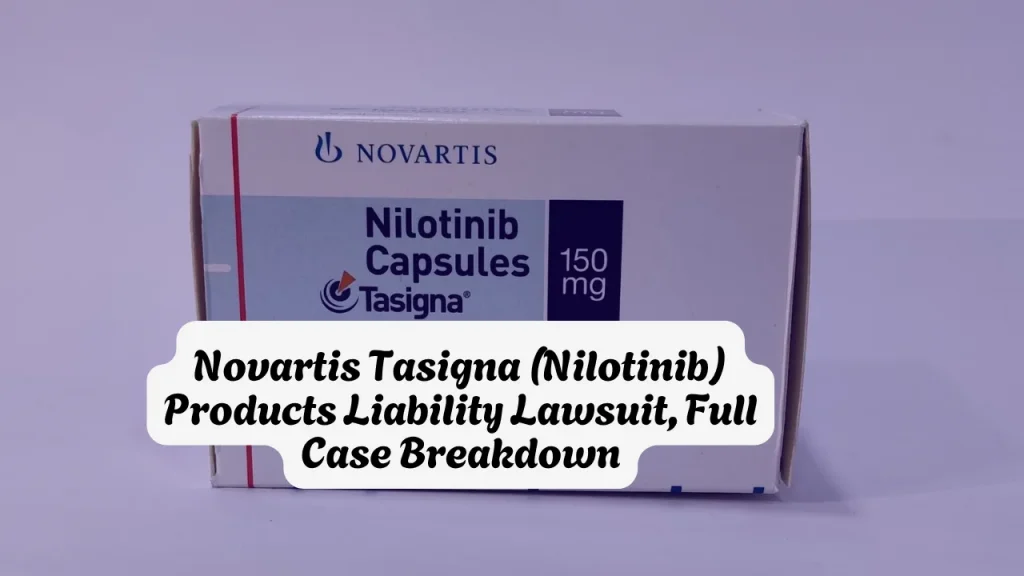
The Tasigna (Nilotinib) Products Liability Litigation is a federal Multidistrict Litigation (MDL) in which plaintiffs allege that Novartis Pharmaceuticals Corporation failed to appropriately warn that use of Tasigna may cause severe atherosclerotic injuries, and that Novartis concealed knowledge of Tasigna’s unreasonably dangerous risks from patients, consumers, and the U.S. medical community. As of April 1, 2025, 39 cases had been filed in the federal MDL, with 36 still pending, and the New Jersey state court Multicounty Litigation (MCL) remains active with discovery extended through December 31, 2025. No global settlement has been reached as of April 2026.
Note: The Tasigna litigation consists of individually filed personal injury lawsuits consolidated into a Multidistrict Litigation (MDL) — not a class action. Each plaintiff controls their own case and recovery. This article covers the active MDL proceedings as of April 2026.
Quick-Facts
| Field | Detail |
| Plaintiffs | Individual patients and wrongful death families across the U.S. |
| Defendant | Novartis Pharmaceuticals Corporation |
| Case Name | In re: Tasigna (Nilotinib) Products Liability Litigation |
| Federal MDL Number | MDL No. 3006 |
| Federal Court | U.S. District Court for the Middle District of Florida |
| Presiding Judge | Hon. Roy B. “Skip” Dalton, Jr., U.S. District Judge |
| NJ State MCL Court | New Jersey Superior Court, Bergen Vicinage — Judge Gregg A. Padovano |
| Date MDL Established | August 10, 2021 |
| Legal Claims | Failure to warn, negligence, strict products liability, wrongful death |
| Damages Sought | Compensatory and punitive damages — amounts vary per individual case |
| Current Stage | Active MDL and MCL proceedings; discovery ongoing; no bellwether trial date confirmed |
| Next Scheduled Date | NJ MCL discovery extended through December 31, 2025; federal MDL next dates TBD — check PACER for updates |
| Settlement Status | No global settlement reached as of April 21, 2026 |
| Last Updated | April 21, 2026 |
Case Timeline
| Date | Event |
| 2007 | FDA approves Tasigna (nilotinib) for treatment of Philadelphia chromosome-positive chronic myeloid leukemia (CML) in the U.S. |
| 2010 | Post-marketing reports begin describing patients developing severe, accelerated atherosclerosis-related conditions on Tasigna |
| April 2013 | Health Canada issues public warning about Tasigna’s link to atherosclerosis; Novartis updates Canadian label — no equivalent U.S. warning issued |
| 2015 | U.S. Department of Justice: Novartis agrees to pay $390,000,000 to resolve charges of paying illegal kickbacks to pharmacies promoting Tasigna to Medicare and Medicaid patients |
| March 2016 | Family of California patient Dainis Lauris files the first major wrongful death lawsuit against Novartis, Lauris et al. v. Novartis AG et al., Case No. 16-393 — Novartis settles out of court for an undisclosed amount |
| February 2021 | Virginia man files suit in New Jersey Superior Court alleging atherosclerosis, coronary artery disease, peripheral vascular disease, and stroke caused by Tasigna |
| April 6, 2021 | New Jersey Supreme Court designates all pending and future NJ Tasigna lawsuits as Multicounty Litigation (MCL), assigned to Bergen County Superior Court |
| August 10, 2021 | U.S. Judicial Panel on Multidistrict Litigation establishes federal MDL No. 3006 before Judge Roy B. Dalton, Jr. in the Middle District of Florida |
| August 12, 2021 | NJ MCL court appoints a Special Discovery Master to oversee discovery disputes |
| April 2023 | NJ MCL cases reassigned to Superior Court Judge Gregg A. Padovano, Bergen Vicinage |
| April 1, 2025 | 39 federal MDL cases filed; 36 still pending — no bellwether trial dates set |
| February 25, 2025 | Judge Padovano extends NJ MCL discovery through December 31, 2025 |
| April 2026 | MDL and MCL both ongoing — no global settlement reached |
What Is the Novartis Tasigna Lawsuit About? In re: Tasigna (Nilotinib) Products Liability Litigation, MDL No. 3006
The central allegation across all Tasigna lawsuits is that Novartis failed to warn U.S. patients and their doctors that Tasigna may cause severe, accelerated, and irreversible atherosclerosis-related conditions — including heart attack, stroke, peripheral vascular disease, and limb amputation. Atherosclerosis is the hardening and narrowing of arteries caused by a buildup of fat, cholesterol, and other substances. In Tasigna patients, plaintiffs allege this process occurred at a dramatically accelerated rate — far faster than it would in the normal aging process.
The crux of the failure-to-warn claims is that Novartis warned Canadian doctors and patients about Tasigna’s link to atherosclerosis for years through prominent “Serious Warnings and Risks” labeling — while the equivalent warning was notably absent from the U.S. label. Plaintiffs allege that Novartis was aware of the cardiovascular dangers in the U.S. market and chose not to disclose them, allowing American patients to take the drug without informed consent about its true risks. This disparity between Canadian and U.S. labeling is a central pillar of every case in the MDL and MCL. For broader context on how pharmaceutical failure-to-warn cases develop, our Guide to Drug Products Liability Litigation explains the legal standard courts apply to prescription drug manufacturers.
The U.S. Judicial Panel on Multidistrict Litigation found that all actions share factual questions arising from Novartis’s alleged failure to warn and concealment of known risks, as well as common issues of general causation and Tasigna’s labeling and regulatory history — which is why the cases were centralized together for coordinated pretrial proceedings rather than litigated separately in dozens of different courts across the country.
Who Are the Parties Involved?
Plaintiffs — Individual patients and families
Plaintiffs are U.S. patients who were prescribed Tasigna (nilotinib) to treat Philadelphia chromosome-positive chronic myeloid leukemia (CML) and subsequently suffered cardiovascular injuries that they allege were caused or accelerated by the drug. Many CML patients who took Tasigna and developed atherosclerosis have died, and families of those victims have pursued wrongful death lawsuits against Novartis. Each plaintiff maintains their own individual case and their own attorney — unlike a class action, where one law firm represents everyone.
Defendant — Novartis Pharmaceuticals Corporation
CarGuard Administration, commonly known as CarGuard, is a Kansas-based company — [Note: Novartis Pharmaceuticals Corporation is a U.S. subsidiary of Swiss pharmaceutical giant Novartis AG, one of the world’s largest drug manufacturers. Novartis developed and markets Tasigna (nilotinib), which received FDA approval in 2007 for treating CML. Novartis has denied wrongdoing throughout the litigation.]
Related article: NPCA vs. Interior Department Mojave Mine Lawsuit, Full Case Breakdown
What Is at Stake in This Lawsuit?
Plaintiffs in the Tasigna MDL and MCL are seeking compensation for some of the most severe injuries in pharmaceutical litigation. The main injuries claimed in Tasigna lawsuits include atherosclerosis, heart attack, stroke, peripheral vascular disease, and amputations of extremities. These are permanent, life-altering conditions — many of which required repeated hospitalizations, surgical interventions, and long-term disability care.
The legal theories pursued against Novartis include failure to adequately research Tasigna’s atherosclerosis side effects during development, failure to properly investigate post-market adverse event reports, and withholding critical safety information from patients and doctors in the United States. If plaintiffs succeed, Novartis could face substantial compensatory damages covering medical expenses, lost income, pain and suffering, and — in wrongful death cases — damages on behalf of surviving family members. Courts may also award punitive damages — additional monetary penalties designed to punish a defendant for willful or reckless misconduct.
A notable early case involved Dainis Lauris, whose family alleged he died after suffering near-total arterial blockage in certain areas of the body from atherosclerosis linked to taking Tasigna. Court filings showed Novartis warned of atherosclerosis dangers in Canada but not in the U.S. Novartis settled that case out of court, but the terms were never disclosed.
What Happens Next in This Case?
The Tasigna litigation is now in its most active phase in both federal and state courts. In New Jersey, Judge Padovano issued an order on February 25, 2025, extending discovery in the MCL through December 31, 2025. Discovery — the process by which both sides exchange evidence, documents, and expert opinions — is a critical stage that will shape whether cases settle or go to trial.
In the federal MDL before Judge Dalton in the Middle District of Florida, as of April 1, 2025, no orders regarding discovery or other pretrial matters appear to have been entered. The federal MDL appears to be in an early organizational stage, with the New Jersey MCL further along procedurally.
Key upcoming stages to watch:
- Bellwether trial selection: TBD — no bellwether trial cases have been publicly selected in the federal MDL as of April 2026. Bellwether trials are test cases that give both sides a realistic picture of how juries value the claims, which typically drives settlement negotiations.
- Expert discovery (Daubert hearings): TBD — courts must rule on which expert witnesses can testify on causation, which is critical in pharmaceutical litigation.
- Global settlement negotiations: TBD — no settlement has been announced. The outcome of early bellwether trials typically triggers serious settlement talks in MDLs of this type.
- Individual case remand: If no global settlement is reached after bellwether trials, individual cases will be sent back to their home courts for trial.
Frequently Asked Questions
1. Who filed the Tasigna lawsuit and why?
Individual patients and families filed lawsuits alleging that Novartis failed to warn them and their doctors that Tasigna could cause atherosclerosis, coronary artery disease, peripheral vascular disease, stroke, and other severe cardiovascular conditions. The earliest major federal lawsuit traces to 2016. Cases were later consolidated into MDL No. 3006 in the Middle District of Florida and an MCL in New Jersey state court.
2. What court is handling this case?
The federal MDL is before Judge Roy B. “Skip” Dalton, Jr., in the U.S. District Court for the Middle District of Florida. The New Jersey state court Multicounty Litigation (MCL) is managed by Superior Court Judge Gregg A. Padovano in the Bergen Vicinage. Both proceedings are active as of April 2026.
3. What is the current status of the Tasigna lawsuit?
As of April 1, 2025, 39 federal MDL cases had been filed with 36 still pending. The NJ MCL discovery was extended through December 31, 2025. No global settlement has been reached as of April 2026, and no bellwether trial dates have been confirmed in the federal MDL.
4. How much are plaintiffs seeking in damages?
Damages vary by individual plaintiff based on injury severity, medical costs, lost income, and pain and suffering. Novartis previously paid an out-of-court settlement for an undisclosed amount in the 2016 Lauris wrongful death case. No public figures have been disclosed in any current MDL or MCL case, and any future global settlement amount will depend on the number of valid claims and bellwether trial outcomes.
5. Can I read the court documents?
Yes. Federal MDL No. 3006 filings are available on PACER at pacer.gov and through CourtListener at courtlistener.com. The official Middle District of Florida case page is at flmd.uscourts.gov. New Jersey MCL case information is available at njcourts.gov.
6. Is the Tasigna lawsuit a class action?
No. No one has organized the Tasigna cases into a single class action lawsuit. Instead, cases are filed individually and consolidated into multidistrict litigation, which allows plaintiffs to choose their own attorney and maintain greater control over their individual case and settlement.
7. Who may qualify to file a Tasigna lawsuit?
You may qualify if you were prescribed Tasigna, experienced serious cardiovascular side effects including atherosclerosis or peripheral artery disease, required medical treatment or hospitalization, and can provide medical documentation linking your injuries to Tasigna use. Families of patients who died from Tasigna-related atherosclerosis complications may qualify to file a wrongful death claim. Consult a pharmaceutical products liability attorney for a free case evaluation.
8. Did Novartis ever warn anyone about these risks?
Yes — but only in Canada. The Canadian packaging prominently warned health professionals in a box entitled “Serious Warnings and Risks” that atherosclerosis-related conditions could result in death and that Tasigna-related peripheral arterial occlusive disease could be severe, rapidly evolving, and may involve more than one site. Plaintiffs allege that equivalent warnings were never issued to U.S. patients or physicians, which forms the core of the failure-to-warn claims in every case.
Sources & References
- Official MDL Court Page: flmd.uscourts.gov — Tasigna MDL No. 3006
- CourtListener Docket: In re: Tasigna (Nilotinib) Products Liability Litigation, MDL No. 3006
- New Jersey Courts MCL Page: njcourts.gov — Tasigna MCL
- U.S. Judicial Panel on Multidistrict Litigation Transfer Order: FindLaw — In re: Tasigna (Nilotinib) Products Liability Litigation (2021)
Prepared by the AllAboutLawyer.com Editorial Team and reviewed for factual accuracy against official court records from the U.S. District Court for the Middle District of Florida, CourtListener, and the New Jersey Courts MCL portal on April 21, 2026. Last Updated: April 21, 2026
Disclaimer: This article is for informational purposes only and does not constitute legal advice. Information about ongoing legal cases is based on publicly available court records and verified public sources. Allegations described in this article have not been proven in court. For advice regarding a particular legal situation, consult a qualified attorney.
About the Author
Israr Ahmad is a legal content researcher with 4+ years of experience covering class action settlements and consumer rights cases. He has researched and published coverage of 2,500+ settlements using verified court records, settlement administrator filings, and government sources. Learn more about Israr.