
Nevada Question 6 Explained, Abortion Rights After the November 2026 Vote
Nevada voters approved Question 6 on November 3, 2026, giving final voter approval to a constitutional amendment protecting abortion until fetal viability and afterward when medically necessary to protect a pregnant patient’s life or health. The new protection is scheduled to take effect November 24, 2026.
Abortion was already legal in Nevada before the election. Existing state law generally allows abortion within the first 24 weeks of pregnancy and afterward when necessary to preserve the patient’s life or health.
Question 6 strengthens that framework by adding an explicit constitutional right.
The measure received approximately 63.5% support in preliminary election results.
The vote does not mean Nevada previously banned abortion, and it does not eliminate all medical regulations.
Nevada Question 6: Quick Facts
| Question | Answer |
| Election date | November 3, 2026 |
| Measure | Question 6 |
| Result | Approved |
| Yes vote | Approximately 63.5% |
| First approval | November 5, 2024 |
| Second approval | November 3, 2026 |
| Scheduled effective date | November 24, 2026 |
| New constitutional section | Article 1, Section 25 |
| Existing abortion law | NRS 442.250 |
| General statutory period | First 24 weeks |
| Later abortions | Permitted to preserve life or health under the statutory standard |
| Parental-notification statute | Subject to a 2026 preliminary injunction |
| Election certification | Separate from reported election result |
Is Abortion Legal in Nevada After Question 6?
Yes. Abortion remains legal in Nevada.
The primary statutory provision is Nevada Revised Statutes § 442.250.
It generally permits abortions performed by qualified physicians during the first 24 weeks of pregnancy.
After the 24th week, the statute allows abortion when the physician has reasonable cause to believe the procedure is necessary to preserve the pregnant patient’s life or health.
The 24-week rule and the new constitutional viability standard should not be treated as identical.
What Is Fetal Viability?
Viability concerns whether a fetus can survive outside the uterus in the circumstances of a particular pregnancy.
It is a medical determination rather than a universal date.
The new constitutional language expressly recognizes the professional judgment of a qualified healthcare practitioner.
Therefore, a reader should not interpret Question 6 as automatically setting one unchanging gestational cutoff for every pregnancy.
What Exactly Did Question 6 Add to Nevada’s Constitution?
The amendment creates Article 1, Section 25 — Fundamental Right to Reproductive Freedom.
The provision protects an individual’s right to obtain abortion care from a qualified healthcare practitioner until fetal viability.
It also protects abortion when needed to safeguard the pregnant patient’s life or health.
Government interference must satisfy a demanding constitutional standard involving a compelling state interest and the least restrictive means.
The amendment defines the applicable compelling interest in terms of protecting or improving the health of the person seeking care in accordance with accepted clinical standards.
Why Does a Constitutional Amendment Matter?
Statutes can ordinarily be changed by the legislature within constitutional limits.
Constitutional protections place additional limits on government action.
Question 6 means that future abortion restrictions must be evaluated against a right expressly recognized in Nevada’s highest state-law document.
That does not mean every existing medical licensing requirement or healthcare regulation disappears.
The constitutional question is whether a particular restriction unlawfully burdens the protected right.
Related article: Supreme Court Assault Weapons Ban Case 2026, Could the Justices Change Gun Laws Nationwide?
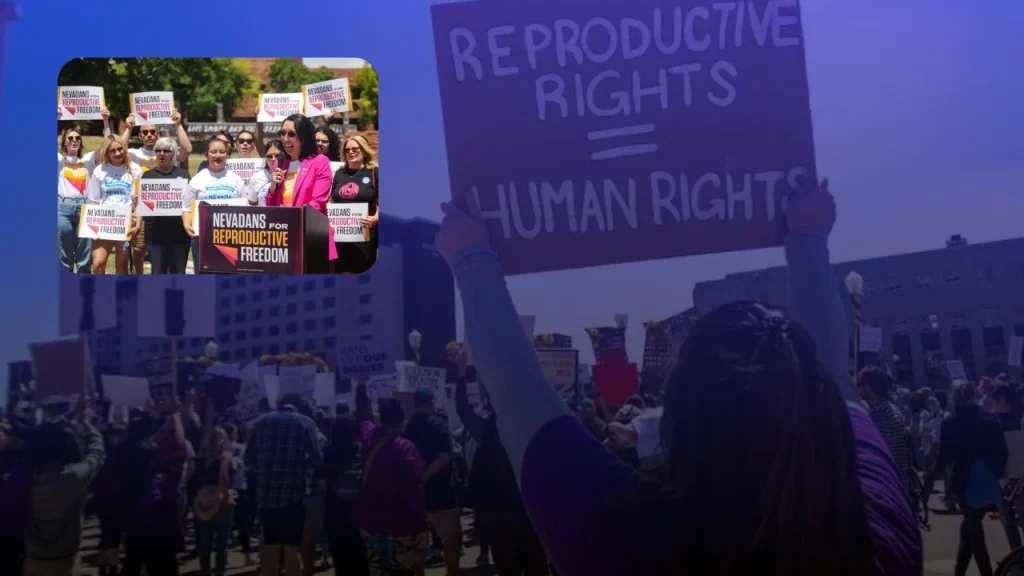
Why Did Nevada Vote on Question 6 Twice?
Nevada has a special process for citizen-initiated constitutional amendments.
Under Article 19, Section 2 of the Nevada Constitution, qualifying initiatives must be approved by voters at two successive general elections before becoming constitutional amendments.
Question 6 first passed on November 5, 2024.
It returned to the ballot on November 3, 2026.
Voters approved it again, completing the two-election requirement.
This is different from Virginia, where the state legislature referred an amendment to voters after two legislative approvals. See Is Abortion Legal in Virginia? The 2026 Amendment Passed, What Changes January 1, 2027 and Can the November 13 Lawsuit Stop It?.
When Does Nevada Question 6 Take Effect?
The Nevada Legislature’s constitutional text identifies November 24, 2026, as the scheduled effective date following voter approval and ratification.
As of November 16, that date is still in the future.
Election projections and preliminary vote totals are not identical to formal certification.
Patients and healthcare providers should continue to consult current statutes and any applicable court orders rather than assume all legal changes became operative on November 3.
What Happens to Nevada’s Existing 24-Week Law?
The 1990 referendum establishing NRS 442.250 remains important.
Question 6 does not expressly delete the statute.
Instead, it establishes a constitutional right that may affect how existing or future regulations are interpreted.
Two potentially different standards must be considered:
| Legal provision | Relevant standard |
| NRS 442.250 | Generally permits abortion within 24 weeks; later care for life or health |
| New Article 1, Section 25 | Protects abortion until viability and afterward for life or health |
If a conflict arises, a court may need to determine how the statute operates under the constitutional protection.
The amendment also does not guarantee that every provider offers care at every gestational stage.
Medical qualifications, facility capabilities and professional standards remain relevant.
Can Nevada Minors Obtain Abortion Without Parental Notification?
Nevada has an unusually important separate legal development.
In 1985, lawmakers enacted parental-notification provisions now codified in NRS 442.255 and 442.2555.
Those provisions were blocked by federal litigation for decades.
In 2025, a federal court removed the longstanding injunction, creating the possibility that the notification requirement could become enforceable.
But on May 28, 2026, the Nevada Supreme Court ruled in Planned Parenthood Mar Monte, Inc. v. State of Nevada, No. 91394, that the challengers were entitled to preliminary relief.
The Supreme Court concluded that they demonstrated a likelihood of success on arguments that the notification and judicial-bypass provisions were unconstitutionally vague.
It reversed the lower court and instructed it to issue a preliminary injunction.
The statute remains in Nevada’s legal code, but the 2026 injunction prevents enforcement while the relevant proceedings continue.
The Supreme Court’s decision was preliminary, not a final judgment resolving every constitutional question.
Does Question 6 Protect Abortion in Medical Emergencies?
Yes.
The amendment expressly protects abortion when needed to protect the pregnant patient’s life or health, including after viability.
Nevada’s existing statute also contains a post-24-week life-or-health exception.
The existence of these protections does not eliminate the need for medical evaluation.
If a patient has serious pregnancy complications, their healthcare team must assess the medical facts, appropriate treatment and applicable legal requirements.
Can Someone From Another State Obtain an Abortion in Nevada?
Nevada’s abortion statute does not create a general residency requirement for patients.
Individuals who live outside Nevada may seek lawful care from qualified providers in the state.
However, the law of the patient’s home state, insurance coverage, travel arrangements and other circumstances may affect practical decisions.
Question 6 does not automatically change abortion restrictions in Idaho, Utah, Texas or other states.
The rules in those jurisdictions remain separate.
Does Question 6 Change Medication Abortion Rules?
The amendment does not alter the FDA’s approval of mifepristone or the federal rules governing medication abortion.
It establishes a state constitutional protection.
The availability of telehealth, medication prescribing and dispensing remains subject to federal and state regulations.
For background, see Mifepristone Supreme Court Ruling Explained, What the Supreme Court Just Decided and What Happens Next.
How Is Nevada Different From Missouri?
Both states have voter-approved constitutional protections, but their recent election histories differ.
Nevada approved the same proposed amendment twice, in 2024 and 2026, as required by its initiative process.
Missouri approved reproductive-freedom protections in 2024 and then rejected a separate proposal to repeal them in 2026.
Read Missouri Amendment 3 Rejected, What Happens to Abortion Rights and Gender-Affirming Care Now? for that distinct outcome.
Nevada Question 6 Timeline
| Date | Development |
| 1990 | Voters approve the statutory abortion framework |
| November 5, 2024 | Question 6 passes first vote |
| May 28, 2026 | Nevada Supreme Court rules on parental-notification injunction |
| November 3, 2026 | Question 6 receives second voter approval |
| November 24, 2026 | Scheduled constitutional effective date |
Frequently Asked Questions
Did Nevada make abortion legal for the first time in 2026?
No. Abortion was already legal under NRS 442.250. The vote adds explicit constitutional protection.
Is abortion legal after 24 weeks in Nevada?
Existing law permits abortion after 24 weeks when the physician reasonably believes it is necessary to preserve the patient’s life or health. The amendment also protects medically necessary care after viability.
Does Question 6 remove parental-notification requirements?
Question 6 does not expressly repeal NRS 442.255. Separately, the Nevada Supreme Court ordered preliminary relief against enforcement of the notification statute in May 2026.
When does the constitutional amendment start?
November 24, 2026, is the scheduled effective date, subject to completion of the applicable ratification process.
Can Nevada lawmakers repeal Question 6 through an ordinary bill?
They cannot simply repeal a constitutional right through ordinary legislation. Any legislation must comply with the constitutional protections in force.
Latest Nevada Abortion Law Update — November 16, 2026
Nevada voters have approved Question 6 for the second time.
The amendment is scheduled to add an express abortion right to the state constitution on November 24.
Existing abortion access remains governed by NRS 442.250 and applicable court orders until the new provision takes effect.
For readers, the key point is that abortion remains legal, while the election strengthens the legal foundation for protecting that access.
Primary Sources
- Nevada Constitution — Article 1, Section 25
- Nevada Revised Statutes Chapter 442 — Abortion Laws
- Nevada Secretary of State — 2026 Election Information
- Nevada Supreme Court — Planned Parenthood Mar Monte v. Nevada, May 28, 2026
- Nevada Constitution — Article 19, Initiative and Referendum
Legal disclaimer: This article provides general legal information, not medical or legal advice. Consult current state law and court orders for individual circumstances.
Last reviewed: November 16, 2026.
Researched by AllAboutLawyer.com — Legal Content Research.
About the Author
Israr Ahmad is a legal content researcher with 4+ years of experience covering class action settlements and consumer rights cases. He has researched and published coverage of 2,500+ settlements using verified court records, settlement administrator filings, and government sources. Learn more about Israr.