
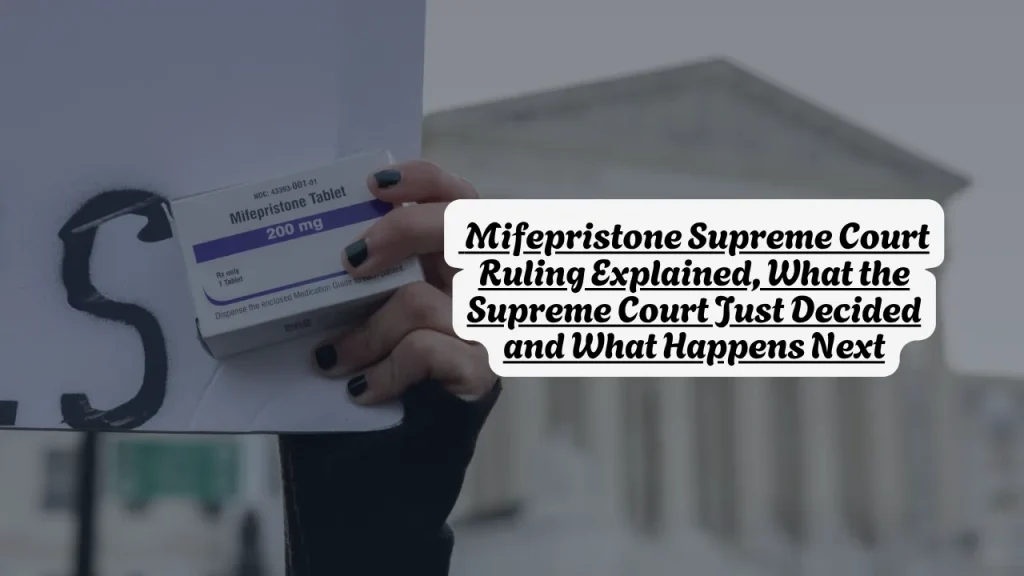
Mifepristone Supreme Court Ruling Explained, What the Supreme Court Just Decided and What Happens Next
Prepared by the AllAboutLawyer.com Editorial Team and reviewed for factual accuracy against official court records, FDA.gov, and reporting from the Associated Press, NPR, and CBS News on May 15, 2026. Last Updated: May 15, 2026
The Supreme Court ruled on May 14, 2026 that mifepristone — the drug used in nearly two-thirds of all U.S. abortions — can continue to be prescribed through telehealth and delivered by mail while a challenge brought by the state of Louisiana against the Food and Drug Administration proceeds through the lower courts. The unsigned order blocked a May 1 ruling from the 5th U.S. Circuit Court of Appeals that would have required women to obtain the drug in person. Justices Clarence Thomas and Samuel Alito publicly dissented.
Quick Facts — Supreme Court Mifepristone Ruling
| Field | Detail |
| Case Name | Danco Laboratories v. Louisiana (consolidated) |
| Decision Date | May 14, 2026 |
| Court | U.S. Supreme Court |
| What the Court Did | Granted emergency stay — blocked 5th Circuit’s in-person requirement |
| Vote Count | Not disclosed — Thomas and Alito dissented publicly |
| Underlying Case | State of Louisiana v. U.S. Food and Drug Administration |
| Current Status | Case returns to 5th Circuit for merits ruling; FDA review ongoing |
| Who Is Affected | Anyone who accesses mifepristone through telehealth or mail, nationwide |
| Last Updated | May 15, 2026 |
What Is Mifepristone and Why Is It at the Center of This Lawsuit?
Mifepristone is a prescription drug the FDA first approved in 2000 to end a pregnancy through ten weeks of gestation. It is taken as the first pill in a two-drug regimen — followed by misoprostol — that together cause the pregnancy to end. Medication abortion successfully terminates a pregnancy 99.6% of the time, with a 0.4% risk of major complications and an associated mortality rate of less than 0.001%.
Of the more than 7.5 million people in the U.S. who used mifepristone between its approval in 2000 and December 31, 2024, 36 deaths associated with the drug were reported to the FDA. No deaths have been directly attributed to the drug itself. Medication abortions now account for roughly 63% of all U.S. abortions as of 2023, according to the Guttmacher Institute.
For years, patients had to pick up mifepristone in person from a certified medical provider. That changed in 2023, when the FDA formally eliminated the in-person dispensing requirement and allowed the drug to be prescribed through telehealth visits and sent through the mail. Louisiana sued the FDA over that 2023 rule, arguing it undercut the state’s near-total abortion ban. That lawsuit is the origin of everything that has happened since.
Related article: Abbott FreeStyle Libre 2 Class Action, Diabetic Patients Say the Sensor Gives Deadly Wrong Readings
How We Got Here — The Full Legal Timeline
Understanding the Supreme Court’s May 14 order requires understanding the chain of court decisions that triggered it.
October 2025 — Louisiana filed a lawsuit against the FDA, arguing the agency’s 2023 rule allowing telehealth prescribing and mail delivery of mifepristone violated federal law and undermined the state’s abortion ban.
April 7, 2026 — A federal district court in Louisiana denied the state’s request to immediately reinstate the in-person requirement, instead pausing the entire case for up to six months to give the FDA time to complete an ongoing safety review of mifepristone. The district court ordered the FDA to file a status report no later than October 7, 2026, updating the court on its progress.
May 1, 2026 — A three-judge panel of the Fifth Circuit Court of Appeals sided with Louisiana and stayed two significant expansions of mifepristone availability adopted in 2023. The panel held that Louisiana had standing to sue and was likely to show the FDA violated the Administrative Procedure Act when it allowed mifepristone to be permanently available through telehealth and pharmacies. The ruling took effect immediately and applied nationwide — not just in Louisiana.
May 4, 2026 — Justice Samuel Alito issued a temporary administrative stay of at least one week, pausing the 5th Circuit ruling from taking effect while the full court considered emergency requests from mifepristone manufacturers Danco Laboratories and GenBioPro.
May 14, 2026 — The Supreme Court imposed a pause on the May 1 decision from the 5th Circuit Court of Appeals that had abruptly required women to obtain the drug through in-person visits. The court did not explain its reasoning, nor did it disclose the vote count. Justices Clarence Thomas and Samuel Alito dissented.
What the Supreme Court Actually Did — and What It Did Not Do
This ruling is important to understand precisely. The Court did not rule on whether the FDA’s 2023 telehealth rule was lawful. It did not decide whether Louisiana has the legal right — known as standing — to challenge FDA rules. It did not make any final ruling on mifepristone access.
The justices granted emergency requests from makers of mifepristone who were appealing a federal appeals court ruling that would require women to see a doctor in person and halt delivery of mifepristone through the mail. This is an emergency stay — a temporary pause — while the case continues working through the courts. The focus will now return to the New Orleans-based 5th Circuit Court of Appeals, which will decide the merits of Louisiana’s challenge.
Access is likely to remain uninterrupted at least until into next year as the case plays out, including a potential appeal back to the high court.
What the Two Dissenting Justices Argued
Justices Alito and Thomas each wrote separate dissents explaining why they would have let the 5th Circuit’s ruling stand.
Thomas pointed to the Comstock Act, an 1873 law that banned the mailing of abortion-related drugs, writing that the drugmakers “are not entitled to a stay of an adverse court order based on lost profits from their criminal enterprise.”
Alito argued there is no indication the FDA is planning to enforce the in-person dispensing rule. He also wrote that the continued availability of mifepristone in states like Louisiana had “thwarted” state officials’ efforts to largely ban abortion, and that what is at stake is “the perpetration of a scheme to undermine” the court’s 2022 Dobbs ruling that overturned Roe v. Wade.
The majority issued no written explanation — a standard feature of emergency orders from the Supreme Court.
Who Is Affected Right Now and in What States
The immediate practical effect of the May 14 ruling is that nothing changes for patients, pharmacies, or telehealth providers. Mifepristone remains available through telehealth prescriptions and retail pharmacies or mail, in every state where abortion is legal.
Roughly 1 in 4 abortions nationwide were provided through telehealth in 2025, up from fewer than 1 in 10 in 2022. For patients in states with abortion bans, access through telehealth involves providers in other states operating under shield laws — a legally complex area that this lawsuit does not directly resolve.
As of May 2026, 41 states have some form of restriction on abortion, while 13 states enforce total bans. This ruling does not change state-level abortion bans. What it preserves is the FDA’s 2023 rule allowing telehealth prescribing and mail delivery in states where abortion remains legal — and allowing providers in legal states to use telehealth to reach patients elsewhere.
What Comes Next in the Louisiana v. FDA Case
The case now returns to the 5th Circuit for a full ruling on the merits — meaning the appeals court will decide whether Louisiana actually wins the underlying legal argument, not just the emergency motion. That process will take months at minimum.
Separately, anti-abortion groups are pushing the FDA to move faster with a safety review that they hope will result in restrictions on mifepristone, including blocking its prescribing through telehealth platforms. The Trump administration has not engaged directly with the Supreme Court proceedings — the FDA filed no brief to the justices in this case.
There are also two additional pending lawsuits. Texas and Florida filed a lawsuit in December targeting the FDA’s initial approval of mifepristone in 2000 and several subsequent approvals and regulations that eased access, including the mail-order access rule. Those cases are entirely separate and moving on their own timelines.
The Supreme Court could ultimately agree to hear Louisiana’s challenge on the merits — but that decision has not been made, and the case must fully work through the 5th Circuit first.
Frequently Asked Questions
Does the Supreme Court’s ruling mean mifepristone is permanently protected?
No. Thursday’s order is a temporary emergency stay, not a final ruling on the merits. The 5th Circuit will still decide whether Louisiana’s legal challenge succeeds. If the 5th Circuit rules against mifepristone access, the case could return to the Supreme Court again.
Can states ban mifepristone on their own?
States cannot override an FDA drug approval, but they can restrict how the drug is dispensed within their borders. Thirteen states currently enforce near-total abortion bans that effectively prohibit mifepristone use for abortion regardless of federal rules. This Supreme Court ruling does not override state bans.
What is the Comstock Act and why did Justice Thomas mention it?
The Comstock Act is an 1873 federal law that prohibits mailing obscene materials, including drugs used for abortion. It has not been enforced for decades. Justice Thomas cited it in his dissent to argue that mailing mifepristone is a federal crime — a legal position that, if adopted by a court, would have far broader implications for medication abortion access nationwide.
What happens if the FDA finishes its safety review and restricts mifepristone?
The FDA’s ongoing review could result in new restrictions on prescribing or dispensing mifepristone — independent of the outcome in the Louisiana v. FDA lawsuit. The review has no court-ordered deadline, though the district court required a status report by October 7, 2026.
Does this ruling affect misoprostol?
No. Misoprostol — the second drug in the medication abortion regimen — is not named in this lawsuit and remains available without the restrictions at issue here. Some providers have already begun using misoprostol-only protocols as an alternative, though that approach tends to cause more side effects than the two-drug combination.
Sources & References
- U.S. Supreme Court Emergency Order, Danco Laboratories v. Louisiana, May 14, 2026
- Associated Press / PBS NewsHour — May 14, 2026 ruling coverage
- Center for Reproductive Rights — Louisiana v. FDA case tracker: reproductiverights.org
Disclaimer: This article is for general informational and educational purposes only and does not constitute legal advice. Laws vary by state and jurisdiction. For advice about your specific situation, consult a qualified attorney.
About the Author
Israr Ahmad is a legal content researcher with 4+ years of experience covering class action settlements and consumer rights cases. He has researched and published coverage of 2,500+ settlements using verified court records, settlement administrator filings, and government sources. Learn more about Israr.