
Overloaded Truck Accident Lawyer, Who Is Liable When a Truck Is Too Heavy to Stop?
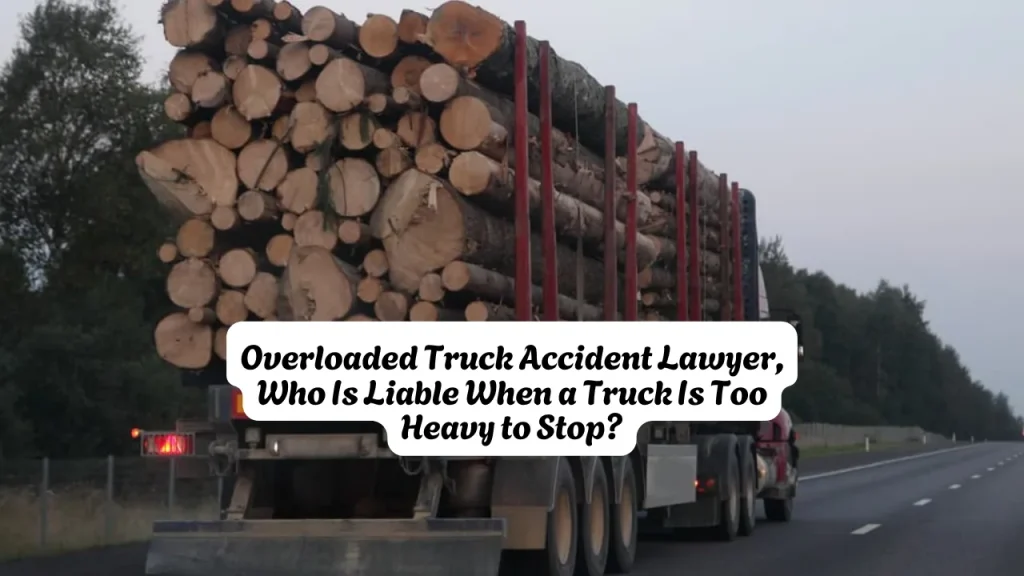
An overloaded truck accident lawyer helps victims injured when a commercial truck carried cargo beyond federal weight limits. Excess weight destroys braking ability, causes tire blowouts, and triggers rollovers. Attorneys prove negligence by examining weight tickets, bills of lading, and weigh station records. They hold trucking companies, shippers, and cargo loaders legally accountable for the crash and your injuries.
What does an overloaded truck accident lawyer do?
An overloaded truck accident lawyer investigates whether excess cargo weight caused or contributed to your crash. They obtain weight tickets, shipping records, and bills of lading to prove the truck exceeded federal limits. They then identify every liable party — the carrier, the shipper, the loading company — and pursue full compensation for your injuries. You pay nothing unless they win.
Most people assume a commercial truck that causes an accident was either driven recklessly or poorly maintained. What many victims never consider — and what trucking companies count on them not knowing — is that the truck may have been carrying far more weight than the law allows.
An overloaded commercial truck is not just a vehicle that weighs too much. It is a vehicle whose entire engineered safety margin has been erased. Its brakes were designed for a specific maximum load. Its tires were rated for a specific pressure threshold. Its suspension was built to manage a specific weight distribution. Pile cargo beyond those limits and every one of those safety systems begins to fail — often without warning, and always at the worst possible moment.
Federal law sets strict weight limits for commercial trucks on American highways. When carriers, shippers, or loading companies ignore those limits to move more freight faster and at lower cost, they create a predictable danger for everyone sharing the road. When that danger causes a crash, the law provides victims with a clear path to accountability.
This guide explains exactly how overloading causes accidents, which federal regulations set the weight limits, who bears legal responsibility when those limits are violated, and how a truck accident attorney proves the overloading caused your crash and recovers the compensation you deserve.
What an Overloaded Truck Actually Does to a Vehicle — and to Everyone Around It
Understanding why overloading is so dangerous requires understanding what excess weight does to the physical systems that keep an 80,000-pound truck under control. This is not abstract engineering — it is the direct mechanical chain that leads from a weight limit violation to a catastrophic crash.
Braking Distance Grows Dramatically
A fully loaded commercial truck traveling at 65 mph already needs approximately 525 feet to stop. Add 20,000 pounds of overweight cargo, and that stopping distance increases substantially — meaning the driver may need an additional 100 to 200 feet they simply do not have on a congested highway or at a busy intersection. When the truck cannot stop in time, it becomes an unstoppable projectile.
Tire Blowouts Become Inevitable
Every commercial truck tire carries a maximum load rating. Exceeding that rating generates heat inside the tire from excessive flexing of the sidewall. That heat builds with every mile driven. At some point — sometimes sooner, sometimes later, but always unpredictably — the tire fails catastrophically. A blowout on a rear axle at highway speed can send an overloaded tractor-trailer swerving across multiple lanes before the driver has any chance to respond.
Rollovers Happen at Speeds That Would Otherwise Be Safe
An overloaded truck’s center of gravity rises as cargo weight increases. A higher center of gravity makes the vehicle far more prone to rolling over during lane changes, highway curves, and emergency steering maneuvers that a properly loaded truck would handle without difficulty. Rollovers kill. They also frequently sweep multiple vehicles into a crash that began with one overloaded truck taking a curve too fast.
Brake Fade Compounds on Grades and Downhills
Overloaded trucks generate extreme heat in their braking systems on downhill grades. As brake temperature rises beyond design limits, brake fade sets in — a progressive loss of stopping power that can become total brake failure within minutes. A driver managing a properly loaded truck on a mountain grade is simply driving. A driver managing an overloaded truck on the same grade may be rapidly losing the ability to stop at all.
The Federal Weight Limits Every Commercial Truck Must Follow
The Federal Highway Administration (FHWA) and the FMCSA jointly enforce weight limits for commercial vehicles operating on interstate highways. These limits exist because engineers, regulators, and highway designers calculated the maximum loads that vehicles and road infrastructure can safely handle. Violating them is not a technicality — it is a safety violation with foreseeable, documented consequences.
| Weight Limit Category | Federal Maximum |
| Gross Vehicle Weight (GVW) | 80,000 pounds on interstate highways |
| Single axle weight limit | 20,000 pounds |
| Tandem axle weight limit | 34,000 pounds |
| Bridge formula weight limit | Varies based on axle spacing and number |
| State permit requirements | Oversize/overweight loads require special permits and route approval |
Every state also maintains weigh stations specifically to catch trucks exceeding these limits before they reach densely traveled roads. A truck that bypasses a required weigh station — or that a carrier routes around weigh stations deliberately — is itself evidence of negligence. Carriers know their loads are overweight. They choose routes and timing designed to avoid detection. That choice is not an oversight — it is a knowing decision to endanger the public.
When a truck exceeds federal weight limits without a proper oversize/overweight permit, that violation is strong evidence of negligence, and in many jurisdictions, it establishes negligence per se — automatic legal liability without requiring additional proof that the party acted unreasonably.
Understanding how federal safety regulation violations create legal liability in commercial truck accident cases is foundational to building a successful overloaded truck claim, because the carrier rarely acts alone in creating the overload condition.
Who Is Legally Responsible When a Truck Is Overloaded?
This is the question victims most urgently need answered — and the answer is almost always more than one party. An experienced overloaded truck accident lawyer investigates every link in the chain that put an overweight truck on the road with you.
The Trucking Company
The carrier that owns and operates the truck bears primary responsibility for ensuring the vehicle complies with federal weight limits before dispatch. This obligation is not delegable. Carriers must verify load weights, maintain accurate weight records, and refuse to dispatch trucks that exceed legal limits. When a carrier dispatches an overloaded truck — whether because of inadequate weight verification processes, pressure to meet tight delivery windows, or deliberate disregard for limits — that decision is negligent. The company is also vicariously liable for the driver’s conduct under respondeat superior.
The Shipper
The company that hired the trucking carrier to move the freight is often a direct contributor to overloading. Shippers who provide inaccurate weight declarations, pressure carriers to accept loads they know exceed weight limits, or simply fail to verify that their freight complies with federal requirements can be held independently liable for the crash. Shipper liability is frequently overlooked by victims — and by defense attorneys who would prefer the focus remain only on the driver.
The Cargo Loading Company
Many carriers use third-party loading companies and freight handlers to physically load cargo into trailers. When that loading company places excess weight on a single axle in violation of bridge formula requirements, stacks cargo in a way that shifts the load’s center of gravity, or simply loads more freight than the weight ticket allows, that company shares direct liability for the resulting crash. Improper load distribution — even within total weight limits — can itself cause rollovers and handling failures.
The Driver
Federal regulations require commercial truck drivers to know the weight of their load and refuse to operate vehicles that exceed legal limits. A driver who proceeds with a load they know is overweight — or who fails to verify the weight before departing — is independently negligent. Drivers cannot simply defer responsibility to the carrier or the shipper. They have an independent federal obligation to refuse unsafe dispatches.
Related article: Truck Tire Blowout Accident Lawyer, Who Is Liable When a Tire Destroys Your Life?
Potentially the Manufacturer
When overloading causes a component failure — a tire blowout, a brake system collapse, a suspension failure — and that component was defective in a way that made it less capable of handling loads within its rated capacity, the component manufacturer may share liability under product liability law. This theory requires expert analysis but can be a significant additional recovery avenue.
How a Lawyer Proves Overloading Caused Your Accident
Overloading cases require fast, precise evidence preservation. Here is how attorneys build the case that connects the excess weight to your crash and your injuries:
Step 1: Preserve the truck and its cargo immediately. A litigation hold letter goes to the carrier the day you retain an attorney. The truck, the trailer, any remaining cargo, and all weighing equipment must be preserved in post-crash condition. Once the cargo is unloaded and the truck is repaired, critical physical evidence is gone permanently.
Step 2: Obtain all weight tickets and shipping records. Weight tickets from the shipper’s facility, the loading dock, and any weigh stations the truck passed through document exactly what the truck weighed and when. Bills of lading specify what cargo was loaded and its declared weight. Discrepancies between declared and actual weights are direct evidence of negligent weight management.
Step 3: Subpoena the carrier’s dispatch records. Internal dispatch communications often reveal that the carrier knew the load was at or over the weight limit and dispatched the truck anyway. Time-pressure communications from shippers demanding rapid delivery despite overweight conditions are particularly powerful evidence.
Step 4: Request weigh station bypass records. Some carriers deliberately time routes and departures to avoid mandatory weigh stations. GPS data, ELD records, and route documentation can reveal weigh station avoidance patterns that demonstrate the carrier knew the truck was overweight and chose evasion over compliance.
Step 5: Retain a cargo and load distribution expert. These specialists analyze the weight distribution across axles, assess how the load shift affected vehicle handling, and provide expert testimony connecting the overloading directly to the crash mechanics — whether that means extended stopping distance, tire failure, or rollover.
Step 6: Analyze the Electronic Data Recorder (EDR). The truck’s black box records speed, braking inputs, and steering behavior in the moments before the crash. An overloaded truck that cannot brake in time leaves a distinctive signature in EDR data — maximum brake application with insufficient deceleration — that expert witnesses can explain to a jury in compelling terms.
Step 7: Examine the accident reconstruction evidence. Tire marks, impact angles, vehicle crush patterns, and post-crash trajectory all provide physical evidence of how the truck behaved in the moments of the crash. An accident reconstruction expert can testify about how that behavior is consistent with — and caused by — excess weight beyond the truck’s engineered capacity.
The Injuries Overloaded Truck Crashes Cause
Overloaded truck crashes are among the most severe in personal injury law because they combine the already-catastrophic physics of large commercial vehicle impacts with the additional force and loss of control created by excess weight. The injuries these crashes produce reflect that reality:
- Traumatic brain injuries (TBI) ranging from moderate concussion to permanent severe cognitive impairment
- Spinal cord injuries including partial and complete paralysis
- Multiple fractures — femur, pelvis, spine, and skull fractures are common in high-force impacts
- Crush injuries requiring surgical amputation
- Internal organ damage from blunt force trauma
- Severe burns from fuel system ruptures that frequently accompany high-energy crashes
- Permanent disability affecting the victim’s ability to work, care for themselves, or maintain relationships
- Wrongful death
The severity of these injuries directly shapes the value of your legal claim. A personal injury claim that accounts for long-term medical needs, lost earning capacity, and permanent disability produces a fundamentally different recovery than a claim limited to current medical bills. An attorney builds the full damages picture from day one.
What Compensation Can You Recover?
Victims of overloaded truck crashes can pursue several categories of financial recovery:
Economic damages cover all measurable losses — emergency medical care, surgeries, hospital stays, rehabilitation, physical and occupational therapy, future medical expenses, assistive devices and home modifications, lost wages, and the long-term reduction in your earning capacity caused by permanent injury.
Non-economic damages address losses without price tags — physical pain and suffering, emotional distress, psychological trauma, loss of enjoyment of life, and loss of companionship when an overloaded truck crash takes a family member’s life.
Punitive damages become available when the carrier’s or shipper’s conduct was particularly egregious — for example, when internal records show they knew the truck was 30,000 pounds over the legal limit and dispatched it anyway to avoid losing a client contract. Courts award punitive damages to punish deliberate disregard for public safety and deter future misconduct.
Wrongful death damages are available to surviving family members when overloading causes a fatal crash. These include funeral and burial costs, loss of financial support, and loss of consortium.
Because overloaded truck cases often involve multiple liable defendants — each carrying their own insurance policy — total recoveries can be pursued across several policies simultaneously. A single truck crash caused by overloading can involve claims against the carrier’s commercial policy, the shipper’s liability coverage, and the loading company’s policy at the same time.
Frequently Asked Questions
How do I know if the truck that hit me was actually overloaded?
You may not know immediately — and that is exactly why retaining a lawyer quickly matters. Attorneys subpoena weight tickets, bills of lading, and weigh station records that document the truck’s actual weight at the time of the crash. They also obtain the truck’s EDR data and retain cargo experts to analyze whether the load distribution contributed to the crash. Post-crash vehicle inspections can reveal physical evidence of overloading such as tire damage patterns and suspension stress consistent with excess weight. You do not need to know the truck was overloaded before contacting a lawyer — that investigation is the lawyer’s job.
Can I sue the company that loaded the cargo, not just the trucking company?
Yes. When a third-party loading company placed excessive weight on the truck or distributed the cargo in a way that violated federal axle weight limits, that company is independently liable for the crash. Your attorney can file claims against the carrier, the shipper, and the loading company simultaneously. Each party’s insurance coverage is a separate potential source of recovery. In overloading cases, pursuing all three defendants often produces substantially larger total compensation than pursuing only the carrier.
How long do I have to file an overloaded truck accident lawsuit?
Most states allow two to three years from the accident date to file a personal injury claim, but deadlines vary by state and by defendant type. Far more urgent is the evidence timeline — weight tickets, dispatch communications, and loading records may be discarded within weeks. EDR and ELD data can be overwritten within 30 days. An attorney must act immediately to issue a litigation hold and preserve this evidence before it disappears. The filing deadline matters, but it is far less pressing than the evidence preservation window.
What if the trucking company claims the shipper gave them inaccurate weight information?
That defense does not eliminate the carrier’s liability — it adds a second liable party. Carriers have an independent obligation to verify load weights before dispatch and to refuse overweight loads regardless of what the shipper declares. When a shipper provides false weight information and the carrier fails to independently verify the load, both parties are negligent. Your attorney pursues claims against both simultaneously, forcing them to apportion fault between themselves rather than shifting it entirely onto you.
Does an overweight truck automatically mean someone was negligent?
In most cases, yes — particularly when the truck exceeds federal interstate weight limits without a valid oversize/overweight permit. This type of regulatory violation typically establishes negligence per se in most jurisdictions, meaning negligence is presumed from the violation itself. Even in states that do not apply negligence per se, a weight limit violation is strong evidence of unreasonable conduct. The carrier, shipper, and loading company all had legal obligations to keep the truck within weight limits. When those obligations are violated and a crash results, the legal presumption of negligence is well-supported.
Legal Terms Used in This Article
Gross Vehicle Weight (GVW): The total weight of a fully loaded commercial truck, including the vehicle, fuel, driver, and all cargo. Federal law sets the interstate GVW limit at 80,000 pounds.
Axle Weight Limit: The maximum weight permitted on a single axle or tandem axle group. Federal limits are 20,000 pounds per single axle and 34,000 pounds per tandem axle group, enforced to protect road infrastructure and vehicle handling.
Bridge Formula: A federal calculation that limits the weight a vehicle may carry based on the number of axles and the distance between them, designed to distribute load in a way that protects highway bridges from structural stress.
Negligence Per Se: A legal doctrine establishing automatic negligence when a defendant violates a safety statute. A truck exceeding federal weight limits without a permit typically satisfies negligence per se in most jurisdictions.
Bill of Lading: A shipping document that identifies the cargo being transported, its origin, its destination, and its declared weight. Bills of lading are key evidence in overloading cases because they document what weight the shipper and carrier agreed was being transported.
Respondeat Superior: A legal doctrine making employers automatically liable for their employees’ negligent acts committed within the scope of employment. Under this doctrine, a carrier is liable for a driver’s decision to operate an overweight truck.
Vicarious Liability: Legal responsibility imposed on one party for the actions of another based on their relationship. Trucking companies are vicariously liable for drivers’ weight limit violations committed on company business.
Brake Fade: A progressive loss of braking effectiveness caused by overheating of brake components, most commonly occurring on downhill grades when excess cargo weight generates more heat than the braking system was designed to manage.
Weight Limits Exist for a Reason — and Ignoring Them Has Consequences
Federal truck weight limits are not bureaucratic formalities. They are the product of engineering calculations, bridge load studies, accident data, and decades of highway safety research. Every pound a carrier loads beyond those limits is a pound of risk transferred directly onto every other driver, passenger, and pedestrian sharing the road.
When a carrier, shipper, or loading company ignores those limits to move more freight at lower cost, they make a calculated decision to endanger the public. The law holds that decision accountable.
If you or a loved one was injured in a crash involving an overloaded truck, do not wait to act. Weight tickets are discarded. Loading records disappear. EDR data is overwritten. Every day without a litigation hold is a day of evidence lost. Contact an overloaded truck accident lawyer today for a free consultation. Your attorney will move immediately to preserve the evidence, identify every liable party, and build the case that recovers the full compensation you deserve. You pay nothing unless your attorney wins.
Disclaimer: This article is for general informational purposes only and does not constitute legal advice. Laws vary by state and individual circumstances differ. Always consult a licensed attorney in your jurisdiction for advice specific to your situation.