
Can Border Agents Search Your Phone? Massachusetts Judge Blocks Review of Immigration Lawyer’s Data
Federal border agents can search travelers’ phones in some circumstances without a warrant, but that power has limits. On November 13, 2026, a federal judge in Boston blocked the government from reviewing data copied from an immigration lawyer’s cellphone after finding he was likely to succeed on a claim that agents targeted him because of his protected speech.
U.S. District Judge Allison D. Burroughs granted a preliminary injunction to attorney Andrew Lattarulo, whose phone was seized at Boston Logan International Airport in September 2025. The judge ordered the government to keep its copy of the data in an unreadable, unreviewable format while the case continues. She did not order the data destroyed, and the physical phone had already been returned.
The case is Lattarulo v. Mullin (originally Lattarulo v. Noem), No. 1:25-cv-12861-ADB, in the U.S. District Court for the District of Massachusetts.
This is mainly a First Amendment retaliation ruling. The judge did not issue a final Fourth Amendment decision, and the order does not ban warrantless phone searches at U.S. borders.
Read the November 13 Memorandum and Order
Lattarulo v. Mullin: Quick Facts
| Detail | Confirmed information |
| Plaintiff | Andrew Lattarulo, immigration attorney |
| Case | Lattarulo v. Mullin, formerly Lattarulo v. Noem |
| Case number | 1:25-cv-12861-ADB |
| Court | U.S. District Court, District of Massachusetts |
| Judge | Allison D. Burroughs |
| Defendants | Secretary of Homeland Security, the Department of Homeland Security, and other federal officials |
| Seizure location | Boston Logan International Airport |
| Seizure date | September 28, 2025 |
| Lawsuit filed | October 2, 2025 |
| Temporary restraining order | October 3, 2025 |
| Preliminary injunction | November 13, 2026 |
| Main ruling | Likely success on First Amendment retaliation claim |
| Fourth Amendment | Final ruling deferred |
| Phone returned? | Yes |
| Copied data destroyed? | No |
| Government may review the data? | No, while the injunction applies |
| Final judgment? | No |
Why Did Federal Agents Seize Andrew Lattarulo’s Phone?
Lattarulo is an immigration lawyer and part owner of Georges Cote LLP, a firm that represents many clients in immigration matters. According to the court’s order, he also posted videos on Instagram explaining immigrants’ legal rights and criticizing federal immigration enforcement.
At the same time, Homeland Security Investigations (HSI) was examining whether the firm had employed workers without proper employment authorization. HSI served Lattarulo’s law partner, Audai Cote, with a Notice of Inspection on September 8, 2025, and issued a Notice of Suspect Documents on September 25, 2025, giving the firm ten days to address the listed records.
What Happened at Boston Logan Airport?
Lattarulo and Cote took a weekend trip to Aruba. Cote came back through Boston on September 27 without incident. Lattarulo returned on September 28, after completing U.S. customs preclearance in Aruba.
Per the court’s account, three Customs and Border Protection (CBP) agents and one HSI officer stopped him after he left the plane at Logan. Agents seized his phone without a warrant and copied its full contents. The phone held client information, including communications Lattarulo says are protected by attorney-client privilege. The device was later returned, but the government kept the copy.
Having cleared preclearance abroad did not by itself end border-search authority when he arrived in the United States.
Why Did the Judge Block the Government From Reading His Phone Data?
Judge Burroughs found, on the limited record before her, that Lattarulo was likely to succeed on his First Amendment retaliation claim. Reporting on the order quotes her conclusion that the evidence suggested he would not have been searched except for his protected speech. She pointed to several facts:
- The government had not shown that phone searches are a routine tool in this kind of employment-compliance investigation.
- The seizure came while the firm was still within the time given to respond to the government’s document concerns.
- Lattarulo’s law partner, who had access to the relevant employment records, returned from the same trip a day earlier and was not stopped, and he had not made the same public criticism of immigration enforcement.
Did the Judge Find That Agents Retaliated Against Lattarulo?
Not as a final finding. She concluded only that the current evidence made retaliation likely enough to justify temporary relief.
The government argued that it had reasonable suspicion tied to its employment investigation and that the seizure was not motivated by his speech. Officials said they held additional evidence supporting their position but did not want to disclose it publicly during an ongoing investigation. Lattarulo objected to having the judge review that material in private at this stage. The court ruled on the record it had.
The judge did not decide that the firm violated any employment law, or that the government had no legitimate basis for its investigation.
What Does the November 13 Order Require?
| Issue | Court’s decision |
| Physical phone | Already returned |
| Copy of the data | Government keeps it, unreadable and unreviewable |
| Reviewing or analyzing the copy | Barred while the injunction applies |
| Destroying the copy | Not ordered |
| Final Fourth Amendment ruling | Deferred |
| First Amendment retaliation | Likely success shown for preliminary relief |
The judge found that letting officials examine the data could cause irreparable privacy harm. The order stays in place while the case proceeds, subject to appeal or later changes by the court.
What Legal Standards Applied to the Preliminary Injunction?
A preliminary injunction under Federal Rule of Civil Procedure 65 requires the plaintiff to show that he is likely to succeed on the merits, likely to suffer irreparable harm without relief, that the balance of equities favors him, and that an injunction serves the public interest (Winter v. Natural Resources Defense Council, Inc., 555 U.S. 7 (2008)). It preserves the parties’ positions until the case can be decided. It is not a final judgment.
First Amendment Retaliation
The government generally may not retaliate against a person for protected speech (Hartman v. Moore, 547 U.S. 250 (2006)). A plaintiff must show that he engaged in protected conduct, that the government took an action that would deter a person of ordinary firmness from speaking, and that the speech was a but-for cause of the action. In Nieves v. Bartlett, 587 U.S. 391 (2019), the Supreme Court held that probable cause generally defeats a retaliatory-arrest claim, with a narrow exception where similarly situated people who did not speak were not arrested.
Here, the judge treated Lattarulo’s public criticism of immigration policy as protected speech and weighed the timing and the unusual use of a phone search as evidence of causation.
The Compelled-Disclosure Argument
Lattarulo also argued that the search forced disclosure of privileged and associational information. The judge concluded that safeguards the government said it would use could address that argument at this stage. The injunction rests on the retaliation finding.
Related article: Washington Judge Rules Adams County Sheriff Violated ICE Cooperation Law, What Changes Now?
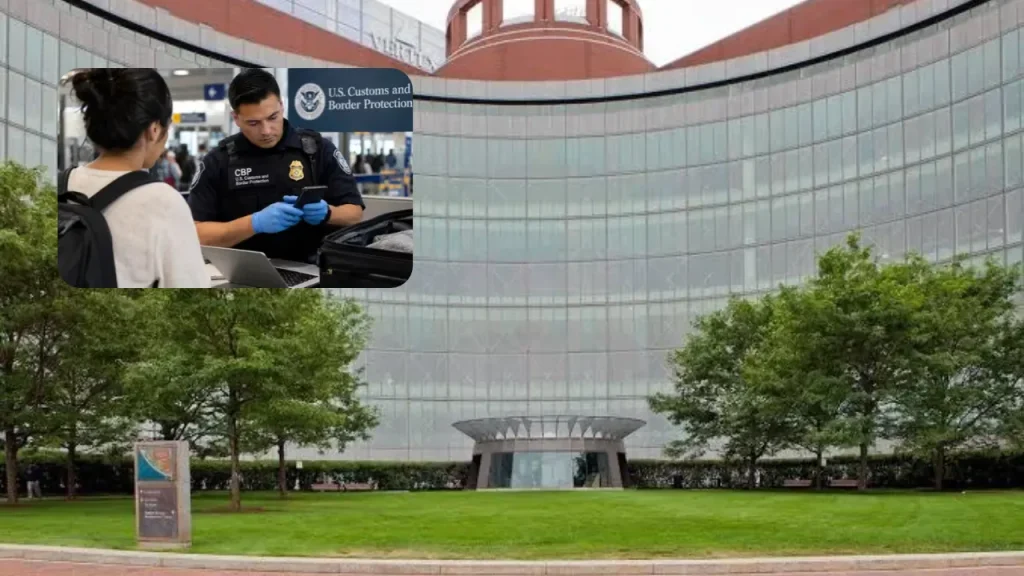
Can CBP Search Your Phone at a U.S. Airport Without a Warrant?
In some international-border situations, yes. But the rules are not the same for every encounter.
The government has broad authority to inspect people and belongings entering the country. Federal law and regulations support that authority, including 19 CFR § 162.6 (people, baggage, and merchandise arriving in the United States are subject to inspection) and 8 U.S.C. § 1357(c) (searches of people seeking admission). The Supreme Court has long recognized a border-search exception to the Fourth Amendment’s usual warrant requirement (United States v. Ramsey, 431 U.S. 606 (1977)), while requiring reasonable suspicion for especially intrusive detentions (United States v. Montoya de Hernandez, 473 U.S. 531 (1985)).
Why Riley v. California Does Not Settle Border Phone Searches
In Riley v. California, 573 U.S. 373 (2014), the Supreme Court held that police generally need a warrant to search a phone seized during an arrest. But Riley involved a search incident to arrest, not an international border. Lower courts have not treated it as automatically requiring a warrant at the border.
Basic and Advanced Phone Searches Under CBP Policy
CBP’s electronic-device directive separates two kinds of searches. According to CBP’s published policy, a basic search is a manual review of what is stored on the device and can occur without individualized suspicion. An advanced search connects external equipment to review, copy, or analyze the contents and generally requires reasonable suspicion of a violation of law CBP enforces or a national-security concern, plus supervisory approval. CBP issued an updated directive, Directive 3340-049B, effective January 1, 2026.
That directive took effect after the September 2025 seizure, so the government’s conduct in this case is judged under the law and policy in place then.
What Does the First Circuit Say About Border Phone Searches?
Massachusetts sits in the First Circuit. In Alasaad v. Mayorkas, 988 F.3d 8 (1st Cir. 2021), the court upheld the government’s practice of searching electronic devices at the border. It held that basic searches need no individualized suspicion and that advanced searches do not require a warrant or probable cause. The court tied the border-search exception to the government’s interest in enforcing customs and immigration laws and stopping contraband, including digital contraband. The decision binds federal courts in Massachusetts, Maine, New Hampshire, Rhode Island, and Puerto Rico.
The Fourth Amendment Question Left Open in Lattarulo
Judge Burroughs raised, but did not finally resolve, a significant question: can agents use border-search power to gather evidence of a suspected domestic employment violation under 8 U.S.C. § 1324a that has no clear link to international travel? She reserved that Fourth Amendment question for later proceedings. If it is decided in his favor, it could narrow how far the border-search exception reaches in the First Circuit. For now, it is an open issue.
How Employment Inspections Work Under 8 U.S.C. § 1324a
Section 1324a makes it unlawful to knowingly employ unauthorized workers and requires employers to verify work authorization using Form I-9. HSI audits typically start with a Notice of Inspection, which generally gives the employer at least three business days to produce its I-9 forms (see 8 CFR § 274a.2(b)(2)). Those audits are ordinarily paper-based inspections of employer records. That context is why the judge asked why a phone search was needed.
Can Border Agents Search Your Phone on a Domestic Flight?
A domestic flight is legally different from an international arrival. Flying from Boston to Chicago does not trigger the border-search exception. TSA screening is aimed at security threats, not general criminal investigation of phone contents. Inland searches generally require a valid warrant, consent, or another recognized exception.
The 100-mile zone near the border is also not a free pass. Federal law lets immigration officers board and search certain vehicles within a reasonable distance of the border (8 U.S.C. § 1357(a)(3)), but that does not give them unlimited authority to search your phone.
What Happens When an Immigration Lawyer’s Phone Holds Client Secrets?
Attorney-client privilege protects confidential communications made to get or give legal advice. A lawyer’s phone may hold client messages, case strategy, identity documents, and details of pending removal proceedings. Lawyers also have professional duties to protect that information, such as the duty to make reasonable efforts to prevent unauthorized access under ABA Model Rule 1.6(c) and state counterparts.
Can Agents Search a Lawyer’s Phone at the Border?
Being a lawyer does not exempt a phone from a lawful border search, but privileged material gets special handling. CBP’s directive sets procedures for identifying and separating privileged material, including consultation with CBP legal counsel and use of a filter team or similar safeguards.
What Is a Taint Team in the Lattarulo Case?
A taint team, or filter team, is a group of government personnel who screen out potentially privileged material before investigators see the rest. Government lawyers told the court they would use such procedures if allowed to search Lattarulo’s data. Judge Burroughs found those safeguards could address the compelled-disclosure argument, but she noted that names and phone numbers could relate both to his immigration clients and to people relevant to the employment investigation, which complicates filtering. She barred review anyway because of the retaliation finding and the privacy harm.
For a different case on government retaliation and speech, see DHS Class Action Lawsuit, Maine ICE Observers Fight Back Against First Amendment Retaliation.
Can You Refuse to Unlock Your Phone for Border Agents?
You can decline to give a passcode, but refusal can carry consequences. Under CBP policy, officers may ask for help unlocking a device and may detain it if they cannot finish the inspection. CBP states that for U.S. citizens, an inability to inspect a device does not by itself justify denying entry, though officers may keep the device for further examination. For noncitizens seeking admission, refusing to cooperate can affect admissibility and lead to further questioning or other consequences.
Whether a person can be compelled to disclose a passcode raises separate Fifth Amendment questions that depend on the facts and jurisdiction. There is no single rule that refusing always prevents a search.
What Should You Do if Federal Agents Ask to Search Your Phone?
What to do depends on whether you are at an international border, being questioned inland, or part of another investigation. If an officer asks for access:
- Stay calm and do not physically resist.
- Ask which agency is acting and what legal authority it is using.
- Ask whether this is a border inspection or part of a separate investigation.
- If you do not consent, say so clearly without obstructing officers.
- Say that the device holds privileged legal communications and ask for protective procedures.
- Ask for a supervisor and, when possible, an attorney.
- If your device is held, ask for a receipt or written record.
- Afterward, write down officers’ names, the location, and what happened.
CBP policy generally limits border device searches to data stored on the device itself rather than information available only through the cloud. Do not delete data, give false information, or interfere with officers.
Where Can You Complain About a Border Phone Search?
Depending on the facts, you can contact CBP, file a complaint with the DHS Office of Inspector General, or use the DHS Traveler Redress Inquiry Program. A complaint does not automatically lead to deletion of your data or to money damages.
Getting an injunction and recovering damages from individual federal officers involve different legal rules, and the second is harder. That issue is covered in Nielsen v. Watanabe, Could the Supreme Court Make It Harder to Sue Federal Agents Like ICE?.
Andrew Lattarulo Phone Seizure Timeline
| Date | Development |
| September 8, 2025 | HSI serves the law firm with a Notice of Inspection |
| September 25, 2025 | Notice of Suspect Documents issued |
| September 27, 2025 | Audai Cote returns from Aruba without incident |
| September 28, 2025 | Agents seize Lattarulo’s phone at Boston Logan |
| October 2, 2025 | Lattarulo files suit |
| October 3, 2025 | Judge Burroughs issues a temporary restraining order |
| October 20, 2025 | Preliminary injunction hearing |
| November 13, 2026 | Preliminary injunction barring review of the copied data |
| To be determined | Final ruling on the Fourth Amendment and the merits |
What Happens Next in Lattarulo v. Mullin?
The case remains active. The copied data must stay unreadable and unreviewable under the order. Later proceedings could address whether the border-search exception reaches an investigation of domestic employment practices, whether the seizure violated the Fourth Amendment, whether the government can show the search would have happened without any retaliatory motive, and what should happen to the retained data permanently. The government may also appeal or ask the court to change the order.
There is no class action, settlement fund, claim form, or compensation deadline tied to this individual lawsuit.
Frequently Asked Questions About Border Phone Searches and the Lattarulo Ruling
Can CBP search an American citizen’s phone without a warrant?
In certain border situations, yes. Under First Circuit precedent and CBP policy, qualifying basic searches need no individualized suspicion, and advanced searches do not require a warrant, subject to policy limits.
Did the Massachusetts judge rule that border phone searches are unconstitutional?
No. The injunction rests on a preliminary First Amendment retaliation finding. The judge deferred a final Fourth Amendment decision.
Can agents copy everything on your phone?
CBP policy allows advanced searches that copy and analyze device contents when legal and policy requirements are met. Extra protections apply to privileged and sensitive material.
Does attorney-client privilege stop border officials from searching a lawyer’s phone?
Not automatically. Privileged material requires special handling, and improper access can be challenged in court.
Did the government delete Andrew Lattarulo’s phone data?
No. The court ordered the government to preserve the copy in an unreadable, unreviewable form while the case continues.
Does the Lattarulo ruling protect all travelers?
No. The injunction governs the parties and the data in this case. It is not a nationwide ban on border device searches.
Can the government still get access to the data later?
Possibly. The order is preliminary, and the court could change it as the case develops or after further proceedings.
What the Massachusetts Phone Search Ruling Means
The November 13, 2026 order shows that border-search authority is not unlimited. Judge Burroughs found enough preliminary evidence to keep the government from reviewing Andrew Lattarulo’s copied data while his First Amendment retaliation claim proceeds, and she left open whether the border-search exception can be used to investigate suspected domestic violations.
For ordinary travelers, the practical point is unchanged: border inspections run on broader government authority than inland searches, but constitutional protections still apply. Lawyers and others who carry privileged or sensitive data may reduce risk by carrying less across borders, but that is risk management, not a guarantee against inspection.
The court has not held that all warrantless border phone searches are illegal, and it has not ordered the government to destroy Lattarulo’s data.
Update Log
| Date | Update |
| November 16, 2026 | Article published. Preliminary injunction granted November 13, 2026. Case pending. |
Primary Sources
- Lattarulo v. Mullin, Memorandum and Order, November 13, 2026 (ECF No. 28)
- Lattarulo v. Noem, docket No. 1:25-cv-12861
- Temporary Restraining Order, October 3, 2025
- CBP Directive 3340-049B, Border Search of Electronic Devices, effective January 1, 2026
- CBP: Border Search of Electronic Devices
- Alasaad v. Mayorkas, 988 F.3d 8 (1st Cir. 2021)
- Riley v. California, 573 U.S. 373 (2014)
- Nieves v. Bartlett, 587 U.S. 391 (2019)
- 19 CFR § 162.6, Search of Persons, Baggage and Merchandise
- 8 U.S.C. § 1324a, Unlawful Employment of Aliens
- Federal Rule of Civil Procedure 65
- DHS Traveler Redress Inquiry Program
This article is for informational purposes only and does not constitute legal advice. Laws vary by state and individual circumstances differ. For advice about your specific situation, consult a qualified attorney.
Researched and written by Israr Ahmad, legal content researcher and founder of AllAboutLawyer.com. All facts verified against the November 13, 2026 Memorandum and Order in Lattarulo v. Mullin (D. Mass. No. 1:25-cv-12861, ECF No. 28), the court docket, CBP’s published electronic-device policy, Alasaad v. Mayorkas (1st Cir. 2021), Riley v. California (2014), 19 CFR § 162.6, 8 U.S.C. § 1324a, and Federal Rule of Civil Procedure 65, as of November 16, 2026. Last Updated: November 16, 2026.
About the Author
Israr Ahmad is a legal content researcher with 4+ years of experience covering class action settlements and consumer rights cases. He has researched and published coverage of 2,500+ settlements using verified court records, settlement administrator filings, and government sources. Learn more about Israr.