
DHS Class Action Lawsuit, Maine ICE Observers Fight Back Against First Amendment Retaliation
The Department of Homeland Security is facing a federal class action lawsuit filed in the U.S. District Court for the District of Maine, alleging that ICE agents violated the constitutional rights of Maine residents who observed and filmed immigration enforcement activity during a January 2026 operation. The lawsuit, filed in part by the legal nonprofit Protect Democracy, asks a judge to allow it to proceed as a class action, declare the agencies’ actions as First Amendment violations, and bar future retaliatory actions against class members. No settlement has been reached. This case is active litigation.
Quick Facts: Hilton et al. v. Noem et al., No. 2:26-cv-00092-JAW
| Field | Detail |
| Lawsuit Filed | February 23, 2026 |
| Defendant | U.S. Department of Homeland Security, ICE, HSI, and former Secretary Kristi Noem |
| Alleged Violation | First Amendment — Free Speech, Assembly, and Retaliation |
| Who Is Affected | Maine residents who observed, filmed, or monitored ICE enforcement activity during “Operation Catch of the Day” (January 2026) and were threatened, surveilled, or had biometric data collected |
| Current Court Stage | Amended complaint filed April 29, 2026; class certification and preliminary injunction motions pending |
| Court & Jurisdiction | U.S. District Court for the District of Maine, Portland |
| Lead Law Firms | Protect Democracy; Dunn Isaacson Rhee; Drummond Woodsum |
| Next Hearing Date | TBD — pending court scheduling after amended complaint filing |
| Official Case Website | protectdemocracy.org |
| Last Updated | April 30, 2026 |
Current Status: Where the Case Stands Now
- Attorneys filed an amended complaint on April 29, 2026, adding Carlyn Williams and Polyxenia Pantos of South Portland as new plaintiffs and expanding allegations against DHS.
- U.S. District Judge John Woodcock denied the plaintiffs’ request for a temporary restraining order in March 2026, writing that the lawsuit “raises serious constitutional issues that are better aired and resolved on a nonemergency basis.”
- Plaintiffs are expected to file a motion for a preliminary injunction seeking to block DHS from continuing to collect biometric data from First Amendment observers.
What Is the DHS Lawsuit About? Hilton et al. v. Noem et al., No. 2:26-cv-00092-JAW
Is there a class action lawsuit against DHS for filming ICE agents? Yes — and it is growing. The case started with two Portland women who filmed immigration arrests in January 2026 and were then threatened by federal agents for doing so.
Elinor Hilton and Colleen Fagan filed suit on February 23, 2026 in the U.S. District Court for the District of Maine, alleging the federal government violated their First Amendment rights to free speech and assembly, and retaliated against and intimidated them for observing immigration enforcement in public spaces. The suit, filed by Protect Democracy and co-counsel, alleges that federal agents unconstitutionally retaliated against people who were lawfully observing and recording federal immigration enforcement operations by gathering their personal information and labeling them domestic terrorists.
Related article: Bayer Is Fighting to End Roundup Cancer Lawsuits Here Is Where Things Stand Right Now
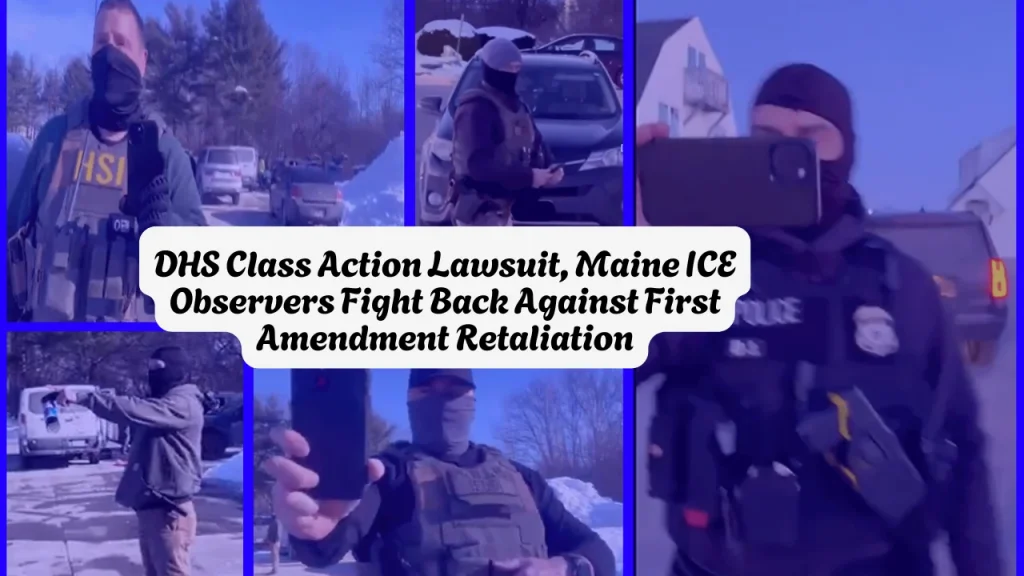
The complaint states that DHS has been using license plate readers and, since May 2025, a facial recognition application called Mobile Fortify, which can identify individuals by accessing roughly 200 million images in the government’s possession. By January 2026, according to the complaint, DHS had used the app more than 100,000 times, routinely targeting individuals who were not themselves subjects of immigration enforcement operations. This is a consumer rights lawyer’s core argument in the case — the government was not targeting criminals. It was targeting witnesses.
The case also gained new weight on April 29, 2026. After Polyxenia Pantos recorded ICE officers in South Portland, her spouse Carlyn Williams received a phone call from someone claiming to represent DHS, warning her to tell Pantos not to film agents again because people who did “might get added” to a list. Two months later, when the couple returned from a trip to Quebec City, a Customs and Border Protection agent detained them for an hour and requested vehicle registration information for a car they were not even traveling in — suggesting they had in fact been flagged in a government system.
If you were in Maine during “Operation Catch of the Day” in January 2026 and filmed, observed, or monitored ICE activity — especially if you were later threatened, surveilled, or had agents appear at your home — this First Amendment retaliation lawsuit may include you. You may want to speak with a consumer rights lawyer about your specific situation.
Are You Part of the DHS ICE Observer Class Action Lawsuit?
The DHS class action lawsuit 2026 could cover a broader group than you might expect. Here is how to know if this case includes you.
You may be part of this class if:
- You were in Maine in January 2026 and observed or filmed ICE or DHS agents during “Operation Catch of the Day”
- Agents recorded your face, license plate, or biometric data while you were watching or filming in a public space
- An agent verbally threatened you — including warnings about being added to a “database,” a “watchlist,” or being labeled a “domestic terrorist”
- Agents came to your home, drove past your residence, or honked outside after you observed their operations
- You were detained at a border crossing or checkpoint following your observation activity in January 2026
- You received a phone call from someone identifying as DHS warning you to stop observing or filming agents
You are likely NOT included if:
- You were not in Maine during the January 2026 ICE enforcement surge
- You were arrested for physically interfering with or obstructing federal agents
- You have no documented contact with, or threat from, DHS or ICE agents related to your observation activity
This am I part of the DHS ICE lawsuit question matters. If you were affected and you have video, photographs, voicemails, or records of any interaction with federal agents, preserve them now. Those records could be important if the case reaches a damages phase.
What Are DHS ICE Lawsuit Plaintiffs Seeking?
This is not a settlement article, and there is no claim form to file right now. Here is what the plaintiffs have asked the court to do.
The lawsuit asks the court to allow it to proceed as a class action, declare the agencies’ actions to be violations of the First Amendment, and bar any future retaliatory actions against class members. Plaintiffs are also seeking an order requiring DHS to expunge their data from any alleged watchlist and declaring the use of such a database unconstitutional.
On the damages side, at least one related filing shows the scope of individual harm being alleged. A separate Federal Tort Claims Act notice filed on behalf of South Portland resident Bob Peck requests $7.5 million in damages, alleging federal agents violated his constitutional rights by threatening to arrest him for observing their activity. That figure gives some indication of what compensation for damages plaintiffs in the broader class may ultimately pursue — but no payout amount exists for the class action itself yet, and no court has awarded or approved any amount.
The legal theory rests squarely on the First Amendment. The complaint states that plaintiffs face a choice between abandoning their constitutional rights or accepting being cataloged and branded as “domestic terrorists” — and argues the Constitution does not require anyone to make that choice.
What Should You Do If You Were Affected by DHS ICE Operations in Maine?
If you observed or filmed ICE agents in Maine in January 2026 and faced any threats, surveillance, or follow-up contact from federal agents, here are your practical options right now.
You do not need to do anything to remain in the class — yet. Most class members are automatically included once a court certifies the class. You do not need to register or file anything at this stage.
Do preserve your evidence immediately. Save any videos you took of ICE activity, screenshots of text messages or social media posts about the encounter, voicemails or call records from anyone identifying as DHS, and any notes you made about what agents said to you. This documentation could be central to the case.
Monitor the case docket. The case — Hilton et al. v. Noem et al., No. 2:26-cv-00092-JAW — is filed in the U.S. District Court for the District of Maine. You can track filings on PACER. Updates are also posted at protectdemocracy.org.
Consider a free legal consultation if you want to pursue an individual claim. If you believe your harm goes beyond what a class action may cover, a class action lawsuit attorney can advise you on whether an individual claim under the Federal Tort Claims Act makes sense for your situation. A free legal consultation with a civil rights attorney costs you nothing up front and helps you understand your options before any deadline passes.
Do NOT wait if you received direct threats. The Federal Tort Claims Act requires a notice of claim to be filed before any individual lawsuit can proceed, and timing rules apply.
DHS ICE Maine Class Action Lawsuit Timeline
| Milestone | Date |
| ICE “Operation Catch of the Day” in Maine | January 20–29, 2026 |
| Hilton and Fagan encounter DHS agents | January 21 and 23, 2026 |
| Lawsuit filed — U.S. District Court, Maine | February 23, 2026 |
| DHS admits agents acted “improperly” in court | March 17, 2026 |
| Judge denies temporary restraining order | March 23, 2026 |
| Williams and Pantos detained at border crossing | March 16, 2026 |
| Amended complaint adds Williams and Pantos as plaintiffs | April 29, 2026 |
| Class certification motion | TBD — not yet filed as of April 30, 2026 |
| Preliminary injunction motion | TBD — expected, per plaintiffs’ attorneys |
| Next scheduled hearing | TBD — pending court scheduling after amended complaint |
| Expected resolution timeline | TBD — federal civil rights class actions typically take 2–4 years to resolve |
Frequently Asked Questions
Is there a class action lawsuit against DHS for filming ICE agents?
Yes. Hilton et al. v. Noem et al., No. 2:26-cv-00092-JAW is an active federal class action filed in the U.S. District Court for the District of Maine. It was first filed on February 23, 2026 by Portland residents Elinor Hilton and Colleen Fagan, and the plaintiff group expanded on April 29, 2026.
Do I need to do anything right now to be included in the DHS class action lawsuit?
No immediate action is required. Most class members are automatically included once a court certifies the class. Focus on preserving any videos, records, or documentation of your interactions with federal agents in January 2026. Check protectdemocracy.org for updates on when class certification is filed.
When will a settlement be reached in the DHS ICE observer case?
There is no settlement in this case. The lawsuit is in active litigation. The court has acknowledged the case raises serious First Amendment issues that need to be resolved on the merits. Federal civil rights class actions of this type often take two to four years to reach resolution. No payout date or settlement amount exists at this time.
Can I file my own lawsuit against DHS instead of joining the class action?
Potentially, yes. If you were individually threatened or harmed by DHS agents during the January 2026 Maine operation, you may be able to pursue an individual claim under the Federal Tort Claims Act — but you must file a formal administrative notice of claim before filing a lawsuit. Speak with an employment discrimination attorney or civil rights attorney about your situation before that window closes.
How will I know if the DHS ICE lawsuit settles or reaches a verdict?
Follow the case docket at PACER (No. 2:26-cv-00092-JAW) and check protectdemocracy.org for updates from plaintiffs’ counsel. If you are part of the class, you will receive formal notice by mail once class certification is granted — which is why documenting your contact with agents now matters.
What did DHS say about the “domestic terrorist” database?
A DHS assistant field office director told the court that ICE has no database or watchlist tracking protesters based on their First Amendment activities, and that agents had been informed not to tell individuals they would be placed on a database for exercising their First Amendment rights. However, plaintiffs’ attorneys have argued that DHS’s statements deliberately avoid the actual question of where their biometric data is being stored.
What is the Mobile Fortify app and why does it matter in this lawsuit?
Mobile Fortify is a facial recognition application DHS began using in May 2025 that can identify individuals by accessing roughly 200 million images in government possession. The lawsuit alleges it was used routinely on people who were simply watching immigration enforcement — not suspected of any crime. Whether that use violates the First Amendment is one of the central legal questions the court will decide.
Did any DHS official admit wrongdoing in this case?
At a court hearing in March 2026, a Department of Homeland Security attorney acknowledged that federal agents had acted “improperly” during Operation Catch of the Day and that collecting data in the manner described was not consistent with DHS’s own written policies. Internal records from that hearing also showed officials were considering disciplinary action against the agents involved.
Sources & References
- Court Filing: Hilton et al. v. Noem et al., No. 2:26-cv-00092-JAW — Original Complaint (PDF), Protect Democracy
- Justia Docket: HILTON et al v. NOEM et al — U.S. District Court, District of Maine
- Portland Press Herald (April 29, 2026): South Portland couple joins amended complaint
Prepared by the AllAboutLawyer.com Editorial Team and reviewed for factual accuracy against official court records and the Protect Democracy case page on April 30, 2026. Last Updated: April 30, 2026
Disclaimer: This article is for informational purposes only and does not constitute legal advice. Legal claims and outcomes depend on specific facts and applicable law. For advice regarding a particular situation, consult a qualified attorney.
About the Author
Israr Ahmad is a legal content researcher with 4+ years of experience covering class action settlements and consumer rights cases. He has researched and published coverage of 2,500+ settlements using verified court records, settlement administrator filings, and government sources. Learn more about Israr.