
Nielsen v. Watanabe, Could the Supreme Court Make It Harder to Sue Federal Agents Like ICE?
Published: November 9, 2026
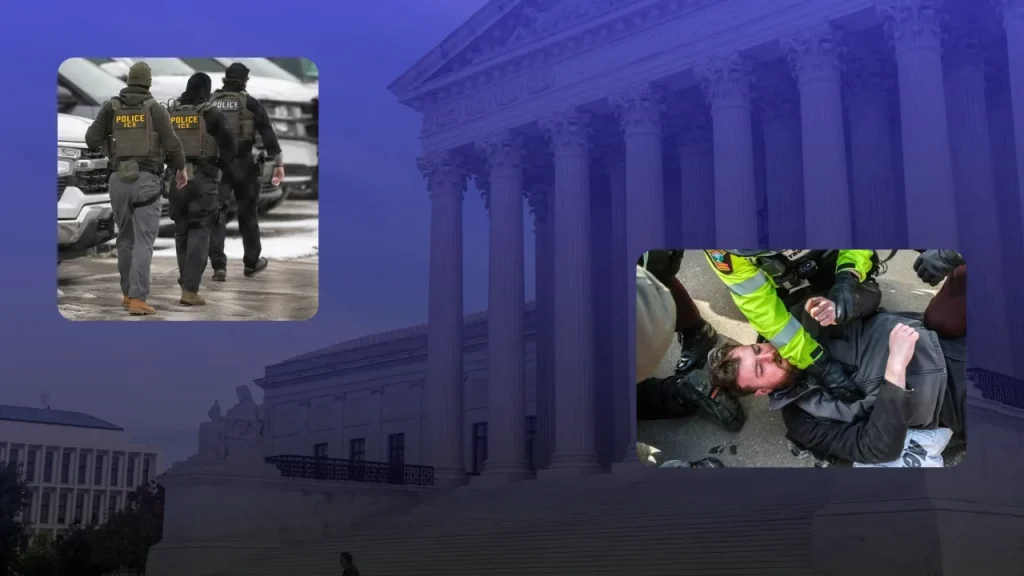
The U.S. Supreme Court hears oral argument today, November 9, 2026, in Nielsen v. Watanabe, No. 25-417. The case asks whether people can keep suing individual federal officers for money damages when they say those officers violated their constitutional rights. The underlying dispute involves a federal prison nurse accused of ignoring an inmate’s serious medical needs after an assault. The ruling could still reach well beyond prisons and affect lawsuits against federal law enforcement, including Immigration and Customs Enforcement (ICE).
The legal doctrine at the center of the case is Bivens. It allows people to seek money damages from individual federal officers in a small number of constitutional-violation cases. Francis Nielsen, the nurse, argues the Court should reject the claim against him, and the U.S. Department of Justice supports him. Kekai Watanabe argues his case fits an existing Supreme Court precedent, Carlson v. Green.
Key distinction: the Supreme Court is not deciding whether ICE agents committed misconduct in any incident. It is deciding when a federal officer can be sued personally for money damages over an alleged constitutional violation.
Nielsen v. Watanabe: Quick Facts
| Case detail | Information |
| Supreme Court case | Nielsen v. Watanabe |
| Docket number | No. 25-417 |
| Petitioner | Francis Nielsen (prison nurse, defendant in the lower courts) |
| Respondent | Kekai Watanabe (federal inmate who sued) |
| Original lower-court case | Watanabe v. Derr, U.S. District Court for the District of Hawaii |
| Decision below | Watanabe v. Derr, 115 F.4th 1034 (9th Cir.) |
| Ninth Circuit case number | No. 23-15605 |
| Underlying events | July 12, 2021 assault at the Federal Detention Center in Honolulu and alleged inadequate medical care |
| Constitutional provision | Eighth Amendment |
| Main legal doctrine | Bivens |
| Certiorari granted | June 22, 2026 |
| Oral argument | November 9, 2026 |
| Supreme Court decision | None issued as of November 9, 2026 |
| Official Supreme Court docket | Docket No. 25-417 |
What Happened to Kekai Watanabe at the Federal Detention Center in Honolulu?
According to Watanabe’s court filings, other inmates attacked him on July 12, 2021, at the Federal Detention Center in Honolulu, Hawaii. He suffered injuries and reported significant pain. Prison staff documented his injuries and placed him in solitary confinement.
Watanabe alleges that when he saw Nielsen, he was still in severe pain, which he rated 10 out of 10. He says Nielsen dismissed his complaints, told him to stop being a “crybaby,” and refused to send him to a hospital. He further alleges he stayed in solitary confinement for more than two months and kept asking for care that never adequately addressed his condition.
A February 2022 X-ray reportedly showed a fractured coccyx (tailbone), with bone fragments that had migrated into surrounding soft tissue. In his Supreme Court brief, Watanabe says he continues to be in “tremendous pain.”
His legal theory is not that a medical professional made a mistaken diagnosis. He claims a federal prison employee knew of a serious medical problem and deliberately ignored it, which matters under the Eighth Amendment.
These are allegations. Nielsen has not been found liable. The Supreme Court is deciding whether the lawsuit may proceed under Bivens. It is not deciding whether every factual allegation is true, and it is not awarding damages.
How Did Watanabe v. Derr Reach the Supreme Court?
Watanabe filed his federal lawsuit in the U.S. District Court for the District of Hawaii in early 2022, under the title Watanabe v. Derr. He sued several prison officials. The district court let part of the case proceed but dismissed the Bivens claim against Nielsen. It reasoned that the claim presented a new context the Supreme Court had never approved, and that other remedies were available.
The Ninth Circuit Reversed the Dismissal in Watanabe v. Derr
On September 6, 2024, a divided three-judge Ninth Circuit panel (2–1) reversed. The majority held that Watanabe’s Eighth Amendment medical-care claim was materially identical to the one the Supreme Court allowed in Carlson v. Green (1980). Both involve alleged deliberate indifference by federal prison medical staff. The panel did not decide that Nielsen was liable. It decided only that a cause of action was available.
The Ninth Circuit later denied rehearing en banc, with judges disagreeing sharply over how far Bivens should extend. Nielsen petitioned the Supreme Court in October 2025, and the Court granted review on June 22, 2026.
What Is the Supreme Court Deciding in Nielsen v. Watanabe?
The question presented is whether the Ninth Circuit erred in recognizing a Bivens cause of action. That is narrower than asking whether federal agents can ever be sued. The Court is examining whether Watanabe’s specific claim falls within the limited circumstances where federal courts have allowed damages suits against federal officers.
Constitutional rights and legal remedies are different things. A person may have a constitutional right against an unreasonable search, but whether that person can recover money from a federal officer for violating it is a separate question. That distinction is the foundation of this case.
What Is a Bivens Lawsuit Against a Federal Officer?
A Bivens lawsuit is a civil action seeking money damages from an individual federal officer for certain constitutional violations. It comes from Bivens v. Six Unknown Named Agents of the Federal Bureau of Narcotics, 403 U.S. 388 (1971). Federal narcotics agents allegedly entered a man’s home without a proper warrant, searched it and arrested him. The Court held he could seek damages for the Fourth Amendment violation. Congress never passed a general statute creating this remedy. The Court recognized it by interpreting the Constitution and federal judicial authority.
The Court recognized two more settings:
- Davis v. Passman, 442 U.S. 228 (1979): a Fifth Amendment sex-discrimination damages claim by a congressional employee against a former member of Congress.
- Carlson v. Green, 446 U.S. 14 (1980): an Eighth Amendment damages claim over alleged deliberate indifference to a federal prisoner’s serious medical needs. The prisoner in Carlson died after an asthma attack.
These three cases are the only settings in which the Supreme Court has recognized a Bivens remedy. The doctrine has been sharply restricted since.
How Did Bivens Shrink? Supreme Court Decisions From Bush v. Lucas to Egbert v. Boule
- Bush v. Lucas, 462 U.S. 367 (1983): no Bivens remedy for a federal employee’s First Amendment claim, because Congress had built a civil-service remedial system.
- Chappell v. Wallace, 462 U.S. 296 (1983) and United States v. Stanley, 483 U.S. 669 (1987): no Bivens claims for military service members over incidents tied to military service.
- Correctional Services Corp. v. Malesko, 534 U.S. 61 (2001): no Bivens action against a private corporation operating a federal prison.
- Wilkie v. Robbins, 551 U.S. 537 (2007): no Bivens remedy for a landowner’s retaliation and harassment claim.
- Minneci v. Pollard, 565 U.S. 118 (2012): no Bivens claim against employees of a privately operated federal prison where state tort law offered an alternative remedy.
- Ziglar v. Abbasi, 582 U.S. 120 (2017): refused a Bivens remedy for post-September 11 detention-policy claims and set out the modern two-step test. Courts ask whether the claim arises in a “new context,” and if so, whether “special factors” suggest Congress should decide whether to create a damages remedy.
- Hernández v. Mesa, 589 U.S. 93 (2020): refused a remedy for a fatal cross-border shooting by a Border Patrol agent, citing foreign relations and national security.
- Egbert v. Boule, 596 U.S. 482 (2022): refused a remedy for excessive-force and retaliation claims against a Border Patrol agent, and said courts should generally leave new damages remedies to Congress.
Hernández and Egbert matter for ICE-related litigation because they show that allegations against border or immigration officers do not automatically carry a right to damages. But they did not declare every lawsuit against a federal agent invalid.
What Do Nielsen, the Justice Department and Watanabe Argue?
Nielsen’s Argument: Watanabe’s Claim Is a New Context Under Bivens
Nielsen’s merits brief argues Watanabe’s claim fails both steps of the “demanding two-part test.” He says the context is new because Carlson involved a fatal injury, while Watanabe survived an assault and alleges a serious but nonfatal injury. He also points to the available prison grievance procedures and the legislative framework that now governs federal prisons. His broader position is that courts should not create new financial remedies against federal employees without congressional authorization.
Nielsen also asks the Justices to go further and overrule the Bivens line of cases, describing this case as a chance to be “the final installment of the Bivens saga,” in Watanabe’s brief’s words. The Court is not required to accept that invitation.
The Department of Justice’s Argument as Amicus Supporting Nielsen
The federal government filed as a friend of the court supporting Nielsen and urges the Justices to shut down Watanabe’s claim. It relies on the Bureau of Prisons’ Administrative Remedy Program (codified after a 1979 rulemaking, 44 Fed. Reg. 62,250), the Prison Litigation Reform Act and other oversight measures, arguing the legal landscape has changed since Carlson. A Solicitor General’s Office lawyer is scheduled to argue for the government.
Watanabe’s Argument: Carlson v. Green Already Covers His Claim
Watanabe argues the Ninth Circuit correctly applied existing precedent, and that his claim is identical to Carlson in all meaningful respects:
- Both involve federal prison inmates.
- Both involve medical personnel in a federal prison.
- Both allege deliberate indifference to serious medical needs.
- Both rest on the Eighth Amendment.
He argues the Constitution protects prisoners from unnecessary suffering, not only from neglect that ends in death. On alternative remedies, he says a grievance process can ask the prison to fix a problem but does not compensate someone for pain already suffered, and that he tried and failed to obtain relief administratively. He also contends Congress, through the Westfall Act and the Prison Litigation Reform Act, did not eliminate constitutional damages claims, and that his brief points to centuries of common-law support for damages remedies.
Amicus Briefs Supporting Watanabe
Law professor Stephen Vladeck filed an amicus brief arguing that Bivens and Carlson were proper exercises of the federal courts’ common-law authority. Another amicus brief argues that Farmer v. Brennan itself was adjudicated as a Bivens action, so overruling Bivens would unsettle that decision too.
The Dispute Over the Bureau of Prisons Administrative Remedy Program
Nielsen and the government treat the Administrative Remedy Program as an alternative remedy the Court should weigh against recognizing a damages claim. Watanabe disputes that, arguing a similar grievance process already existed before the 1979 regulation, so it is not a new development since Carlson. Nielsen’s brief responds that the program cannot be dismissed based on its date of creation. This matters because the Court has treated alternative remedial structures as a reason to hesitate before recognizing a damages action.
Which Laws Matter in Nielsen v. Watanabe? Eighth Amendment, PLRA, FTCA, Westfall Act and Section 1983
| Law or doctrine | Why it matters |
| Eighth Amendment | Prohibits cruel and unusual punishment, including deliberate indifference to a prisoner’s serious medical needs. |
| Bivens doctrine | A limited judicial damages remedy against individual federal officers. |
| Prison Litigation Reform Act, 42 U.S.C. § 1997e | Requires exhaustion of available administrative remedies and limits some inmate damages claims. |
| Bureau of Prisons Administrative Remedy Program, 28 C.F.R. §§ 542.10–542.19 | The BP-9 / BP-10 / BP-11 grievance process the government cites as an alternative remedy. |
| 18 U.S.C. § 3626 | Restricts prospective relief in federal prison-conditions litigation. |
| Federal Tort Claims Act, 28 U.S.C. §§ 1346(b), 2671–2680 | Allows certain tort claims against the United States itself, subject to conditions and exceptions. |
| Westfall Act, 28 U.S.C. § 2679 | Makes the FTCA the exclusive remedy for covered state-law tort claims against federal employees, but § 2679(b)(2)(A) preserves suits for constitutional violations. |
| 42 U.S.C. § 1983 | Authorizes suits against state and local officials, not federal officers. |
| 18 U.S.C. § 242 | Criminalizes willful deprivation of rights under color of law. Does not create a private damages claim. |
| Federal Prison Oversight Act of 2024 | Adds federal prison oversight and complaint-review structures the government cites. |
| Prison Rape Elimination Act | Part of the federal prison safety framework the government discusses. |
| Qualified immunity | A separate defense that can defeat a damages claim even when a cause of action exists. |
Estelle v. Gamble and Farmer v. Brennan: What Deliberate Indifference Means Under the Eighth Amendment
Estelle v. Gamble, 429 U.S. 97 (1976), held that deliberate indifference to a prisoner’s serious medical needs can violate the Eighth Amendment. Not every medical mistake or disagreement over treatment qualifies. Under Farmer v. Brennan, 511 U.S. 825 (1994), an official must know of and disregard a substantial risk to an inmate’s health or safety, and negligence alone is not enough. That is why Watanabe’s allegations about Nielsen’s knowledge of his pain and refusal to arrange further treatment matter.
Prison Litigation Reform Act: 42 U.S.C. § 1997e Exhaustion Rules
Under 42 U.S.C. § 1997e(a), prisoners must exhaust available administrative remedies before suing over prison conditions. In Booth v. Churner, 532 U.S. 731 (2001), the Court held this applies even where the grievance process cannot award money damages. Porter v. Nussle, 534 U.S. 516 (2002), applies it to all inmate suits about prison life, and Ross v. Blake, 578 U.S. 632 (2016), says a remedy must actually be “available” to count. Section 1997e(e) also bars federal claims for mental or emotional injury in custody without a prior showing of physical injury. Watanabe alleges a physical injury, a fractured tailbone, but that does not by itself establish a Bivens cause of action.
Bureau of Prisons Administrative Remedy Program: BP-9, BP-10 and BP-11
Under 28 C.F.R. Part 542, a federal prisoner generally follows these steps:
- Attempt informal resolution.
- File a written complaint with the warden (BP-9).
- Appeal to the regional director (BP-10).
- Make a final appeal to the Bureau of Prisons’ General Counsel (BP-11).
The program can lead the Bureau to investigate and correct an ongoing problem, but it does not produce a court judgment compensating someone for past physical injury. That gap is central to Watanabe’s argument.
Federal Tort Claims Act: 28 U.S.C. §§ 1346(b) and 2675
The Federal Tort Claims Act (FTCA) permits certain suits against the United States, not the individual officer, for negligent or wrongful acts of federal employees within the scope of employment. It requires presenting an administrative claim to the agency first (28 U.S.C. § 2675(a)), has a two-year filing deadline (§ 2401(b)), bars punitive damages (§ 2674), and has exceptions, including the discretionary-function exception (§ 2680(a)) and an intentional-tort exception with a law-enforcement proviso (§ 2680(h)). It is not a general constitutional damages statute.
In Carlson v. Green, the Court held a Bivens claim could proceed even though the FTCA offered a parallel remedy. The government now argues that later developments weaken that reasoning.
In Martin v. United States, No. 24-362 (U.S. June 12, 2025), the Supreme Court held that the Supremacy Clause does not bar FTCA claims arising from a wrong-house FBI raid, and sent the case back for further proceedings. That decision matters for readers because it shows the FTCA remains a live path against the government even as Bivens narrows.
Westfall Act: 28 U.S.C. § 2679(b)(2)(A) and the Constitutional-Claim Exception
The Westfall Act, formally the Federal Employees Liability Reform and Tort Compensation Act of 1988, generally makes the FTCA the exclusive remedy for covered state-law tort claims against federal employees. Section 2679(b)(2)(A) exempts civil actions for violations of the Constitution. Watanabe relies on that exception. The opposing view is that preserving it is different from Congress creating or expanding a Bivens remedy.
Qualified Immunity: Harlow v. Fitzgerald and Pearson v. Callahan
Even if a Bivens claim is allowed, qualified immunity can shield an officer unless the conduct violated clearly established law. See Harlow v. Fitzgerald, 457 U.S. 800 (1982), and Pearson v. Callahan, 555 U.S. 223 (2009). It is a separate hurdle, and it is why successful damages judgments against federal officers have been rare.
Statute-Specific Bars: Hui v. Castaneda and 42 U.S.C. § 233(a)
Some federal employees are shielded by specific statutes. In Hui v. Castaneda, 559 U.S. 799 (2010), the Court held that 42 U.S.C. § 233(a) makes the FTCA the exclusive remedy for claims against Public Health Service personnel, which bars Bivens suits against them. This shows how the defendant’s employer and role can decide whether a damages route exists at all.
42 U.S.C. § 1983 and 18 U.S.C. § 242: Section 1983 vs. Federal Officers
Section 1983 covers people acting under color of state law, so federal employees are not ordinarily sued under it. Bivens has been the narrower federal counterpart. Under 18 U.S.C. § 242, willfully depriving someone of constitutional rights under color of law is a federal crime, but it is enforced by the government and gives no private damages claim.
Could Nielsen v. Watanabe Affect Lawsuits Against ICE Agents?
It could affect some lawsuits against federal law enforcement officers, but it would not automatically end every claim against ICE or other agencies. Bivens is one route to damages, not the only one. Hernández and Egbert already make new Bivens claims in border and immigration contexts hard to bring. The outcome here could go three ways.
A narrow ruling on federal prison medical care. The Court could reject Watanabe’s claim because of the prison grievance system and later legislation. That would directly hurt similar prison medical-care suits, and its reasoning could influence others.
A broad ruling limiting or overruling Bivens. If the Court accepts Nielsen’s invitation, people seeking damages directly from federal officers could face an even narrower path, including in Fourth Amendment search, excessive-force and retaliation cases. The effect would depend on the opinion’s reasoning and scope.
A ruling for Watanabe. The Court could hold his claim falls within the existing Carlson context. That would preserve a damages route for this type of claim. It would not give every person with a complaint against a federal agent a right to sue or recover money.
Can You Still Sue ICE or Other Federal Officers After Nielsen v. Watanabe?
Yes, but the route depends on the facts, the defendant and the right allegedly violated:
- A qualifying constitutional claim against an individual federal officer may fall under Bivens, but the doctrine is narrow.
- A qualifying negligence or other tort claim against the United States may fall under the Federal Tort Claims Act.
- A constitutional claim against a state or local officer may fall under 42 U.S.C. § 1983.
- In appropriate cases, a person may seek prospective relief (an injunction) to stop an ongoing unlawful government action.
- Criminal civil-rights investigations may be possible under 18 U.S.C. § 242, but prosecution is controlled by the government.
For examples, see our related coverage:
- Has Anyone Sued ICE and Won? Court Victories, Legal Grounds, and What These Cases Achieved
- Renee Good Lawsuit, Family Sues U.S. Government and Federal Officials Over January ICE Shooting
- Trina Martin FBI Lawsuit, Appeals Court Lets Fourth Amendment Claim Against Agent Continue After Wrong-House Raid
These cases involve different facts and legal theories and should not be treated as interchangeable with Nielsen v. Watanabe.
What Happens Next in Nielsen v. Watanabe After Oral Argument?
Oral argument takes place today, November 9, 2026. Argument gives the Justices a chance to question the lawyers, but it does not decide the case. Lawyers for Nielsen and Watanabe present, and a Solicitor General’s Office lawyer argues for the United States as amicus supporting Nielsen. The Court’s written opinion, which typically comes months later, will explain whether the Ninth Circuit was right, whether Watanabe’s claim can proceed under Bivens, and how broadly the reasoning applies.
Update note: this section is time-sensitive and should be refreshed after the argument transcript and any opinion are released. Follow the official Supreme Court docket for Nielsen v. Watanabe for orders and the final decision.
Frequently Asked Questions About Nielsen v. Watanabe
Is Nielsen v. Watanabe an ICE lawsuit?
No. It involves Kekai Watanabe’s allegations that a nurse at a federal detention facility in Hawaii ignored his serious medical needs after an assault. The ruling may still affect legal rules used in some suits against federal officers, including immigration agents.
Does Nielsen v. Watanabe mean ICE agents can no longer be sued?
Not automatically. The case concerns whether a Bivens damages remedy is available. Other routes, such as qualifying Federal Tort Claims Act claims or requests for prospective relief, depend on different statutes and requirements.
What constitutional right is at issue in Nielsen v. Watanabe?
The Eighth Amendment’s ban on cruel and unusual punishment. Watanabe alleges deliberate indifference to his serious medical needs.
What is Carlson v. Green and why does it matter here?
Carlson v. Green, 446 U.S. 14 (1980), is the Supreme Court decision allowing a Bivens claim over deliberate indifference to a federal prisoner’s serious medical needs. Watanabe says his case is identical to it, and Nielsen says it is different enough to be a new context.
Can Kekai Watanabe receive money if the Supreme Court rules for him?
Not automatically. A ruling for him would mean his claim may proceed. He would still have to prove the elements of deliberate indifference and overcome defenses such as qualified immunity.
Is Nielsen v. Watanabe a class action or settlement?
No. It is an individual federal civil case before the Supreme Court. There is no settlement fund, claim form or public claims process.
The Bottom Line on Nielsen v. Watanabe
Nielsen v. Watanabe asks a narrow but important question: when can someone obtain money damages from an individual federal officer for an alleged constitutional violation? The underlying facts involve medical care in a federal prison, but the Court’s reasoning could influence other cases against federal officers. The case does not directly decide whether ICE agents can be sued, and it does not automatically grant federal officers immunity. Its significance lies in whether the Court restricts, preserves or reconsiders the already limited Bivens remedy.
The Court’s final written opinion, not the headlines or the argument alone, will determine how far the decision reaches.
Sources
- Supreme Court docket, Nielsen v. Watanabe, No. 25-417
- Question presented, No. 25-417
- Petitioner Nielsen’s merits brief
- Brief for the United States as amicus curiae supporting petitioner
- Respondent Watanabe’s merits brief
- Amicus brief of Professor Stephen Vladeck
- SCOTUSblog: Court to hear argument on whether and when federal officials can be held liable for violations of the Constitution
- Statutes: 42 U.S.C. §§ 1983, 1997e, 233(a); 28 U.S.C. §§ 1346(b), 2401(b), 2671–2680; 18 U.S.C. §§ 242, 3626; 28 C.F.R. §§ 542.10–542.19; 44 Fed. Reg. 62,250 (Oct. 29, 1979)
Disclaimer: This article is general information, not legal advice, and does not create an attorney-client relationship.
Researched and written by Israr Ahmad, legal content researcher and founder of AllAboutLawyer.com. All facts verified against the Supreme Court docket and the parties’ merits and amicus briefs in No. 25-417 (supremecourt.gov), as of November 9, 2026. Last Updated: November 9, 2026.
About the Author
Israr Ahmad is a legal content researcher with 4+ years of experience covering class action settlements and consumer rights cases. He has researched and published coverage of 2,500+ settlements using verified court records, settlement administrator filings, and government sources. Learn more about Israr.