
Alaska Governor Orders Investigation Into Mary Peltola’s Senate Campaign, Can Anyone Be Charged, and Does the Ballot Change?
Alaska Gov. Mike Dunleavy, a Republican, has directed the Alaska Department of Public Safety to investigate whether the U.S. Senate campaign of Democrat Mary Peltola violated state law by helping recruit a second candidate named Dan Sullivan. The other Sullivan shares his name with Republican incumbent Sen. Dan S. Sullivan, Peltola’s opponent. The governor announced the order in a social media post at about 9 p.m. on Wednesday, October 28, 2026.
The order followed a New York Times report published the same day. The report said interviews, text messages and documents indicated that people connected to Peltola’s campaign and senior aides at the Democratic Senatorial Campaign Committee (DSCC) helped recruit retired Petersburg teacher Daniel J. Sullivan Jr. to run. Peltola’s campaign says it “has no involvement with either Sullivan campaign.” The DSCC has also denied involvement, and Sullivan Jr. has said he had no contact with Peltola’s campaign.
An investigation is not a charge. No one has been charged with anything as a result of the governor’s order, the ballot has not changed, and the allegations have not been tested in court. The Times itself noted that “ballot stacking,” meaning encouraging extra candidates to split an opponent’s vote, is common in politics and generally legal.
Alaska’s general election is Tuesday, November 3, 2026, and early voting has already begun.
Alaska Peltola Investigation: Quick Facts
| Detail | Information |
| Investigation ordered | Evening of October 28, 2026 |
| Ordered by | Gov. Mike Dunleavy (R) |
| Investigating agency | Alaska Department of Public Safety |
| Scope of the order | Whether the alleged scheme violated Alaska law, and whether criminal charges or civil action are warranted |
| Campaign at the center | Mary Peltola, Democratic candidate for U.S. Senate |
| Incumbent | Sen. Dan S. Sullivan (R) |
| Second candidate with the same name | Daniel J. Sullivan Jr., retired teacher from Petersburg, listed without party affiliation |
| Charges filed | None as of October 29, 2026 |
| Separate federal lawsuit | Filed by the U.S. Department of Justice against Alaska election officials on October 22, 2026; assigned to Judge Sharon Gleason |
| Separate federal criminal inquiry | Reported by NBC News, Reuters and Fox News; no charges announced |
| Election Day | November 3, 2026 |
What Did the New York Times Report About the Peltola Campaign?
According to the Times report, as summarized by CBS News, CNBC and local Alaska outlets, operatives and aides tied to Peltola’s campaign and the DSCC helped recruit Daniel J. Sullivan Jr. to enter the Senate race. Alaska’s News Source reported that, per the article, the effort began in the summer of 2025 and included searching voter records for Alaskans named Dan Sullivan.
The report also quotes Elisa Rios, Peltola’s former campaign manager, as saying Peltola was aware of the work but was not directly involved. That account conflicts with the campaign’s public denials.
These are allegations drawn from a news report. They are not findings by a court or by investigators.
Why Did Gov. Dunleavy Order the Investigation?
Dunleavy said the reporting “substantially supports” findings the Alaska Division of Elections made earlier this year about Sullivan Jr.’s candidacy. In his post he wrote: “I am therefore directing the Department of Public Safety to investigate whether this scheme violated Alaska’s laws and whether criminal charges or civil action are warranted. The evidence will determine what happens next.”
The Juneau Independent noted that Dunleavy is a strong supporter of both Sullivan and President Donald Trump. Trump said on Wednesday that Peltola should be prosecuted. Those political ties don’t change the legal question, but readers should know about them when weighing the announcement.
An investigation lets authorities gather evidence. A prosecutor would still have to identify a specific offense, prove every element with admissible evidence, and bring a case in court.
Is Recruiting a Same-Name “Spoiler” Candidate Illegal Under Alaska Law?
Not automatically. That is the central unresolved question.
Election-law experts quoted in local coverage describe ballot stacking as common and generally legal. Rick Hasen, who writes the Election Law Blog, argued in a post that it is hard to see how the government could criminalize a person’s running for office with “impure motives.” He asked whether the same logic would make it a crime whenever a party backs a minor-party candidate to hurt a rival. Other lawyers may read the law differently, and no court has decided the point.
Which Alaska statutes could come into play?
Alaska’s election-offense chapter is AS 15.56. Investigators could look at:
- AS 15.56.012, campaign misconduct in the first degree. It applies when a person knowingly engages in conduct that violates a provision of AS 15.13, Alaska’s campaign-finance chapter, or a regulation adopted under it. It is a class A misdemeanor. It would matter only if evidence showed an actual campaign-finance violation, such as unreported spending or contributions, which the public allegations do not themselves establish.
- AS 15.56.014, campaign misconduct in the second degree. It covers certain election-communication offenses, such as specified false or undisclosed campaign communications. It is not a general ban on tactics an opponent calls deceptive.
- AS 15.56.060, unlawful interference with an election. The chapter contains a section by this title. Nothing in the public reporting says investigators are relying on it.
The governor’s order does not name a statute. The list above shows where the law could be relevant, not what anyone will be charged with. You can read the full text in the Alaska Statutes, Title 15, Chapter 56.
Could the First Amendment limit a prosecution?
Possibly. Hasen has argued that prosecuting someone over the motives behind a candidacy raises serious First Amendment concerns. The Alaska Supreme Court has already held that the state’s power over who appears on the ballot is limited to constitutional requirements such as age and residency, not a candidate’s intentions. That ruling concerned ballot access, not criminal liability, but it shows how courts have treated motive-based arguments so far.
Could Mary Peltola or Dan J. Sullivan Jr. Be Removed From the Ballot Before November 3?
The governor’s order does not remove anyone from the ballot. A criminal investigation and a ballot-eligibility decision are separate legal processes.
Earlier this year, Alaska Division of Elections Director Carol Beecher, a Republican appointed by Dunleavy, removed Sullivan Jr. from the ballot. She called him a sham candidate whose purpose was to trick voters. Reporting on her decision says she cited his request to appear on the ballot as “Dan Sullivan,” his switch to Republican registration shortly before filing, his ties to a consultant who has backed Democrats, and a campaign website that resembled the senator’s. Sullivan Jr. has denied trying to confuse voters.
He challenged the decision in court, and the Alaska Supreme Court overruled it, restoring him to the ballot. As of October 29, no order has been reported removing either Peltola or Sullivan Jr. from the November 3 ballot because of the new allegations.
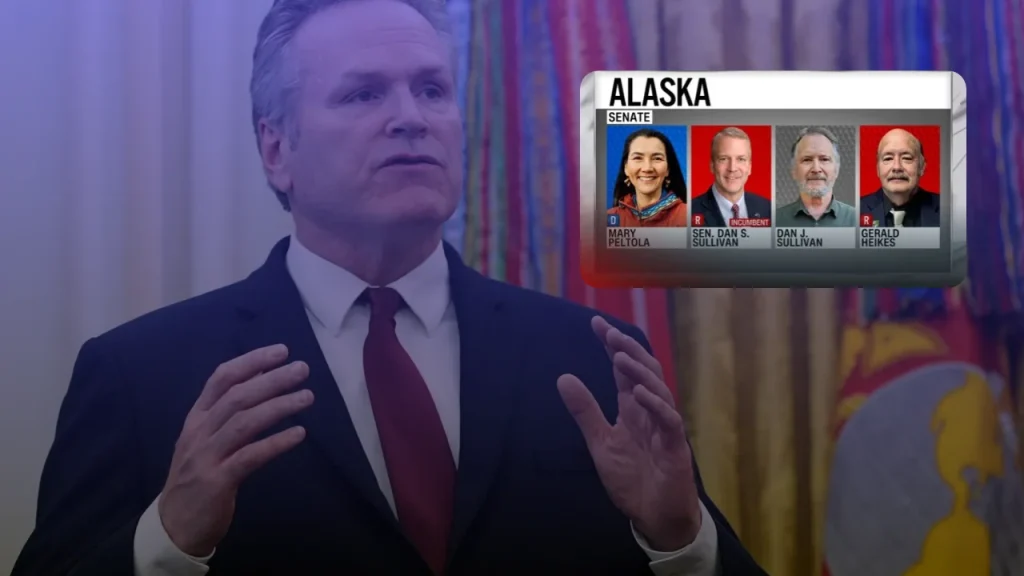
How do voters see the two Sullivans on the ballot?
Four candidates appear in the Senate race: Peltola, incumbent Dan S. Sullivan, Daniel J. Sullivan Jr. and Gerald Heikes. The sample ballot lists the incumbent as a registered Republican and incumbent and lists Sullivan Jr. without party affiliation. Whether those labels are enough to prevent confusion is part of the dispute, but a similar name is not by itself proof of fraud.
What Is the Separate U.S. Department of Justice Lawsuit Against Alaska?
On Thursday, October 22, 2026, the U.S. Department of Justice sued Alaska election officials in federal court. Trump has said he ordered the lawsuit.
The complaint asks the court to block certification of the Senate result if two things are true. First, Dan S. Sullivan does not win. Second, he would have won had all votes cast for Daniel J. Sullivan been cast instead for him and Alaska’s ranked-choice process then played out accordingly. The DOJ relies on the National Voter Registration Act and argues that Sullivan Jr.’s candidacy was designed to confuse voters.
Alaska’s Department of Law, the Peltola campaign and the DSCC all asked Judge Sharon Gleason to dismiss the case before Election Day. The state argues, among other things, that the National Voter Registration Act governs voter registration and does not authorize the DOJ to challenge candidate listings or block certification, and that the Constitution leaves the regulation of congressional elections to the states and Congress. Hasen has also said the suit appears to lack legal standing.
As of the most recent reporting I found, the court had not set a hearing date, and no order blocking certification had been reported.
This lawsuit names the state and its election officials. It does not charge Peltola with a crime.
What federal criminal investigation has been reported?
NBC News and Reuters reported in August that a federal grand jury had issued subpoenas in a probe of Sullivan Jr.’s campaign. Fox News reported on October 28, citing two unnamed sources, that federal prosecutors are conducting an “aggressive criminal investigation” into how Sullivan Jr. got onto the ballot, and that it is expected to continue past Election Day. A Justice Department spokesperson has said the department is taking steps “consistent with the National Voter Registration Act” to protect the integrity of Alaska’s election. No federal charges have been announced.
For another example of the DOJ taking election disputes to court, see DOJ Lawsuit Against California Over Mail-In Ballots: Trump’s Jail Threat, California’s Response and the Laws at Issue. It involves different facts and is not part of the Alaska matter.
Can the President or the Justice Department Stop Alaska From Certifying Its Senate Election?
A presidential statement or a lawsuit does not by itself stop certification. Only a court order can do that, and the DOJ has to show a lawful basis for the relief it seeks. Under the Elections Clause of the U.S. Constitution (Article I, Section 4), states and Congress have the main role in regulating congressional elections, and Alaska argues the federal government has no statute authorizing this suit. The federal court could grant relief, deny it, or resolve the case on other grounds.
For background on other election-law fights in the courts, see Supreme Court Approves Election Lawsuit, Candidates Can Challenge Mail Ballot Laws Without Proving Harm. That case concerns a different issue and does not decide whether the DOJ can block Alaska’s certification.
How Does Ranked-Choice Voting Affect the Two Sullivans?
Alaska uses a top-four primary and ranked-choice voting in the general election. Voters rank candidates in order of preference. If no candidate wins a majority of first-choice votes, the last-place candidate is eliminated and those ballots move to each voter’s next choice, and so on until someone wins.
The DOJ’s theory assumes that votes cast for Sullivan Jr. were really meant for Sen. Sullivan. Alaska’s lawyers dispute that this can be assumed. How many voters actually mix up the two names, if any, would have to be shown with evidence.
What Happens Next in the Peltola Investigation?
- State investigators gather evidence. The Department of Public Safety may review communications, spending and campaign records. Possible outcomes range from no action to a referral to prosecutors, civil action or criminal charges.
- Prosecutors decide whether a specific law was broken. Political coordination alone does not make a crime.
- The federal court rules on the certification lawsuit. That case is separate from the state investigation.
- The election goes ahead on November 3 under the rules and court orders in effect unless a court lawfully changes them. Any criminal or civil findings would likely take longer than the time left before Election Day.
For wider context on the legal fights shaping this year’s elections, see Voting Rules And Legal Challenges Ahead Of The 2026 Midterms, The Complete Picture.
Frequently Asked Questions About the Alaska Peltola Investigation
Has Mary Peltola been charged with a crime?
No. As of October 29, 2026, no criminal charge has been announced. Gov. Dunleavy ordered the Alaska Department of Public Safety to investigate whether Alaska law was violated and whether charges or civil action are warranted.
Did the Peltola campaign recruit the second Dan Sullivan?
The New York Times reported that people connected to the campaign and the DSCC helped recruit him. Peltola’s campaign says it has no involvement with either Sullivan campaign, the DSCC denies involvement, and Daniel J. Sullivan Jr. says he had no contact with the campaign. Peltola’s former campaign manager told the Times that Peltola knew of the effort but was not directly involved. None of this has been proven in court.
Is it illegal to recruit a candidate with the same name as an opponent?
Not automatically. Experts quoted in coverage say ballot stacking is common and generally legal. Specific conduct could still violate Alaska election or campaign-finance law if investigators prove the required elements of an offense.
Can the governor remove Peltola from the ballot?
No. The governor’s order starts an investigation. Ballot changes require a lawful basis and a court or election-official process, and none has been reported.
Why is Daniel J. Sullivan Jr. still on the ballot?
The Alaska Division of Elections removed him earlier this year, but the Alaska Supreme Court overruled that decision, holding that the state’s authority is limited to constitutional requirements such as age and residency rather than a candidate’s intent.
What does the Justice Department lawsuit ask for?
It asks the federal court to block certification of the Alaska Senate result if Dan S. Sullivan loses and the vote-reallocation scenario in the complaint would have changed the outcome. The state and the Peltola campaign have asked for dismissal.
When is Election Day in Alaska?
Tuesday, November 3, 2026.
Sources
- CBS News: Alaska’s governor orders investigation into Peltola campaign over allegedly recruiting second Dan Sullivan
- Juneau Independent: Dunleavy orders state criminal investigation into Peltola campaign ballot-stacking allegations
- CNBC: Peltola campaign aides, DSCC officials helped recruit second Dan Sullivan in Alaska race: NYT
- NBC News: Democrats ask judge to dismiss Trump administration’s challenge to Alaska Senate race
- Alaska’s News Source (KTUU): NYT report on Peltola team and Dan Sullivans
- Election Law Blog: DOJ issues grand jury subpoenas in “Dan J. Sullivan” case
- Alaska Statutes, Title 15, Chapter 56: Election Offenses, Corrupt Practices, and Penalties
Disclaimer: This article is general information, not legal advice. AllAboutLawyer.com is not a law firm. The allegations described have not been proven, and the investigation and lawsuit may change quickly.
Researched and written by Israr Ahmad, legal content researcher and founder of AllAboutLawyer.com. All facts verified against reporting by CBS News, CNBC, NBC News, the Juneau Independent and Alaska’s News Source, the Election Law Blog, and the text of Alaska Statutes AS 15.56.012, as of October 29, 2026. Last Updated: October 29, 2026.
About the Author
Israr Ahmad is a legal content researcher with 4+ years of experience covering class action settlements and consumer rights cases. He has researched and published coverage of 2,500+ settlements using verified court records, settlement administrator filings, and government sources. Learn more about Israr.