
California Noncitizen Voter Registration Lawsuit, DOJ Seeks to Block Counting of 20,000 Mail Ballots
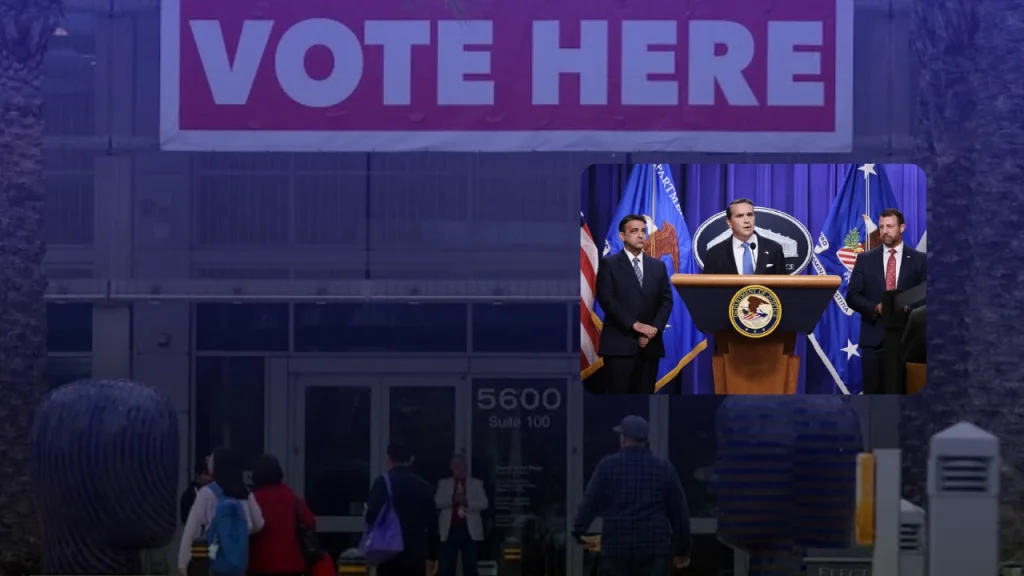
The U.S. Department of Justice (DOJ) has sued California over its handling of voter registration records and mail ballots ahead of the November 3, 2026, general election.
The complaint, filed October 15, 2026, in federal court, alleges that federal agencies identified more than 20,000 people who are registered to vote in California and whom federal officials consider likely noncitizens. The DOJ asks the court to stop California from counting returned mail ballots from those individuals until their U.S. citizenship is verified.
California Secretary of State Shirley N. Weber and Los Angeles County Registrar-Recorder/County Clerk Dean C. Logan dispute the federal approach. They say the underlying data and methodology were not adequately provided, and that election officials cannot withhold ballots from registered voters based only on an unverified list shortly before an election.
As of October 16, 2026, this is a pending lawsuit, not a court finding. It does not establish that all 20,000 people are noncitizens, that all of them received or returned ballots, or that California has a law allowing noncitizens to vote in federal elections.
Quick Facts: United States v. California Noncitizen Voter Registration Lawsuit
| Detail | Verified information |
| Plaintiff | United States of America |
| Defendants | State of California; Secretary of State Shirley N. Weber (official capacity); Los Angeles County Registrar-Recorder/County Clerk Dean C. Logan (official capacity) |
| Case name | United States of America v. State of California, Shirley N. Weber, and Dean C. Logan |
| Case number | 2:26-cv-12025 |
| Court | U.S. District Court for the Central District of California |
| Complaint filed | October 15, 2026 |
| Federal agencies involved | U.S. Citizenship and Immigration Services (USCIS) and Homeland Security Investigations (HSI) |
| People identified by federal agencies | More than 20,000, according to the DOJ complaint |
| Main legal theory | Counting the identified ballots would violate the Supremacy Clause and conflict with 18 U.S.C. § 611 |
| Requested relief | Declaratory relief, a preliminary and permanent injunction against tabulating ballots from listed individuals until citizenship is verified, and litigation costs |
| California’s response | Officials dispute the evidence and the proposed ballot-handling process |
| Current status | Complaint filed; no order granting the requested injunction was identified in the public sources reviewed |
| Damages or settlement | None; this is not a consumer compensation program |
| Public claim form | None; this is a government enforcement lawsuit, not a class action |
The primary filing is the DOJ’s official complaint, Case No. 2:26-cv-12025. The DOJ’s October 15 announcement summarizes the government’s position.
What the DOJ Alleges About More Than 20,000 California Voter Records
The complaint says federal agencies compared California voter-registration information with federal immigration and citizenship records. According to the DOJ, USCIS and HSI used multiple data-enrichment and verification methods to identify people federal officials believe are likely noncitizens.
The DOJ alleges that because California mails ballots to registered voters, the people on its list may have received ballots for the November 3 general election. It says election officials were notified of the list and asked to verify citizenship within 48 hours, and that California did not complete that review in that time.
These are allegations in a complaint. No court has ruled on them.
How USCIS and HSI Say They Identified the California Voter List
The complaint describes a multistep federal review rather than a simple name-only comparison. It says USCIS examined immigration records, checked for evidence of naturalization, consulted other federal records and applied additional review before referring potential cases to HSI.
California officials say the federal government did not give them the data and methodology needed to evaluate the list independently. That gap matters because a person can appear in immigration records and later naturalize, acquire citizenship through a parent, or have records that no longer reflect current status. The DOJ says its process accounts for such circumstances. California says the information supplied for this request was not enough to verify the listed individuals.
A person’s citizenship status cannot be inferred from appearing on a government-generated list.
Does the DOJ Lawsuit Prove That 20,000 Noncitizens Voted in California?
No. The complaint concerns more than 20,000 registered voters whom federal agencies identified as likely noncitizens. That is different from proving that every person is a noncitizen, that each received a ballot, that any particular person returned a ballot, or that any returned ballot was counted.
The distinction between a registration record, a mailed ballot, a returned ballot and a counted ballot is central to understanding this case.
Related article: Ohio BMV Specialty Military License Plate Class Action Settlement, Refunds for 100% Disabled Veterans
What California Secretary of State Shirley Weber Says About the DOJ Lawsuit
Secretary of State Weber responded in a letter dated October 15, 2026. She said her office received a demand to review a list of people the federal government believed were likely noncitizens, but the DOJ had not provided the list directly to her office.
She also said California had asked for the data and methodology behind an earlier federal allegation, made in July 2026, that more than 190,000 registered voters might be noncitizens, and that the federal government had not provided that explanation.
Weber objected to reviewing roughly 20,000 people within 48 hours, fewer than three weeks before the election. She argued that treating listed voters as ineligible without verifiable evidence could unlawfully deprive eligible citizens of their right to vote. Her office also says California has its own procedures for verifying eligibility and maintaining accurate voter lists.
California’s position does not establish that every listed person is a citizen. It argues that officials need reliable evidence and a lawful process before refusing to count particular voters’ ballots.
Read the Secretary of State’s October 15 letter to the DOJ for the full response.
Why Los Angeles County Registrar Dean Logan Rejected the Federal USB Drive
According to Registrar-Recorder/County Clerk Dean Logan, Los Angeles County received the federal list on a protected USB drive on October 13, 2026. In an October 14 statement, Logan said the device came with a handwritten note containing a password. His office declined to open it because staff considered the medium inconsistent with information-security and privacy protocols.
The county said the correspondence did not identify how many people were involved or adequately describe the records. In an October 15 statement, Logan said the county had formally responded to the DOJ’s October 13 correspondence, that the list referenced individuals throughout California rather than only Los Angeles County, and that election officials cannot refuse to count ballots based solely on unverified allegations. The county said it would continue following established procedures while the lawsuit proceeds.
Official statements are posted on the Los Angeles County Registrar-Recorder/County Clerk press-release page.
What the DOJ Wants the Central District of California to Order
The complaint contains one main claim: that California’s alleged handling of ballots from people identified as likely noncitizens violates the Supremacy Clause (U.S. Const. art. VI, cl. 2) because it conflicts with federal law prohibiting noncitizen voting in federal elections.
The DOJ asks the court to:
- Declare that California’s challenged actions, as applied to the identified people, are preempted by federal law.
- Issue a preliminary and permanent injunction preventing California from tabulating mail ballots received from the listed individuals until their citizenship is verified.
- Award the United States its litigation costs and fees.
The complaint does not seek damages for private citizens and does not create a public claims process. It is also narrower than an order to purge every potentially ineligible voter. It focuses on ballots from the people on the federal list, not on every California mail ballot or registration.
Federal and California Laws at the Center of the Noncitizen Voter Registration Lawsuit
18 U.S.C. § 611: Federal Ban on Noncitizen Voting in Federal Elections
The federal statute on voting by aliens, 18 U.S.C. § 611, makes it generally unlawful for a noncitizen to vote in an election held wholly or partly to choose candidates for federal office, including President, Vice President, presidential electors, U.S. Senator and U.S. Representative.
It includes a narrow exception for elections that also contain a separate local or nonfederal question, where state or local law allows noncitizens to vote on that question and the voting is conducted independently of the federal contests. Violations carry criminal penalties.
The DOJ relies on this prohibition. California does not dispute that noncitizens are generally ineligible to vote in federal elections. The disagreement is over the reliability of the federal list and the authority to withhold ballots based on it without further verification.
18 U.S.C. § 1015(f): False Claims of U.S. Citizenship to Register or Vote
Separately, 18 U.S.C. § 1015(f) makes it a federal crime to knowingly make a false claim of U.S. citizenship in order to register to vote or to vote in a federal, state or local election. This statute is not the basis of the DOJ’s civil complaint, but it is the provision most often cited when individual noncitizens are prosecuted for registering or voting.
Immigration Consequences of Unlawful Voting Under 8 U.S.C. §§ 1182 and 1227
Federal immigration law attaches serious consequences to unlawful voting by noncitizens. Under 8 U.S.C. § 1182(a)(10)(D), a noncitizen who has voted unlawfully in a federal, state or local election is generally inadmissible, and under 8 U.S.C. § 1227(a)(6), such a person can be deportable. Individual outcomes depend on the facts, including whether a person actually knew they were ineligible. Anyone with questions about their own situation should consult a licensed immigration attorney.
Help America Vote Act, 52 U.S.C. § 21083: Statewide Voter Registration Lists
The Help America Vote Act (HAVA) requires each state to maintain a computerized statewide voter registration list and to perform list maintenance, including removing ineligible voters in line with the National Voter Registration Act. 52 U.S.C. § 21083 also requires identity-matching information, such as a driver’s license number or the last four digits of a Social Security number, on registration applications. The DOJ may point to HAVA’s list-maintenance duties, while California will point to its existing verification procedures.
National Voter Registration Act’s 90-Day Rule, 52 U.S.C. § 20507(c)(2)(A)
The National Voter Registration Act (NVRA) bars states from completing any systematic program to remove ineligible voters from registration lists within 90 days before a federal election, subject to specified exceptions. The provision is 52 U.S.C. § 20507(c)(2)(A).
For the November 3, 2026, election, the 90-day period began on August 5, 2026. The DOJ’s October 13 request came after that date. Secretary Weber argues that requiring officials to treat thousands of voters as ineligible right before the election conflicts with federal and state law, including this rule.
There is an important wrinkle. The DOJ is not simply asking the court to delete 20,000 names from the rolls. It asks for an order against tabulating certain ballots until citizenship is verified. Whether the 90-day rule controls that remedy is a legal question the court has not resolved. The NVRA also contains criminal penalties for voter-registration fraud and intimidation at 52 U.S.C. § 20511.
California Constitution Article II, Section 2 and Elections Code Section 2101
Under Article II, Section 2 of the California Constitution, a person who is a U.S. citizen, at least 18 years old and a California resident, and who is not imprisoned or on parole for a felony or found mentally incompetent by a court, is entitled to vote. California Elections Code § 2101 repeats these qualifications for registration. Together they make U.S. citizenship a statewide requirement for registering and voting in California elections.
California Elections Code Section 2150: Citizenship Affirmation on the Registration Form
The Secretary of State states that applicants must affirm U.S. citizenship on the registration form, and an application that leaves the citizenship checkbox blank is not accepted. California’s voter registration requirements describe the process. Elections Code § 2150 governs the contents of the registration affidavit.
California Motor Voter Program and AB 60 Driver’s Licenses
California’s Motor Voter program automatically registers eligible people during certain Department of Motor Vehicles (DMV) transactions. The program does not make noncitizens eligible to vote. The Secretary of State says it applies to citizens who meet the other eligibility requirements and excludes holders of AB 60 driver’s licenses, which California issues under Vehicle Code § 12801.9 regardless of immigration status.
The existence of automatic registration does not by itself show that California law permits noncitizens to register. The DOJ’s theory is that people who should not be eligible are still on the rolls, and that California has not taken the steps the government demanded.
Elections Clause and Supremacy Clause: Who Controls Election Rules?
The U.S. Constitution’s Elections Clause (art. I, § 4, cl. 1) gives states the power to set the “times, places and manner” of congressional elections, subject to alteration by Congress. The Supremacy Clause makes valid federal law override conflicting state law. The Supreme Court addressed this relationship in Arizona v. Inter Tribal Council of Arizona, Inc., 570 U.S. 1 (2013), but it also recognized that states set voter qualifications. That tension is where this case sits: the DOJ says federal law preempts California’s ballot handling, while California says it is applying its own eligibility rules and procedures.
Preliminary Injunction Standard Under Federal Rule 65 and Winter v. NRDC
Because the DOJ seeks a preliminary injunction, it must meet the standard in Federal Rule of Civil Procedure 65 and Winter v. Natural Resources Defense Council, Inc., 555 U.S. 7 (2008). A party generally must show a likelihood of success on the merits, a likelihood of irreparable harm without relief, that the balance of equities favors it and that an injunction serves the public interest.
The Purcell Principle: Court Orders Close to Election Day
Courts are often reluctant to change election rules close to an election. This idea comes from Purcell v. Gonzalez, 549 U.S. 1 (2006), which warned that late court orders can confuse voters and election officials. Both sides may invoke it. California can argue that withholding ballots weeks before November 3 would disrupt an election already under way, while the DOJ can argue the requested order is narrow and necessary to protect federal contests.
How the October 9 Common Cause v. DOJ Ruling Relates to the California Lawsuit
On October 9, 2026, the U.S. District Court for the District of Columbia ruled against the DOJ’s broader voter-list maintenance policy in Common Cause v. U.S. Department of Justice, No. 1:26-cv-01352-SLS. Secretary Weber cited that decision in her October 15 letter, arguing that the federal request appeared to rely on a policy the court had vacated.
The California case differs. The DOJ seeks an injunction focused on ballots tied to a specific list of people it says are likely noncitizens, not just access to a statewide registration database. The earlier ruling may bear on how the government obtained and used voter data, but it does not by itself decide whether the DOJ can get the ballot-counting order it requests here.
For background on that decision, read our article Federal Judge Blocks DOJ Voter-Roll Checks, What the Ruling Means for Voters and Their Privacy.
Does the California Voter Registration Lawsuit Mean Noncitizens Can Vote?
No. Federal law generally prohibits noncitizens from voting in federal elections, and California’s statewide qualifications require U.S. citizenship. The lawsuit does not challenge a California statute that expressly lets noncitizens vote for federal candidates. It asks whether California may keep processing ballots from people federal agencies identify as likely noncitizens while their status is disputed.
For the broader legal picture, including registration systems and the narrow local-election exception, see our guide Can Non-Citizens Vote in California? What the Law Says.
What California Voters Should Do While the DOJ Lawsuit Is Pending
As of October 16, 2026, the DOJ has filed its complaint, but no order granting the requested injunction was identified in the public sources reviewed. The complaint does not automatically invalidate mail ballots or require every voter to submit citizenship documents. Voters concerned about their registration or ballot can take these steps.
Step 1: Check Your Registration With the California Secretary of State’s My Voter Status Tool
Use the Secretary of State’s My Voter Status tool to confirm your registration information. If something is wrong, or you receive a notice about eligibility, contact your county elections office using the details on its official website.
Step 2: Track Your California Mail Ballot Through Official Election Channels
Check ballot status through the Secretary of State’s resources or your county registrar’s website and follow the usual return procedures. Do not assume the lawsuit changes your ballot’s status unless an election official tells you about a specific issue or a court enters an order affecting the process.
Step 3: Respond Carefully if a California Election Office Questions Your Citizenship
If you are contacted about a citizenship concern, ask the election office what specific issue must be resolved and how to submit any supporting information securely. Keep copies of official correspondence. Do not send identity documents to an unsolicited caller, text message or unofficial website claiming to represent the DOJ or a county election office. Eligible voters who believe they were wrongly challenged can ask the county elections office about the formal process for correcting the problem.
Step 4: Understand That There Is No Claim Form or Compensation Process
This is not a class-action settlement. The DOJ seeks court-ordered relief about ballot counting, not payments to the public. No claim form or compensation deadline arises from this lawsuit.
What Happens Next in United States v. California, Case No. 2:26-cv-12025
The case is at an early stage. Likely next steps include responses from California, Secretary Weber and Registrar Logan, briefing on the DOJ’s request for a preliminary injunction, a possible hearing or ruling on emergency relief, and further litigation over the evidence and legal theory.
The court may weigh whether the federal list is reliable, whether the facts justify an injunction, how the NVRA’s 90-day rule and Purcell concerns apply, and how any remedy could operate without withholding ballots from eligible citizens. The central question remains open: whether federal authorities can require California to hold the identified ballots until citizenship is verified.
Key Dates in the DOJ v. California Voter Registration Lawsuit
| Date | Event |
| July 16, 2026 | California says it received an earlier federal allegation that more than 190,000 registered voters might be noncitizens. |
| July 23, 2026 | Secretary Weber says she requested the data and methodology behind that allegation. |
| August 5, 2026 | The NVRA 90-day period before the November 3 federal general election began. |
| October 1, 2026 | Los Angeles County began mailing vote-by-mail ballots for the November 3 election. |
| October 9, 2026 | The D.C. federal court’s ruling in Common Cause v. DOJ vacated the DOJ’s broader voter-list maintenance policy. |
| October 13, 2026 | Federal officials sent California and Los Angeles County a request to review a list of people considered likely noncitizens. |
| October 14, 2026 | The Secretary of State and Los Angeles County publicly raised concerns about the list, the short deadline and the verification process. |
| October 15, 2026 | The DOJ filed United States v. State of California, No. 2:26-cv-12025, in the Central District of California. |
| October 16, 2026 | Research cutoff; no order granting the requested injunction was confirmed in the sources reviewed. |
| November 3, 2026 | Scheduled general election. |
Frequently Asked Questions About the California Noncitizen Voter Registration Lawsuit
Did the DOJ Sue California Over Noncitizen Voter Registration?
Yes. The DOJ filed United States of America v. State of California, Shirley N. Weber, and Dean C. Logan, No. 2:26-cv-12025, on October 15, 2026, in the U.S. District Court for the Central District of California.
How Many California Voters Are Identified in the DOJ Lawsuit?
The complaint says federal agencies identified more than 20,000 registered California voters whom the government considers likely noncitizens. The court has not found that everyone on the list is a noncitizen or that every listed person returned a ballot.
Is It Illegal for Noncitizens to Vote in Federal Elections Under 18 U.S.C. § 611?
Yes. Section 611 generally prohibits noncitizens from voting in elections for federal office, with a narrow exception for certain separate local-purpose elections where state or local law allows noncitizen voting and that voting is conducted independently of federal candidates.
Does California’s Motor Voter Program Automatically Register Noncitizens?
No. Motor Voter provides automatic registration for eligible citizens, and the Secretary of State says AB 60 driver’s license holders are excluded. The DOJ alleges that people considered likely noncitizens still appear on the rolls. California disputes that allegation.
Has a Federal Judge Ordered California Not to Count the 20,000 Ballots?
No order granting the requested injunction was identified in the public sources reviewed as of October 16, 2026. Filing a lawsuit does not itself suspend ballot counting.
Does the DOJ Lawsuit Ask California to Remove 20,000 Names From Its Voter Rolls?
Not in the way many readers assume. The complaint’s main requested relief is an order preventing tabulation of ballots from the identified people until citizenship is verified, not a general removal of all listed names.
Why Does California Dispute the DOJ’s List of Likely Noncitizens?
The Secretary of State says the federal government did not provide the data and methodology needed to verify the allegations. Los Angeles County also raised data-security concerns about how the list was delivered and noted that it covered people statewide. The DOJ maintains that its agencies used a multistep process to identify likely noncitizens.
Can California Voters Still Return Mail Ballots While the DOJ Lawsuit Is Pending?
Yes. The lawsuit does not automatically cancel ballots or require all voters to provide citizenship documents. Follow official election instructions and check your status with your county election office. A later court order could change procedures, so rely on official updates.
Does the National Voter Registration Act’s 90-Day Rule Block the DOJ’s Request?
That has not been decided. California’s Secretary of State argues that federal and state law, including the NVRA, restrict last-minute systematic changes to voter lists. The DOJ’s requested relief concerns ballot tabulation, not simply list removal, and the court has not ruled on whether the 90-day rule applies to that remedy.
Is the California Noncitizen Voter Registration Lawsuit a Class Action?
No. It is a federal government lawsuit seeking declaratory and injunctive relief against California and two election officials. It is not a private class action and creates no public claims program.
What Is the Case Number for the DOJ v. California Voter Registration Lawsuit?
The case number is 2:26-cv-12025, in the U.S. District Court for the Central District of California.
Official Sources for the California Noncitizen Voter Registration Lawsuit
- U.S. Department of Justice: Complaint in United States v. State of California, No. 2:26-cv-12025. The primary filing with the allegations, legal theory and requested injunction.
- U.S. Department of Justice: Justice Department Sues State of California over Voter List, October 15, 2026.
- California Secretary of State: October 15, 2026, response letter to the DOJ.
- Los Angeles County Registrar-Recorder/County Clerk: Official press releases, including Dean Logan’s October 14 and 15, 2026, statements.
- California Secretary of State: Voter registration requirements.
- California Secretary of State: California Motor Voter program.
- United States Code: 18 U.S.C. § 611, Voting by aliens.
- United States Code: 52 U.S.C. § 20507, National Voter Registration Act, including the 90-day restriction.
- United States Code: 18 U.S.C. § 1015(f); 52 U.S.C. §§ 20511 and 21083; 8 U.S.C. §§ 1182(a)(10)(D) and 1227(a)(6).
- California Constitution and Codes: Article II, Section 2; Elections Code §§ 2101 and 2150; Vehicle Code § 12801.9.
- U.S. Supreme Court: Purcell v. Gonzalez, 549 U.S. 1 (2006); Winter v. NRDC, 555 U.S. 7 (2008); Arizona v. Inter Tribal Council of Arizona, 570 U.S. 1 (2013).
- AllAboutLawyer.com: Federal Judge Blocks DOJ Voter-Roll Checks, What the Ruling Means for Voters and Their Privacy.
- AllAboutLawyer.com: Can Non-Citizens Vote in California? What the Law Says.
This article is for general information only and is not legal advice. AllAboutLawyer.com is a legal information website, not a law firm.
Researched and written by Israr Ahmad, legal content researcher and founder of AllAboutLawyer.com. All facts verified against the DOJ complaint and press release, the California Secretary of State’s October 15 letter and voter-registration pages, the Los Angeles County Registrar-Recorder/County Clerk statements and the U.S. Code, as of October 16, 2026. Last Updated: October 16, 2026.
About the Author
Israr Ahmad is a legal content researcher with 4+ years of experience covering class action settlements and consumer rights cases. He has researched and published coverage of 2,500+ settlements using verified court records, settlement administrator filings, and government sources. Learn more about Israr.