
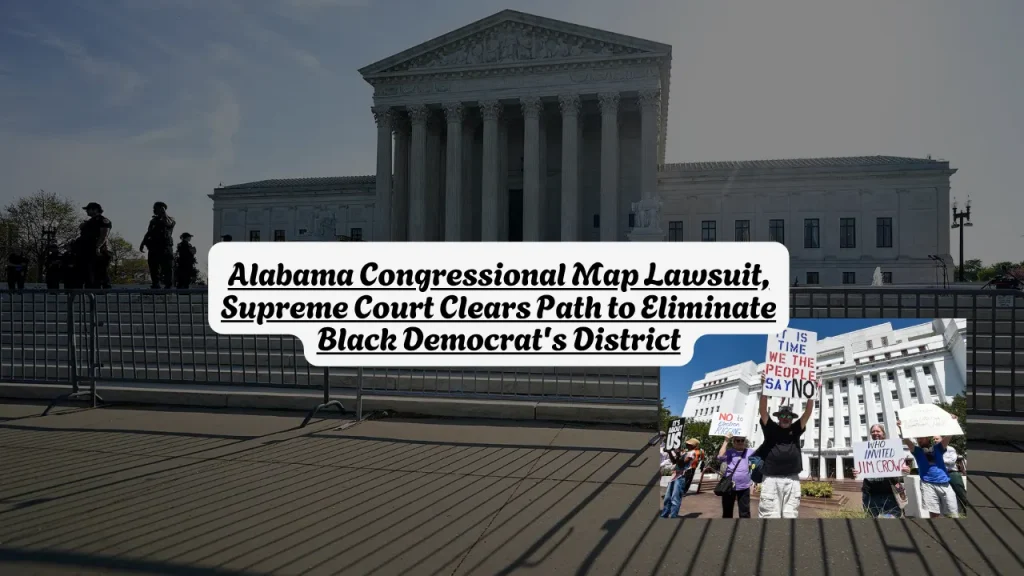
Alabama Congressional Map Lawsuit, Supreme Court Clears Path to Eliminate Black Democrat’s District
The Alabama congressional redistricting case is a years-long legal fight over whether the state’s congressional map illegally strips Black voters of fair political representation — and on May 11, 2026, the U.S. Supreme Court handed Alabama a major win.
| Field | Detail |
| Case Name | Allen v. Milligan |
| Lawsuit Filed | 2022 |
| Defendant | State of Alabama |
| Alleged Violation | Section 2 of the Voting Rights Act of 1965; 14th Amendment |
| Current Stage | Supreme Court halted lower court order — May 11, 2026 |
| Court & Jurisdiction | U.S. District Court, Northern District of Alabama; U.S. Supreme Court |
| Next Step | Lower court to reconsider in light of Louisiana v. Callais |
| Special Primary Deadline | Must occur by August 2026 (per Alabama law) |
| Last Updated | May 12, 2026 |
What the Alabama Congressional Map Lawsuit Is About — Allen v. Milligan
Alabama’s legislature drew its 2021 congressional map with only one majority-Black district, even though Black residents make up over a quarter of the state’s total population. Voting rights groups sued, arguing this deliberately weakened Black voters’ collective political power in violation of federal law.
The federal district court struck down the map in early 2022, ruling that the district lines violated the Voting Rights Act by fracturing Black voters across multiple districts so they could not elect candidates of their choice. Alabama appealed, and the Supreme Court stepped in to allow the original map to be used for the 2022 elections while the case moved forward. If you want to understand how courts decide these cases, the Is Gerrymandering Legal? Supreme Court Ruling, Redistricting Laws & Your Voting Rights guide on AllAboutLawyer.com breaks down the legal framework clearly.
In June 2023, the Supreme Court ruled 5-4 in Allen v. Milligan, upholding Section 2 of the Voting Rights Act and ordering Alabama to draw a second district where Black voters had a genuine opportunity to elect a candidate of their choice. Alabama then defied that ruling by submitting a new map that still had only one majority-Black district. The federal court rejected it again.
How Alabama Defied Court Orders — and What the Courts Did About It
Rather than create a second district with a Black majority or something close to it, Alabama’s legislature passed a map that merely raised the Black percentage of one white-majority district to 40 percent — still far too low to give Black-preferred candidates any meaningful chance given the state’s racially polarized voting patterns.
Failure to comply with the court’s orders cost the Alabama legislature the privilege of drawing its own congressional map. A special master appointed by the court drew three alternative maps, each containing two congressional districts with majority- or near-majority-Black populations. The three-judge panel selected from those maps, and Alabama held its 2024 elections under the court-drawn map.
The court-ordered map resulted in Alabama electing two Black representatives to Congress for the first time in the state’s history. Democrats won both races. Those two representatives are Reps. Shomari Figures and Terri A. Sewell.
Related article: Virginia Congressional Redistricting Lawsuit, Democrats Ask U.S. Supreme Court to Override State Court Ruling
Are You Affected by the Alabama Redistricting Fight?
This case does not involve a settlement or a claim form. But it directly affects Black voters in Alabama and anyone who cares about fair congressional representation in the South. You are likely part of the affected community if:
- You are a registered voter in Alabama, particularly in or near the 2nd Congressional District currently held by Rep. Shomari Figures
- You voted in the 2024 Alabama congressional elections under the court-drawn map
- You are a member of a civil rights or voting rights organization that monitors Section 2 of the Voting Rights Act enforcement
You are likely not directly affected if you live outside Alabama — though the legal outcome shapes voting rights enforcement nationwide, especially after the Louisiana ruling discussed below.
Why the Supreme Court Reversed Course on May 11, 2026
The U.S. Supreme Court on May 11, 2026, set the stage for Alabama to eliminate one of its two largely Black congressional districts before the November midterm elections, creating an opening for Republicans to gain an additional House seat in a partisan battle for control of the closely divided chamber.
The decision connects directly to a separate ruling from April 2026. The Supreme Court struck down a majority-Black U.S. House district in Louisiana as an unconstitutional racial gerrymander, significantly weakening Section 2 of the Voting Rights Act in the process. Alabama officials pointed to that Louisiana ruling as reason for the Supreme Court to end the judicial order requiring Alabama to use the court-imposed map through the 2030 census.
The high court overturned the lower court’s order and directed that court to reconsider the Alabama case in light of the Louisiana decision. To understand exactly how the Louisiana ruling changed the legal landscape for minority voters across the country, see the full breakdown on AllAboutLawyer.com: Louisiana v. Callais Voting Rights Act Redistricting Lawsuit.
What Alabama Republicans Said — and What Comes Next for the Map
Alabama Republican leaders moved quickly to celebrate the ruling. Alabama Attorney General Steve Marshall said the Supreme Court had “vindicated the state’s long held position” and that the power to draw Alabama’s maps now returns to the state legislature. Marshall stated his job was to put the legislature in the best position to draw a congressional map that favors Republicans seven-to-zero.
Anticipating a court reversal, Alabama officials had already passed a law allowing it to void the results of a May 19 primary for some congressional districts and hold a new primary under revised boundaries. Republican Governor Kay Ivey must set a date for a special primary election, though it must occur by August 2026.
Alabama Secretary of State Wes Allen called the decision a “historic win for Alabama voters” and said the May 19 primaries will proceed as scheduled while his office works closely with the governor’s office as the situation develops.
The Dissent — Why Justice Sotomayor Says the Fight Is Not Over
The ruling was not unanimous, and the legal battle almost certainly continues. In her dissent, Justice Sonia Sotomayor said the Louisiana ruling reversed only one of the grounds on which the Alabama case had been decided. Although the Voting Rights Act violation may be gone, Sotomayor argued a lower court could still find that Alabama intentionally discriminated against Black voters in violation of the 14th Amendment.
A three-judge panel had already ruled in May 2025 that Alabama’s legislature intentionally drew its congressional district map to dilute Black voting strength — a finding the court said was both unconstitutional and a violation of the Voting Rights Act. The plaintiffs are also seeking to pull Alabama back under federal preclearance for future congressional redistricting under Section 3 of the Voting Rights Act. That 14th Amendment intentional discrimination finding remains in play before the lower court.
Where This Fits in the Nationwide 2026 Redistricting Battle
Alabama’s case does not exist in isolation. Republicans believe they could win as many as 14 additional seats in the November elections from new districts enacted in Texas, Missouri, North Carolina, Ohio, Florida, and Tennessee. Democrats think they could win up to six additional seats from new districts in California and Utah.
While legal and logistical hurdles may limit how much can change before November 2026 — given that most states have already closed candidate filing windows — the ruling is expected to have a far greater impact on future elections, particularly in 2028, when states will have the time and flexibility to redraw lines comprehensively. Civil rights attorneys and consumer rights lawyers focused on voting rights enforcement are already tracking the next wave of litigation across multiple states.
For the broader picture of how these changes affect minority voters across the South and what legal options remain, see Voting Rights Act 2026 Supreme Court Ruling: What It Means for Voters on AllAboutLawyer.com.
Alabama Congressional Map Lawsuit Timeline
| Milestone | Date |
| Alabama enacts 2021 congressional map | January 2022 |
| Federal court strikes down 2021 map | January 2022 |
| Supreme Court allows 2021 map for 2022 elections | February 2022 |
| Supreme Court rules 5-4 in Allen v. Milligan — orders second Black district | June 2023 |
| Alabama submits defiant 2023 map — rejected by court | August 2023 |
| Court-appointed special master draws remedial maps | September 2023 |
| Supreme Court denies Alabama’s request to block court map | September 2023 |
| 2024 elections held under court-drawn map; two Black representatives elected | November 2024 |
| Three-judge panel rules Alabama intentionally discriminated | May 9, 2025 |
| Supreme Court rules in Louisiana v. Callais — weakens Section 2 of VRA | April 29, 2026 |
| Alabama Legislature passes redistricting bill during special session | May 6, 2026 |
| Supreme Court halts order requiring two-Black-district map | May 11, 2026 |
| Special primary election must be held | By August 2026 |
| Lower court to reconsider under Louisiana ruling | TBD — pending court scheduling |
Frequently Asked Questions
Is there an active lawsuit against Alabama over its congressional map?
Yes. The case Allen v. Milligan has been in federal courts since 2022. The Supreme Court sent it back to the lower court on May 11, 2026, for reconsideration under the new Louisiana v. Callais standard. The litigation is ongoing.
Do I need to do anything right now to be part of this case?
No. Affected Alabama voters are not required to take any action to be part of the class. The legal fight is being led by civil rights organizations including the NAACP Legal Defense Fund and the ACLU of Alabama on behalf of Black voters statewide.
When will the Alabama redistricting case be resolved?
The timeline is uncertain. TBD — the lower court must reconsider the case under the new legal standard set by the Supreme Court’s April 2026 Louisiana ruling, and no hearing date has been announced as of May 12, 2026.
Can Alabama voters pursue individual claims for intentional racial discrimination?
Individual voters can consult a consumer rights lawyer or voting rights attorney about separate 14th Amendment claims. Justice Sotomayor’s dissent noted that the intentional discrimination finding by the lower court remains a live legal issue, even after the Voting Rights Act grounds were removed.
What happens to the May 19, 2026 primary elections in Alabama?
Alabama officials say the May 19 primaries will proceed as scheduled. The state passed a law allowing it to void primary results in affected districts and hold a new special primary under the redrawn map. Governor Kay Ivey must schedule that special primary by August 2026.
How does the Louisiana v. Callais ruling change Alabama’s legal position?
The Supreme Court’s April 2026 Louisiana decision significantly narrowed Section 2 of the Voting Rights Act. Alabama used that ruling to argue that the court-imposed two-Black-district map was itself an unconstitutional racial gerrymander — and the Supreme Court agreed to send the case back for that reason.
Will Black voters in Alabama lose congressional representation because of this ruling?
Potentially. The Supreme Court’s order clears the path for Alabama to revert to a single majority-Black district, which would put Rep. Shomari Figures’s 2nd Congressional District at serious risk ahead of November 2026.
What is Section 2 of the Voting Rights Act?
Section 2 (52 U.S.C. § 10301) prohibits any voting law or practice — including congressional maps — that discriminates based on race or dilutes minority voting power. The Supreme Court’s Louisiana ruling did not eliminate Section 2, but it substantially raised the bar for plaintiffs trying to use it to challenge discriminatory maps.
Sources & References
- Associated Press — Alabama congressional map ruling, May 11, 2026
- CNN Politics — Supreme Court allows Alabama to eliminate Black Democrat’s district, May 11, 2026
- Roll Call — Federal court strikes down Alabama’s congressional map, May 8, 2025
- NPR — Court rules Alabama redistricting intentionally discriminates against Black voters, May 9, 2025
- SCOTUSblog — Court denies Alabama’s request to use voting map with one majority-Black district, September 2023
- Brennan Center for Justice — Alabama’s congressional map struck down as discriminatory, September 2023
- League of Women Voters — What’s Happening with Alabama’s Redistricting Post-Milligan, December 2023
Prepared by the AllAboutLawyer.com Editorial Team and reviewed for factual accuracy against AP reporting, CNN Politics, Roll Call, NPR, and SCOTUSblog coverage on May 12, 2026.
Last Updated: May 12, 2026
Disclaimer: This article is for informational purposes only and does not constitute legal advice. Legal claims and outcomes depend on specific facts and applicable law. For advice regarding a particular situation, consult a qualified attorney.
About the Author
Israr Ahmad is a legal content researcher with 4+ years of experience covering class action settlements and consumer rights cases. He has researched and published coverage of 2,500+ settlements using verified court records, settlement administrator filings, and government sources. Learn more about Israr.