
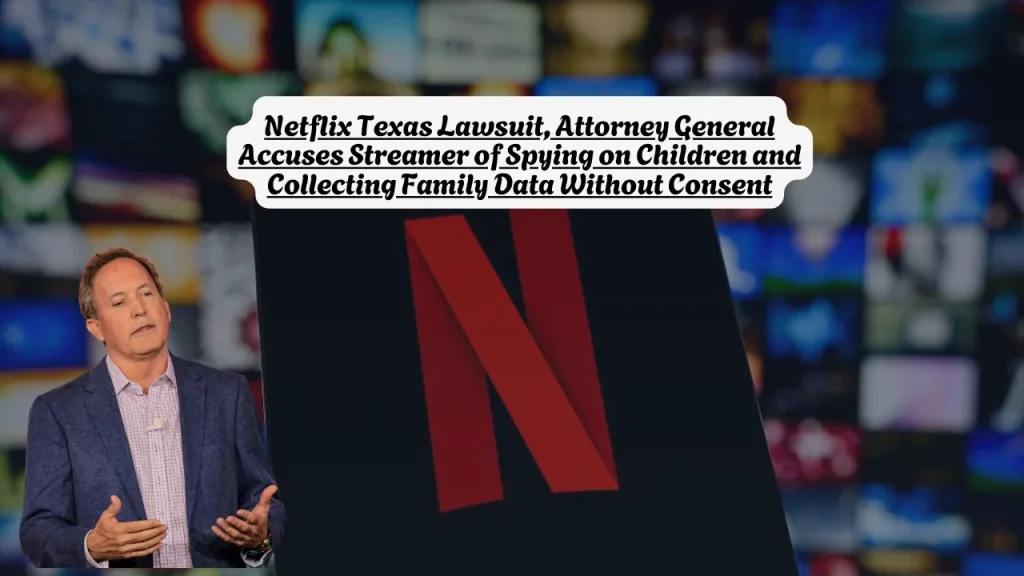
Netflix Texas Lawsuit, Attorney General Accuses Streamer of Spying on Children and Collecting Family Data Without Consent
Texas Attorney General Ken Paxton sued Netflix on Monday, accusing the streaming company of spying on children and other consumers by collecting their data without consent and designing its platform to be addictive. The lawsuit was filed May 11, 2026 in Texas District Court in Collin County, and it seeks to stop Netflix’s unlawful collection and disclosure of user data, require Netflix to disable autoplay by default on kids’ profiles, and secure other injunctive relief and civil penalties. If your family has a Netflix account in Texas — especially if you have kids using the platform — this lawsuit is directly about you.
| Field | Detail |
| Lawsuit Filed | May 11, 2026 |
| Defendant | Netflix, Inc. (NASDAQ: NFLX), headquartered in Los Gatos, California |
| Plaintiff | State of Texas, Office of Attorney General Ken Paxton |
| Alleged Violation | Texas Deceptive Trade Practices Act (DTPA) |
| Who Is Affected | Texas Netflix subscribers, including households with children using kids’ profiles |
| Current Court Stage | Active litigation — recently filed, no ruling yet |
| Court & Jurisdiction | Texas District Court, Collin County (near Dallas) |
| Civil Penalties Sought | Up to $10,000 per violation of the DTPA |
| Netflix’s Response | Denies all allegations; calls lawsuit “lacking merit” |
| Official Case Source | Texas Office of the Attorney General — texasattorneygeneral.gov |
| Last Updated | May 12, 2026 |
What the Netflix Texas Data Lawsuit Is About — Texas v. Netflix, Inc., Collin County District Court
Here is the story Texas is telling in this lawsuit. Netflix spent years telling subscribers that paying for a subscription meant escaping the surveillance economy. Texas said Netflix for years falsely represented to consumers that it did not collect or share user data, when it actually tracked and sold viewers’ habits and preferences to commercial data brokers and advertising technology companies, making billions of dollars a year.
The lawsuit’s central exhibit is a 2020 quote from then-CEO Reed Hastings. Texas’ complaint quoted former Netflix Chief Executive Reed Hastings as saying in 2020 “we don’t collect anything,” as he sought to distinguish Netflix from Amazon, Facebook and Google with regard to data collection. Texas argues that statement was not just wrong — it was a selling point Netflix used to attract subscribers who specifically wanted to avoid being tracked. The State of Texas’ lawsuit says: “Netflix sold subscriptions to its programming as an escape from Big Tech surveillance: pay monthly, avoid tracking. Texans trusted that bargain. Netflix broke it — constructing the very data-collection system subscribers paid to escape.”
What Netflix allegedly built behind the scenes was substantial. The lawsuit claims Netflix operates a “surveillance machinery” that collects roughly five petabytes of user-behavior logs per day, processing over ten million events per second to fuel over 40,000 internal microservices. In plain English: every time you press play, pause, skip, or scroll, Netflix logs it — and according to Texas, it shares that data widely without telling you. The filing describes partnerships between Netflix and companies such as Experian, Acxiom, Google Display & Video 360, The Trade Desk, Yahoo DSP, Amazon DSP, and LiveRamp — relationships Texas alleges allow advertisers to combine Netflix user data with information gathered across the broader internet to create detailed advertising profiles.
This lawsuit is part of a broader national pattern of state attorneys general targeting streaming platforms and tech companies for data privacy violations affecting families. For context on a similar case, see our coverage of the Discord child safety and data breach lawsuits where a state AG made nearly identical allegations about failing to protect children’s personal data.
European regulators got there first. The complaint references a decision by the Dutch Data Protection Authority, which fined Netflix around $5 million in 2024 over alleged violations of Europe’s General Data Protection Regulation between 2018 and 2020, finding that during those years Netflix failed to give customers sufficient information about what it did with their personal data. According to the lawsuit, it wasn’t until after that Dutch investigation in 2024 that Netflix “finally name-checked items in its privacy policy like ‘playback events (play, pause),’ ‘app clicks,’ ‘text input,’ and ‘time and duration'” — data Netflix had long collected without disclosure.
Related article: Family of Police Chaplain Antonio Seales Sues Alabama Police Over Fatal High-Speed Chase
Netflix denies everything. Netflix said the lawsuit “lacks merit and is based on inaccurate and distorted information” and added that “Netflix takes our members’ privacy seriously and complies with privacy and data-protection laws everywhere we operate.”
Are You Part of the Netflix Texas Lawsuit?
This is a government enforcement action — not a class action — which means Texas is suing Netflix on behalf of its residents. You do not join this lawsuit and there is no claim form. But you are directly affected if:
- You are a Texas resident with an active or former Netflix subscription at any point the alleged data collection occurred
- You have children who use Netflix kids’ profiles — Texas specifically targets data collected from children’s accounts and the autoplay feature enabled by default on those profiles
- You subscribed to Netflix believing it did not track or share your viewing behavior — the alleged deception is the gap between what Netflix said publicly and what it allegedly did
- You pay for a standard (non-ad) subscription but may still have had your data used for advertising purposes — the lawsuit alleges that 2025 privacy-policy changes furtively imply that Netflix collects and leverages data from non-ad-tier subscribers for advertising, and has likely done so since 2022
You are likely not a direct party to this action if you live outside Texas — though similar lawsuits from other state AGs could follow, and federal action remains possible.
What Texas Is Demanding Netflix Do
Texas is not asking for a small fine and a policy tweak. The remedies sought would fundamentally change how Netflix operates in the state. Among the remedies requested, Texas wants Netflix ordered to purge data deceptively collected from Texans, prohibit targeted advertising without express informed consent, and bar Netflix from collecting children’s data without appropriate disclosure.
Paxton is seeking a jury trial, a permanent injunction to stop the data collection, and civil penalties of up to $10,000 per violation of the Texas Deceptive Trade Practices Act. Because violations are counted per consumer and per deceptive act, the total exposure across millions of Texas Netflix subscribers could run into the billions.
The autoplay demand is the most specific and immediate. The Attorney General requests that autoplay default settings on children’s accounts be turned off — a direct change to how Netflix operates kids’ profiles across the state. The lawsuit alleges that “Netflix uses autoplay to intentionally strip away the natural breaking points that cue a user to step away from their screen,” and that “the feature is on by default for every profile — including the kids profiles that Netflix advertises as protected spaces.”
No settlement exists. The case was filed May 11, 2026 and is in its earliest stage. The litigation will take months or years to resolve. Texas could win a court order forcing Netflix to change its practices and pay civil penalties, or the parties could eventually negotiate a resolution. If a settlement is reached that includes consumer relief, Texas residents may become eligible for compensation at that time.
What Texas Netflix Subscribers Should Do Right Now
This is a government lawsuit — you do not need to take legal action today. But here is what makes sense for your family right now:
- Turn off autoplay manually on your children’s Netflix profiles. Go to Account → Profile → Playback Settings → uncheck “Autoplay next episode.” Do not wait for a court to require it.
- Review Netflix’s current privacy settings. Log in, go to Account → Privacy → and review what data Netflix says it collects and how you can limit it.
- Check your Netflix subscription tier. If you are on an ad-supported plan, Netflix has disclosed some data sharing. If you are on a premium plan and did not expect your data to be used for advertising, this lawsuit speaks directly to that concern.
- Document your subscription history if you believe you signed up for Netflix in part because of its stated no-tracking, no-advertising policy. This kind of evidence could matter if private class action lawsuits follow this government case.
- Monitor this case for consumer relief announcements. If Texas wins or settles and obtains restitution for consumers, eligible Texas subscribers will likely be notified. Bookmark the Texas AG’s case page for updates.
- Consult a consumer rights lawyer if you believe your child’s data was collected and shared without your consent. Several law firms are already investigating potential private data privacy claims against Netflix following this filing.
Netflix Texas Lawsuit Timeline
| Milestone | Date |
| Netflix launches ad-supported subscription tier | Late 2022 |
| Reed Hastings states Netflix “doesn’t collect anything” | January 2020 |
| Dutch Data Protection Authority investigates Netflix GDPR violations | 2018–2020 |
| Dutch DPA fines Netflix approximately $5 million | 2024 |
| Netflix updates privacy policy referencing granular interaction data | 2024 |
| Netflix introduces further 2025 privacy policy changes (implying broader data use) | 2025 |
| Texas AG Ken Paxton files 59-page lawsuit in Collin County | May 11, 2026 |
| Netflix denies all allegations publicly | May 11–12, 2026 |
| Next court date or hearing | TBD — case in opening stage |
| Potential trial or resolution | TBD — likely 1–3 years |
Frequently Asked Questions
Is there a class action lawsuit against Netflix for tracking children?
Not yet — this is a government enforcement action filed by the Texas Attorney General, not a private class action. Attorney General Ken Paxton sued Netflix for spying on Texans, including children, and collecting users’ data without their knowledge or consent under the Texas Deceptive Trade Practices Act. Private class actions from individual consumers or parents could follow.
Do I need to do anything right now to protect my rights?
No immediate legal action is required. If private class action lawsuits are filed against Netflix in Texas — which often follows government enforcement actions — Texas subscribers who were affected may automatically be included in a plaintiff class. For now, the most important step is adjusting your privacy and autoplay settings directly in your Netflix account.
When will the Netflix Texas lawsuit settle?
TBD — the case was filed May 11, 2026 and is in its earliest stage. Government enforcement actions like this typically take one to three years to resolve through trial, negotiated settlement, or consent decree. If a settlement includes consumer restitution, eligible Texas Netflix subscribers will be notified.
My child uses a Netflix kids’ profile — what was actually collected?
Paxton’s lawsuit alleges Netflix built “surveillance machinery” that tracks and logs users’ viewing habits, preferences, devices, household networks, application usage and other sensitive behavioral data via adult and kid profiles alike. Texas alleges this data was then shared with third-party data brokers without parents’ knowledge or consent.
Can I sue Netflix myself over this data collection?
Possibly. If the data collection violated Texas law on an individual level, private civil claims may be available alongside the government lawsuit. Speak with a consumer rights lawyer experienced in data privacy attorney work — many handle these cases on contingency, meaning no upfront cost to you.
Does this affect Netflix subscribers outside Texas?
This specific lawsuit only covers Texas under the Texas DTPA. However, Texas’s complaint follows a spate of lawsuits targeting tech companies over features that the plaintiffs have said are addictive and dangerous to children, and similar state AG actions in other states are plausible. The Dutch DPA already fined Netflix in 2024, suggesting the data practices at issue are not limited to Texas.
Netflix says the lawsuit lacks merit — who is right?
That is for a Texas jury to decide. Netflix disputes every allegation. A Netflix spokesperson said the lawsuit “lacks merit and is based on inaccurate and distorted information” and added the company “looks forward to addressing the Texas Attorney General’s allegations in court and further explaining its industry-leading, kid-friendly parental controls and transparent privacy practices.” The court will weigh the company’s internal documents against those statements.
Sources & References
- Texas Office of the Attorney General: Attorney General Ken Paxton Sues Netflix for Spying on Texas Kids and Consumers, May 11, 2026 — texasattorneygeneral.gov
Disclaimer: This article is for informational purposes only and does not constitute legal advice. This lawsuit involves active government litigation, and outcomes depend on specific facts and applicable law. For advice about your particular situation or potential individual claims, consult a qualified consumer rights attorney.
Prepared by the AllAboutLawyer.com Editorial Team and reviewed for factual accuracy against the official Texas Attorney General press release, the 59-page Collin County petition, and verified reporting from CNBC, NBC News, and Variety. Last Updated: May 12, 2026
About the Author
Israr Ahmad is a legal content researcher with 4+ years of experience covering class action settlements and consumer rights cases. He has researched and published coverage of 2,500+ settlements using verified court records, settlement administrator filings, and government sources. Learn more about Israr.