
Virginia Congressional Redistricting Lawsuit, Democrats Ask U.S. Supreme Court to Override State Court Ruling
Virginia is at the center of a fast-moving redistricting legal fight that reached the U.S. Supreme Court on May 11, 2026. Virginia Democrats asked the U.S. Supreme Court to revive the voter-approved redistricting amendment struck down by the Supreme Court of Virginia, escalating the fight over the state’s congressional map to the nation’s highest court with the 2026 midterms drawing closer.
| Field | Detail |
| Case | Virginia Redistricting Amendment Emergency Appeal |
| Filed With | U.S. Supreme Court — Chief Justice John Roberts |
| Filed By | Virginia AG Jay Jones; House Speaker Don Scott; Senate Majority Leader Scott Surovell; Senate President Pro Tempore Louise Lucas |
| State Court Ruling | Supreme Court of Virginia, May 8, 2026 — 4-3 against Democrats |
| Current Congressional Map | 6 Democratic, 5 Republican districts (2021 map) |
| Map Democrats Sought | Up to 10 Democratic-leaning districts out of 11 |
| Virginia Primary Date | August 4, 2026 |
| Early Voting Begins | June 19, 2026 |
| Last Updated | May 12, 2026 |
What the Virginia Redistricting Fight Is About
Virginia’s redistricting battle did not start in a vacuum. President Trump prompted a mid-decade redistricting race by urging Republican-led states including Texas, Missouri, North Carolina, Ohio, and Florida to redraw their maps to help Republicans keep control of the House in November. Virginia Democrats responded with their own plan to counter those gains.
The voter-approved amendment would have allowed the Democratic-controlled General Assembly to redraw Virginia’s congressional districts in response to similar efforts already underway in Republican-led states. The new maps were projected to heavily favor Democrats in as many as 10 of the state’s 11 congressional districts. The current map gives Democrats a 6-5 edge. That four-seat pickup would have been a major counterweight to Republican gains across the South.
To understand how this fits into the broader national redistricting fight and what the Voting Rights Act changes mean for minority voters in Virginia and beyond, see Voting Rights Act 2026 Supreme Court Ruling: What It Means for Voters on AllAboutLawyer.com.
Why the Virginia Supreme Court Struck Down the Amendment
The legal dispute centers on a procedural requirement in the Virginia Constitution. The Supreme Court of Virginia found that the legislative process used to advance the redistricting referendum violated Article XII, Section 1, of the state constitution. The court said the constitutional violation “incurably taints the resulting referendum vote and nullifies its legal efficacy.”
The central dispute was over what qualifies as a “general election” under Virginia’s constitution. The state court sided with Republicans, ruling that Virginia’s general election includes the early voting period — not just Election Day itself. That finding meant Democrats had improperly advanced the amendment after early voting for the 2025 House of Delegates elections had already begun.
The General Assembly first passed the constitutional amendment on October 31, 2025, by gaveling in the 2024 special session that had never formally been adjourned. That October 31 passage took place while early voting for the 2025 general election was already underway. The second passage took place on January 19, 2026. Republicans argued that the first vote simply did not count.
The majority opinion held that the constitutional violation “irreparably undermines the integrity of the resulting referendum vote and renders it null and void,” and ordered Virginia to use the same congressional district map it used in 2022 and 2024.
Related article: The Rip Defamation Lawsuit, Miami-Dade Officers Sue Ben Affleck and Matt Damon’s Production Company Over Netflix Film
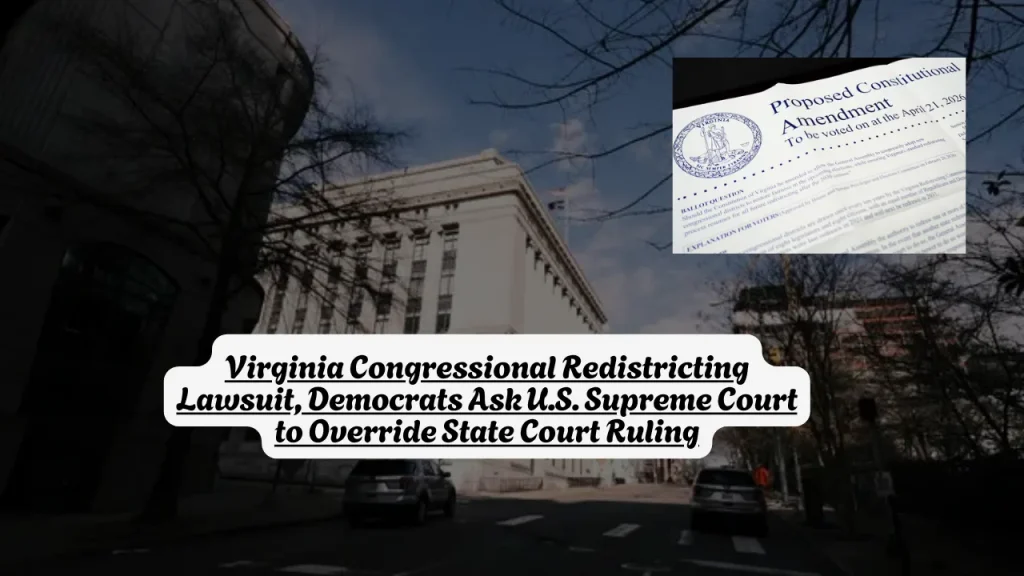
What Virginia Voters Actually Approved
Despite the legal outcome, Virginia voters had their say at the ballot box. Virginia voters approved the redistricting referendum by a 52 percent to 48 percent margin in the April 21, 2026, special election. The state spent $5.2 million to conduct that election, and outside groups on both sides raised nearly $100 million to sway voters.
The Supreme Court of Virginia had previously allowed the April special election to go forward while reserving the right to rule on the measure’s legality later, setting the stage for a post-election ruling that ultimately voided what voters had decided. Democratic Gov. Abigail Spanberger said she was disappointed by the ruling but pledged to focus on ensuring voters make their voices heard in the November midterms.
The Emergency Appeal to the U.S. Supreme Court
In an emergency application filed with Chief Justice John Roberts, attorneys representing House Speaker Don Scott, Senate Majority Leader Scott Surovell, Senate President Pro Tempore Louise Lucas, and the commonwealth of Virginia asked the court to pause the state ruling while the appeal moves forward. The filing stated that “the irreparable harm resulting from the Supreme Court of Virginia’s decision is profound and immediate.”
Democrats made two core federal arguments. First, the filing argued that elections under federal law occur on a single election day, even when states permit weeks of early voting beforehand, and that the Virginia court improperly expanded the meaning of “election” beyond its traditional legal definition.
Second, the appeal cited the U.S. Supreme Court’s 2023 ruling in Moore v. Harper, which limited how far state courts can go when interpreting election laws affecting federal races. Virginia Democrats argued the state court “transgressed the ordinary bounds of judicial review” in its interpretation of the state constitution.
Democrats also warned the ruling creates serious logistical problems for election officials, noting that Virginia’s congressional primary was already moved from June to August 4 because of the ongoing litigation, and that election officials face approaching deadlines for ballot certification and absentee voting.
Why Legal Experts Say This Appeal Faces Long Odds
The emergency appeal confronts a significant legal obstacle. Constitutional law professor Carl Tobias of the University of Richmond said an appeal to the U.S. Supreme Court would face significant practical and legal obstacles, particularly this late in the court’s term and so close to the 2026 elections. He noted the justices are often reluctant to rule on voting disputes as elections approach, though he acknowledged this is an important enough case that the court may entertain an appeal.
The appeal is likely to be an uphill fight because the state’s highest court resolved the case based on state, not federal, law. Under the Virginia Constitution, the General Assembly must vote twice before sending a proposed constitutional amendment to voters, with a general election intervening between those votes. Federal courts are generally reluctant to second-guess state courts interpreting their own state constitutions.
For background on how the independent state legislature theory and Moore v. Harper have shaped redistricting fights nationwide, see the full breakdown at Is Gerrymandering Legal? Supreme Court Ruling, Redistricting Laws & Your Voting Rights on AllAboutLawyer.com.
What Republicans and Democrats Said After the Ruling
The reaction split sharply along party lines. Republican National Committee Chair Joe Gruters said Democrats had spent more than $66 million into an effort to “lock in control,” and called the ruling a victory for the rule of law. Trump praised the state Supreme Court’s decision on Truth Social as a “Huge win for the Republican Party, and America.”
U.S. House Minority Leader Hakeem Jeffries called the decision to overturn an entire election “an unprecedented and undemocratic action that cannot stand.”
Virginia Democrats called the state court decision “deeply mistaken” and said it had “profound practical importance to the nation.” Attorney General Jay Jones argued the ruling put politics above the rule of law.
Where This Leaves the 2026 Midterms in Virginia
This ruling, combined with GOP map-drawing efforts in other states and the U.S. Supreme Court’s April ruling weakening the Voting Rights Act, means Republicans will head into the midterms with a clear redistricting advantage. Republicans could gain as many as 14 seats from redrawn maps across six states so far, compared with six for Democrats from redrawn maps in California and Utah.
Virginia’s primary contests for the 2026 elections are slated for August 4. Early in-person voting is scheduled to start on June 19. Voters can check their registration status and congressional district at elections.virginia.gov/VoterInformation.
Virginia Redistricting Timeline
| Milestone | Date |
| Virginia voters approve 2020 bipartisan redistricting commission | November 2020 |
| Current 2021 congressional map adopted (6D-5R) | 2021 |
| General Assembly first passes redistricting amendment | October 31, 2025 |
| Republican lawsuit filed in Tazewell County Circuit Court | October 28, 2025 |
| Tazewell County judge rules amendment unlawful | January 27, 2026 |
| General Assembly passes amendment a second time | January 19, 2026 |
| Virginia Supreme Court allows April referendum to proceed | February 13, 2026 |
| Virginia voters approve redistricting referendum 52%-48% | April 21, 2026 |
| Virginia Supreme Court voids referendum 4-3 | May 8, 2026 |
| Virginia Democrats file U.S. Supreme Court emergency appeal | May 11, 2026 |
| Virginia congressional primary | August 4, 2026 |
| U.S. Supreme Court response | TBD — no ruling or hearing date set as of May 12, 2026 |
| November midterm elections | November 3, 2026 |
Frequently Asked Questions
Is there an active lawsuit over Virginia’s congressional map?
Yes. Virginia Democrats filed an emergency appeal with the U.S. Supreme Court on May 11, 2026, after the Supreme Court of Virginia struck down a voter-approved redistricting amendment. The case has not yet been accepted, denied, or scheduled by the federal court.
Do Virginia voters need to do anything right now because of this lawsuit?
No immediate action is required. Virginia’s congressional primary was moved to August 4, 2026, and early in-person voting begins June 19. Voters should verify their congressional district at elections.virginia.gov/VoterInformation since boundaries could still change if the U.S. Supreme Court acts.
What map will Virginia use in the 2026 midterms if the Supreme Court does nothing?
The 2021 bipartisan map remains in effect — the same map used in 2022 and 2024. That map gives Democrats a 6-5 edge across Virginia’s 11 congressional districts.
Can Virginia Democrats still pursue other legal strategies?
Potentially. Justice Sonia Sotomayor’s dissent in the Alabama redistricting case suggested that intentional discrimination claims under the 14th Amendment remain available separately from Voting Rights Act claims. Whether Virginia Democrats pursue a 14th Amendment argument before the U.S. Supreme Court is TBD — no additional filings have been announced as of May 12, 2026.
Why is this case connected to Moore v. Harper?
Virginia Democrats argue the state Supreme Court went too far in overriding the General Assembly’s redistricting authority. Moore v. Harper, decided by the U.S. Supreme Court in 2023, set limits on how aggressively state courts can constrain state legislatures on federal election law matters — which is the hook Democrats are using to bring this case before the federal court.
How does this fit into the national redistricting battle?
Virginia’s fight is one piece of a nationwide mid-decade redistricting race. Republicans have pursued new maps in Texas, Missouri, North Carolina, Ohio, Florida, Tennessee, and Alabama. Democrats responded in California, Utah, and Virginia. The Virginia ruling — combined with the April 2026 Voting Rights Act decision — currently leaves Republicans with a substantially larger projected seat gain heading into November.
What were the spending totals in the Virginia redistricting referendum campaign?
Outside groups raised nearly $100 million to influence Virginia voters on the April 21 redistricting referendum. The state of Virginia itself spent $5.2 million to conduct the special election, which was ultimately voided by the state Supreme Court.
Sources & References
- Virginia Mercury — Virginia Democrats seek emergency injunction from U.S. Supreme Court, May 11, 2026
- CNN Politics — Virginia Democrats ask U.S. Supreme Court to let them use new congressional map, May 11, 2026
- Associated Press / NPR — Court rejects Virginia redistricting, May 8, 2026
- NBC News — Virginia Supreme Court blocks Democratic congressional map, May 8, 2026
- Axios Richmond — Virginia Supreme Court throws out redistricting referendum results, May 8, 2026
- Cardinal News — Supreme Court of Virginia voids redistricting election as unconstitutional, May 8, 2026
Prepared by the AllAboutLawyer.com Editorial Team and reviewed for factual accuracy against Virginia Mercury, CNN Politics, NPR, NBC News, and Associated Press reporting on May 12, 2026.
Last Updated: May 12, 2026
Disclaimer: This article is for informational purposes only and does not constitute legal advice. Legal claims and outcomes depend on specific facts and applicable law. For advice regarding a particular situation, consult a qualified attorney.
About the Author
Israr Ahmad is a legal content researcher with 4+ years of experience covering class action settlements and consumer rights cases. He has researched and published coverage of 2,500+ settlements using verified court records, settlement administrator filings, and government sources. Learn more about Israr.