
United States vs. Southern Poverty Law Center, Federal Fraud Indictment and the Fidelity & Vanguard Donor Fund Blockade
This article covers a recently filed criminal indictment and related policy decisions by financial institutions. Information is based on the official DOJ press release, the federal indictment, and verified reporting from NPR, CBS News, CNBC, and The Hill. This page will be updated as the case develops.
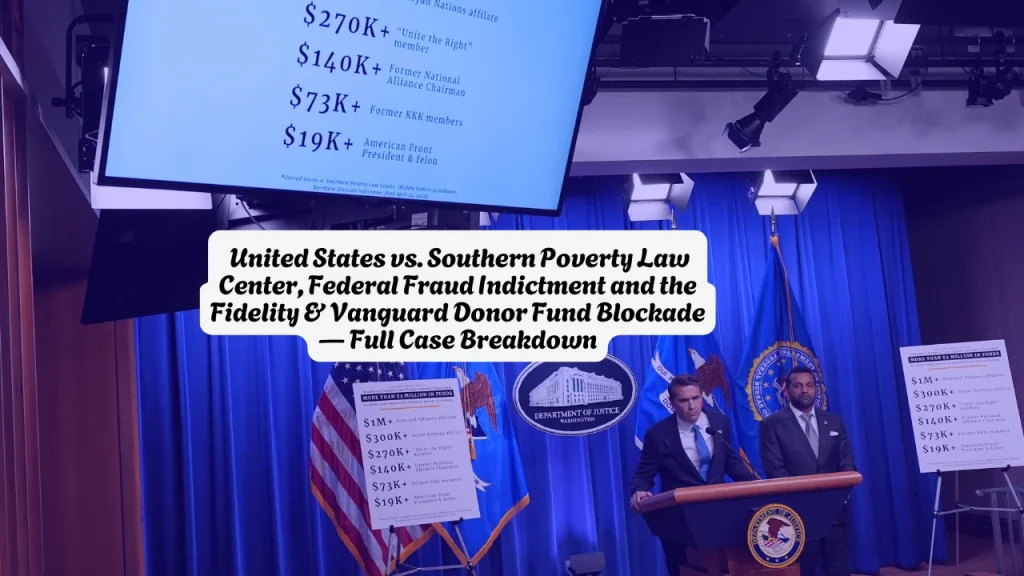
United States vs. Southern Poverty Law Center is a federal criminal case in which a grand jury in Montgomery, Alabama indicted the Southern Poverty Law Center on April 21, 2026 on 11 counts of wire fraud, bank fraud, and conspiracy to commit money laundering. Prosecutors allege that between 2014 and 2023, the SPLC secretly funneled more than $3 million in donated funds to individuals associated with violent extremist groups including the Ku Klux Klan, the Aryan Nations, and the National Socialist Party of America.
The SPLC has strongly denied all charges and called the indictment politically motivated. Within days of the indictment, Fidelity Charitable and Vanguard Charitable — two of the largest sponsors of donor-advised funds in the United States — blocked their account holders from donating to the SPLC through those accounts.
| Field | Detail |
| Plaintiff | United States of America |
| Defendant | Southern Poverty Law Center (SPLC) |
| Case Name | United States v. Southern Poverty Law Center |
| Court | U.S. District Court, Middle District of Alabama |
| Judge | U.S. District Judge Emily Marks |
| Grand Jury Return Date | April 21, 2026 |
| Charges | 6 counts wire fraud; 4 counts bank fraud; 1 count conspiracy to commit money laundering — 11 counts total |
| Amount Alleged | More than $3 million allegedly funneled to eight individuals associated with extremist groups between 2014 and 2023 |
| SPLC’s Position | Denies all charges; says informant program saved lives and was not secret |
| Fidelity Charitable Action | Blocked SPLC as eligible DAF recipient during investigation |
| Vanguard Charitable Action | Blocked SPLC DAF donations citing pending criminal charges |
| Charles Schwab Action | TBD — as of publication still allowing SPLC donations per reporting |
| Defence Filed? | SPLC has filed a discovery motion; formal defence TBD |
| Trial Date | TBD — not yet scheduled as of publication |
| Last Updated | April 30, 2026 |
What Is the SPLC Indictment About?
The Southern Poverty Law Center is a nonprofit civil rights organisation based in Montgomery, Alabama, founded in 1971. It became widely known for using civil litigation to fight white supremacist groups and for publishing a “hate map” that tracks extremist organisations across the United States.
According to the indictment, starting in the 1980s, the SPLC began operating a covert network of individuals who were either associated with violent extremist groups or had infiltrated those groups at the SPLC’s direction. The government alleges that unbeknownst to donors, some of their donated money was being used to fund the leaders and organizers of racist groups at the same time that the SPLC was publicly denouncing those same groups on its website.
To pay the informants, the indictment alleges the SPLC opened bank accounts connected to fictitious entities — with names such as “Center Investigative Agency,” “Fox Photography,” and “Rare Books Warehouse” — which allegedly let the group disguise the true nature and ownership of the donor money it was paying out. The government alleges this constitutes fraud against both donors and the banks that held those accounts.
One informant was paid more than $1 million between 2014 and 2023 while affiliated with the neo-Nazi National Alliance. Another informant was allegedly a member of the online leadership group that planned the 2017 Unite the Right rally in Charlottesville, Virginia — and was allegedly paid more than $270,000 between 2015 and 2023.
The indictment was returned in the Middle District of Alabama by a federal grand jury, which means prosecutors presented evidence to grand jurors and at least 12 of them voted that probable cause exists to bring the charges. A grand jury indictment is a formal accusation — not a conviction. All charges are unproven allegations as of publication.
Related article: Wes Campbell & Newsboys vs. LiveCo, World Vision, The Roys Report & MercyMe, Defamation and Antitrust Lawsuit Full Case Breakdown
What Does the SPLC Say?
The SPLC has pushed back hard on every element of the government’s case. Interim CEO and president Bryan Fair said the organisation will “vigorously defend” itself, calling the charges false. The SPLC said its informant program was not kept secret and that the information provided by those informants — including to the FBI — saved lives.
The indictment has been strongly condemned by a wide range of legal experts as an attack unsupported by the facts and the law, and based on political animus. The SPLC has filed a discovery motion and hired a strong legal team.
The SPLC noted that its investigation could add to concerns that the Trump administration is using the Justice Department to go after organisations that oppose the president’s policies — following a pattern of other investigations into Trump critics that have raised questions about whether law enforcement has been turned into a political weapon.
Why Did Fidelity and Vanguard Block SPLC Donations?
A donor-advised fund (DAF) is a charitable giving account that lets individuals contribute money or investments, take an immediate tax deduction, and then recommend grants to eligible nonprofits over time. Fidelity Charitable alone manages more than 350,000 such accounts. Critically, however, the financial institution — not the account holder — has final authority over whether a grant recommendation is approved.
Fidelity Charitable’s own website states that a grant recommendation might be declined if the organisation “is being investigated for alleged illegal activities or non-charitable activities, such as terrorism, money laundering, hate crimes, or fraud.” After the indictment, Fidelity applied that policy to the SPLC.
Vanguard Charitable also blocked donations, writing to a DAF account holder: “The organisation has had allegations and/or charges brought against them for activities that may call into question their ability to carry out their tax-exempt charitable purpose.”
A Vanguard spokesperson told The New York Times that the institution would block donations in the event of any federal or state criminal indictment and would not attempt to evaluate the legitimacy of the charges. That policy means any criminal indictment — regardless of whether it is considered politically motivated or legally weak — triggers an automatic block.
The SPLC remains a recognised 501(c)(3) organisation eligible to receive tax-deductible grants, and at least one major DAF provider, Charles Schwab, was still allowing account holders to request donations to the SPLC as of the date of reporting.
What Happens Next?
The criminal case will now proceed through the federal courts in the Middle District of Alabama. The SPLC has already filed a discovery motion — a request for the government to provide the evidence it intends to use. No trial date has been set.
Legal analysts have questioned whether the government’s theory meets the legal standard required for fraud charges, noting that the indictment does not clearly establish that the SPLC made materially false representations to donors about the existence of a confidential informant programme.
The Fidelity and Vanguard blocks will remain in place for as long as the criminal investigation and prosecution continue, under each institution’s stated policies. If the case is dismissed or the SPLC is acquitted, donors could potentially resume using DAFs to support the organisation at that point.
Frequently Asked Questions
Who filed the charges and why?
A federal grand jury in the Middle District of Alabama returned the indictment on April 21, 2026. Acting Attorney General Todd Blanche alleged that the SPLC was “manufacturing racism to justify its existence” by secretly funding informants inside the same extremist groups it publicly claimed to be fighting.
What court is handling the criminal case?
The case was filed in the U.S. District Court for the Middle District of Alabama and randomly assigned to U.S. District Judge Emily Marks, who was nominated to the bench by President Trump in 2018.
What is the current status of the case?
The SPLC has already filed a discovery motion and hired legal counsel. It is in the early pre-trial phase. No hearing or trial date has been scheduled as of publication.
Did the SPLC actually pay money directly to hate groups?
The indictment does not allege that funds went directly to the hate groups themselves. It alleges payments went to individual informants — some of whom were associated with or members of those groups — to gather intelligence. Whether those payments constituted fraud is the central legal question in the case.
Can I still donate to the SPLC directly?
Yes. The SPLC remains a recognised 501(c)(3) and donors can give directly to it at any time. The Fidelity and Vanguard blocks apply only to donations routed through those companies’ donor-advised fund accounts.
Can I read the indictment?
Yes. The full indictment is publicly available on the DOJ’s website at justice.gov and through PACER at pacer.gov under the Middle District of Alabama.
Why do Fidelity and Vanguard have the power to block these donations?
Donor-advised fund grant recommendations by account holders are not binding — they are subject to review and approval by the DAF sponsor’s trustees. Fidelity’s own programme guidelines explicitly allow it to decline grants to organisations under criminal investigation.
Sources & References
- DOJ Official Press Release, April 21, 2026: justice.gov
- NPR: npr.org
Prepared by the AllAboutLawyer.com Editorial Team and reviewed for factual accuracy against the official federal indictment and verified public sources on April 30, 2026. Last Updated: April 30, 2026
Disclaimer: This article is for informational purposes only and does not constitute legal advice. All criminal charges described in this article are unproven allegations. The SPLC has denied all wrongdoing. For advice regarding a particular legal situation, consult a qualified attorney.
About the Author
Israr Ahmad is a legal content researcher with 4+ years of experience covering class action settlements and consumer rights cases. He has researched and published coverage of 2,500+ settlements using verified court records, settlement administrator filings, and government sources. Learn more about Israr.