
United States vs. Southern Poverty Law Center Federal Fraud Indictment Lawsuit, Full Case Breakdown
Note: This article covers a federal criminal indictment announced on April 21, 2026. Information is limited to the indictment as announced and confirmed public statements. This page will be updated as the case develops.
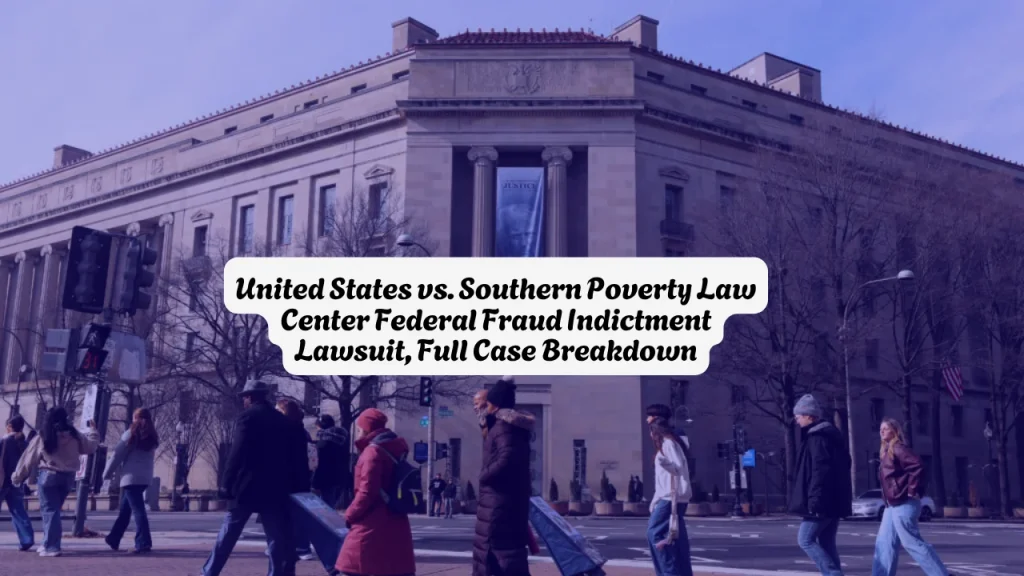
United States vs. Southern Poverty Law Center is a federal criminal case in which the U.S. Department of Justice charged the Southern Poverty Law Center (SPLC) with wire fraud, bank fraud, and conspiracy to commit money laundering, alleging the organization secretly paid at least $3,000,000 to informants embedded in white supremacist and other extremist groups without disclosing those payments to donors. The indictment was announced on April 21, 2026, by Acting Attorney General Todd Blanche, and the SPLC has stated it will vigorously contest the charges.
Quick Facts
| Field | Detail |
| Plaintiff | United States of America (federal prosecution) |
| Defendant | Southern Poverty Law Center (SPLC) |
| Case Type | Federal criminal indictment — wire fraud, bank fraud, conspiracy to commit money laundering |
| Court | Federal court in Alabama — exact district and case number TBD — not yet confirmed in publicly available docket records as of April 22, 2026 |
| Date Indictment Announced | April 21, 2026 |
| Legal Claims | Wire fraud; bank fraud; conspiracy to commit money laundering |
| Alleged Conduct Period | 2014–2023 (payments period per indictment); program alleged to have begun in the 1980s |
| Amount at Issue | At least $3,000,000 in payments to informants, per the indictment |
| Current Stage | Recently indicted — arraignment and subsequent proceedings TBD |
| SPLC’s Position | Disputes all charges; CEO Bryan Fair states the organization will “vigorously defend” itself |
| Attorneys of Record | TBD — defense counsel not yet confirmed in publicly available reporting as of April 22, 2026 |
| Last Updated | April 22, 2026 |
Case Timeline
| Date | Event |
| 1980s (approx.) | SPLC alleges its paid-informant program began, according to the indictment |
| 2014 | Alleged period of documented payments to informants begins, per indictment |
| 2023 | Alleged period of documented payments ends, per indictment |
| October 2025 | FBI Director Kash Patel severs the FBI’s relationship with the SPLC |
| December 2025 | U.S. House of Representatives holds a hearing on the SPLC’s activities |
| April 21, 2026 | Federal indictment announced by Acting AG Todd Blanche; SPLC CEO Bryan Fair confirms criminal investigation and announces intent to fight charges |
| TBD | Arraignment and initial court appearances — not yet scheduled in public records |
| TBD | Pre-trial proceedings — TBD pending court scheduling |
What Do We Know About the United States vs. Southern Poverty Law Center Case?
The Southern Poverty Law Center is a nonprofit civil rights organization founded in Montgomery, Alabama, in 1971. It built its reputation over decades using civil litigation to fight white supremacist groups, and it operates a widely cited “hate map” that documents alleged extremist organizations across the United States. The organization is based in Montgomery, which is also where the Justice Department brought this case.
The indictment accuses the SPLC of paying at least nine unnamed informants embedded in far-right organizations — including the Ku Klux Klan, the United Klans of America, the National Socialist Party of America, the National Socialist Movement, and the Aryan Nations-affiliated Sadistic Souls Motorcycle Club. According to the indictment, one informant was paid more than $1,000,000 between 2014 and 2023 while affiliated with the neo-Nazi National Alliance, and another held the title of imperial wizard of the United Klans of America.
Prosecutors allege the payments were routed through two different bank accounts before being loaded onto prepaid cards given to the informants — a structure the DOJ characterizes as fraudulent concealment from donors. The SPLC maintains the secrecy was necessary to protect the safety of the sources.
What Does the DOJ Allege Against the SPLC?
The indictment contains three core allegations. Prosecutors must prove each beyond a reasonable doubt at trial — these are charges, not findings of guilt.
According to the indictment and Acting AG Blanche’s announcement, the government alleges:
- Wire fraud: The SPLC solicited donations by representing to the public that it was fighting extremism, while concealing that a portion of those funds went directly to paid informants inside hate groups. Under 18 U.S.C. § 1343, wire fraud requires proof that the defendant used electronic communications as part of a scheme to defraud — meaning to obtain money through false or misleading representations.
- Bank fraud: The SPLC allegedly used bank accounts in a manner designed to conceal the true destination of the payments. Under 18 U.S.C. § 1344, bank fraud covers schemes that defraud financial institutions or obtain funds through false pretenses.
- Conspiracy to commit money laundering: The indictment alleges the SPLC engaged in financial transactions designed to conceal the source or destination of the funds paid to informants. Under 18 U.S.C. § 1956, money laundering conspiracy requires proof of an agreement to conduct transactions involving the proceeds of unlawful activity with intent to conceal or disguise their origin.
Acting AG Blanche said nonprofits are “required under the laws associated with a nonprofit to have certain transparency and honesty in what they’re telling donors they’re going to spend money on.” The DOJ’s theory is that the SPLC violated that obligation by never disclosing the informant program to donors.
Related article: Apple iCloud UK Class Action Lawsuit 2026, Apple for £3 billion over iCloud Overcharging on Behalf of 38.5M UK Users
What Does the SPLC Say?
The SPLC has directly disputed the government’s characterization of the informant program. CEO Bryan Fair stated the program was used to monitor threats of violence and that information gathered was frequently shared with local and federal law enforcement, including the FBI.
Fair said: “When we began working with informants, we were living in the shadow of the height of the Civil Rights Movement, which had seen bombings at churches, state-sponsored violence against demonstrators, and the murders of activists that went unanswered by the justice system. There is no question that what we learned from informants saved lives.”
Fair stated the SPLC “will vigorously defend ourselves, our staff, and our work.” The SPLC frames the secrecy around the program as a safety measure for informants — not as concealment of wrongdoing from donors.
The indictment comes after the SPLC faced escalating political pressure following the September 2025 assassination of conservative activist Charlie Kirk, which brought renewed scrutiny to the SPLC’s classification of Kirk’s organization, Turning Point USA, in its annual hate and extremism report. Critics and supporters of the SPLC disagree sharply about whether the federal prosecution reflects a legitimate legal case or a politically motivated use of the Justice Department against a prominent civil rights organization.
What Happens Next in This Case?
The SPLC now faces the standard sequence of a federal criminal prosecution. After an indictment, the next step is an arraignment — a court appearance at which the defendant enters a formal plea. The SPLC has already indicated it will contest the charges, which means a not-guilty plea is expected. Following the arraignment, the case moves into pre-trial proceedings, which in complex white-collar federal cases typically include extensive discovery, pre-trial motions, and potential hearings over many months before any trial date is set.
The case was brought in Alabama, where federal district courts fall under the Eleventh Circuit Court of Appeals. All specific upcoming dates are TBD — the court has not yet publicly scheduled an arraignment as of April 22, 2026.
Because this is a criminal case, the government bears the burden of proving each charge beyond a reasonable doubt. The SPLC, as the defendant, is presumed innocent of all charges unless and until a court finds otherwise.
Frequently Asked Questions
1. Who filed the lawsuit against the SPLC, and why?
This is a criminal indictment, not a civil lawsuit. The federal government — specifically the U.S. Department of Justice under Acting Attorney General Todd Blanche — filed the indictment on April 21, 2026. The DOJ alleged the SPLC defrauded donors by secretly paying informants inside extremist groups without disclosing those payments, which prosecutors argue violated federal wire fraud, bank fraud, and money laundering statutes.
2. What court is handling this case?
The indictment was brought in federal court in Alabama, where the SPLC is headquartered. The specific district and case number are TBD — not yet confirmed in publicly available court records as of April 22, 2026.
3. What is the current status of the case?
The case was indicted on April 21, 2026. The SPLC has announced it will fight the charges. Arraignment and all subsequent proceedings are TBD pending court scheduling.
4. Has anyone been convicted?
No. These are criminal charges — allegations only. The SPLC is presumed innocent unless convicted at trial or upon a guilty plea. No trial date has been set.
5. Can I read the court documents?
Federal indictments become public court records upon filing. Searching PACER at pacer.gov or CourtListener at courtlistener.com for “United States v. Southern Poverty Law Center” should surface the indictment once the full docket is available. The Associated Press and NPR reported on the indictment on April 21, 2026.
6. Is this a civil lawsuit or a criminal case?
This is a criminal case — a federal indictment. Criminal cases are brought by the government, require proof beyond a reasonable doubt, and can result in fines, organizational penalties, or other criminal sanctions against the defendant. This is distinct from a civil lawsuit, where a private party sues for money damages. The two involve entirely different legal standards and consequences.
7. What is the SPLC’s position?
The SPLC disputes the charges entirely. CEO Bryan Fair stated the informant program was a legitimate law enforcement tool that saved lives, the information gathered was shared with the FBI and other agencies, and the organization kept the program confidential to protect the safety of its sources. The SPLC has announced it will vigorously defend against all charges.
Sources & References
- Associated Press / NPR — Federal indictment announced April 21, 2026: npr.org
- PACER federal court docket search: pacer.gov
Prepared by the AllAboutLawyer.com Editorial Team and reviewed for factual accuracy against official announcements and verified public reporting from AP and Al Jazeera on April 22, 2026. Last Updated: April 22, 2026
Disclaimer: This article is for informational purposes only and does not constitute legal advice. Information about this ongoing criminal case is based on publicly available court filings and verified reporting. Charges described in this article are allegations only and have not been proven in court. The Southern Poverty Law Center is presumed innocent unless and until convicted. For advice regarding a particular legal situation, consult a qualified attorney.
About the Author
Israr Ahmad is a legal content researcher with 4+ years of experience covering class action settlements and consumer rights cases. He has researched and published coverage of 2,500+ settlements using verified court records, settlement administrator filings, and government sources. Learn more about Israr.