
John Litterer vs. Vail Summit Resorts Inc. Snowmobile Injury & Epic Pass Waiver Lawsuit Full Case Breakdown
This article covers an active case pending a ruling from the Colorado Supreme Court. Information is based on official court records and verified reporting from Summit Daily News, Colorado Sun, and CBS Colorado. This page will be updated as the case develops.
John Litterer vs. Vail Summit Resorts Inc. is a personal injury lawsuit in which Texas snowboarder John Litterer alleged that a Vail Resorts employee struck him with a snowmobile at Breckenridge Ski Resort in December 2020 in violation of Colorado’s Snowmobile Safety Act. Two lower courts dismissed the case, determining that Litterer gave up his right to sue when he signed a liability waiver while purchasing a second Epic Pass — and the Colorado Supreme Court heard oral arguments on April 16, 2026. A ruling from Colorado’s highest court is now pending.
| Field | Detail |
| Plaintiff | John Litterer |
| Defendants | Vail Summit Resorts Inc. (subsidiary of Vail Resorts); snowmobile driver (added as co-defendant in amended complaint) |
| Case Name | John Litterer v. Vail Summit Resorts Inc. |
| Court | Colorado Supreme Court (on appeal) |
| Date Filed | 2022 — Summit County District Court |
| Legal Claims | Negligence per se; personal injury; reckless endangerment |
| Damages Sought | TBD — specific dollar amount not confirmed in public court record |
| Current Stage | Oral arguments completed April 16, 2026 — ruling pending |
| Next Scheduled Date | TBD — Colorado Supreme Court decision expected; no date confirmed |
| Attorneys of Record | Trent Ongert and Joseph Bloch (for Litterer); Michael Hofmann and Kaitlin DeWulf of Bryan Cave Leighton Paisner (for Vail Resorts) |
| Last Updated | April 30, 2026 |
Case Timeline
| Date | Event |
| December 2020 | Litterer struck by employee-driven snowmobile at Breckenridge Ski Resort |
| 2020–21 ski season | Litterer purchased his Epic Pass for the 2020-21 season, signing a liability waiver at the time of purchase |
| 2022 | Litterer files lawsuit against Vail Summit Resorts in Summit County District Court |
| November 2022 | Litterer purchased an Epic Pass for the 2022-23 ski season, signing a second liability waiver while his lawsuit was already active |
| 2023 | Summit County District Court dismisses the case |
| January 2025 | Colorado Court of Appeals unanimously upholds dismissal in a 23-page opinion |
| Fall 2025 | Colorado Supreme Court grants certiorari and agrees to hear the case |
| April 16, 2026 | Colorado Supreme Court hears oral arguments in Holyoke, Colorado |
| TBD | Colorado Supreme Court ruling — date not confirmed |
What Is the John Litterer vs. Vail Summit Resorts Lawsuit About?
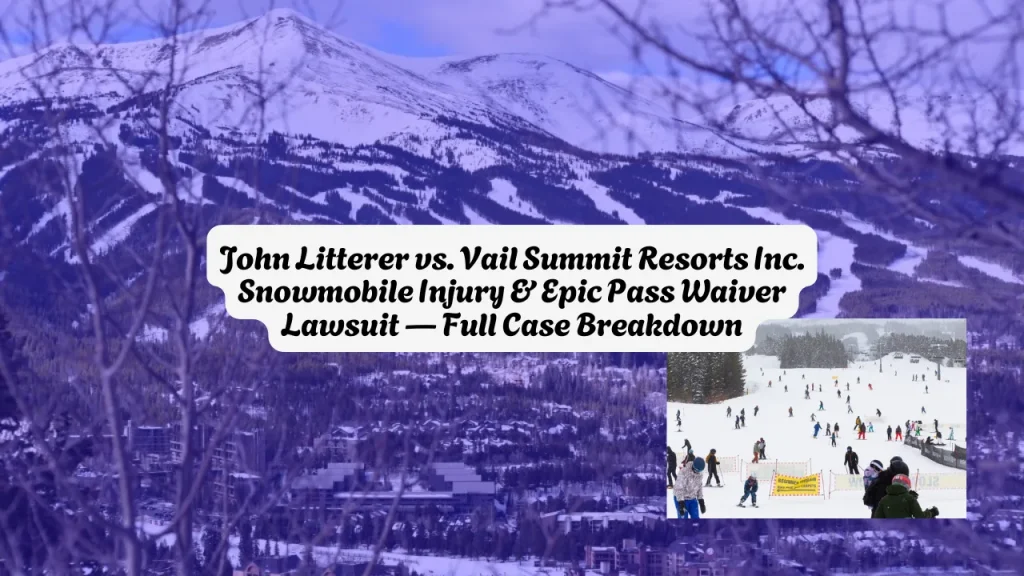
Litterer was snowboarding down the Wirepatch trail at Breckenridge and turned left onto Peak 8 Road — a route approved for snowmobiles — when he collided with a resort employee riding a snowmobile. He later said in a deposition that he was one second from impact before he saw the snowmobile and had no time to react.
Litterer’s legal team argues the collision was not a simple skiing accident — it was a violation of state law. His attorneys argue that his claim for negligence per se should move forward because the employee was operating the snowmobile carelessly around a “blind corner” in violation of Colorado’s Snowmobile Safety Statute. Negligence per se is a legal doctrine that means breaking a safety law is automatically considered negligence — no further proof of carelessness needed.
Vail Resorts’ Epic Pass purchase contracts include all-caps language requiring the buyer to assume the risk of any injury resulting from inherent dangers of skiing, and the contracts specifically list “employees using snowmobiles on ski slopes” as one of those listed risks. The case now turns on whether those waivers can legally override a state safety statute — and whether a waiver signed after an injury can wipe out an active lawsuit.
Who Are the Parties?
John Litterer is a Texas resident and recreational snowboarder. He was injured at Breckenridge during the 2020-21 ski season and, according to court filings, recovered enough to return to snowboarding before purchasing a second Epic Pass for the 2022-23 season — while his lawsuit against Vail Resorts was still active.
Vail Summit Resorts Inc. is a subsidiary of Vail Resorts, the largest ski resort operator in North America, which owns Breckenridge, Crested Butte, and dozens of other resorts across the U.S., Canada, Australia, and Switzerland. For the last several decades, the liability waiver defense has been used to swiftly dismiss lawsuits like Litterer’s — and today every lift ticket and season pass sale in Colorado includes scroll-and-click contracts that release resorts from liability should a skier be injured.
Related article: Louisiana vs. Callais, Voting Rights Act Redistricting Lawsuit — Full Case Breakdown and Final Ruling
What Is at Stake in This Lawsuit?
The central issue the Colorado Supreme Court must decide is not just whether Litterer was injured — it’s whether the second Epic Pass waiver he signed in 2022 legally erased his ongoing lawsuit from 2020.
The liability waiver stated that the customer agrees to “give up any and all claims and rights I may now have against” Vail Resorts, “including those not mentioned in this release and those resulting from anything which has happened up to now.” Litterer’s attorney argues he did not intend to dismiss his active lawsuit by clicking through that agreement when buying a ski pass. Vail Resorts argues the language is clear and binding.
There is also a bigger question hanging over the whole case. Two years ago, in Miller v. Crested Butte, the Colorado Supreme Court ruled that blanket liability waivers do not protect ski resorts in all cases — specifically when the resort violates a state safety law. A jury later awarded the Miller plaintiff $20 million in damages after finding Crested Butte negligent for violating state tramway safety regulations. Litterer’s team argues the same logic should apply here under the Snowmobile Safety Act. If the court agrees, it would be another significant blow to the waiver-first defense the ski industry has relied on for decades.
What Happens Next?
The Colorado Supreme Court accepted the case in fall 2025 after the Court of Appeals dismissed Litterer’s claims in January 2025. Oral arguments are now complete. The court will issue a written ruling — there is no confirmed date for that decision as of publication.
If the court rules in Litterer’s favor, the case would be sent back to a lower court to proceed on the merits of the injury claim itself. If the court rules for Vail Resorts, the dismissal stands and Litterer’s lawsuit ends permanently.
Litterer’s attorney argued during oral arguments that “it is up to the court” to act on skier safety, because the legislature has repeatedly failed to pass laws strengthening ski area accountability. Vail Resorts’ attorney countered that Colorado is a “freedom of contract” state and that it is not the court’s role to override clear contract language.
Frequently Asked Questions
Who filed this lawsuit and why?
John Litterer, a Texas snowboarder, sued Vail Summit Resorts Inc. in 2022 after he was struck by an employee-driven snowmobile at Breckenridge Ski Resort in December 2020. According to the complaint, the employee was operating the snowmobile carelessly around a blind corner in alleged violation of Colorado’s Snowmobile Safety Act.
What court is handling this case?
The case is currently before the Colorado Supreme Court, which heard oral arguments on April 16, 2026. The Summit County District Court and Colorado Court of Appeals both previously dismissed the lawsuit.
What is the current status of the case?
Oral arguments concluded April 16, 2026. The Colorado Supreme Court has not yet issued a ruling. No decision date has been confirmed as of publication.
How much is Litterer seeking in damages?
A specific damages figure has not been confirmed in verified public court records as of publication. TBD — the case has not yet reached the remedies stage.
Can I read the court documents?
Yes. Colorado Supreme Court filings are publicly accessible through the Colorado Judicial Branch online case search at colorado.gov/pacific/courts.
Why does the second Epic Pass matter so much?
When Litterer bought an Epic Pass for the 2022-23 ski season, he had already filed a lawsuit against Vail Resorts for injuries from the 2020 collision. The purchase agreement he signed stated he agreed to release all claims “including anything which has happened up to now.” Both lower courts found that language ended his right to sue — and the Supreme Court is now deciding whether that interpretation holds.
How does the Miller case connect to this one?
In Miller v. Crested Butte, the Colorado Supreme Court ruled that liability waivers do not shield ski resorts from injury claims when the resort has violated a state safety law. Litterer’s attorneys argue the same principle applies here, because the snowmobile operator allegedly broke the Colorado Snowmobile Safety Act. If the court agrees, Litterer’s claims could proceed regardless of the waivers he signed.
Sources & References
- Summit Daily News: summitdaily.com
- Colorado Sun: coloradosun.com
Prepared by the AllAboutLawyer.com Editorial Team and reviewed for factual accuracy against official court records and verified public sources on April 30, 2026. Last Updated: April 30, 2026
Disclaimer: This article is for informational purposes only and does not constitute legal advice. Information about this ongoing legal case is based on publicly available court records and verified reporting. Allegations described have not been proven in court. For advice regarding a particular legal situation, consult a qualified attorney.
About the Author
Israr Ahmad is a legal content researcher with 4+ years of experience covering class action settlements and consumer rights cases. He has researched and published coverage of 2,500+ settlements using verified court records, settlement administrator filings, and government sources. Learn more about Israr.