
Illinois HOA Fence Lawsuit 2026, Why Ashford Farms Homeowners Lost Their Security Fence Appeal Despite Trespassing Concerns
On November 17, 2026, the Illinois Appellate Court, Fifth District, ruled in Ashford Farms Homeowners’ Association v. Williams (2026 IL App (5th) 250405-U) that Vincent and Lekeisha Williams must move their fence to the location their homeowners association approved. The couple, who live in the Ashford Farms subdivision in Shiloh, St. Clair County, Illinois, said they built the fence after trespassers appeared near their bedroom window and a vehicle was stolen. Representing themselves on appeal, they argued their fence complied with the covenants, that the association enforced the rules selectively, and that it waited too long to respond.
The court found that the fence went beyond what the architectural committee had approved. It affirmed the St. Clair County order requiring relocation, but the trial court had denied the HOA’s request for attorney fees.
The ruling does not ban security fences in Illinois. It means that where enforceable HOA covenants apply, owners may need written approval for a fence’s design and placement before building. This is an individual dispute, not a class action or settlement, and there is no claim form or compensation fund.
Ashford Farms HOA Fence Lawsuit Quick Facts
| Detail | Verified information |
| Case | Ashford Farms Homeowners’ Association v. Williams |
| Appellate decision | November 17, 2026 |
| Court | Illinois Appellate Court, Fifth District |
| Appellate case number | 5-25-0405 |
| Citation | 2026 IL App (5th) 250405-U |
| Trial court and case number | St. Clair County Circuit Court, 23-CH-49 |
| Location | Ashford Farms, Shiloh, Illinois |
| Plaintiff | Ashford Farms Homeowners’ Association |
| Defendants | Vincent and Lekeisha Williams |
| Main dispute | Fence built farther forward than the approved location |
| Original lawsuit filed | July 6, 2023 |
| Trial court decision | April 14, 2025 (Judge Leah A. Captain) |
| Appellate outcome | HOA judgment affirmed (Justice Clarke, with Justices Boie and Sholar concurring) |
| Order | Move fence to approved location; 120 days to comply |
| HOA attorney fees | Denied by the trial court |
| Settlement or class action | Neither |
| Ruling status | Nonprecedential Rule 23 order |
Official court document: Illinois Appellate Court ruling, November 17, 2026 (PDF)
Why Did the Ashford Farms Homeowners Build a Security Fence?
According to testimony summarized in the ruling, Lekeisha Williams said people had trespassed on the property, including near their bedroom window, and that the family called police several times and had photographs. She also described a vehicle theft. Vincent Williams testified that people entered their yard and rang the doorbell, and that the couple’s pharmacy had been broken into twice. He said he was unsure whether they were being targeted.
They built the fence around parts of the house, including windows and an electrical box, and said moving it back would leave those areas exposed. Vincent testified there were no further incidents after the fence went up. The court did not independently find that the fence prevented crime. The couple also asked the association to consider making Ashford Farms a gated community.
What Ashford Farms Covenants Did the Homeowners Violate?
The subdivision is governed by an Indenture of Trust and Restrictions recorded in St. Clair County in June 2011. These recorded rules are called restrictive covenants.
- Article VI requires owners to submit plans and get written architectural approval before building or changing exterior improvements, including fences. The committee can review location, height, materials and design.
- Article IX restricts fence placement, including between the rear of a house and the street it faces, and provides for written committee approval of fences elsewhere.
The Williamses argued their fence did not reach the street and so complied. The HOA’s position was that written approval was required either way. The court agreed with the HOA and read the two provisions together, so the placement rule could not erase the approval requirement.
What Was the HOA’s Partial Variance?
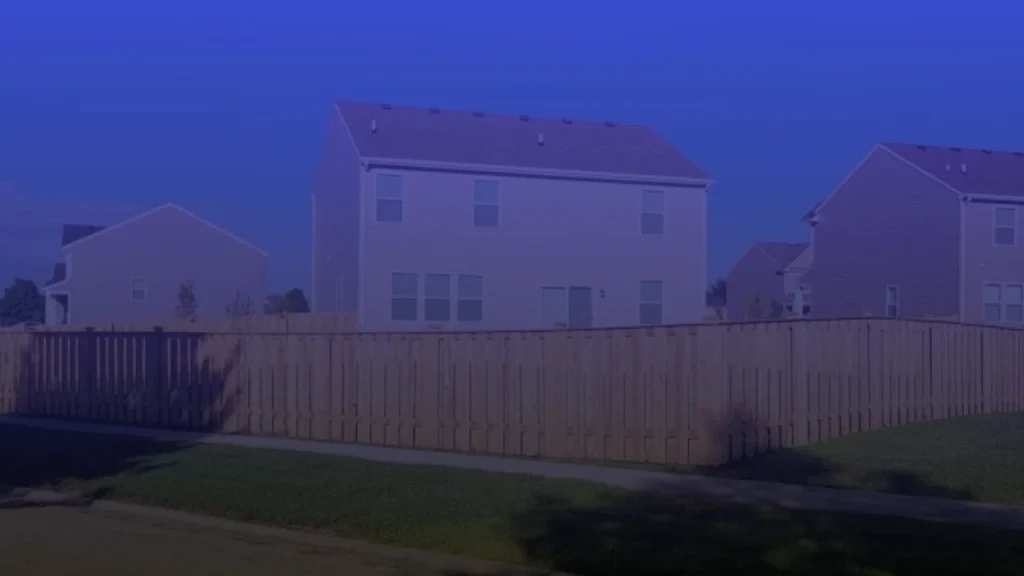
The association’s property manager testified that the board denied the original request because the placement did not meet its criteria. It offered a compromise: the fence could extend forward to about the midpoint of the house, where the roofline peaks. The couple instead built to the front corners of the home. That gap between the approved midpoint and the built location became the core of the case.
How Did the Fence Dispute Become a Lawsuit?
On March 17, 2023, the association notified the Williamses of a violation and gave 30 days to fix it. On July 6, 2023, it sued in St. Clair County Circuit Court for specific performance (a court order requiring compliance with the covenants), plus attorney fees and costs.
In their November 6, 2023 response, the Williamses acknowledged that the fence’s location had not been approved and that they had not moved it to the midpoint. They disputed the HOA’s reading of the covenants and questioned whether the Village of Shiloh had a fence permitting process. A bench trial was held October 8, 2024.
Related article: Parma Shooting on Ridge Road, November 21, 2026, Several Victims, Police Say No Ongoing Danger to the Public
What Did the St. Clair County Judge Decide in April 2025?
On April 14, 2025, Judge Leah A. Captain ruled for the HOA. She acknowledged some wording about the front of the house was unclear, but found the written approval requirement was clear and that the homeowners knew the committee controlled fence placement. She ordered the fence relocated within 120 days and denied the HOA’s request for attorney fees, leaving each side to pay its own costs.
Why Did the Illinois Appeals Court Rule Against the Williamses?
The appellate court held the trial court’s findings were not against the manifest weight of the evidence, meaning the opposite conclusion was not clearly apparent. It rejected three arguments.
Did the Fence Comply With the Covenants?
No. The evidence showed the HOA had not approved the fence in its installed location.
Did the Ashford Farms HOA Enforce the Fence Rules Selectively?
No. The couple pointed to another home with a fence toward the front. But the HOA had also sued those owners (St. Clair County case 23-CH-42) and obtained a judgment requiring removal. The Williamses did not show the association approved comparable violations while singling them out.
Did the HOA Wait Too Long Under the 60-Day Provision?
The covenants say that when the committee fails to act on a complete application within 60 days, certain approval requirements may be treated as satisfied. The Williamses raised this for the first time on appeal, so the court declined to decide it. The court did not hold the 60-day provision invalid. Owners whose documents have similar deadlines should note that arguments must be raised at trial.
Can an Illinois HOA Force You to Move a Security Fence?
Yes, in some circumstances. Illinois courts enforce reasonable, sufficiently clear covenants, and safety concerns do not automatically cancel them. A court may still look at whether the covenant is valid, applies to the property, was enforced using required procedures and is not limited by other law. The judges did not rule that appearance always outweighs safety. They applied this subdivision’s documents to the evidence.
What Does Illinois Law Say About HOA Fence Restrictions?
- Covenant interpretation: Courts read restrictive covenants under contract principles. The appellate court relied on Standlee v. Bostedt, 2019 IL App (2d) 180325. Restrictions must be reasonable, clear and definite, and real ambiguity may favor the owner, but courts read the documents as a whole.
- Common Interest Community Association Act, 765 ILCS 160: governs many non-condominium associations, including board duties, records and fines (Section 1-30(g) requires notice and a chance to be heard). Not every HOA is covered by every provision. The Ashford Farms ruling concerns covenant enforcement, not a statutory claim. See 765 ILCS 160.
- Court orders enforcing covenants: an HOA can ask a court to stop or correct a violation. Here the remedy was relocation.
- Illinois Supreme Court Rule 23: the order is nonprecedential, though orders issued after January 1, 2021 may be cited for persuasive purposes. It does not create a statewide fence rule.
Does the Village of Shiloh Have Its Own Fence Rules?
The homeowners argued Shiloh had no permitting process, but that does not excuse private covenants. A village not requiring a permit does not waive HOA restrictions, and HOA approval does not excuse municipal compliance. The Village’s Development Code (Section 151.167) regulates fences, generally barring residential fences in the front-yard setback except decorative landscaping fences, capping fences behind the setback at six feet, and requiring authorization for structures in rights-of-way and easements. Confirm the procedure with Shiloh officials. See Village of Shiloh, Section 151.167.
Does Illinois Criminal Trespass Law Excuse HOA Fence Rules?
No. Under 720 ILCS 5/21-3, certain unauthorized entries onto land can be criminal trespass, and that supports calling police or taking reasonable steps to secure property. The statute does not exempt anyone from architectural approval requirements.
Can a Fair Housing Act Disability Accommodation Change an HOA Fence Decision?
Possibly. Under 42 U.S.C. § 3604(f)(3)(B), associations may need to make reasonable accommodations when necessary for a person with a disability to use and enjoy housing. This does not guarantee any fence will be approved, and the Williamses’ defense was about trespassing and family safety, so the court did not decide an accommodation claim.
What Should Illinois Homeowners Do if an HOA Rejects a Security Fence?
- Get the recorded covenants, architectural guidelines and amendments.
- Find the fence rules on placement, height, materials, setbacks, written approval and response deadlines.
- Submit a complete written application with drawings, measurements and photos, and keep proof it was received.
- Document safety concerns: police reports, photos, video, dates and communications.
- Ask for a written explanation of any denial and consider a revised design or placement.
- Document comparables carefully if you claim unequal enforcement. Courts check whether the other structures were approved, existed earlier or were already enforced against.
- Use any internal appeal or hearing process and talk to an Illinois real estate attorney before building or ignoring a notice. Arguments not raised in the trial court can be lost on appeal.
Can an HOA Fine You or Make You Pay Its Legal Fees?
Only with a legal basis, such as the governing documents or a statute. For associations covered by the Act, fines require notice and a hearing. In this case the HOA asked for fees and the trial court refused, so winning on the fence did not automatically mean recovering litigation costs.
How Is the Ashford Farms Case Different From Other Fence and Property Disputes?
This case is about HOA architectural approval, not who owns land. For comparison, see Utah Property Line Fence Dispute, Family Wins Land Despite Neighbor’s Survey as Appeals Court Upholds $4,420 Judgment, Del Webb Lake Las Vegas Construction Defect Lawsuit, Pulte Wants Arbitration Homeowners Want Their Day in Court and Old Brick Store Lawsuit, Charlotte, Vermont Neighbors Sue Owner Jolene Kao Over Well, Septic and Parking Dispute. Results under Utah, Nevada or Vermont law do not decide an Illinois HOA case.
Ashford Farms Fence Lawsuit Timeline
| Date | Development |
| June 2011 | Ashford Farms covenants recorded in St. Clair County |
| March 17, 2023 | HOA gives notice of violation and 30 days to correct |
| July 6, 2023 | HOA sues the Williamses |
| November 6, 2023 | Homeowners respond |
| October 8, 2024 | Bench trial |
| April 14, 2025 | Trial court orders fence moved within 120 days; denies HOA fees |
| November 17, 2026 | Fifth District affirms |
Ashford Farms HOA Fence Lawsuit Frequently Asked Questions
Who won the Ashford Farms fence lawsuit?
The Ashford Farms Homeowners’ Association. The appellate court affirmed the order to move the fence.
Why did the HOA want the fence moved?
It extended farther toward the front of the house than the committee had approved.
Can an Illinois HOA make you remove a fence?
Yes, when an enforceable restriction applies and proper procedures are followed.
Did the judge ignore the family’s safety concerns?
No, the court heard the testimony, but it did not override the approval requirement.
Did the homeowners have to pay the HOA’s legal fees?
No. The trial court denied the HOA’s fee request, and the judgment was affirmed.
Is this a class action settlement?
No. It is a dispute between an HOA and two homeowners.
Can the Williamses appeal again?
They may have options under Illinois court rules and deadlines. No later decision overturning the ruling was verified as of November 22, 2026.
Bottom Line: What the Ashford Farms Ruling Means for Illinois Homeowners
Homeowners who built a fence for security still had to obtain approval for its location under valid covenants. Owning your home and wanting to protect it does not erase enforceable HOA restrictions, but associations must follow their documents and the law, and owners can seek exceptions or challenge restrictions. Before building, review your subdivision rules and local ordinances and get approval in writing.
Official Sources for the Ashford Farms HOA Fence Ruling
- Illinois Appellate Court, Ashford Farms Homeowners’ Association v. Williams, 2026 IL App (5th) 250405-U (PDF)
- Illinois Courts, Appellate Opinions and Rule 23 Orders
- 765 ILCS 160, Common Interest Community Association Act
- Village of Shiloh, Section 151.167, Fences
- 720 ILCS 5/21-3, Criminal Trespass to Real Property
- Illinois Courts, Rule 23 Amendment
- Standlee v. Bostedt, 2019 IL App (2d) 180325
- 42 U.S.C. § 3604(f)(3)(B)
Disclaimer: General legal information, not legal advice. The case turned on Ashford Farms’ specific covenants and evidence.
Researched and written by Israr Ahmad, legal content researcher and founder of AllAboutLawyer.com. All facts verified against the official Illinois Appellate Court order of November 17, 2026, Illinois statutes and court rules, and the Village of Shiloh development code, as of November 22, 2026. Last Updated: November 22, 2026.
About the Author
Israr Ahmad is a legal content researcher with 4+ years of experience covering class action settlements and consumer rights cases. He has researched and published coverage of 2,500+ settlements using verified court records, settlement administrator filings, and government sources. Learn more about Israr.