
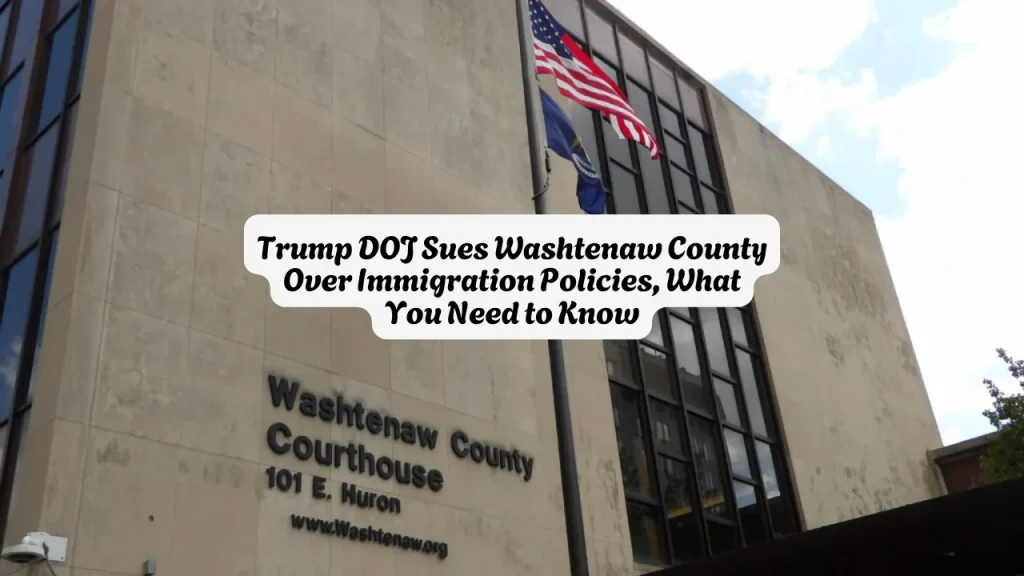
Trump DOJ Sues Washtenaw County Over Immigration Policies, What You Need to Know
The Trump administration filed a federal lawsuit against Washtenaw County, Michigan, on April 9, 2026, claiming that three county policies unlawfully interfere with U.S. Immigration and Customs Enforcement (ICE) and violate the Constitution’s Supremacy Clause. The county says it will fight the case in court. No settlement exists. This article explains who filed the lawsuit, what the county’s policies actually say, and where the case stands now.
Quick Facts
| Field | Detail |
| Lawsuit Type | Federal Civil — Constitutional / Supremacy Clause |
| Plaintiff | U.S. Department of Justice (Trump Administration) |
| Defendants | Washtenaw County, Sheriff Alyshia M. Dyer, Prosecuting Attorney Eli Savit, Board of Commissioners |
| Court | U.S. District Court, Eastern District of Michigan |
| Filed | April 9, 2026 |
| Settlement | None — Active Litigation |
| Relief Sought | Injunction to invalidate county immigration policies |
| County Response | Will “vigorously defend” its policies |
Current Status
- The DOJ filed the lawsuit on April 9, 2026, and is seeking injunctions and fees against county officials.
- In response to the lawsuit, Washtenaw County said it will “vigorously defend” its policies in court.
- The lawsuit requests that the U.S. District Court for the Eastern District of Michigan invalidate and block the implementation of three specific county policies related to local immigration response.
- No hearing date or ruling has been issued yet.
What Is the Washtenaw County Immigration Lawsuit About?
The Trump administration filed a federal lawsuit against Washtenaw County accusing county officials of deliberately obstructing federal immigration enforcement in violation of the U.S. Constitution’s Supremacy Clause. The Supremacy Clause means that when federal law and local law conflict, federal law wins. The DOJ argues that Washtenaw County’s policies cross that line.
The lawsuit claims the county’s policies obstruct immigration enforcement and “interfere with the Federal Government’s authority to protect Americans from criminal illegal aliens.” The county disputes this framing entirely. Sheriff Dyer said the county is “not obstructing anyone,” and pointed out that ICE’s own official guidance describes detainers as requests, not mandates, and that local law enforcement is not required to become an arm of federal immigration enforcement.
The lawsuit is part of a broader DOJ effort to target what it describes as “sanctuary” jurisdictions across the country. Acting Attorney General Todd Blanche said the administration intends to challenge similar policies nationwide.
Related article: Fontainebleau Miami Beach Condo Lawsuit, Are New Rental Rules Illegal?
What Are the Three Policies at the Center of the Case?
The DOJ targets three specific Washtenaw County actions. Each one is separate, and together the federal government argues they create a deliberate wall against ICE cooperation.
1. Sheriff’s Office General Order 1.14 This order tells staff not to honor ICE detainers unless there is a judicial warrant attached. ICE detainers are notices asking local jails to hold someone beyond their release date so ICE can take custody. The Sheriff’s Office says those requests are voluntary. The DOJ says refusing them obstructs federal law.
2. Prosecuting Attorney Directive — Policy 2021-12 Signed on February 24, 2021, this directive instructs prosecutors to minimize collateral immigration consequences throughout the course of legal proceedings. The DOJ argues this policy tells county prosecutors to actively work against federal immigration enforcement as part of their everyday charging decisions.
3. Board of Commissioners Resolution 26-015 Adopted on January 21, 2026, this resolution bars ICE officers from entering, remaining in, or conducting civil immigration enforcement on any county-owned, leased, or operated property — including parking areas — unless required by law or pursuant to a valid judicial warrant or court order. The resolution also applies to county employees, contractors, and agents.
What Does the DOJ Say Went Wrong?
The DOJ complaint asserts that in 2025 alone, county officials failed to respond to 40 ICE detainer requests, and it highlights several criminal cases as examples of what it casts as public safety risks.
One case involves Miguel Angel Aparicio-Navas, convicted on May 1, 2025, of sexual assault crimes and subject to a federal arrest warrant. Another involves Mario Araujo Rodriguez, who received a 365-day sentence after criminal sexual conduct convictions. The DOJ used these cases to argue that the county’s policies put dangerous individuals back on the street instead of transferring them to ICE custody.
The DOJ press release stated that Washtenaw County’s policies shield people from apprehension, including those convicted of criminal sexual conduct with a child under the age of thirteen.
What Does Washtenaw County Say?
Washtenaw County and its officials push back strongly on the DOJ’s characterization of their policies.
Sheriff Dyer said the county is not obstructing anyone, and noted that ICE’s own official guidance makes clear that detainers are requests, not mandates. County officials argue that local law enforcement agencies cannot be legally forced to hold people on behalf of federal immigration authorities.
The American Immigration Council, cited in local reporting, has noted that local governments cannot be forced to participate in immigration enforcement. This legal position — sometimes called the “anti-commandeering doctrine” — stems from earlier Supreme Court decisions and is the foundation of how many so-called sanctuary jurisdictions defend their policies.
The county has not backed down from any of its three policies and says it will defend all of them in federal court.
Who Are the Named Defendants?
The complaint names the county, Sheriff Alyshia M. Dyer, Prosecuting Attorney Eli Savit, the Washtenaw County Sheriff’s Office, and the Office of the Prosecuting Attorney as defendants. The Washtenaw County Board of Commissioners is also named for adopting the January 2026 resolution banning ICE from county property.
Prosecuting Attorney Eli Savit said he was not aware of the lawsuit when first contacted by a reporter and indicated he likely would not be able to comment because of the pending litigation.
What Is the Broader Context?
This lawsuit does not exist in isolation. It reflects a national pattern of the Trump administration using federal courts to pressure local governments that have adopted immigration-limiting policies.
A Detroit News review of records found that immigrants who have never been convicted of a crime made up the majority of ICE arrests in Michigan from January through late July 2025 — close to 65% of more than 3,100 people the Detroit ICE office arrested during that period had pending charges or were never charged with a crime at all. Critics of ICE’s approach argue this context matters when evaluating whether county cooperation policies actually protect public safety or undermine it.
The day after the lawsuit was filed, a man was detained by ICE on Michigan Avenue in Ypsilanti, near a local restaurant, alarming community members who had already been watching federal enforcement activity increase in the area.
Important Dates
| Milestone | Date |
| Prosecutor’s Directive (Policy 2021-12) Signed | February 24, 2021 |
| FHGC Street Licenses Terminated (unrelated — see above) | TBD |
| Board of Commissioners Resolution 26-015 Adopted | January 21, 2026 |
| DOJ Lawsuit Filed | April 9, 2026 |
| DOJ Press Release Issued | April 10, 2026 |
| Court Hearing / Next Steps | TBD |
| Expected Ruling | TBD |
Frequently Asked Questions
What is the Washtenaw County immigration lawsuit about?
The Trump DOJ sued Washtenaw County, Michigan, on April 9, 2026, claiming three county policies block ICE from detaining and arresting people. The county says its policies are legal and plans to fight the case in federal court.
What is an ICE detainer and why does it matter here?
An ICE detainer is a written request asking a local jail to hold someone beyond their scheduled release so federal agents can take custody. Washtenaw County’s sheriff’s policy says these requests are voluntary and the county will not honor them without a judicial warrant. The DOJ says this violates federal law.
Does this lawsuit affect regular residents or immigrants in Washtenaw County?
The lawsuit does not directly charge or arrest any individual. It targets county government policies. However, if the DOJ wins an injunction, county officials could be ordered to change how they handle ICE requests, which could affect how immigrants in the county are treated during criminal proceedings.
What is the Supremacy Clause and why is it central to this case?
The Supremacy Clause in the U.S. Constitution says federal law overrides state or local law when they conflict. The DOJ argues Washtenaw County’s policies conflict with federal immigration law. The county argues there is no conflict because local agencies are never required to enforce federal immigration law in the first place.
Has any court ruled on this lawsuit yet?
No. As of April 12, 2026, the case is in early litigation. No hearing date has been set and no judge has issued a ruling.
Do I need a lawyer if I am an immigrant in Washtenaw County?
If you are personally facing immigration proceedings, you should consult a qualified immigration attorney as soon as possible. This lawsuit involves government policy, not individual cases, but its outcome could affect how local officials handle immigration-related arrests in the county.
What happens if the DOJ wins?
If a federal court grants the injunction the DOJ is seeking, Washtenaw County officials could be ordered to comply with ICE detainer requests, allow ICE onto county property, and stop directing prosecutors to minimize immigration consequences in criminal cases.
Last Updated: April 12, 2026
Disclaimer: This article is for informational purposes only and does not constitute legal advice. Legal claims and outcomes depend on specific facts and applicable law. For advice regarding a particular situation, consult a qualified attorney.
About the Author
Israr Ahmad is a legal content researcher with 4+ years of experience covering class action settlements and consumer rights cases. He has researched and published coverage of 2,500+ settlements using verified court records, settlement administrator filings, and government sources. Learn more about Israr.